๐Ÿชพ Lecture 8: Energy Partitioning

0.0(0)
Studied by 0 people
call kaiCall Kai
learnLearn
examPractice Test
spaced repetitionSpaced Repetition
heart puzzleMatch
flashcardsFlashcards
GameKnowt Play
Card Sorting

1/20

encourage image

There's no tags or description

Looks like no tags are added yet.

Last updated 11:37 PM on 10/18/26
Name
Mastery
Learn
Test
Matching
Spaced
Call with Kai
Chat

No analytics yet

Send a link to your students to track their progress

21 Terms

1
New cards

Food Energy: Lecture Objectives

Energy Concepts

  • Understand energy as the capacity of a physical system to perform work

  • Recognize different forms of energy, including mechanical, chemical, and light

Food Energy

  • Understand energy terminology

  • Understand energy partitioning โ†’ how energy is divided into different uses

  • Use Atwater Factors to perform energy partitioning calculations


<p>Energy Concepts</p><ul><li><p>Understand energy as the capacity of a physical system to perform work</p></li><li><p>Recognize different forms of energy, including mechanical, chemical, and light</p></li></ul><p>Food Energy</p><ul><li><p>Understand energy terminology</p></li><li><p>Understand energy partitioning โ†’ how energy is divided into different uses</p></li><li><p>Use Atwater Factors to perform energy partitioning calculations</p></li></ul><p></p>
2
New cards

Energy in Animal Nutrition

Definition of Energy

  • Energy โ†’ capacity of a physical system to perform work

  • Exists in many forms, including mechanical, chemical, and light

Food Energy

  • Chemical energy animals obtain from certain nutrients in food

  • Derived from carbohydrates, proteins, and fats

  • During metabolism, energy is released or absorbed as nutrients are broken down or used to build molecules


<p>Definition of Energy</p><ul><li><p>Energy โ†’ capacity of a physical system to perform work</p></li><li><p>Exists in many forms, including mechanical, chemical, and light</p></li></ul><p>Food Energy</p><ul><li><p>Chemical energy animals obtain from certain nutrients in food</p></li><li><p>Derived from carbohydrates, proteins, and fats</p></li><li><p>During metabolism, energy is released or absorbed as nutrients are broken down or used to build molecules</p></li></ul><p></p>
3
New cards

Units of Food Energy

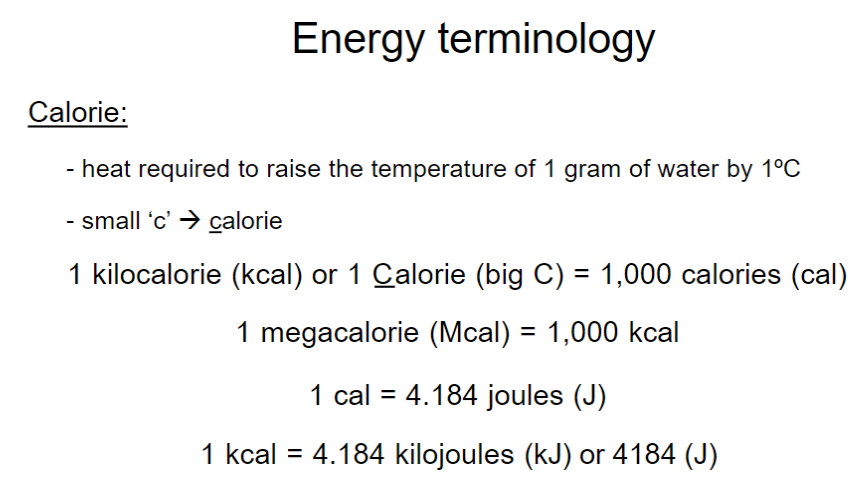
Calories and Energy Conversion

  • Calorie (cal) โ†’ heat required to raise 1 g of water by 1ยฐC

  • 1 kilocalorie (kcal) = 1,000 calories (cal)

    • Also called 1 Calorie (big C)

  • 1 megacalorie (Mcal) = 1,000 kcal

  • 1 cal = 4.184 joules (J)

  • 1 kcal = 4.184 kilojoules (kJ) = 4,184 J

<p>Calories and Energy Conversion</p><ul><li><p>Calorie (cal) โ†’ heat required to raise 1 g of water by 1ยฐC</p></li><li><p>1 kilocalorie (kcal) = 1,000 calories (cal)</p><ul><li><p>Also called 1 Calorie (big C)</p></li></ul></li><li><p>1 megacalorie (Mcal) = 1,000 kcal</p></li><li><p>1 cal = 4.184 joules (J)</p></li><li><p>1 kcal = 4.184 kilojoules (kJ) = 4,184 J</p></li></ul><p></p>
4
New cards

Energy Partitioning in Animals

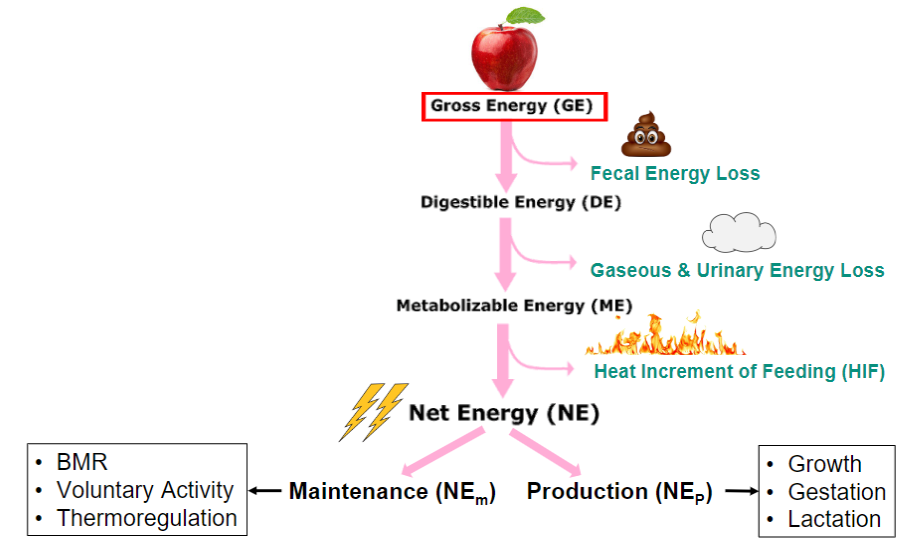
From Gross Energy to Net Energy

  • Gross Energy (GE) โ†’ total energy in food

  • Fecal energy loss โ†’ energy lost in feces

  • Digestible Energy (DE) โ†’ GE โˆ’ fecal energy loss

  • Gaseous and urinary energy loss โ†’ energy lost in gases and urine

  • Metabolizable Energy (ME) โ†’ DE โˆ’ gaseous and urinary energy loss

  • Heat Increment of Feeding (HIF) โ†’ heat produced during digestion and nutrient metabolism

  • Net Energy (NE) โ†’ ME โˆ’ HIF; energy available for body functions and production

How Net Energy Is Used

Maintenance (NEm, Net Energy for Maintenance)

  • BMR โ†’ supports essential body functions

  • Voluntary activity โ†’ movement

  • Thermoregulation โ†’ maintaining body temperature

Production (NEP, Net Energy for Production)

  • Growth โ†’ building body tissues

  • Gestation โ†’ supporting pregnancy and fetal development

  • Lactation โ†’ producing milk


<p>From Gross Energy to Net Energy</p><ul><li><p>Gross Energy (GE) โ†’ total energy in food</p></li><li><p>Fecal energy loss โ†’ energy lost in feces</p></li><li><p>Digestible Energy (DE) โ†’ GE โˆ’ fecal energy loss</p></li><li><p>Gaseous and urinary energy loss โ†’ energy lost in gases and urine</p></li><li><p>Metabolizable Energy (ME) โ†’ DE โˆ’ gaseous and urinary energy loss</p></li><li><p>Heat Increment of Feeding (HIF) โ†’ heat produced during digestion and nutrient metabolism</p></li><li><p>Net Energy (NE) โ†’ ME โˆ’ HIF; energy available for body functions and production</p></li></ul><p>How Net Energy Is Used</p><p>Maintenance (NE<sub>m</sub>, Net Energy for Maintenance)</p><ul><li><p>BMR โ†’ supports essential body functions</p></li><li><p>Voluntary activity โ†’ movement</p></li><li><p>Thermoregulation โ†’ maintaining body temperature</p></li></ul><p>Production (NE<sub>P</sub>, Net Energy for Production)</p><ul><li><p>Growth โ†’ building body tissues</p></li><li><p>Gestation โ†’ supporting pregnancy and fetal development</p></li><li><p>Lactation โ†’ producing milk</p></li></ul><p></p>
5
New cards

Gross Energy (GE)

Definition and Measurement

  • Gross energy (GE) โ†’ heat released when a food item is completely combusted (burned with oxygen)

  • Not all GE is available to the animal for use

  • Measured using bomb calorimetry

    • Measures the heat released during combustion by detecting the temperature change compared with a calibration temperature


<p>Definition and Measurement</p><ul><li><p>Gross energy (GE) โ†’ heat released when a food item is completely combusted (burned with oxygen)</p></li><li><p>Not all GE is available to the animal for use</p></li><li><p>Measured using bomb calorimetry</p><ul><li><p>Measures the heat released during combustion by detecting the temperature change compared with a calibration temperature</p></li></ul></li></ul><p></p>
6
New cards

Gross Energy (GE) by Nutrient Type

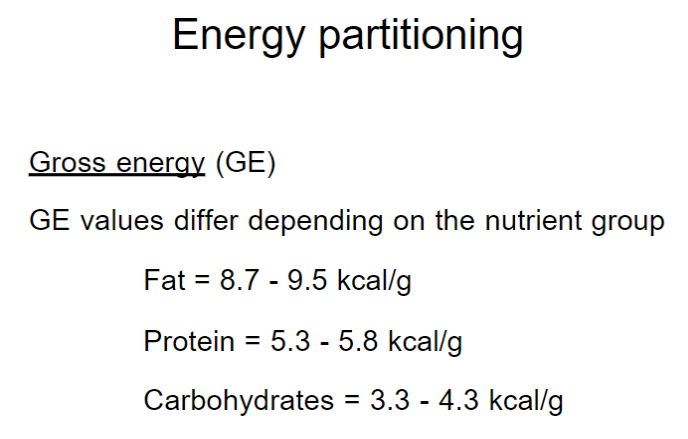
Energy Released During Combustion

  • Fat โ†’ 8.7โ€“9.5 kcal/g

  • Protein โ†’ 5.3โ€“5.8 kcal/g

  • Carbohydrates โ†’ 3.3โ€“4.3 kcal/g

Memory Cue

- Fat > Protein > Carbohydrates in gross energy per gram
<p>Energy Released During Combustion</p><ul><li><p>Fat โ†’ 8.7โ€“9.5 kcal/g</p></li><li><p>Protein โ†’ 5.3โ€“5.8 kcal/g</p></li><li><p>Carbohydrates โ†’ 3.3โ€“4.3 kcal/g</p></li></ul><p>Memory Cue</p><p>- Fat &gt; Protein &gt; Carbohydrates in gross energy per gram</p>
7
New cards

Standardized Gross Energy Values

GE per Gram of Nutrient

  • Fat โ†’ 9.4 kcal/g

  • Protein โ†’ 5.7 kcal/g

  • Carbohydrates โ†’ 4.1 kcal/g

Important Note

- These are standardized values, not the middle of the previously listed ranges

<p>GE per Gram of Nutrient</p><ul><li><p>Fat โ†’ 9.4 kcal/g</p></li><li><p>Protein โ†’ 5.7 kcal/g</p></li><li><p>Carbohydrates โ†’ 4.1 kcal/g</p></li></ul><p>Important Note</p><p>- These are standardized values, not the middle of the previously listed ranges</p>
8
New cards

Gross Energy (GE) Limitations

Why GE Values Are Not Exact

  • Standardized GE values are estimates, not exact values

  • Carbohydrates = 4.1 kcal/g

    • Includes heat of combustion from starch, sugars, and structural/insoluble carbohydrates

    • Can overestimate carbohydrate GE available to some animal species

Effect of Microbial Fermentation

  • With microbial fermentation โ†’ microbes can break down structural/insoluble carbohydrates, allowing animals to use their energy

  • Without microbial fermentation โ†’ animals cannot effectively utilize structural/insoluble carbohydrates

Memory Cue

- Microbial fermentation โ†’ structural carbohydrates can be used for energy

<p>Why GE Values Are Not Exact</p><ul><li><p>Standardized GE values are estimates, not exact values</p></li><li><p>Carbohydrates = 4.1 kcal/g</p><ul><li><p>Includes heat of combustion from starch, sugars, and structural/insoluble carbohydrates</p></li><li><p>Can overestimate carbohydrate GE available to some animal species</p></li></ul></li></ul><p>Effect of Microbial Fermentation</p><ul><li><p>With microbial fermentation โ†’ microbes can break down structural/insoluble carbohydrates, allowing animals to use their energy</p></li><li><p>Without microbial fermentation โ†’ animals cannot effectively utilize structural/insoluble carbohydrates</p></li></ul><p>Memory Cue</p><p>- Microbial fermentation โ†’ structural carbohydrates can be used for energy</p>
9
New cards

Digestible Energy (DE)

Definition and Calculation

  • Energy available after digestion

  • DE = GE โˆ’ Energy Lost in Feces

  • Fecal energy loss โ†’ energy contained in undigested food components

How DE Is Determined

- Measured through animal experiments using total fecal collection

<p>Definition and Calculation</p><ul><li><p>Energy available after digestion</p></li><li><p>DE = GE โˆ’ Energy Lost in Feces</p></li><li><p>Fecal energy loss โ†’ energy contained in undigested food components</p></li></ul><p>How DE Is Determined</p><p>- Measured through animal experiments using total fecal collection</p>
10
New cards

Metabolizable Energy (ME)

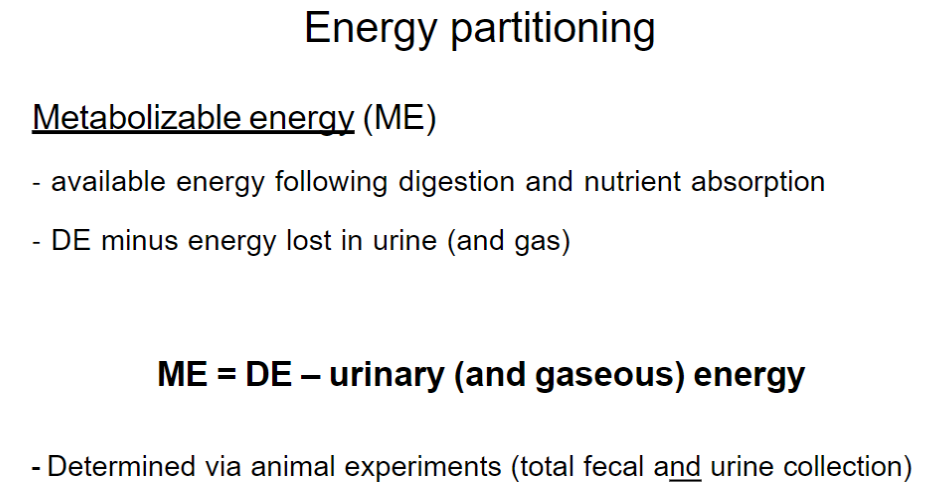
Definition and Calculation

  • Energy available after digestion and nutrient absorption

  • ME = DE โˆ’ Energy Lost in Urine and Gases

  • Urinary and gaseous energy losses โ†’ energy not retained for the animal to use

How ME Is Determined

- Measured through animal experiments using total fecal and urine collection
<p>Definition and Calculation</p><ul><li><p>Energy available after digestion and nutrient absorption</p></li><li><p>ME = DE โˆ’ Energy Lost in Urine and Gases</p></li><li><p>Urinary and gaseous energy losses โ†’ energy not retained for the animal to use</p></li></ul><p>How ME Is Determined</p><p>- Measured through animal experiments using total fecal and urine collection</p>
11
New cards

Measuring Metabolizable Energy (ME)

Metabolic Chamber

  • Used to determine energy use after a meal

  • Measures:

    • Oxygen consumption

    • Carbon dioxide production


<p>Metabolic Chamber</p><ul><li><p>Used to determine energy use after a meal</p></li><li><p>Measures:</p><ul><li><p>Oxygen consumption</p></li><li><p>Carbon dioxide production</p></li></ul></li></ul><p></p>
12
New cards

Gross Energy (GE) to Metabolizable Energy (ME)

Energy Lost from Protein

  • Protein GE = 5.7 kcal/g

  • Energy lost through nitrogenous waste = 1.25 kcal/g

  • Protein ME = 5.7 โˆ’ 1.25 = 4.45 kcal/g (GE - fecal and gaseous/urinary loss)

Nitrogenous Waste Excretion

  • Mammals โ†’ urea

  • Birds and reptiles โ†’ uric acid

  • Aquatic animals โ†’ ammonia

Gross Energy Values

  • Fat โ†’ 9.4 kcal/g

  • Protein โ†’ 5.7 kcal/g

  • Carbohydrates โ†’ 4.1 kcal/g


<p>Energy Lost from Protein</p><ul><li><p>Protein GE = 5.7 kcal/g</p></li><li><p>Energy lost through nitrogenous waste = 1.25 kcal/g</p></li><li><p>Protein ME = 5.7 โˆ’ 1.25 = 4.45 kcal/g (GE - fecal and gaseous/urinary loss)</p></li></ul><p>Nitrogenous Waste Excretion</p><ul><li><p>Mammals โ†’ urea</p></li><li><p>Birds and reptiles โ†’ uric acid</p></li><li><p>Aquatic animals โ†’ ammonia</p></li></ul><p>Gross Energy Values</p><ul><li><p>Fat โ†’ 9.4 kcal/g</p></li><li><p>Protein โ†’ 5.7 kcal/g</p></li><li><p>Carbohydrates โ†’ 4.1 kcal/g</p></li></ul><p></p>
13
New cards

From Gross Energy (GE) to Metabolizable Energy (ME)

Accounting for Energy Losses

  • Energy is lost through feces and urine (and gases)

  • GE > DE > ME

    • GE โ†’ total energy in food

    • DE โ†’ GE minus energy lost in feces

    • ME โ†’ DE minus energy lost in urine and gases

Energy Values Before Accounting for Fecal Loss

  • Fat โ†’ 9.4 kcal/g

  • Protein โ†’ 4.45 kcal/g after urinary energy loss

  • Carbohydrates โ†’ 4.1 kcal/g

Key Point

- These values do not fully account for digestibility yet; DE must be considered to determine ME accurately

<p>Accounting for Energy Losses</p><ul><li><p>Energy is lost through feces and urine (and gases)</p></li><li><p>GE &gt; DE &gt; ME</p><ul><li><p>GE โ†’ total energy in food</p></li><li><p>DE โ†’ GE minus energy lost in feces</p></li><li><p>ME โ†’ DE minus energy lost in urine and gases</p></li></ul></li></ul><p>Energy Values Before Accounting for Fecal Loss</p><ul><li><p>Fat โ†’ 9.4 kcal/g</p></li><li><p>Protein โ†’ 4.45 kcal/g after urinary energy loss</p></li><li><p>Carbohydrates โ†’ 4.1 kcal/g</p></li></ul><p>Key Point</p><p>- These values do not fully account for digestibility yet; DE must be considered to determine ME accurately</p>
14
New cards

Atwater Factors: GE to ME

Accounting for Digestibility

  • Fat: 9.4 kcal/g ร— 96% digestibility = 9.0 kcal/g

  • Protein: 4.45 kcal/g ร— 90% digestibility = 4.0 kcal/g

  • Carbohydrates: 4.1 kcal/g ร— 98% digestibility = 4.0 kcal/g

Energy Conversion

  • GE โ†’ DE โ†’ ME

  • Digestibility accounts for energy lost in feces when converting GE to DE

  • Further energy losses, such as urinary and gaseous losses, are accounted for when converting DE to ME


<p>Accounting for Digestibility</p><ul><li><p>Fat: 9.4 kcal/g ร— 96% digestibility = 9.0 kcal/g</p></li><li><p>Protein: 4.45 kcal/g ร— 90% digestibility = 4.0 kcal/g</p></li><li><p>Carbohydrates: 4.1 kcal/g ร— 98% digestibility = 4.0 kcal/g</p></li></ul><p>Energy Conversion</p><ul><li><p>GE โ†’ DE โ†’ ME</p></li><li><p>Digestibility accounts for energy lost in feces when converting GE to DE</p></li><li><p>Further energy losses, such as urinary and gaseous losses, are accounted for when converting DE to ME</p></li></ul><p></p>
15
New cards

Atwater Factors for Metabolizable Energy (ME)

Standard Energy Values

  • Fat โ†’ 9 kcal/g

  • Protein โ†’ 4 kcal/g

  • Carbohydrates โ†’ 4 kcal/g

Calculating ME

  • Used to predict the metabolizable energy content of food

  • ME (kcal) = (9 ร— g fat) + (4 ร— g protein) + (4 ร— g carbohydrates)


<p>Standard Energy Values</p><ul><li><p>Fat โ†’ 9 kcal/g</p></li><li><p>Protein โ†’ 4 kcal/g</p></li><li><p>Carbohydrates โ†’ 4 kcal/g</p></li></ul><p>Calculating ME</p><ul><li><p>Used to predict the metabolizable energy content of food</p></li><li><p>ME (kcal) = (9 ร— g fat) + (4 ร— g protein) + (4 ร— g carbohydrates)</p></li></ul><p></p>
16
New cards

Calculating Metabolizable Energy (ME)

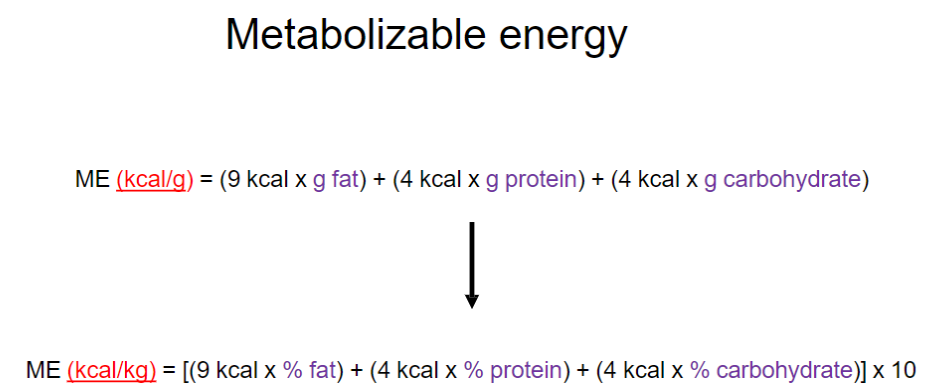
ME in kcal/g

- ME = (9 x g fat) + (4 x g protein) + (4 x g carbs)

ME in kcal/kg

- [ME = (9 x % fat) + (4 x % protein) + (4 x % carbs)] x 10

Key Difference

  • kcal/g โ†’ uses grams of each nutrient

  • kcal/kg โ†’ uses nutrient percentages and multiplies the result by 10

<p>ME in kcal/g</p><p>- ME = (9 x g fat) + (4 x g protein) + (4 x g carbs)</p><p>ME in kcal/kg</p><p>- [ME = (9 x % fat) + (4 x % protein) + (4 x % carbs)] x 10</p><p>Key Difference</p><ul><li><p>kcal/g โ†’ uses grams of each nutrient</p></li><li><p>kcal/kg โ†’ uses nutrient percentages and multiplies the result by 10</p></li></ul><p></p>
17
New cards

Converting Nutrient Grams to Percentages for ME Calculations

Converting Grams to Percentages

  • % = (g รท total g of food) ร— 100

  • Percentage represents grams of nutrient per 100 g of food

  • Example: 5% protein = 5 g protein per 100 g of food

Metabolizable Energy (ME) Formulas

  • ME (kcal/g) = (9 ร— g fat) + (4 ร— g protein) + (4 ร— g carbohydrates)

  • ME (kcal/kg) = [(9 ร— % fat) + (4 ร— % protein) + (4 ร— % carbohydrates)] ร— 10


<p>Converting Grams to Percentages</p><ul><li><p>% = (g รท total g of food) ร— 100</p></li><li><p>Percentage represents grams of nutrient per 100 g of food</p></li><li><p>Example: 5% protein = 5 g protein per 100 g of food</p></li></ul><p>Metabolizable Energy (ME) Formulas</p><ul><li><p>ME (kcal/g) = (9 ร— g fat) + (4 ร— g protein) + (4 ร— g carbohydrates)</p></li><li><p>ME (kcal/kg) = [(9 ร— % fat) + (4 ร— % protein) + (4 ร— % carbohydrates)] ร— 10</p></li></ul><p></p>
18
New cards

Converting Nutrient Content to Metabolizable Energy (ME)

ME Calculation Formulas

  • ME (kcal/g) = (9 ร— g fat) + (4 ร— g protein) + (4 ร— g carbohydrates)

  • ME (kcal/kg) = [(9 ร— % fat) + (4 ร— % protein) + (4 ร— % carbohydrates)] ร— 10

  • ME (kcal/kg) = [(9 ร— g fat/100 g) + (4 ร— g protein/100 g) + (4 ร— g carbohydrates/100 g)] ร— 10

Why Multiply by 10?

  • Converts nutrient amounts per 100 g of food to amounts per 1 kg of food

  • 1 kg = 1000 g

  • 100 g x 10 = 1000 g = 1 kg


<p>ME Calculation Formulas</p><ul><li><p>ME (kcal/g) = (9 ร— g fat) + (4 ร— g protein) + (4 ร— g carbohydrates)</p></li><li><p>ME (kcal/kg) = [(9 ร— % fat) + (4 ร— % protein) + (4 ร— % carbohydrates)] ร— 10</p></li><li><p>ME (kcal/kg) = [(9 ร— g fat/100 g) + (4 ร— g protein/100 g) + (4 ร— g carbohydrates/100 g)] ร— 10</p></li></ul><p>Why Multiply by 10?</p><ul><li><p>Converts nutrient amounts per 100 g of food to amounts per 1 kg of food</p></li><li><p>1 kg = 1000 g</p></li><li><p>100 g x 10 = 1000 g = 1 kg</p></li></ul><p></p>
19
New cards

Atwater Factors: When to Use Them

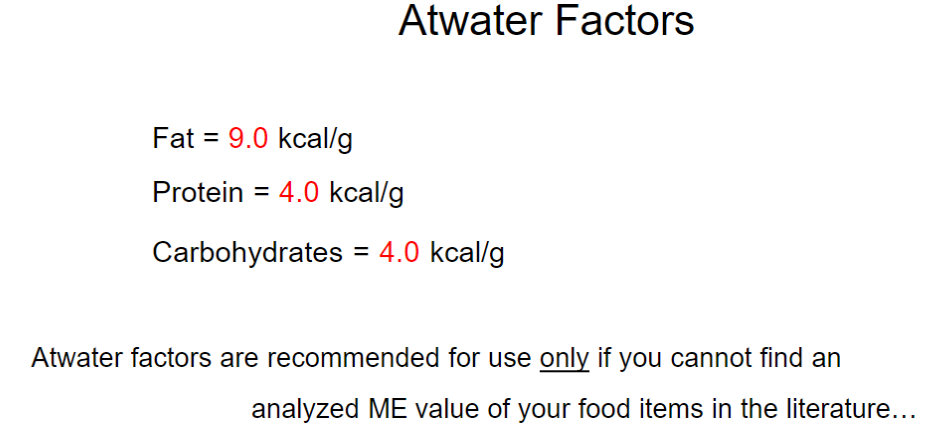
Standard ME Values

  • Fat โ†’ 9.0 kcal/g

  • Protein โ†’ 4.0 kcal/g

  • Carbohydrates โ†’ 4.0 kcal/g

When to Use Atwater Factors

  • Use to estimate metabolizable energy (ME) only when an analyzed ME value for the food item cannot be found in the literature

  • Prefer analyzed ME values when available, as Atwater factors provide estimates

<p>Standard ME Values</p><ul><li><p>Fat โ†’ 9.0 kcal/g</p></li><li><p>Protein โ†’ 4.0 kcal/g</p></li><li><p>Carbohydrates โ†’ 4.0 kcal/g</p></li></ul><p>When to Use Atwater Factors</p><ul><li><p>Use to estimate metabolizable energy (ME) only when an analyzed ME value for the food item cannot be found in the literature</p></li><li><p>Prefer analyzed ME values when available, as Atwater factors provide estimates</p></li></ul><p></p>
20
New cards

Net Energy (NE)

Definition and Calculation

  • Energy available for maintenance and production

  • NE = ME โˆ’ Heat Increment of Feeding (HIF)

  • HIF โ†’ energy lost as metabolic heat during digestion and nutrient metabolism

Heat Increment of Feeding (HIF)

- Difference in heat loss between an animal after feeding and a fasting animal

<p>Definition and Calculation</p><ul><li><p>Energy available for maintenance and production</p></li><li><p>NE = ME โˆ’ Heat Increment of Feeding (HIF)</p></li><li><p>HIF โ†’ energy lost as metabolic heat during digestion and nutrient metabolism</p></li></ul><p>Heat Increment of Feeding (HIF)</p><p>- Difference in heat loss between an animal after feeding and a fasting animal</p>
21
New cards

Measuring Net Energy (NE)

Metabolic Chamber

  • Used to measure energy expenditure and heat production

  • Helps determine NE by accounting for heat lost after feeding compared with fasting conditions


<p>Metabolic Chamber</p><ul><li><p>Used to measure energy expenditure and heat production</p></li><li><p>Helps determine NE by accounting for heat lost after feeding compared with fasting conditions</p></li></ul><p></p>