Anatomy- Back Muscles
 Call Kai
 Learn
Learn Practice Test
 Spaced Repetition
 Match
Match Flashcards
 Knowt Play
1/40

There's no tags or description
Looks like no tags are added yet.
Name | Mastery | Learn | Test | Matching | Spaced | Call with Kai | Chat |
|---|
No analytics yet
Send a link to your students to track their progress
41 Terms
Origin
the fixed attachment site of the muscle to the bone (close to the body PROXIMAL)
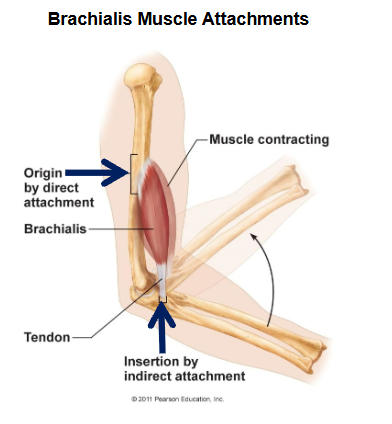
Insertion
the attachment site of the muscle to the bone that is movable when the muscle contracts (far from body DISTAL)

When a muscle contracts…
Its insertion is pulled toward the origin
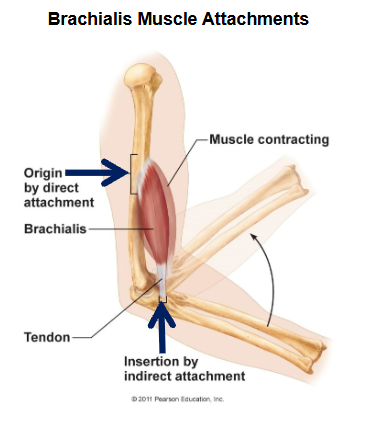
Direct attachment
Short connective tissue fibers
Indirect attachment- 2 methods
connective tissue called a tendon extends beyond the muscle fibers
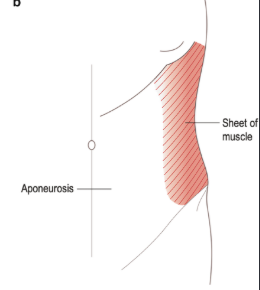
connective tissue called a aponeurosis sheet extends beyond muscle fibers
What’s more common direct or indirect muscle attachment?
Indirect
Tendon
concentrates force in a limited area

Aponeurosis Sheet
spreads force over a wide area
Isometric contraction
No change in muscle length; no movement = stabilization

Concentric Contraction
muscle length changes and shortens during movement (Concentric climbs)

Eccentric Contraction
muscle length changes and lengthens during movement (Eccentric extends)

Muscles cross… and work in…
one or more joints, groups
Agonist
Primary muscle(s) responsible for a movement
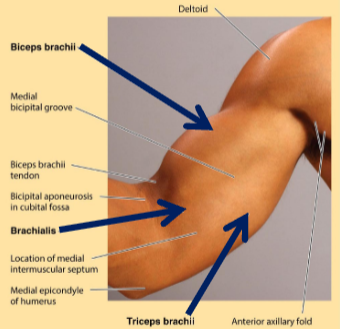
Antagonist
Secondary muscle(s) responsible for opposite movement of the agonist
helps stabilize and control
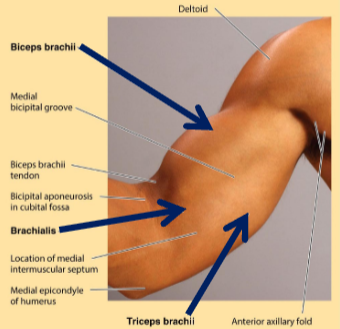
Synergist
compliments the action of the agonist(s), counteracts unwanted movement

The plasma membrane of a muscle fiber
sarcolemma

The cytoplasm of a muscle fiber
sarcoplasm

Skeletal muscle Fibers
composed of long, cylindrical, multinucleated cells

The sarcoplasm is filled with…
myofibrils

Myofibrils
long rod-like organelles inside muscle cells composed of myofilaments

Myofilaments
the proteins actin and myosin
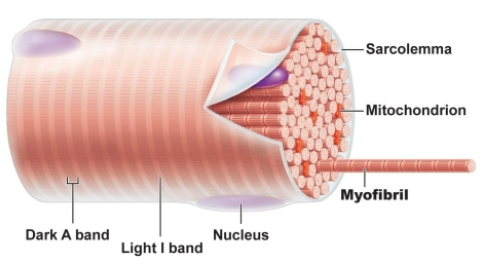
Repeating segments inside a myofibril
Sarcomeres (muscle segments)
Sarcomeres
The basic unit of muscle contraction
The myofibril protein that resists overstretching
Titin
Thin filaments
composed of actin, extends toward the sarcomere (Light colored bands)
Thick filaments
composed of myosin, at the center of the sarcomere, help split ATP (Dark colored bands)
I Band
thin filaments only

H Zone
thick filaments only
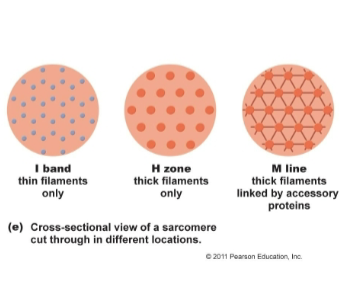
M Line
Thick filaments linked by proteins

Why do muscles appear striated?
Because of the repeating and overlapping Thin and Thick filaments
Epimysium
tough, dense outer layer that surrounds the entire muscle (OUTER)
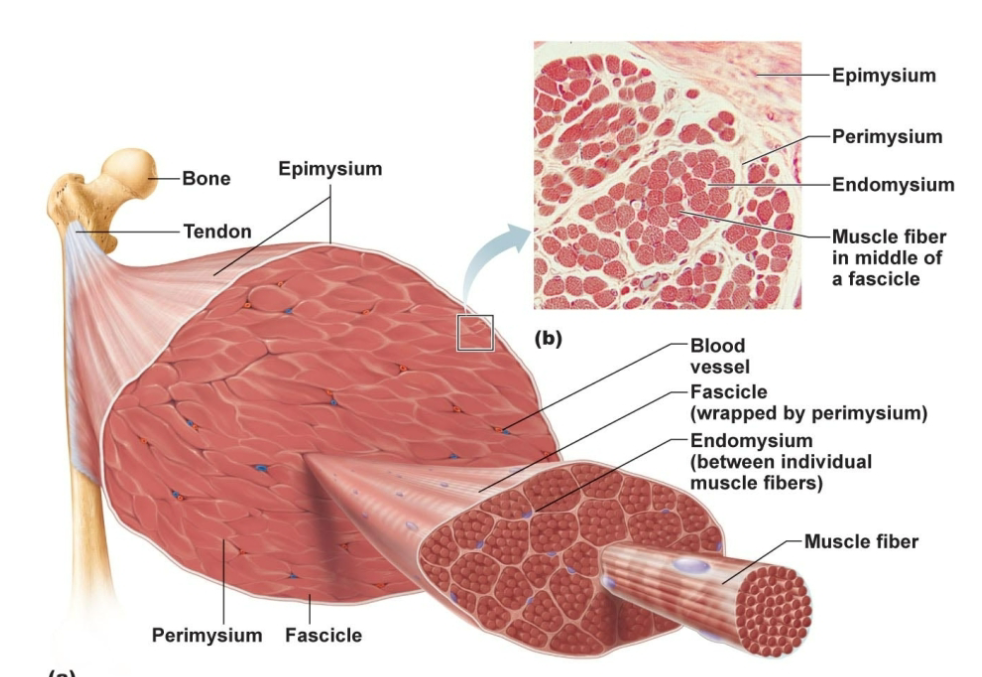
Perimysium
Thick CT that groups individual muscle fibers (MIDDLE)

Endomysium
Thin inner network of CT that surround individual muscle fibers (INSIDE)
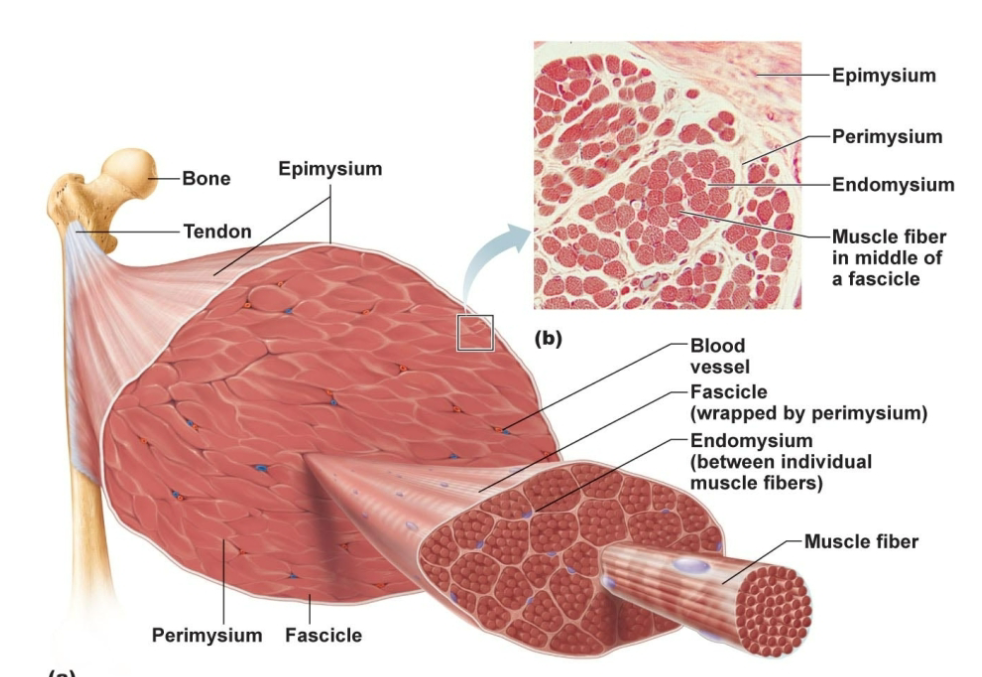
The 3 layers of muscle CT unite at the…
myotendinal junction

Hyaline Cartilage
most common, covers the ends of long bones and joint surfaces; trachea, larynx, nose

Elastic Cartilage
flexible cartilage that easily bend and returns to original shape; ear, epiglottis

Fibrocartilage
toughest and most resilient; intervertebral discs

Trapezius
elevates, retracts, and depresses the scapula
Innervated by spinal accessory nerve (CN11)

Levator Scapulae
elevates the scapula
Innervated by dorsal scapular nerve (C3,4)

Rhomboids
(major and minor) – retract the scapula.
Innervated by dorsal scapular nerve (C4,5)
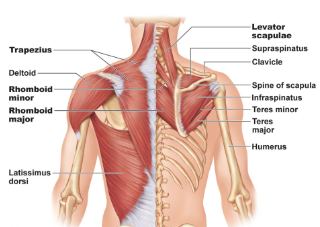
Latissimus Dorsi
Extends, adducts, and medially rotates the humerus
Innervated by Thoracodorsal nerve (C6,7,8)
CLIMBING
