Earthwork Test 3
 Call Kai
 Learn
 Practice Test
 Spaced Repetition
 Match
 Flashcards
 Knowt Play
1/70

There's no tags or description
Looks like no tags are added yet.
71 Terms
What do engineers consider when designing asphalt?
- Climate of Project Site
- Subgrade strength
- Traffic Loading
- Traffic Speed
AASHO Road Test
- Ottawa, Illinois
- Conducted 1958-1960
- Published 1962
-Each lane was subjected to repeated loading by a specific vehicle type and weight
- Still used by most pavement designers
What does ESAL stand for?
Equivalent Single Axel Load
How many cars does it take to provide the load of a single 18-wheel truck?
12,000 cars
Over a 20-year design life, what is the STANDARD traffic level for asphalt?
less than 10 million ESALs
Over a 20-year design life, what is a high traffic level for asphalt?
10-30 million ESALs
Over a 20-year design life, what is very high traffic level for asphalt?
greater than 30 million ESALs
Over a 20-year design life, what is an extremely high traffic level for asphalt?
much greater than 30 million ESALs
What are the three asphalt pavement materials?
-Asphalt Binder
-Aggregate
-Air
Asphalt Binder in Asphalt
- Black sticky adhesive
- Comes from crude oil
- Viscous Liquid: Flows at high temperatures (~300ºF)
- Elastic Solid: Resists loads at lower temperatures (>180ºF)
- Non-Newtonian Fluid: Resists quick loads, deforms to slow loads
Aggregate in Asphalt
- Crushed stone, sand, gravel, etc
- Multiple sizes
Air in Asphalt
- Typically 4% to 8% by volume
- Provides durability to temperature change
As the Asphalt Binder ages, the pavement:
- loses color
- loses elasticity
- becomes more brittle
Aggregates in Asphalt are:
- Particles of random shape
- Mineral particles with origin as rock
- Typically sorted or processed
Examples of aggregate in asphalt:
- Gravel
- Stone
- Crushed Rock
What are the sources of aggregate in asphalt?
- gravel pits
- quarries
- recycled materials (RAP, slag, etc.)
Course Aggregate
The blend portion retained on the 4.75 mm sieve
Fine Aggregate
The blend portion passing the 4.75 mm sieve
Dust
Material passing the #200 sieve
What does NMAS stand for?
Nominal Maximum Aggregate Size
NMAS
One sieve larger than the first sieve to retain more than 10%
Maximum Aggregate Size
One sieve size larger than the NMAS
What are the two types of asphalt plants?
-batch plant
-continuous drum plant
What are the major components of an asphalt plant?
- cold feed bins
- weigh bridge
- aggregate dryer/heater
- mixing chamber
- storage silos
- binder tanks
- dust collection
- RAP feed
- Bag house
- control room
Truck loading at asphalt plants
-Drop from silo (or batch plant) into truck
-Efforts are made to reduce partial segregation as trucks are loaded
- tarps are used to keep in heat
Objectives of Surface Prep
- Provided strength and uniformity of supporting layers
- Address distressed condition of existing surface
- Provide a bond between new and existing layers
- Promote a smooth final layer
- Maintain drainage
Preparing Subgrade Under New Pavement
- Compaction of subgrade material is key
- Typically imported aggregate material
- Slopes, grades, and drainage are set
-Material is dry and free of standing water
- (Optional) Prime coat: A layer of asphalt emulsion sprayed over the surface to promote the asphalt binder in the mixture to stay in the mixture
Existing Surface Preparation: Repairing Distressed Areas
- patching
- leveling
- repairing
Existing Surface Preparation: Milling
- remove layers of existing asphalt
- change or correct slopes/profiles
Existing Surface Preparation: Cleaning
- Remove dirt or loose material
- Dry existing surface
Surface Preparation: Tack Coat
-extremely important
-pavements are designed to have layers glued together
-the glue between the existing and new layer
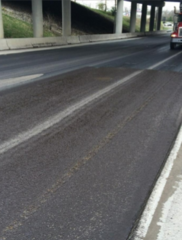
Poor Tack Coat Application

Good Tack Coat Application
Delivery of Asphalt Mixtures
- Mix should be delivered near the high compaction
temperature provided by the binder supplier
- Typical high compaction temperatures are between
300ºF and 340ºF
- The longer the mix is in the truck to more it cools
- Typical haul times are less than one hour
325ºF to 195ºF is an example of a _____ temparature range
compaction
compaction
the process of changing the material's density
density
the measurement of mass per unit volume
Compaction of asphalt mixtures
-improves mechanical stability
-Improves resistance to permanent deformation
- Reduces moisture penetration
- Improves fatigue resistance
Importance of Density per a University of California Study in 1995:
- Asphalt mixtures with the same asphalt content (5%) showed a 30% reduction in fatigue life with only 1 reduction in density during construction
-Typically specifications require density between 92% and 97% of the maximum specific gravity
Compaction Methods for Asphalt
- Rollers
- Vibration plates
Types of Rollers
- Static Steel Wheel
- Pneumatic - Rubber Tired
- Vibratory

Vibratory Roller
-most common for roadways
-static weight of roller
- dynamic (Impact) force
Thick lights have a _____ amplitude and thin lifts have a _______ amplitude.
high, low
Amplitude
how high
Frequency
how fast the drum vibrates
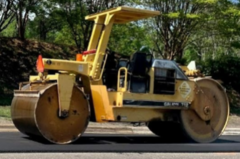
Static Steel Roller
-used on all kinds of projects
-static weight of roller
For smaller projects, how might a static steel roller be used?
may be the only roller
For larger projects, how might a static steel roller be used?
used as the finish roller

Pneumatic Roller
-used on large projects or with mixes that are difficult to compact
- Some roadway specifications require
-Wheel load, kneading action: can help seal the surface; helps with difficult mixes
Factors affecting compaction
-Mix properties: temperature, binder grade
- Layer Thickness: should be 3 to 4 times the NMAS
-Stiffness of underlying material: roadbed, existing pavement, etc.
-Environmental Factors: ground temp, air temp, wind, sun, etc.
Paving Best Practices
-Don't stop the paver during paving: leaves a bump in the finished mat, and uneven compaction
-Don't allow a delivery truck to bump into the paver: this pushes the screed backward into the mat and leaves a bump in the mat
-Use of diesel fuel to keep tools, truck beds, etc. clean is strongly discouraged: most agencies prohibit this, it breaks down the asphalt binder and leaves defects in the pavement
What is quality in asphalt for different parties?
- Public: smooth ride
- Politician: quick and cheap fix
- Engineer: carry the traffic
- HMA Plant - easy to produce
- HMA Paver - Easy to place and compact
Quality Control in Asphalt Pavements
-All Items tested start to finish
- Materials testing
- Mixture design
- Checks during production
- Best practices in deliver and laydown
- Tack application
- Thickness
- Compaction
- Smoothness
Materials Quality Control Measures
-source testing
-binder grading
-gradation checks
-specific gravity checks
-ensuring that the materials provided in construction match the materials in design is typically the responsibility of the contract and verified by the contract and verified by the agency
What do mixture quality control tests typically include?
- Asphalt content
- Gradation
- Air voids (based on specific lab compaction)
- Maximum Specific Gravity
- Bulk Specific Gravity
- Temperature Checks (plant and field)
Mixture Quality Control tests are often done on lots and sublots based on what?
the tons of mix produced
Thickness Checks
-often verified by application rate
-checked by the screed operator
-ultimate determination of thickness is measured using cores drilled from the finished mat
A roller platter is determined for a mixture using:
- the maximum specific gravity determined in the lab
- nuclear density gauge measured after each pass of the roller
Once a number of roller passes is determined the density is check on a per ton or area basis with what tool?
nuclear density gauge
Compaction quality control
- Higher level specification require density of the complete mat to be measured in the laboratory using cores taken from the completed mat
- This process can also be used to calibrate a nuclear gauge to the mix and project
Phases of Operation for Walter F. George Lock and Dam
• Mobilization and Site Preparation
• Exploratory Holes and Grouting
• Marine Preparatory Work
• Cut-Off Wall Installation
• Navigation Lock Cut
• Major Changes and Additional Work
• Cut-Off Wall Concrete Coring
• Cap Beam Installation
• Demobilization
Marine Preparatory Work for Walter F. George Lock and Dam
- Removal of Coffer Cell Remnants
-Installation of the Working Apron
Cut-off Wall Installation for Walter F. George Lock and Dam
-Secant Pile Wall: 492 piles, 142,000 sf area of cutoff, 31,800 cubic yards of concrete
-Diaphragm Wall: 66 panels, 129,000 sf of area cut off, 12,300 cubic yards of concrete
Secant Pile Installation for Walter F. George Lock and Dam
- Frame and Template Installation
- Casing Installation
- Drill Rig Installation
- Shaft Drilling
- Verticality Check
- Rig Removal
- Concrete Placement
- Casing Removal and Relocation
Concrete Placement for Walter F. George Lock and Dam
-concrete batch plant on site
- 6 ready mic trucks
-2 high volume concrete pump trucks
- average concrete volume per pile: 63 cubic yards
Diaphragm Wall Installation for Walter F. George Lock and Dam
- Desanding Plant Installation
- Hydromill Assembly
- Guide Wall Construction
- Working Platform Construction
- Panel Excavation
- Verticality Check
- Concrete Placement
Major Changes and Additional Work for Walter F. George Lock and Dam
-In-Water Disposal
- Concrete Mass
- Consolidation Jet Grouting
- Underwater Retaining Wall Cut
- Secant Pile # 187 Obstruction
Secant Pile #187 Obstruction on Walter F. George Lock and Dam
- Ground Penetrating Radar
- Template and Frame Modified
- Installation of 4 additional Piles
Demobilization of Walter F. George Lock and Dam
- Disassemble Barges
- Remove Equipment
- Disassemble Concrete Batching Plant
- Restore Batching Plant Site
- Restore Office Site
Walter F. George Lock and Dam had 400,000 man hours with no lost time accidents. T/F
True
Mobilization and Site Preparation for Walter F. George Lock and Dam
- Office Area Preparation
-Work Shop Construction
-Concrete Batching Plant Installation
-Barge Procurement and Set-Up