Mineralogy, Petrology, and Geochemistry
 Call Kai
 Learn
 Practice Test
 Spaced Repetition
 Match
 Flashcards
 Knowt Play
1/91

There's no tags or description
Looks like no tags are added yet.
92 Terms
mineral groups
native, halides, sulfides, sulfates, phosphates, carbonates, oxides, silicates
identifying minerals
crystal form, cleavage, hardness, luster, streak, special properties
igneous rock types
basalts
granites
granodiorites, diorites
syenites
peridotites
sedimentary rock types
sandstone
clays/shales
carbonates/evaporites
metamorphic rock types
gneisses
schists
marbles
earth’s crust composition
oxygen- 46.6%
silicon- 27.8%
aluminum- 8.1%
oceanic vs continental crust
oceanic- mafic (gabbro, basalt)
continental- intermediate (granodiorite)
core composition
Fe + N alloy (liquid outer core, solid inner core)
non-silicate mineral groups
native minerals/elements (Au, Cu, Ag)
halides (halogen, Cl, F)
sulfides (S at the end)
carbonates (CO3)
phosphates (PO4)
oxides (O3/O2)
polymorphs
minerals with the same chemical composition but different crystal structures
native minerals/elements
gold (Au), copper (Cu), silver (Ag)
graphite and diamond (polymorphs)
halides
halite (NaCl), sylvite (KCl), fluorite (CaF2)
sulfides
galena (PbS), cinnabar (HgS), chalocite (Cu2S), sphalerite (ZnS)
pyrite + marcasite (FeS2) (polymorphs)
carbonates
magnesite (MgCO3), siderite (FeCO3), rhodochrosite (MnCO3), smithsonite (ZnCO3), dolomite (CaMg(CO3)2)
phosphates
monazite ((Ce, La, Nd, Th)PO4), apatite (CaS(PO4)3(F,Cl,OH)
calcite + argonite (polymorphs) CaCO3
oxides
corundum (Al2O3), hematite (Fe2O3), ilmenite (FeTiO3), rutile (TiO2), pyrolusite (MnO2), cassiterite (SnO2)
silicate mineral group
the largest mineral group
basic building block: silicate tetrahedron- links by sharing O2-
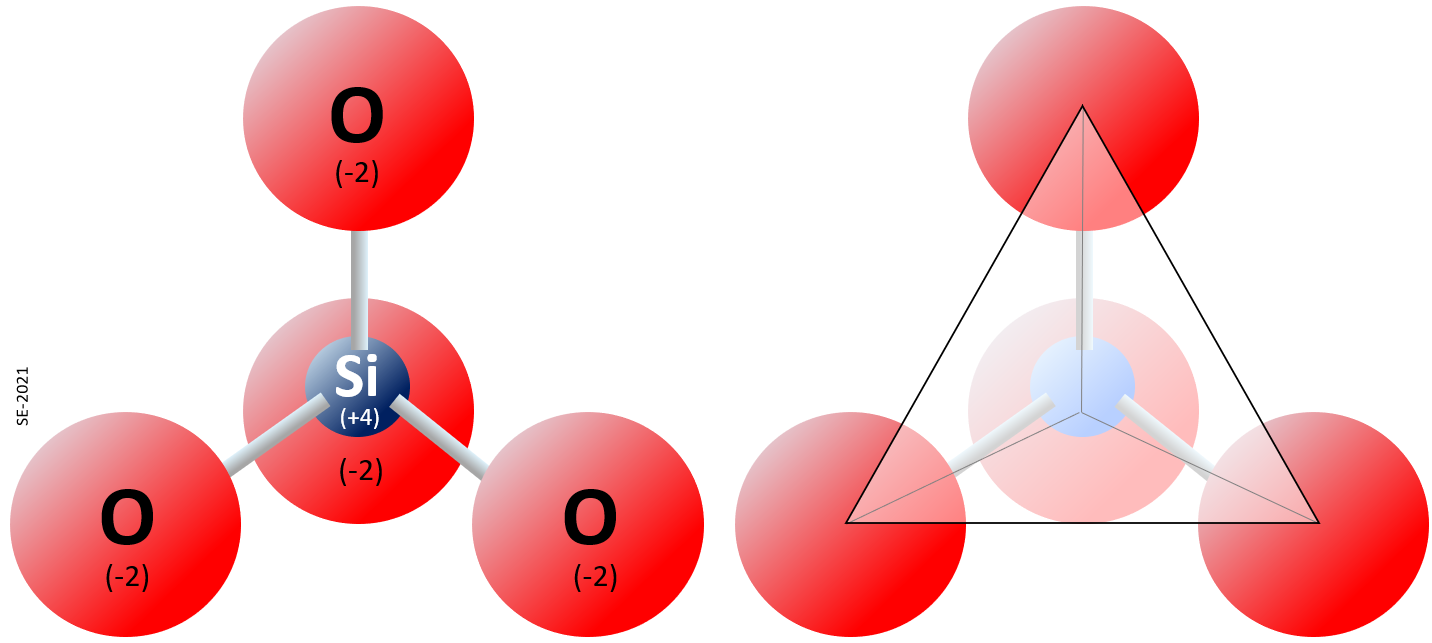
silicate mineral subgroups
neosilicates
sorosilicates
cyclosilicates
inosilicates
phyllosilicates
tectosilicates
neosilicates
isolated tetrahedra
olivine, garnet, zircon
sorosilicates
two linked tetrahedra
epidote
cyclosilicates
tetrahedra linked into a ring structure
beryl, cordierite, tourmaline
inosilicates
a single or double chain or linked tetrahedra
pyroxene (single chain), amphibole (double chain)
phyllosilicates
tetrahedra linked into sheet-like structure
micas, clay minerals
tectosilicates
tetrahedra linked into a 3-D framework
quartz, alkali feldspars, plagioclase feldspars
feldspars
aluminum tectosilicate minerals
most abundant minerals on earth
phase diagrams
pressure vs. temp
what phase occurs at what pressure and temperature
ternary diagram
each phase is an element

plagioclase feldspars- tectosilicates within feldspar group
A.O Alba: Albite, Oligoclase, Andesine, Labradorite, Bytownite, Anorthite
alkali feldspars
Albite, Anorthoclase, Sanidine, Orthoclase, Microline
alkali vs. plagioclase feldspars
plagioclase-
alkali-
phyllosilicates
mica, serpentine, chlorite, clay mineral groups
similar in composition but different first elements
clay mineral group vs. clay sediment
clay minerals are hydrous silicate minerals (contain significant amts. of water in their structure)
not all clay sized sediment is clay mineral
surface have a negative surface charge leads to adsorption of cations
adsorption
process in which atoms, molecules, or ions from a gas, liquid, dissolved solid adhere to a surface, forming a film
expandable clays
smectite group: montmorillonite, beidellite, nontronite
vermiculite
non-expandable clays
kaolinite group:
illite group: illite, hydrous micas, phengite, glauconite
diagram page review
mineral chemical and physical properties
moh’s scale of hardness
cleavage, uneven fracture, conchoidal fracture
crystal form
luster
streak
special properties
moh’s scale of hardness
1 to 10
fingernail- 2.5
penny- 3.5
glass plate- 5.5
steel file- 6.5
diamond- 10
cleavage, fracture
how a mineral breaks
repeated flat planes= cleavage planes
irregular surfaces= uneven fracture
curved surfaces= conchoidal fracture

crystal form
how a crystal grows
-cubic or tetrahedron (pyrite)
-rhombohedron (calcite)
-dodecahedron (garnet)
-hexagonal prism (quartz)
luster
metallic vs. nonmetallic
how a mineral reflects light
nonmetallic: vitreous/glassy (quartz), silky (selenite), resinous (sphalerite)
streak
color of a mineral in powder form
special properties
high density (specific gravity), magnetism, taste, double refraction, reaction to acid
hazardous minerals
radioactivity- Uranium and Thorium
toxic metals- carsenic, mercury, lead
inhalation hazards- absestos, silicosis
environmental hazards- acid mine drainage (pyrite)
engineering hazards- swelling/shrinking clays, thixotropic clays
thixotropic behavior in clays
stiff clays at rest will become softer or liquify when stressed
igneous
tectonic settings and magma production
normal geotherm- away from plate boundaries
decompression melting- divergent plate boundary
mantle plume- hot spots
flux melting- subduction zones

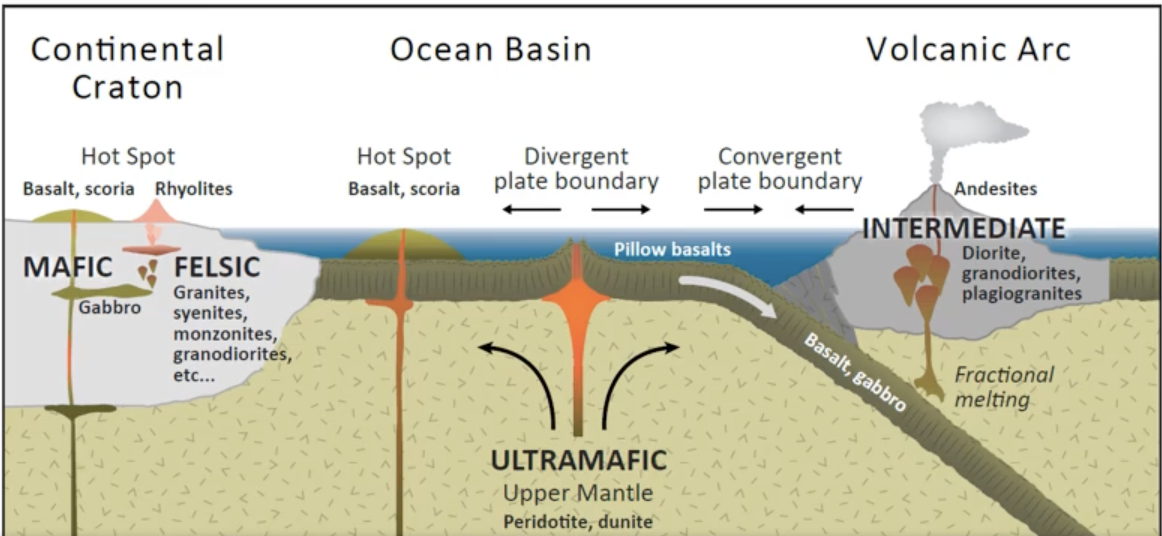
tectonic settings and magma composition
continental craton → hot spot → basalt (mafic), rhyolites (felsic)
ocean basin → hot spot (basalt) or divergent plate boundary (ultramafic)
volcanic arc → andesites (intermediate)
Bowen’s Reaction Series
order of crystallization of minerals from cooling magma- first to crystallize to last to crystallize
from top to bottom: inc. silica %, inc. viscosity, dec. temp.
Rock types: ultramafic → mafic → intermediate → felsic

felsic
high SiO2
low viscosity magma
flows easily
continuous reaction series
from top to bottom:
plagioclase feldspars: Ca rich to Na rich
discontinuous reaction series
olivine → pyroxene → amphibole → biotite mica
bowen’s reaction series: felsic
from highest weathering to lowest:
potassium feldspar → muscovite mica → quartz (and zircon)(most resistant to weathering)
explosive eruption style
more viscous magma + volatiles
IUGS classification of igneous rocks
plutonic (intrusive)- slow cooling, coarse grained
volcanic (extrusive)- fast cooling, fine grained, glass textures
poryphyritic (porphyry)
two grain size populations
pegmatite
igneous felsic, coarse grain sizes variable (cm to m), intrusive, dike (cuts across other rock types)
diabase (dolerite)
igneous coarse grained basalt, cools slower than others
aplite
igneous felsic, fine grained dike (mostly quartz and feldspar)
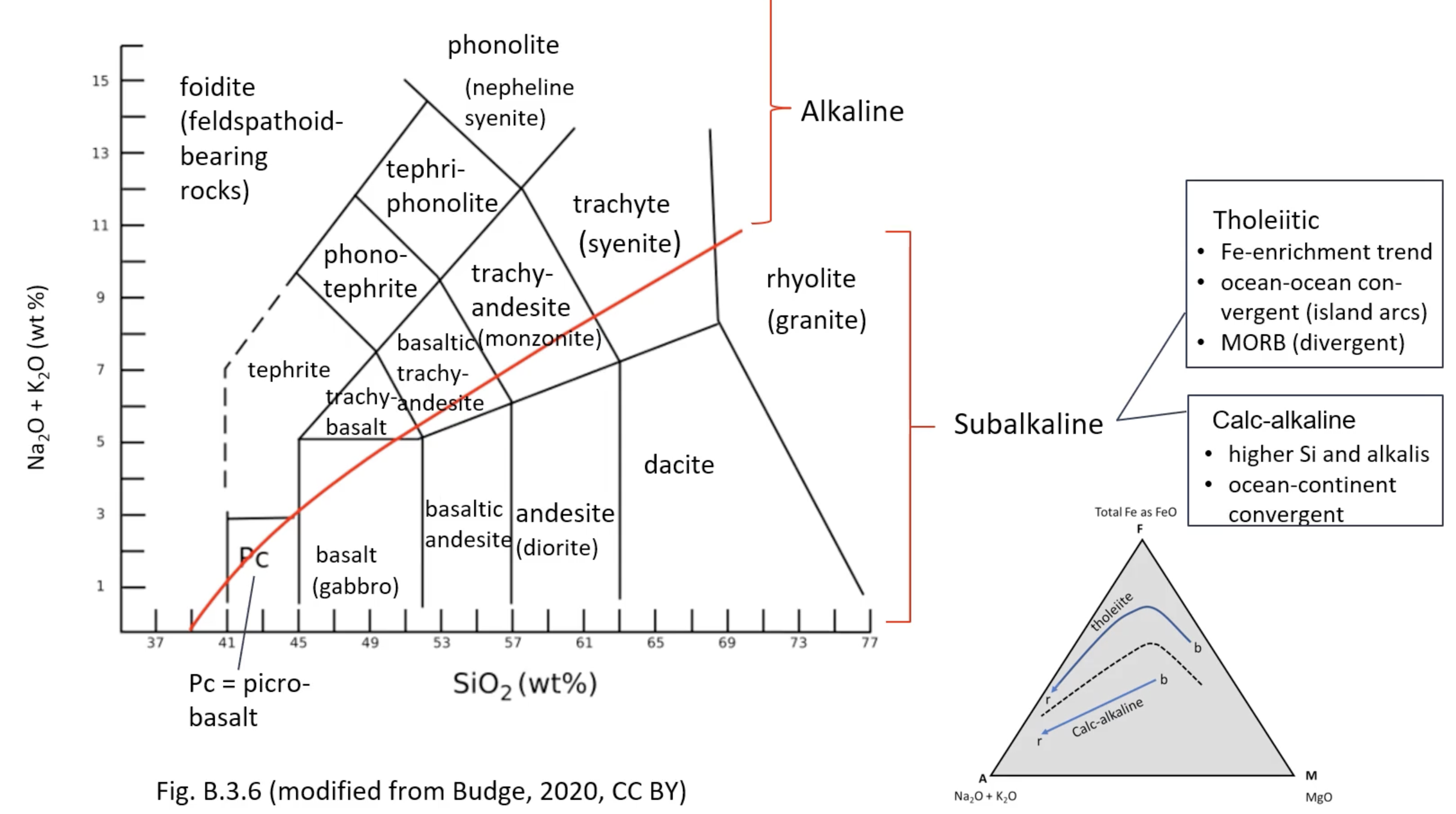
TAS diagram (Total Alkali Silica)
Na2O + K2O vs. SiO2 content
classifying volcanic rocks by their chemistry
magma type and eruption styles
Basaltic (mafic)- non explosive, high temp, flowing lava (45-55% silica)
rhyolitic (felsic)- most explosive, lower temp with higher silica content (65-75%)
andesitic (intermediate)- intermediate temp and silica content
sedimentary rock classification
clastic (detrital)
chemical
organic
sedimentary: clastic
classified by clast (rock fragment) size, shape, and sorting
types: mudstone (clay +silt), siltstone (silt), sandstone (sand), conglomerate (sand, silt, pebbles), breccia (gravel mix)
sedimentary: chemical
classified by chemical composition
types: limestone (calcite), dolostone (dolomite), travertine (calcite, in caves), rock salt/evaporite (halite), rock gypsum (gypsum), chert (quartz)
sedimentary: organic
carbonaceous rocks
type: coal (plant debris, plankton)
chemical weathering of common minerals
congruent weathering
incongruent
congruent weathering
simple dissolution (complete dissolving of a mineral)
calcite and dolomite (in acidic solutions)
halite, gypsum, anhydrite (in water)
incongruent weathering
dissolution reaction results in the formation of a new insoluble compound
plagioclase + alkali feldspars, micas: weather into clay minerals, while dissolved portion becomes ions
-most igneous rocks have feldspars, so clay minerals and particles are most common sediment
quartz is
dominant mineral type in sand due to resistance to weathering
shale is
most common sedimentary rock
oil and gas formation
sedimentary basin → deposition of organic-rich sediments → immature source rock → source rock begins oil generation phase (oil window) → gas generation → over mature
*source rock moves deeper with processes, inc. in temp with depth

oil and gas formation: diagenesis
any change that occurs post-deposition, but prior to the onset of any metamorphic changes
oil and gas formation: catagenesis
thermal alteration
oil and gas formation: metagenesis
thermal destruction
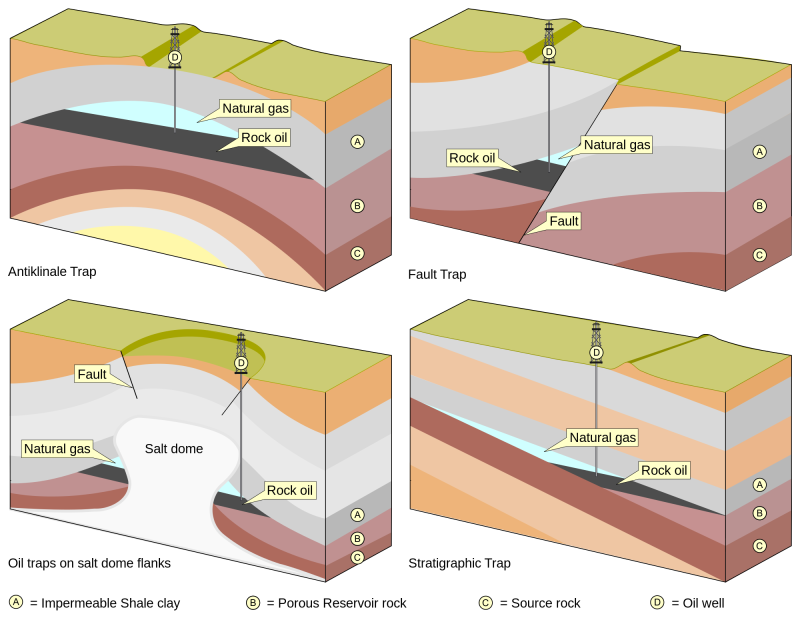
hydrocarbon trap requirements:
porous reservoir rock
structure that allows hydrocarbons to accumulate
a cap rock or impermeable surface to avoid any further upward migration of the low-density hydrocarbons
examples of hydrocarbon traps
anticlinal trap, fault trap, salt dome flanks, stratigraphic traps
classifying metamorphic rocks
non-foliated (contact metamorphism), foliated (regional metamorphism)
non-foliated (granufels or hornfels)
quartzite
marble
greenstone
soapstone
cataclasite (fault zone)
foliated
slate
phyllite
schist
gneiss
mylonite (fault zone)
ultramyonite (fault zone)
metamorphic grade
low → intermediate → high (very different from original rock)
the mineralogy of metamorphic rock is controlled primarily by
the mineralogy of the original rock (protolith), in addition to T/P conditions
the majority of metamorphic rocks are formed by
tectonic activity (and result in foliation of varying degrees)
metamorphic facies
describe a region of P/T conditions
depth (km) vs. temp (C)
foliated- from increased pressure ± temp

facies- from lowest depths to deepest (not temp)
zeolite, prehnite-pumpellyite, greenschist, amphibole, granulite, blueschist, eclogite
Al2SiO5 polymorphs
sillimanite- high temp
kyanite- high pressure
andalusite- lower temp, lower pressure
facies can have different protoliths based on
felsic, intermediate, mafic, ultramafic
goldschmidt classification of elements
lithophiles (rock loving)
siderophiles (iron loving)
chalcophiles (sulfur loving)