Chapter 5 - Energy Crisis Solved by Glycolysis
 Call Kai
 Learn
Learn Practice Test
 Spaced Repetition
 Match
Match Flashcards
 Knowt Play
1/45

There's no tags or description
Looks like no tags are added yet.
Name | Mastery | Learn | Test | Matching | Spaced | Call with Kai | Chat |
|---|
No analytics yet
Send a link to your students to track their progress
46 Terms
Chapter 5 - Energy Crisis Solved by Glycolysis
Remember the solution to the osmosis crisis. What new crisis does this create? Why?
proton pump (of hydrogen ions)
creates an energy crisis because the cells are now depleting the environment of ATP when using it to pump protons out of the cell
What did the calcium pump do?
pumped out divalent cation Ca++
used 1 ATP and converted it to ADP
worked for the same purpose as the proton pump
How does the sodium potassium pump work? What is the net movement of ions it creates?
takes in 3 Na+ and 2 K+
net flow of 1 Na+ out of the cell
used 1 ATP and converted it to ADP
What are the 3 phase of glycolysis?
Investment
Crux Reaction
Harvesting
What happens during the Investment phase of glycolysis? What is the resulting molecule?
glucose is split into two 3-carbon molecules
ATP invests into glucose by giving it two phosphates (1 from each ATP)
the resulting molecules are G3P an another molecule that rearranges to become G3P
Glucose’s 3-carbon molecule with a Phosphate attached
What is it called when a phosphate group is added?
phosphorylated
What is the important result of phosphorylating a glucose molecule twice during glycolysis?
it creates a reducing power
What kind of atoms get reduced and what kind of atoms do the reducing?
get reduced: high electronegativity (their charge is REDUCED from neutral to negative when they accept electrons from the other atom)
doing the reducing: the electron that wants to give up their electrons (gives the electron to the more electronegative atom, and reducing it)
What does it mean to be oxidized? What types of atoms get oxidized?
an atom that gives away an electron is oxidized
less electronegative atoms
In NaCl, which atom is reduced and which is oxidized?
Na+
Cl-
Na is oxidized, Cl is reduced
What is reducing power? What level of chemical organization does this refer to?
a molecule’s ability to donate elections
What are the three ways you can tell that a molecule was reduced? Oxidized?
Reduced
gains a hydrogen
loses an oxygen
charge is reduced to a negative charge
gains electron
Oxidized
gains an oxygen
loses a hydrogen
charge becomes positive/more positive
loses electrons
How do free protons and electrons play a role in oxidation-reduction reactions?
they don’t! these only happen between molecules
Explain the reducing power of these 1-carbon molecules.
CH4
CH2O
CO2
CH4 - maximally reduced (cannot gain any more H’s, and does not have any O to lose)
CH2O - in the middle (could lose an O, doesn’t have 4 H’s bonded to carbon, so could gain)
CO2 - maximally oxidized (cannot lose any H, cannot gain any more O)
Out of the following molecules, which has the greatest reducing power, and which has the least?
CH4
CH2O
CO2
Greatest - CH4
Least - CO2
What is a redox reaction?
oxidation-reduction reaction ( the gain and loss of electrons powered by the difference in reducing power of molecules)
What is the reducing power of G3P?
very high, really wants to give up an electron
What happens in the Crux reaction of glycolysis? What does this reaction NOT require and why?
G3P (which really wants to give up an electron) reacts with NAD+ (which really wants electrons)
the difference in reducing power is so great that G3P can gain an additional phosphate without the use of ATP
NAD+ is reduced to NADH (reduced by G3P)
G3P is oxidized to 1, 3 Biphosphoglycerate
What is a cofactor? What is the cofactor in the Crux reaction?
a molecule that is required for the function of an enzyme
usually really good at transferring electrons
NAD+ is the cofactor for Crux
What happens in the harvesting phase of glycolysis?
the 4 phosphates from the 2 1,3 biphosphoglycerates are harvested to add on to 4 ADPs
the products are 4 ATPs and 2 pyruvate
Draw out the steps of glycolysis.

What is the GROSS output of ATP in glycolysis? What is the NET output?
gross: 4 ATPs
net: 2 ATPs (because 2 ATPs are invested
What does the structure of NAD look like? What does this tell you about where the two other phosphates used to phosphorylate the 4 ATPs at the end of glycolysis come from?
looks like two RNA molecules
there are two phosphates that come from here

What is the most common way that cells gain NAD+ for more glycolysis reactions?
fermentation
Explain the two types of fermentation with their reactants and products. Include the redox process that produces NAD+.
Two-step process converting pyruvate into ethanol
Pyruvate is converted directly to lactate
*NADH is re-oxidized into NAD+, losing its reducing power (losing its hydrogen)
*note that pyruvate is a product of glycolysis and is used in fermentatin (which creates one of the reactants for glycolysis
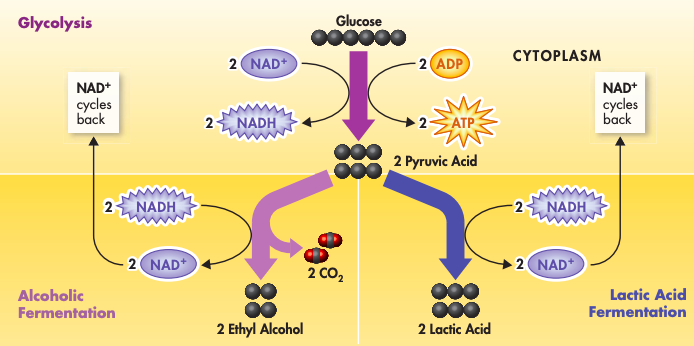
What new crisis does glycolysis create? Draw a simple work map of all of the previous crises, how they were solved, and what new crisis it created.

What are cations?
positively charged ions
What is the additional benefit of pumping cations out of the cell (other than prevent the osmosis crisis)?
it can create a very strong concentration gradient (with a much higher concentration existing outside of the cell)
Explain the co-transport system used to actively transport a glucose molecule even where there isn’t a high concentration of glucose outside of the cell.
The sodium potassium pump pumps sodium ions (Na+) out of the cell
One sodium ion binds to the glucose co-transporter (on the outside of the cell)
The co-transport protein snatches a glucose molecule from the outside and bring it (along with the sodium ion) into the cell

How does the work done by the sodium potassium pump benefit the glucose co-transport protein?
the sodium potassium pump pumps a lot of sodium ions outside of the cell
when there are a lot more sodium ions outside of the cell than inside, the glucose co-transport protein works a lot faster
the concentration gradient is stronger, making sodium ions move faster and down the gradient into the cell
there are more sodium ions to attach to the co-transport protein
How does a coupled transport protein work? Use the example of the glucose co-transport protein.
It uses the movement of one molecule (the Na+ ion) down its concentration gradient to bring in another molecule against its concentration gradient (the glucose molecule)
How much ATP is used to transport glucose into the cell? Which system(s) use this ATP?
1 ATP molecule
the sodium potassium pump requires one ATP
After glycolysis, fermentation, the pumping of sodium ions outside of the cell, and the pumping of glucose molecules into the cell, what is the net gain of ATP? What does this mean for the efficiency of this system.
Glycolysis produces 2 net ATP
Sodium/Potassium pump uses 1 of those ATP to pump sodium ions out so that glucose can enter
there is only 1 net ATP gained, making this system extremely inefficient
What is the only locomotion that does not require ATP? How is it powered?
the flagella of bacteria
powered by a strong concentration gradient (specifically the high concentration of protons on the outside of the cell)

What is ATP used for in RNA?
it is the a nucleotide
Draw out the hydrolysis of ATP.

What is the main point of glycolysis?
harvest energy from glucose to create ATP
powering the proton pumps
With NAD+ and NADH, which donate electrons and which receives electrons? Describe what this means for redox reactions.
NAD+
receives electrons
gets reduced during glycolysis
NADH
donates electrons
gets oxidized during fermentation
Draw out the flow of energy and main products in a cell. Include glycolysis, fermentation, and proton pumps/co-transport proteins.

6CO2 + 6H2O → C6H12O6 + 6O2
Is this depolymerization or polymerization? How do you know? Explain how ATP is either used or produced.
polymerization
we have many (6) smaller carbon molecules (CO2) on the reactant side
there is one larger carbon molecule on the end that was polymerized from the smaller molecules
ATP is on the reactants side, leaving ADP + an inorganic phosphate on the right
*note that water being a reactant does not indicate depolymerization
6CO2 + 6H2O → C6H12O6 + 6O2
In this reaction, what is being reduced and what is being oxidized? How do you know?
the CO2 molecules are being reduced because they gained hydrogens
the H2O molecules are oxidized
it has to be the opposite of the other molecule
we also know because it lost a hydrogen
When a molecule is reduced, does energy increase or decrease? What about for a molecule that is oxidized?
reduced = gains electrons, therefore gains energy/”reducing power”
oxidized = loses electrons, therefore loses energy
What is the carbon molecule input of glycolysis? What is the carbon molecule output? What is the cofactor and what happens to it during the process?
glucose is input
pyruvate is the output
NAD+ is reduced to NADH
What is the carbon molecule input of fermentation? What is the carbon molecule output? What is the cofactor and what happens to it during the process?
pyruvate is input
ethanol or lactic acid is output
NADH gets oxidized to NAD+ to be used in glycolysis
Draw and map out the functions of a proto-cell that performs glycolysis, fermentation, and has a proton pump.
