math day 13+14
 Call Kai
 Learn
Learn Practice Test
 Spaced Repetition
 Match
Match Flashcards
 Knowt Play
1/29

There's no tags or description
Looks like no tags are added yet.
Name | Mastery | Learn | Test | Matching | Spaced | Call with Kai | Chat |
|---|
No analytics yet
Send a link to your students to track their progress
30 Terms
Checking for Independence
Two events A and B are independent if any one of the following
equivalent conditions holds:
• P ( |B ) = P (A) ;
• P (B | A ) = P (B) ;
• P (A ∩ B) = P (A )P (B)
Law of Total Probability
An event A can be split into two disjoint events: (A ∩ B) and (A ∩ B^c)
then P(A) = P(A ∩ B) + P(A ∩ B^c) By using the multiplication rule,

Bayes’ Theorem
Once event A has occurred, the updated or posterior probability of
B is given by the conditional probability:
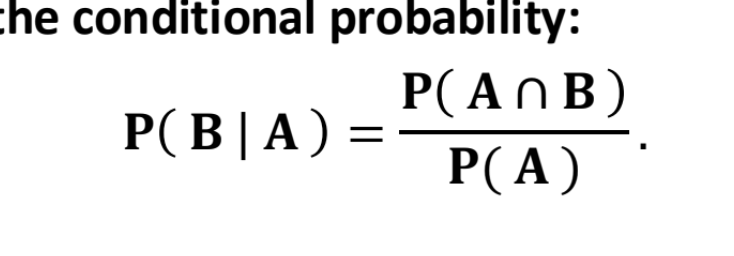
posterior probability
Posterior probability is the revised probability of a hypothesis or event occurring after you take new evidence into account, calculated using Bayes' theorem

Sensitivity
• Probability that the test is positive when the condition is truly present.
• Measures how well the test identifies people who have the condition.
A high sensitivity
means few false negatives
Specificity
• Probability that the test is negative when the condition is truly absent.
• Measures how well the test identifies people who do not have the condition.
A high specificity means
few false positives.
bayes’ theorem impact on data science
• Provides a foundation for probabilistic prediction and classification.
• Incorporate prior knowledge and uncertainty into data analysis.
• Enables learning and updating as new data arrive.
• Underlines method such as Naïve Bayes, Bayesian inference, spam filtering
medical diagnosis, and recommendation systems.
Bayes’ theorem is more than a formula because….
It provides a framework for updating our belief about an event after observing new evidence.
Random Variable
a numerical measurement for the outcome of a random phenomenon (experiment).
random variable lettering system
• Capital letters (X or Y) refer to random variables.
• Lowercase letters (x or y) refer to specific realizations.
Number of pets (discrete random variable) find X and x
• We refer to the Number of pets as X, until we have a concrete
observation.
• x = 2 pets is a realization – a concrete observation.
Discrete Probability Distribution
The probability distribution (i.e., distribution) of a discrete random
variable X is a list of possible outcomes of X and their associated
probabilities:
Discrete Probability Distribution equation
P (x) = P( X = x ) for all possible x’s.
where the probabilities satisfy the following conditions:
1. 0 ≤ P x ≤ 1 for each value of x of X.
2. σ P x = 1.
P(X=x) or P(x):
the probability that the random variable X takes on the specific value x.
• The possible outcomes must be discrete (countable).
• Often, a formula can be used in place of a detailed list.
The (population) mean of a discrete probability distribution for random variable X:
It is also called the expected value or expectation of X.
• The summation extends over all the distinct values of xi of X.

The Variance of a Discrete Distribution
represented by sigma

Bernoulli Trials
Each trial yields one of two outcomes, technically called success (S) and failure (F)
Success (S) and Failure (F) bear no connotation of success or failure in real life. Customarily, the outcome of primary interest in a study is labeled success (even if it is a disastrous event).
Bernoulli Trials formulas
For each trial, the probability of success P(S) is the same and is denoted by p = P(S). The probability of failure is then P(F) = 1- p for each trial and is denoted by q, so that p + q = 1.
bernoulli Trials condition
Trials are independent. The probability of success in a trial remains unchanged given the outcomes of all the other trials.
Bernoulli Trials in Real Life
Fraudulent Transactions
• It is known that 2% of all credit card transactions in a certain region are
fraudulent. Transactions are checked to see the situation.
o Spam Emails per Day
• It is known that 4% of all emails are spam and emails are checked.
Our interest is the binomial random variable represented by:
X = the number of successes in n fixed Bernoulli trials.
n =
a fixed number of Bernoulli trials
p =
= the probability of success for each trial
q=
the probability of failure for each trial
• By complement rule: q = 1 - p
binomial distribution symbols:
X is the random variable, n and p are parameters; x will be the actual observation.
The binomial distribution with n trials and p success probability is described by the function:

factorial
In mathematics, an exclamation mark (!) stands for a factorial, which is an operation where you multiply a whole number by every positive whole number smaller than it down to one
0! =
1