Mice Models
 Note
Note Call Kai
 Learn
Learn Practice Test
 Spaced Repetition
 Match
Match Flashcards
 Knowt Play
1/117

There's no tags or description
Looks like no tags are added yet.
Name | Mastery | Learn | Test | Matching | Spaced | Call with Kai | Chat |
|---|
No analytics yet
Send a link to your students to track their progress
118 Terms
Negative model
An animal that is resistant to a disease of interest, used to explore the mechanism of resistance.
Orphan model
An animal disease or condition that has no known human counterpart.
Athymic nude mice gene deficiency on what chromosome and what does it cause?
A type of mouse characterized by the gene FOXN1U located on chromosome 11, which results in nonfunctional T-cells.
Nonfunctional T-cells
T-cells that do not function properly due to genetic mutations, specifically in athymic nude mice.
Leaky T-cells
T-cells that differentiate outside the thymus, leading to some functional T-cells despite the absence of a normal thymus.
Tumor bio and xenograft research
Areas of study where athymic nude mice are used as models for cancer research and transplantation of human tissues.
DiGeorge’s syndrome
A human congenital condition characterized by thymic aplasia, which can be modeled using athymic nude mice.
What is the importance of FOXN1U gene and what mice strain are they important in?
The gene associated with the athymic nude mouse phenotype, located on chromosome 11.
Chromosome 11
The chromosome that contains the FOXN1U gene, crucial for T-cell development in mice.
"Nude mice are foxy"
A mnemonic to remember the characteristics of athymic nude mice, emphasizing their unique genetic traits.
SCID mice
Severe combined immunodeficient mice that lack functional immune responses.
PRKDC-SCID
A specific type of SCID caused by a mutation in the PRKDC gene affecting DNA repair.
Mutation on chromosome 16
The genetic alteration responsible for SCID is located on chromosome 16.
Memory aid for SCID
"Kids get a driver’s license at 16 and SCID off the road" helps remember the chromosome number.
What does SCID mice not producing Ig or T-cell responses cause clinically?
SCID mice do not produce immunoglobulins or T-cells, leading to severe immunodeficiency.
Become leaky as they age
SCID mice develop increased susceptibility to infections as they grow older.
Why are SCID mice good models for thymic lymphomas?
SCID mice are used in studies involving radiation due to their impaired DNA repair mechanisms and tendency to develop large primary thymic lymphoma.
VDJ SCID mouse
A mouse model used to study V(D)J recombination and its role in immune function.
V(D)J recombination
A process of somatic recombination that occurs in primary lymphoid tissues, essential for generating diverse antibodies.
Immunoglobulin G (IgG)
A type of antibody produced as a result of V(D)J recombination.
Uses of VDJ SCID mice
Employed in studies of V(D)J recombination, tumor and xenograft transplantation, lymphocyte subset transfer, and reconstitution of the human hematopoietic system. Similar to NOD strains
What are RAG-1 / RAG-2 genes necessary for?
Genes responsible for the recombination activation necessary for T and B cell development.
Functional deficiency in RAG-1 / RAG-2 mice
These mice lack functional T and B cells due to the deletion of recombinase activation genes.
"No leaks" analogy for RAG1/2 - strains?
Refers to the necessity of both RAG-1 and RAG-2 for effective V(D)J recombination, likening it to needing two rags to soak up leaks.
Applications of RAG-1 / RAG-2 mice
Used as models for studying transplantation, tumors, and xenograft rejection, similar to SCID mice.
What does the NOD strain cause pathologically to cause diabetes, and what type of diabetes?
NOD Strain: Cause Non-Obese type 1 Diabetes.
Pathology: Generalized dysregulation of the immune system contributes to inflammation/destruction of pancreatic islets.
What are NOD strains models for?
Type 1 juvenile Diabetes
Immunologic deficits with NOD strains are?
Immunological problems: deficits in antigen presentation, T cell regulation, NK cell function, cytokine production, and absence of complement protein C5
What strain of mouse causes hearing loss as they age?
NOD mice
Strains common recipient of human hematopoietic cells
NOD-SCID
What are NOD-SCID strains models for
- Used for accepting allogenic and exogenic graft,
- Models for HIV studies and gene therapy
Which mouse strain commonly have thymic lymphomas
NOD-SCID
How leaky NOD-SCID mice?
not very leaky
Do NOD mice still have diabetes when crossed with SCID?
No
Characteristics of NOG and NSG (NOD-SCID-IL2Ry) mice
Severely immunodeficient
Lack mature T/B/NK cells
Missing y (gamma) causes significant deficits in cytokine production
What are humanized mice?
A humanized mouse is a mouse carrying functioning human genes, cells, tissues, and/or organs. Humanized mice are commonly used as small animal models in biological and medical research for human therapeutics. Immunodeficient mice are often used as recipients for human cells or tissues, because they can relatively easily accept heterologous cells due to lack of host immunity. Traditionally, the nude mouse and severe combined immunodeficiency (SCID) mouse have been used for this purpose, but recently the NOG mouse[1] and the NSG mouse[2] have been shown to engraft human cells and tissues more efficiently than other models.
XID Mice: X linked immunodeficiency
-Lack B cells, low IgM, but T cells normal
- Model for human X-linked agammaglobulinemia
Moth eaten mouse
Mutation on chromosome 6.
Moth eaten mouse memorization sentence
: combine two 6s looks like a moth
Moth eaten mouse deficiencies
- Defective SHP-1 protein tyrosine phosphatase
- Deficient humoral & cellular immunity
- Deficient cytotoxic T & NK cell activity
Moth eaten mouse common pathology
- Moth-eaten pelage secondary to folliculitis.
- Tend to have osteoporosis and a short life span (usually 2 months) tend to look like the runt of a group and not grow
What are moth eaten mice models for?
- Models: for apoptosis studies and autoimmune syndromes
Beige mouse have a defect on what chromosome?
defect on chromosome 13
beige mouse memorization
combine 1 and 3 and it equals a B. May be crossed onto nude or SCID backgrounds for multiple immunodeficiencies
Beige mouse immune deficiency characteristics
- Mutation pigment granules (coat & retina), lysosomal granules of type II pneumocytes, mast cells, and NK cells. Diluted coat color (not necessarily always beige) due to mutation in Lystbg
- Decreased NK activity is predominant defect
What are beige mice models for?
- Model: Homozygotes are model for Chediak-Higashi syndrome (human lysosomal storage disease)
Beige mouse pathology and clinical signs
- This defect prevents initiation of antibody-dependent or antibody-independent cytolysis of tumor cells by NK cells
- Beige mice have a platelet storage pool deficiency producing prolonged bleeding times
- Mice that survive to 17 months of age show a progressive neurological disorder
- See abnormal giant lysosomal granules because they cannot be activated due to NK cell abnormalities.
MRL.lpr (lymphoproliferative) or lpr mouse
Defect in FAS-LPR: cause defective apoptosis of self-reactive T / B cells so they do not die naturally during bone marrow maturation.
Memorization for MRL.ipr mice
MRL.ipr is defects make your FASt computer lupi
Model for MRL.ipr mice?
- Model: Systemic Lupus Erythematosus, rheumatoid arthritis, and Sjögren's syndrome (autoimmune sialadenitis -> dry eyes and dry mouth
Clinical signs and progression of MRL.ipr mice
- Animals have enlarged lymph nodes and splenomegaly by 10 wks old
- Death usually in 20 weeks.
- Restricted diets and fish oil seem to reduce clinical signs
What does the name for BXSB.yaa mice mean?
Recombinant inbred strain; B6 x SB/Le, Y chromosome autoimmune accelerator (yaa)
Memorization tool for BXSB.yaa mice
Only B6 males say YaaS when skating with Nike SB Le’s
BXSB.yaa mice models
Humoral autoimmunity, Lupus nephritis
BXSB.yaa Clinical signs and pathology
100% mortality by 6 months of age
Similar presentation to other murine lupus models: Glomerulonephritis, IgG autoantibodies, Hypercellularity of the spleen and LNs
FAS or FAS-GLD mice
generalized lymphatic disease, FAS ligand defect, similar presentation to FAS lpr mice
FAS GLD mice clinical signs and pathology
- Homozygous mice exhibit SQ edema, marked LN enlargement (up to 50 X the control) by 20 wks of age
- Systemic lupus erythematosus (SLE)-like dz
- Immune complex GN by 22 weeks
FAS GLD mice are models for?
lupus
BWF1: [NZB x NZW] F1 Hybrid meaning?
New Zealand Black crossed w/ New Zealand White
BWF1 mice are models for what diseases?
Autoimmune dz model, Systemic lupus erythematous
BWF1 mice clinical disease progression
Develop progressive, severe GN & high levels of antinuclear antigen-specific IgG autoAbs, similar to both BXSB.yaa & MRL.lpr
- Dz progression:
o 3-6 months of age= proteinuria
o 6-7 month= chronic renal insufficiency
o 12-14 month females= death
o 19 month males =death
How are OVA Mouse models immunized for allergy modeling?
Mice are immunized intraperitoneally once or twice with the ovalbumin (OVA) antigen (+/- adjuvant). Used for allergic modeling
Progression of airway antigen presentation for allergic reaction presentation
- Airway antigen challenge typically performed 14 days after immunization expose to the antigen once a day for several days via aerosol or IN administration
- See airway inflammation and airway hyperresponsiveness (AHR) in acute model (1-5 days)
Better model of airway inflammation and AHR
- See airway remodeling in chronic model (4-8 weeks’ exposure)
Better model of human asthma
- Alternative antigens: house dust mite or cockroach’
None of the common mouse strains spontaneously develop atherosclerotic plaques, even on a high-fat diet, true or false?
true
C57BL/6 and cardiovascular disease
susceptible to diet-induced hyperlipidemia and develop vascular lesions, however the plaques rarely progress beyond the fatty streak stage
ApoE-deficient (ApoE-/- KO) mice and cardiovascular disease
develop aortic atherosclerotic plaques when fed regular diet
LDL receptor-deficient (LDLR-/- KO) mice
less overt disease & plaques grow more slowly when fed regular diet, severe aortic atherosclerotic lesions when fed high fat & cholesterol diet
What is ApoE and what disease processes are they important for?
Apolipoprotein E (ApoE) is a class of proteins involved in the metabolism of fats in the body. It is important in Alzheimer's disease and cardiovascular disease. Lipoproteins are molecules composed of fats and proteins.
List of List convulsive diseases: : A Bang Causes 129s to Slip Right Down From Loud Soundy Farts
AKR
Balb/c
CBA
129
SJL
RF
DBA/2 –wanes with age as they go deaf
FVB: Fatal Very Bad seizures.
LP
SM
Frings
How long are DBA/2J susceptible to seizures and why does susceptbility to induced seizures decrease at this time?
susceptible from ~15-30 days only, completely resistant by adulthood due to deafness
Frings Audiogenic Seizure (AGS)-Susceptible Mouse
o Model for human reflex epilepsy
o Audiogenic seizures persist into adulthood (better drug screening model
Epilepsy Prone (EP) mice strains and onset of epilepsy / how long does it last?
Derived from BALB/c, similar phenotype to D2 & Fring’s mice but onset occurs at 30 days and persists throughout adulthood
Epilepsy-like (EL) mouse:
One of the most extensively studied mouse models for human idiopathic epilepsy. Induce seizure by handling (equilibrium (EL) seizures)
What is most studied mouse model for idiopathic epilepsy?
Epilepsy-like (EL) mouse:
Tottering, leaner, rocker, and rolling mice
Mutant alleles of Cacna1a,
- Mutations in Voltage-Gated Ca++ Channel α1A subunit
Models for tottering leaner, rocker and rolling mice
human absence seizures
Orphan Mouse mutants
- Gene mutations which have not yet been determined to precipitate epilepsy in humans
What strain are most susceptible and what strain is most resistant to electroinducable seizures?
DBA most susceptible, B6s most resistant
What is Pentylenetetrazol (PTZ) used for?
Widely used systemically administered convulsant in mice, rats, cats, primates. Cause absent seizure
What does giving Kainic Acid cause?
High doses reliably trigger tonic-clonic convulsions. Used for screening chemical compounds for anti-seizure activity
C57BL/10ScSn-Dmdmdx (aka - mdx mice)
Dystrophin gene defect
o Model for Duchenne muscular dystrophy
o Rare neuromuscular disorder in young males
o inherited as an X-linked recessive trait
SJL and A/J strains
o Decreased dysferlin protein
o Model for limb girdle muscular dystrophy
What gene is mutated for Lissencephalic Disorders (Schizophrenia models)? How does it differ if the mutation is heterzygous vs. homozygous?
Mice homozygous for the reeler (Relnrl) mutation exhibit an ataxic gait and dystonic posture. Mice heterozygous for the Relnrl mutation may be useful in studies of dopamine-related pathophysiological disorders such as schizophrenia
What disease is Homozygous piebald-lethal mice (SLSL) models for?
model for Hirschsprung’s Disease (aka aganglionic megacolon)
Homozygous piebald lethal mice clinical progression
- Congenital disease present at birth – missing nerve cells in colon
- Colonic impaction grossly apparent by 2-3 weeks
- Skin melanoblasts & enteric plexuses both derived from embryonic neural crest cells
What are your differentials for “Big Guts”?
- Chloral Hydrate
- Tribromoethanol (Avertin is trade name)
- Salmonella
- Tyzzer’s Dz
- Axenic animals
- Hirshsprung’s Dz
How is Parkinsons DZ simulated in mice models?
◦ Induced with MPTP
1-methyl-4-phenyl-1,2,3,6-tetrahydropyridine
◦ Induced with 6-hydroxydopamine
◦ Neurotoxic compounds which cause selective degeneration of the dopaminergic neurons in the substantia nigra after systemic administration
Wobbler mouse
one of the few well-characterized mutations that has been well-studied for its phenotypic outcome, yet the responsible gene has not been identified; wobbler homozygotes have progressive muscle weakness accompanied by significant loss of spinal motor neurons.
Nervous mouse
Homozygotes suffer significant losses of cerebellar Purkinje cells post-natally. Similar phenotype to nervous mouse and also see degeneration of bipolar retinal cells, mitral cell, and thalamic cells
Alzheimer’s dz stimulation in mice
APP=amyloid precursor protein. Duplication of amyloid precursor protein (APP), but not prion protein (PRNP) gene is a significant cause of early onset dementia in a large UK series. Amyloid precursor protein gene (APP) duplications have been identified in screens of selected families with early onset familial Alzheimer's disease (FAD). APP duplication is a significant cause of early onset dementia in the UK.
What is huntington’s disease?
Huntington’s dz: late onset autosomal dominant neurodegenerative disease marked by severe motor, psychiatric and cognitive deficits; mouse models have been used to uncover properties of the neurodegenerative cascade.
What is ALS
ALS: vacuolar degeneration of anterior horn neurons of the spinal cord with neuronal atrophy and loss later
What mice model is used for glaucoma
DBA/2J
What mice strains are models for retinal degeneration? What is the gene affected? And how early do these strains become blind?
SJL, C3H, CBA, Swiss (SWR), FVB
Models of retinitis pigmentosa in humans
Gene: Pde6brd1 causes retinal degeneration in mice
•Important to avoid mouse strains or stocks carrying the rd1 allele when studying new retinal disorders
Blind by weaning
Eyl2 (Eyeless) mice mutation, clinical signs and models for research?
}Mutation arose spontaneously on Lystbg-10J
}Anophthalmos in 80% of offspring
}Mice with intact globes have micro-ophthalmia & frequent congenital corneal perforations and collapse of the anterior chamber
}Used for developmental biology research (eye defects) & sensorineural research
obese (ob) mouse characteristics
characterized by morbid obesity, hyperglycemia, hyperinsulinemia, and dyslipidemia
2x weight of wild-type & show hyperphagia & ↓energy expenditure
Obese mouse (ob) deficiency
Leptin deficient
Diabetes mouse (db) deficiency
Leptin receptor deficient
Lethal yellow agouti (Ay) deficiency
satiety receptor (MC4R) blocked in hypothalmus
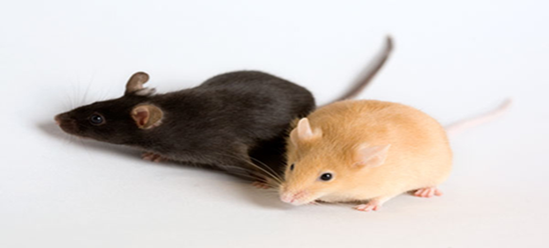
Characterized by a yellow coat color (mutation rearranges the agouti color gene)
Moderate late-onset obesity, hyperinsulinemia, insulin resistance, hyperphagia, low energy
Dominant mutation; chromosome 2
}Homozygosity results in pre-implantation lethality
}Heterozygotes have abnormal lipid homeostasis
Marked hyperglycemia (400-500 mg/dl) by 16 weeks of age
Insulin resistance--insulin sensitivity impaired at 10 weeks & lost by 16 weeks
Diabetes mouse DB, characteristics
recessive mutation
Identical phenotypical presentation as ob mouse
model of leptin resistance (defective receptor)
Spontaneous autosomal recessive diabetes (Leprdb) mutation discovered in 1966 on the inbred strain C57BLKS/J
Leprdb homozygotes are sterile, the misty (m) mutation from DBA/J was incorporated into stocks for maintenance of the diabetes mutation
Profound insulin resistance: Obese FVB-db mice of both sexes show long-term hyperglycemia that persists despite continued extreme hyperinsulinemia
Presents a marked obesity/diabetes phenotype