Agglomeration
 Call Kai
 Learn
Learn Practice Test
 Spaced Repetition
 Match
Match Flashcards
 Knowt Play
1/38

There's no tags or description
Looks like no tags are added yet.
Name | Mastery | Learn | Test | Matching | Spaced | Call with Kai | Chat |
|---|
No analytics yet
Send a link to your students to track their progress
39 Terms
Agglomeration
The formation of larger particles form smaller particles
Opposite process of agglomeration
Milling, making smaller particles from larger ones
Why agglomeration/pelleting?
Improve palatibility
Provision of definite quanity units for metering, dispensing and administration
Reduction of (potential) allergenic dust, reduciton of handling hazards
Destroy pathogens/microorganisms
Creation of non-segregating blends of particles
Improved product-appearance and flow-properties
Control of heat transfer and moisture diffusion by, for example, control of porosity and surface-to-volume ration (particle size in grinding)
Control over the release of acive substances in certain parts of the digestive tract by applyging coatings with different solubility’s.
Increase formulation flexibility (allowing for alternative ingredients)
Affects (improves) nutritional value
Heat and moisture diffusion
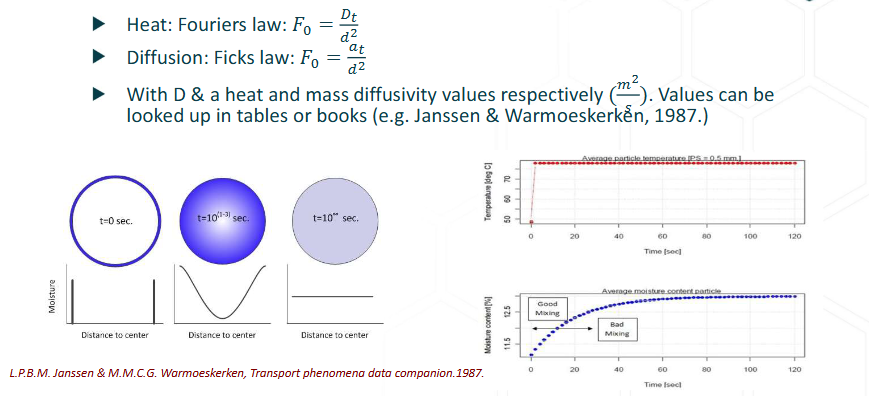
Diffusion coefficents
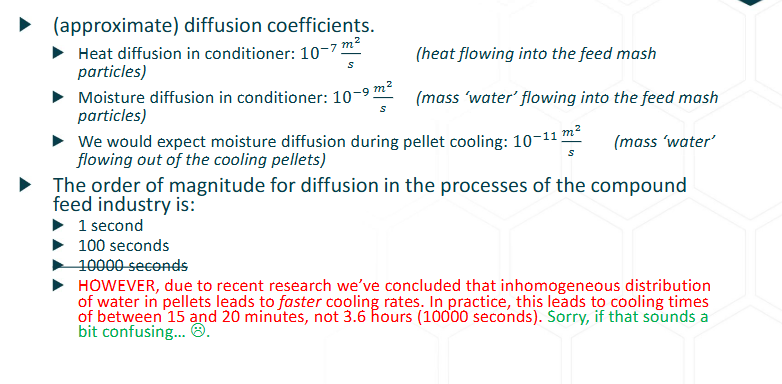
Heat diffusion is quick
Particles in a hot environment (e.g. conditioner) are typically heated to the core in 1 about 1 sec.
Water diffusin is lower than heat diffusion, this is due to
Amount of available moisture (from steam or added liquid)
Amount of mechanical energy (agitation)Mo
Moisture, conditoning and starch transformation
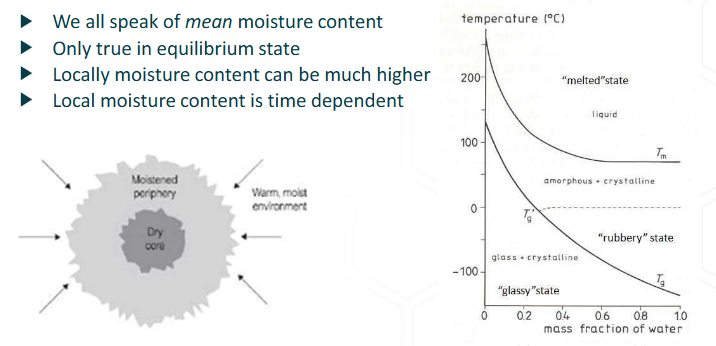
Transformation on particle level
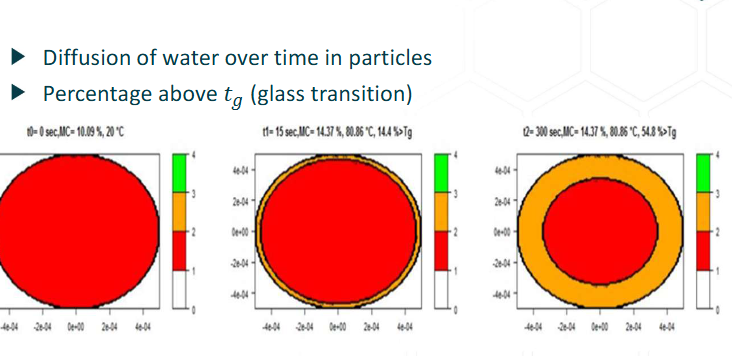
State phase diagrams
Tell you somethign about the state of a raw material or one of its components as a function of (at least) moisture and temperature
All sorts of chagnes of state can be graphed
melt stage: (e.g. native starch to gelatinized starch; melting of fats)
tg: glass transition (for amorphous polymers the cahgne from hard/brittle to soft/rubbery/elastic)
tr: thermo setting temperature, above which polymers (proteins) set
also: bioactives (e.g. vitamins, enzymes, yeats, proteinaceous ANF’s( are transformed and may become inactive (tdenaturation)
note: a state phase diagram tells you only something where a transofmration may take place. It does not say anything about the time involved
Compactuin agglomeration - e.g. pelleting
re-arrangement, collapse of cohesive arches
elastic and plastic deformation
materail aproaching true density
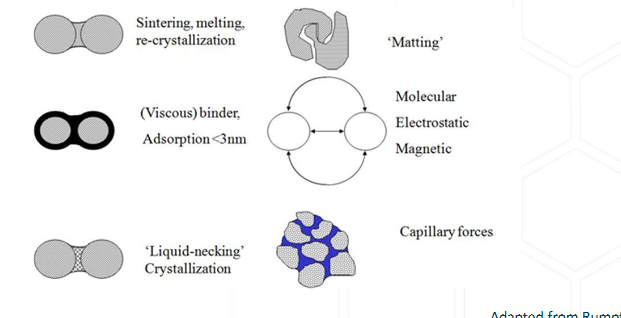
Bond types - how to hold pellets together
Types of steam
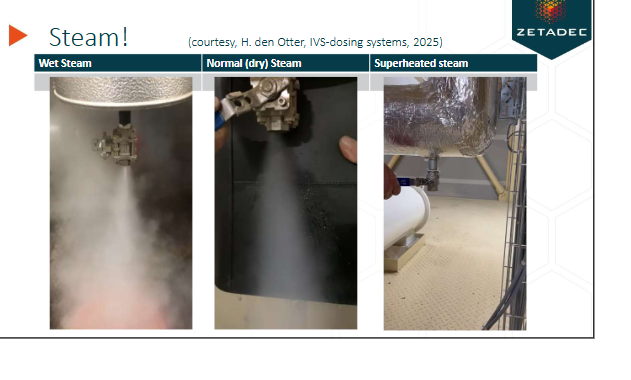
Issues in steam supply
Defective steam regulator
Blocked conditioner steam jets
Worn conditioner paddles
Faulty insulation
Excessive boiler blow-down
Variations in piping size
Step-down/undersized steam regulators
Low total dissolved solids (boiler)
Pellet cooler malfunction
Low boiler pressure
Steam tram line leaks
In summary: steam supply
We can’t alter heat diffusivity (particles heat up very quickly)
We can affect the amount of moisture that is added or taken away from the feed
Conditioning quality depend on
Starting moisture content and temprature of the raw materials
Conditoining installation (Type and steam supply)
Formulation type
80% of problems with pellet quality are associated with steam and team supply
Conditioning types
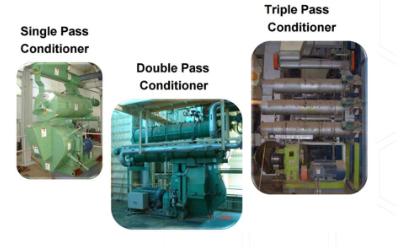
Standard barrel type conditioner - work horse in feed manufacturing
Ripening vessel - process principle very good; not economic in current feed manufacture operations
Long term conditioners - started of as sterilisation equipment
Double pelleting - if one press is good, two must be better
Boa compactor - pressure conditioner
Expander - pressure conditoner
Standard barrel type condtioner
Workhorse to improve capacity and quality in feed manufacturing
Homogenous mixing of gas (steam) and powder
One of the most important piece of equipment in feed manufacture
Thin layer mixer
Hot start version (alwasy hot feed msash at start up)
Ripening vessel
Large vessel which can hold sufficient conditioned feed mash to hold-up for 15-20 minutes
Absorption of large amouts of liquids
Advantages
conditioning quality
Large liquid inclusion level, 12%
Disadvantages
Long residence time 15-20 min
Construction height
Contamination with moulds and bacteria (cold spots)
Mainly due to rapid changes required in formulations, the ripening vessel is no longer installed in compound feed factories
In terms of pelletability,it’s a good system
Long term conditioners
Archimedes screw which controls feed mash flow (FIFO)
residence time can be adjusted up till 4 minutes
Advantages
conditioning quality
large luquid inclusion levels, 5%
construction size (<1 m requiremnt)
low energy consumption
good controllability of time/temperature for sterilisation purposes
disadvantages
static feed mash (no relative movement of particles to help moisutre diffusion)
can’t go higher than 95C
Double pelleting
Two pelletizers on top of one another
the first pre-densifying
the second shaping the feed mash into granules
advantages
high density, and hence low pellet porositiy
short residence time, short strat-up/slow down sequence
disadvantages
extra pelletizer required
construction height required for extra pelletizer and condtioner
for bio-actives, extra shear → breakage of particles
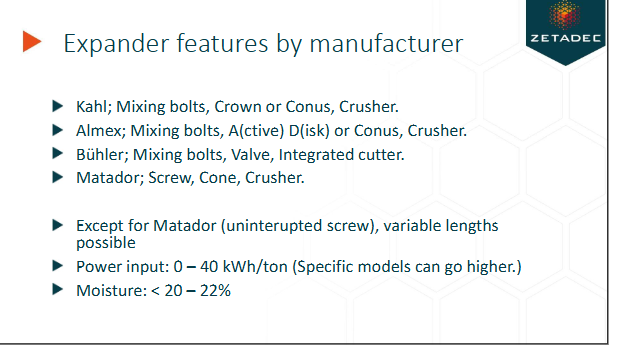
Expander
Advantes
good pre-conditong (shear enhances water diffusion)
high liquid levels, 15%
modern expanders L/D<5
disadvantages
energy consumption
may be consider difficult by operators
boa compactor - PTN
advantages
conditioning and pre-compaction in one installation (construction height)
disadvantages
extra pelletizer required
less broad processing parameter spectrum as compared to expander (but larger processing soectrym as for most other installations)
In summary: conditioning
Large variety in pre-conditioning system
Which one to choose is often a matter of taste/preference/history of the feed plant
Selection of equipment is preferably based on
formulation types that require producing
raw materials and quality of rm available
level and/or availabilit of liquids that can be used
desired production capacity
arguably the most imporant unit-operation in making good quality pellets
pelletizer - shaping the feed
large particles are shattered (large number of small fragments) or are deformed
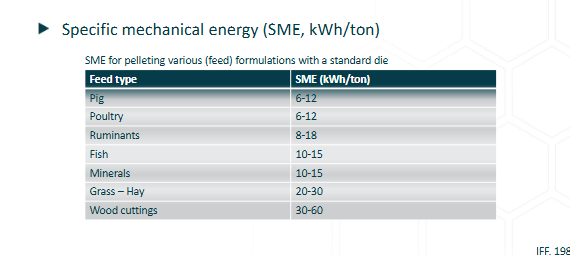
pelletizer - specific power consumption
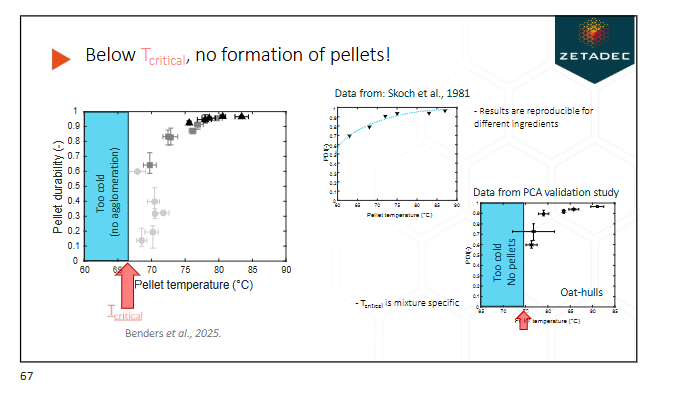
Tcritical
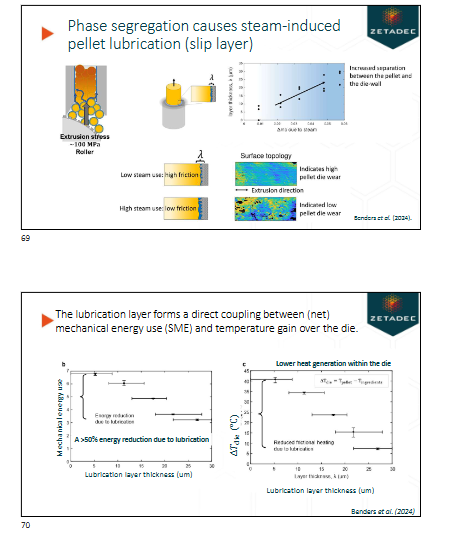
Phase separation and slip layer development
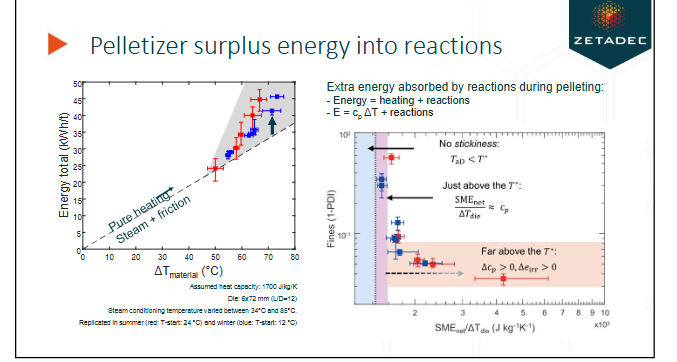
The lubrication layer forms a direct coupling between (net) mechanical energy use (SME) and temperature gain over the die
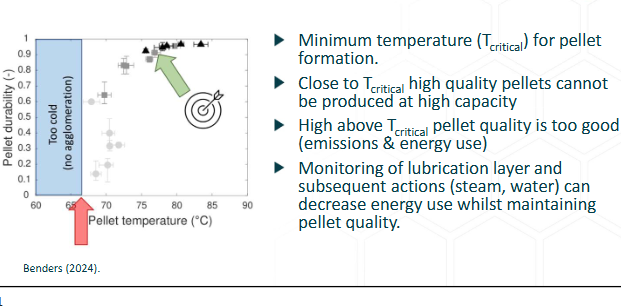
Pellet temperature and PDI
mimimum temperature Tcritical for pellet formation
close to tcritical high quality pelelts cannot be produced at high capacity
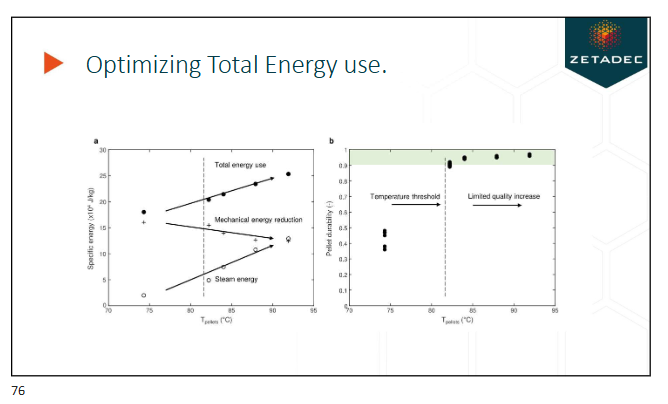
high above tcritical pellet quality is too good (emisions and energy use)
monitorign of lubrication layer and subsequent actions (steam, water) can decrease energy use whilst maintaining pellet quality
Pelletizer surplus energy into reactions
O
optimizing total energy use
Futur
future developments in pelleting
optimisation and understanding the effects of
slip layer development in the pelleting die
surplus energy and the connection with pellet quality and change in feed components
purpose of cooling
remove moisture and heat included and/or generated during the conditioning and pelleting process
transform the liquid type of bond into a solid type of bond (stronger pellets)
Cooler design
co-flow
hot and old air flow jointly together
cross-flow
hot and cold air cross onea nother (belt-cooler)
counter-flow
hot and cold air flow in counter current
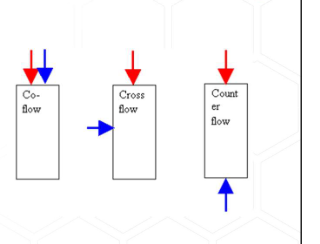
Counter=flow cooler
features
minimal floor space required
moderate to high capacities available
low air requirement
lower capital costs as opposed to belt cooler
mechanically simple
limitations
doesn’t work well for small particles of mashes
difficult to add heat if drying is required
Measuremtn of physical pellet quality
hardness and durabiltiya re correlated
particle size distribution
elasticity of particles making up the pellet
porosityu
binder mechanism in the pellet
Strenght of one granule
expressed as force (kgf or N) to break a certain agglomerate
or stress (force per surface unit N/m2 kgf/mm2)
kahl hardness tester
tablet strenght measuremnt device
durability testers
measuremetn of the amount of fines
expresses as percentage fines
or, durability, percentage prudcti (100%-fines%)
In summary: physical pellet quality
pellet quality measurements should folllow feed back obtained from feed users
durability, from a practical point of view, is more relevant than hardness