(5) soil and infiltration
 Call Kai
 Learn
Learn Practice Test
 Spaced Repetition
 Match
Match Flashcards
 Knowt Play
1/35

There's no tags or description
Looks like no tags are added yet.
Name | Mastery | Learn | Test | Matching | Spaced | Call with Kai | Chat |
|---|
No analytics yet
Send a link to your students to track their progress
36 Terms
(apparently) jenny equation for soil formation
S = f(cl,o,r,p,t)
→ soil is a function of the 6 variables
climate, organisms, relief, parent material, time
what are some main conponents of soil

soil texture classes (3)
sand
silt
clay
→ size of individual grains (particle size) → levels of infiltraiton

properties of soil: 3 phase system
Volume and Mass of: air, water solids

formulas for 3 phase system
particle density: how dense the solid material is (excluding pore spaces)
bulk density: mass of dry soil/total soil volume
porosity: pore spaces
volumetric water content: how much water is in the soil
gravimetric water content: ratio of mass between water & solids
relative saturation: how saturatedsoil is, how much water is this soil holding in relation to how much it can possibly hold
if void space Vf is totally filled by water → fully saturated

what is volumetric water content?
the volume of water contained in a given total volume of soil
→ tells what fraction of soil’s total volume is occupied by water
θ = Vw/Vt
Vw = volume of water in soil
Vt = total volume of the soil sample
→ the total soil volume includes both solid soil particles AND pore spaces
→ often expressed as m3
soil moisture measurement methods (5)
gravimetric
neutron scattering
di-electric constant methods
electrical conductance
tensiometry
gravimetric - soil moisture measuring
taking soil sample → weigh → oven dry → reweigh
gives moisture content
θ: volumetric soil moisture content
pw: constant (1000 kg/m3)
volume of soil sample: using samping container of known volume
neutron scattering - soil moisture measuring
neutrons emitted from radioactive source → scattered by water molecules
rate of return of neutrons to probe = water content of soil (both liquid and solid!!!!)

di-electric constant - soil moisture measuring
measuring propagation of an electrical signal through soil
time domain reflectometry (TDR)
frequency domain reflectometry (FDR)
aka capacitance probes
only records liquid water content

tensiometry - soil moisture measuring
measures water pressure content
provides indirect measure of soil moisture changes
moisture content in an unsaturated soil is related to water pressure
soil moisture retention curve
→ pressure to determine… amount of suction required (pressure) to calculate water in soil
→ more pressure = less moisture/less saturated

soil water potential: instruments
→ potential energy in soil
tensiometer
well
piezometer
but first, soil water potential (by way of hydraulic head)
what is hydraulic head (h)
measures amount of total energy associated with water at certain depths
potential of water to move across a space
soil water potential
→ water droplets in relation to surface distance (depth)
elevation head and pressure head

well
water level inside well indicates depth of the water table
difference in pressure in stuff directs water towards well
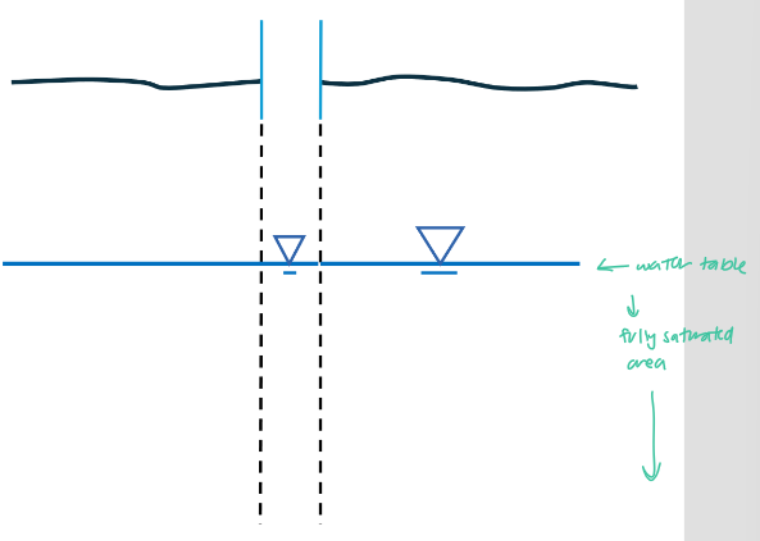
piezometer
pressure & sucking measurement tool
measures height to which a column of fluid rises against gravity, or groundwater pressure
Water moves until the hydraulic head inside the tube matches the hydraulic head in the surrounding soil
matching hydraulic head (at equilibrium, no flow)
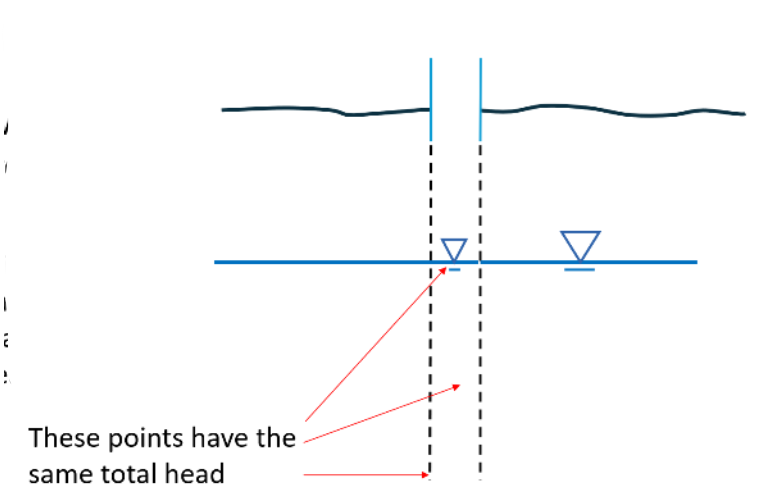
piezometer and equilibrium
assume hydrostatic equilibrium in the piezometer
hD = hC
assume water in piezometer is in equilibrium with soil water at B
hC = hB
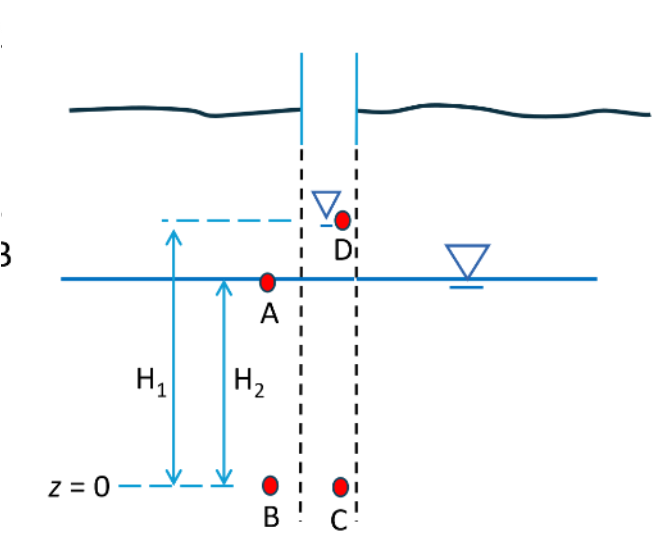
soil water movement
A= cross sectional area (m2)
V = volume of water draining through A in a time interval Δt (m3)
Q = discharge rate = V/Δt (m3/s)
q = flux rate = V/(A× Δt) (or = Q/A) (m/s)
→ water always moves from higher h to lower h
→ high pressure/energy to low pressure/energy
darcy’s law
water flow rate is proportional to hydraulic head gradient in the direction of flow
water flow depends on the soil's ability to transmit water and the difference in hydraulic head over a distance
Larger hydraulic head difference over the same distance → faster flow.
Shorter distance with the same head difference → faster flow.
darcy’s law equation
→ describes flow of a fluid through a prorous medium (how easily and how quickly)
q = -K × ΔH/ΔL

what variables make up darcy’s law?
q = Water flux: How much water flows through a given area (m/s).
K = Hydraulic conductivity: How easily water moves through soil (sand = high, clay = low).
Δh = Change in hydraulic head: Difference in hydraulic head between two points (m).
ΔL = Distance: Distance between the two points (m).
(-) = Indicates that water flows from higher to lower hydraulic head.
darcy’s law equation vertical flow vs downslope flow
Vertical flow | Downslope flow |
|---|
Water moves up or down. | Water moves sideways along a slope. |
Uses vertical distance, Δz | Uses distance along the slope, L. |
Uses vertical hydraulic conductivity, Kz. | Uses hydraulic conductivity, K, in the direction of flow. |
Includes a negative sign to indicate flow direction. | Uses the absolute head difference to calculate the magnitude of flow. |

darcy’s law: K
K = hydraulic conductivity
how easily pore fluid escapes from compacted pore space
saturated hydraulic conductivity: K =
rf = density of fluid (kg m-3)
g = gravitational acceleration (m s-2) → constant
k = intrinsic permeability (m2) → given value
µ = dynamic viscosity of fluid (k m-1 s-2)
→ higher K = easier water movement
example: groundwater flow between 2 points
point A | point B | |
elevation, z | 120 m | 105 m |
pressure head ψ | 8 m | 18 m |
L= 500 m |
key concept: water flows down the hydraulic head gradient (not always from higher elevation to lower elevation)
answer: 2 ×10⁻⁶ m/s (slow!!)

darcy’s law, relationship between saturated hydraulic conductivity vs temp

surplus of water in soil
reaches field capacity (amount of water soil can hold after excess water drains away), extra warer leaves in two ways
Deep percolation: Water drains downward past plant roots into deeper soil.
Evapotranspiration (ET): Water returns to the atmosphere through evaporation from soil and water released by plants.
water surplus vs water deficit
P > PET = surplus (too much water coming in).
P < PET = deficit (not enough water coming in).
P = precipitation, input
PET = potential evapotranspiration, how much water could evaporate from ground
soil infiltration
permeation of liquid into something by filtration
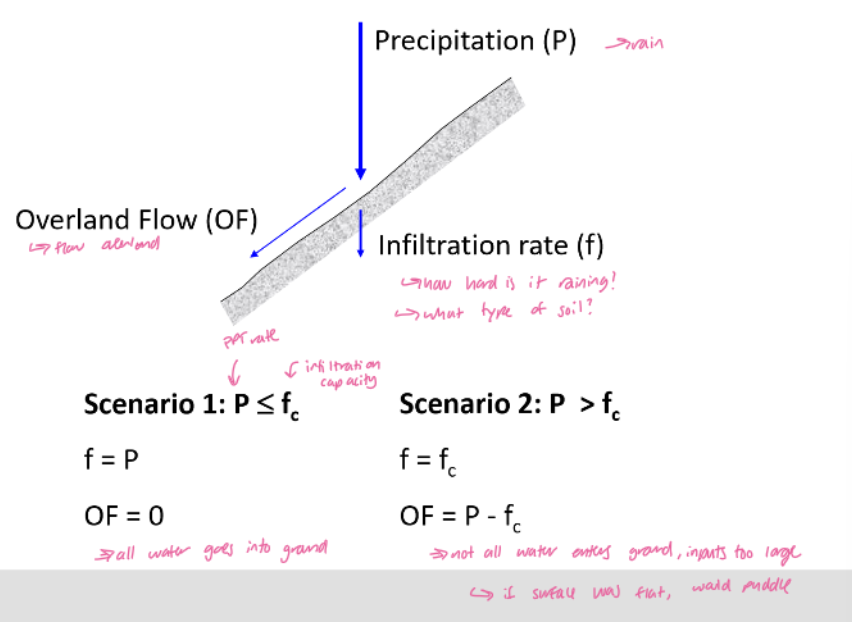
infiltration rate (f): rate at which water enters a soil at the surface
infiltrability (fc): infiltration capactiy. maximum rate at which water can enter a soil
impacted by soil type, compaction, input intensity, previous conditions of soil (dry/wet)

soil infiltration: infiltration rate and precipitation relationship
soil infiltration measurement types
ring infiltrometer
infiltration measured in inner ring. rates are all known, isolates infiltation rate of confined vertical area
sprinkling experiments
water sprinkled at rate that exceeds infiltrability
excess flows over surface → captured and measured
infiltrability: difference between the sprinkling rate and rate of overland flow production
hortons equation
know briefly
describes how the infiltration capacity of soil decreases over time during rainfall

phillips equation
briefly
how water infiltrates into soil over time
infiltration changes over time as soil becomes wetter (infiltration decreases)
infiltration eventually reaches steady state

soil infiltration: green and ampt theory
how water infiltrates into soil during rainfall, assuming a relatively sharp boundary between wet soil above and drier soil below

green and ampt theory in relation to darcy
Green-Ampt uses Darcy's Law to estimate infiltration capacity based on soil conductivity, capillary suction, and wetting-front depth.

green- ampt theory: how does infiltration change over time
Early in rainfall: Capillary suction pulls water into the soil, creating a strong pressure head gradient. Infiltration is high.
Later in rainfall: The wetting front moves deeper, reducing the effect of capillary suction. Infiltration decreases.
Eventually: Gravity becomes the main force driving water downward, and the infiltration rate approaches the saturated hydraulic conductivity (Ks).
Remember: Infiltration starts high and decreases over time until it approaches Ks, as the influence of capillary suction decreases and gravity becomes dominant.

green and ampt theory: example calculations HUGE!!!

soil moisture balance
accounting of water entering, leaving, and being stored in soil over time
tells us if soil is gaining, losing, or maintaining water storage
Water inputs: Precipitation (rain and snowmelt).
Water outputs: Evapotranspiration, runoff, and drainage into deeper soil.
Water storage: Water retained in the soil for later use by plants.