Histology: Tissue Types, Classification, and Microscopic Features
 Call Kai
 Learn
Learn Practice Test
 Spaced Repetition
 Match
Match Flashcards
 Knowt Play
1/37

There's no tags or description
Looks like no tags are added yet.
Name | Mastery | Learn | Test | Matching | Spaced | Call with Kai | Chat |
|---|
No analytics yet
Send a link to your students to track their progress
38 Terms
What are the main tissue types recognized in histology?
Epithelium, Muscle, Connective tissue, Nervous tissue
What is the purpose of histology?
It provides a structural basis for gross anatomy and is essential for understanding function and pathological change.
What are the steps involved in tissue processing?
Fixation, Dehydration, Clearing, Impregnation, Embedding and blocking, Section cutting and mounting, Routine staining.
What is the most common staining method used in histology?
Haematoxylin and eosin (H&E) staining.
What is the significance of the cutting plane and angle in histology?
It affects the appearance of the sectioned tissue.
What is the function of epithelial tissue?
It lines internal surfaces, covers external surfaces, and can be secretory.
What are the two main types of epithelium?
Surface epithelium and Glandular epithelium.
What are the three criteria used to classify surface epithelia?
Number of cell layers, Shape of surface cells, Surface specializations .
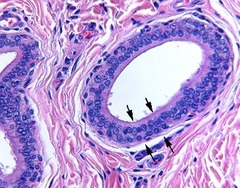
What is simple squamous epithelium suited for?
Surfaces where mechanical protection is not required, such as the lining of blood vessels.
What is the function of simple cuboidal epithelium?
It is suited for surfaces with an absorptive/secretory role, such as secretory cells of exocrine glands.
What is the role of simple columnar epithelium?
It is suited for surfaces with an absorptive role, such as the small intestine.
What type of epithelium provides mechanical protection?
Stratified squamous epithelium.

What is transitional epithelium functionally suited for?
Surfaces that are required to stretch, such as the urinary bladder.
What are goblet cells?
Single secretory cells that retain connection with surface epithelial cells.

What are the two main types of secretion produced by exocrine glands?
Serous and mucus secretions.
What is the appearance of serous secretory units when stained?
They appear dark due to their staining affinity.
What is the appearance of mucus secretory units when stained?
They appear pale due to their staining affinity.
What are the structural modifications of epithelial cells that mediate specialized functions?
Microvilli, cilia, and specialized junctional complexes.
What are occluding (tight) junctions?
They prevent diffusion of molecules between adjacent cells and form a selectively permeable barrier.

What are anchoring (adhering) junctions?
They link cells together and provide mechanical strength.

What are communicating (gap) junctions?
They allow movement of molecules between cells.

What is the total magnification formula in histology?
eyepiece magnification x objective magnification.
What is the role of connective tissue?
It provides support and includes blood, bone, tendons, and fat.
What types of muscle are recognized in histology?
Cardiac, skeletal, and smooth muscle.
What is nervous tissue composed of?
The brain, spinal cord, and nerves.
What type of epithelium appears stratified but all cells are in contact with the basement membrane?
Pseudostratified epithelium
What are the two main types of glandular epithelia?
Exocrine (with ducts) and endocrine (without ducts)
Which epithelial type is adapted to stretch and recoil without damage?
Transitional epithelium
What is the main function of stratified squamous epithelium?
Protection against mechanical stress and abrasion
What are the two subtypes of general adult connective tissues?
Loose connective tissue and dense connective tissue (regular and irregular)
What is the primary function of adipose tissue?
Energy storage, insulation, and protection
What is the main cell type in adipose tissue?
Adipocytes
What type of connective tissue is characterized by fibers arranged in multiple directions?
Dense irregular connective tissue
What is the role of fibroblasts in connective tissue?
They produce fibers and ground substance.
What type of epithelium contains goblet cells?
Pseudostratified ciliated columnar epithelium
What is the function of plasma cells in connective tissue?
They produce antibodies.
What type of connective tissue is characterized by a high proportion of ground substance?
Loose connective tissue
What is the primary role of neutrophils in connective tissue?
Protection against infection