GENE222 Mods 1-6
 Call Kai
 Learn
Learn Practice Test
 Spaced Repetition
 Match
Match Flashcards
 Knowt Play
1/137

There's no tags or description
Looks like no tags are added yet.
Name | Mastery | Learn | Test | Matching | Spaced | Call with Kai | Chat |
|---|
No analytics yet
Send a link to your students to track their progress
138 Terms
Describe the order of Maori family hierarchies (4 levels)
Whanau - closely related family
Hapu - A group of closely related families, you can marry within your hapu
Iwi - Broad collections of many families, some are connected by common ancestors
Pan-Iwi - (Across many different tribes with varying relatedness)
What are some of the main constructs that are key to Maori concepts of inheritance? (5)
Constructs such as;
‘whakapapa’ (genealogy),
‘pepeha’ (introduction/identity)
‘mokopuna’ (grandchildren/nephews/nieces)
‘momo’ (type, variety, type of, kind, race, breed, species, genus, offspring, descendant, sort of, manner, genre)
‘kākano (seed, kernel, grain, egg, ovum)
Describe the concept of whakapapa
It means ‘to place in layers’ and it is an understanding of ones ancestors and history. One’s whakapapa is their family tree and a knowledge of your background is seen as a sign of intelligence and wisdom. Often used in a powhiri to welcome visitors on a marae.
Describe the concept of Pepeha and how it relates to quantitative genetics
Pepeha is a traditional introduction of ones heritage and identity. The first half explains ones environment that they come from, their mountain and river etc, and the second half explains their ancestors/heritage. This reflects the genetics relationship that Phenotype = Environment + Genotype.
Describe the concept of mokopuna
Moko means tattoo or marking, and Puna means spring (of water). This reflects that people are seen as the blueprint of their ancestors. This means grandchildren or descendants, grand nephews/nieces.
Describe the concept of Momo and its derivatives
Momo means ‘type, variety, race, breed, classification’ kind of thing.
He Momo means ‘true to form, it's a family trait, inherited quality, hereditary trait -this idiom highlights a person's character and inherited qualities or those of his/her ancestors. It can be applied to both good and bad traits.
Momo mate
– hereditary disease
• Mātauranga momo whakaeke
– genetics
Describe the concept of Kakano
Relates to inheritance and passing things on, can mean seed or to reproduce, or ova or sperm. It can also mean to descend, or stock or pedigree.
Give an example of Matauranga Maori being used in modern Genetics research.
the He Kākano/Variome Project. Traditional Ancestral Knowledge of Whakapapa (Genealogy) enables this by, researchers surveyed Hapu around New Zealand for their whakapapa information.
Whakapapa knowledge (waka/hapu/iwi/whanau) enables:
1. More accurate prediction of disease risk
2. Lower cost of prediction – whakapapa is cheaper than DNA for similar outcomes
What are the limitation of Mendels 2nd law?
The Law of Independent Assortment. Linkage is the primary limitations of M2L, genes very close together on a chromosome do not recombine relative to each other very much.
In 1905, Bateson, Saunders and Punnett crossbred sweet peas, and did not find the expected 9:3:3:1 ratio, they found more “parental” phenotypes than recombinant phenotypes. This made them think the genes were ‘linked’
What is the difference between Dominant/Recessive vs Parental/Non-parental inheritance?
Dominant/Recessive – based on molecular action of allele Determined based on phenotype seen in F1 generation Dominant: purple flowers + long pollen Recessive: red flowers + round pollen
Parental/Non-Parental – based on coupling/linkage of loci Determined based on phenotype seen in P generation Parental: purple flowers + long pollen OR red flowers + round pollen Non-Parental: purple flowers + round pollen OR red flowers + long pollen
What can affect rate of crossing over of a point in a chromosome?
If the chromatin is open, so euchromatin, it is more likely to cross over and recombine.
Cross-over hotspot can be caused be sequence motifs that can bind with other chromosomes or splicing factors.
• How do you calculate if two genes/traits are linked by their phenotype ratios.
Chi squared test, observed versus expected. If the variability is already captured in expected values (ie it has a confidence interval), you only have to use one degree of freedom.
What is the Difference between a genetic and physical map
A physical map occurs through sequencing of DNA, the human one is nearly done. Genetic maps are usually formed through linkage and frequency of recombination between genes. Physical map is much more accurate and specific.
How do we form a linkage/genetic map?
The further away two genes on a chromosome are the more likely a crossing over event will occur between them
• This can be used to map genes onto chromosomes
• Use frequency of recombinants to predict distance between genes
• Map units are centiMorgans (cM)
• Genes must have a visible/ detectable phenotype
What does the map unit centimorgan mean?
One genetic map unit (m.u.) or centiMorgan (cM), is defined as the distance between two genes for which 1 product of meiosis in 100 is recombinant. => one map unit is a recombinant frequency of 1%
What do we use to map genes or other genetic elements that don’t cause visible phenotypes.
Linkage studies and whole-genome analysis allow us to see the genotype of the organism. genome wide linkage studies will let us find the location of the genes by its recombination rate with all the markers in the genome, it will have the least recombination with the closest markers and so on
In the FecX sheep gene example, how did the researchers perform step 1 of gene mapping and characterise the phenotype?
In sheep to find the FecX gene that causes common twinning and triplets during lambing in sheep.
Step 1: Characterising the phenotype
A flock of highly prolific Romney ewes: One particular ewe (A281) had 33 lambs over 11 lambings - her daughters also had consistently high progeny rates. Set up a series of progeny tests. Measured ovulation rates via laparoscopy. From the pedigree, determined an X-linked gene is responsible for increased ovulation. Named this gene FecX.
In the FecX sheep gene example, how did they map FecX chromosome position?
Step 2 and 3: What is already known and how do we map FecX position
• Had already created a partial gene map of sheep X chromosome.
A three-generation test cross for FecX was set up •
Searched available X-chromosome markers for one with a very low recombination frequency = Must be close to FecX on genetic map
In the sheep FecX gene example, after finding the relative position of the gene, how did they identify the actual FecX gene?
Step 4: Finding the variant in the linked gene(s)
• TIMP1 and BMP15 are genes in the mapped region for FecX
• Searched for sequence differences between FecXI /FecXI and FecX+ / FecX+ sheep
• Found no differences within TIMP1 Later found a TIMP1 recombinant to further confirm this is not the gene of interest
• Found a T→A change in FecXI carriers at nucleotide position 92 (c.92T>A) of BMP15 • Results in a valine to aspartate substitution at amino acid 31 p.(V31D)
• Interrupts a conserved region of the protein. This allowed them to conclude BMP15 was the important gene, which was later found to be a transforming growth factor (TGFBeta) expressed in oocytes.
What are some kinds of tests done to identify organisms using genetic markers? (4)
DNA fingerprinting (think forsenics) Detects mini/microsatellites PCR around repeat region and visualise product length
• Restriction fragment length polymorphism (RFLP) Detects SNPs that change a restriction enzyme recognition site PCR around SNP, then cut with restriction enzyme, visualise fragment lengths
• TaqMan or gene-chipping Detects SNPs Small specific probe binds SNP, PCR around SNP – probe releases fluorescent molecule, different colour per allele, measure how much of each colour seen
• Genotyping by sequencing (GBS) Detects SNPs and indels (very short insertions/deletions) Use high-throughput short read sequencing for a fraction of the genome (DNA fragments chopped up by restriction enzymes) Line up sequence across individuals and call SNPs
Compare differences and similarities in human vs other organism gene mapping approaches
The biggest thing is ethical concerns we can’t do as much to humans, Mainly we can’t breed them to cause phenotypes to show. This is less of a problem now we have gene sequencing.
With model organisms we have much more prior knowledge of their genetic structure, if they exhibit a phenotype of interest, we can usually identify the locus causing this. We have access to very inbred and homozygous strains.
Humans are usually outbred as well, making pedigree information vital.
What are outbred organisms and when are they used/useful?
The result of matings between pairs that are not closely related. Commonly livestock/farm crops as genetic diversity is important for them. We are still able to control matings and will have prior pedigree information. These have more genetic differences between individuals, so phenotype-causing variants are harder to find.
What are the key aspects of approaching making pedigrees of humans? (5)
- Most pedigrees are drawn for medical reasons, often to discover the genetics behind a rare disease / disorder, common for a pedigree to be created in response to an extreme / exceptional case (proband = first person in a family to have or be at risk of a rare disorder)
- Available medical records from family members searched for evidence of same condition
- Family history / knowledge of heritage can be used to “bulk out” pedigree
- Start by searching for mode of inheritance, you won’t necessarily see Mendelian ratios because humans often don’t have enough offspring
Describe the part of the process of finding a linked gene that is universal to every case
Step 1. Draw a pedigree based on available information
We get as many DNA samples as possible - Depends on availability and funding. Require both affected and unaffected individuals to be able to make a useful comparison.
briefly describe, and Contrast the two methods of finding a Linked Gene.
Candidate gene approach
- Create a list of genes with potentially relevant function, generally if we have a hypothesis, you run this method
- Test the region(s) those genes sit within for linkage
- Find markers within the region(s)
- Limited by current knowledge of phenotype and gene functions
Genome-wide approach
- Obtain genotypes for a large number of markers
- Need to be regularly spaced throughout genome (~ every 10 centiMorgan)
- Test all markers for linkage
- Does not rely on current knowledge of genes, gene functions, or phenotype mechanisms but is much more work, candidate gene is more targeted.
Describe the Candidate Gene/Locus approach
1. Sequence gene directly (used to be expensive)
2. Handpick microsatellite markers that flank the gene / locus - Test for linkage using LOD scores
- Test for linkage
- Notice higher theta (θ) – score trends towards zero

How do you measure linkage in linkage analysis?
(LOD scores)
LOD = log of odds - Compares the likelihood of observing the “test data” if the gene and phenotype are linked, to the likelihood of observing the same thing by chance (chi-squ basically)
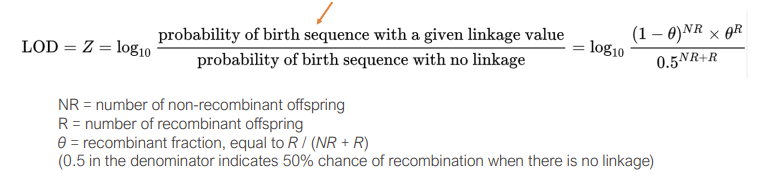
How are LOD scores used to find candidate genes?
- Calculated for a range of recombination frequency estimates
- Estimate with the highest LOD score considered best / most likely
- Number of meioses can limit max LOD score possible (recombinants vs nonrecombinants)
- Positive LOD scores indicate linkage
- LOD score >3.0 is considered good evidence for linkage because they equal 1000 to 1 odds that the observed pedigree happened by chance. (genome-wide LOD score > 3.3)
- Negative LOD scores indicate no linkage
- LOD score < -2.0 is considered good evidence for no linkage
Define a haplotype
a group of gene variations or DNA markers on a single chromosome that are inherited together from one parent.
What are the advantages of Linkage studies for finding genes? (4)
- Does not require huge numbers of markers to find linked locus, - <1,000 genome-wide markers required. This is because - Can find potential disease loci located far from linked marker because it has Low resolution (finds big candidate regions).
- Can be used in conjunction with whole-genome sequencing
- Can account for incomplete penetrance, you can include an estimate of penetrance in LOD score calculation
- You don’t need to know inheritance pattern. Can also use “model-free” calculations.
What are the limitations of Linkage studies (3)
– requires pedigree information (with good phenotyping) - One large multi-generational family pedigree - Especially powerful in consanguineous families. If we have many small family pedigrees we need to make the Assumption: all have same causal gene (depends on specificity of phenotype)
- Most applicable to single-gene disorders - Searching for one linked site - If more than one gene can create the same phenotype (functional redundancies) LOD scores may be reduced and truly linked sites rejected as candidate loci
- LOD scores underestimate the distance between two loci (unknown causative gene and microsatellite marker) the further apart the loci get, Due to double cross-overs reducing apparent recombination rate.
How is linkage analysis used in the modern day?
Focus shifted to association studies mid 00’s as they are Powerful for finding common variants that have a modest effect
- Emerging view is that rare variants could be responsible for a substantial portion of complex human disease. This could bring linkage analysis back to the forefront of analysis methods
- Linkage studies incorporating whole-genome sequencing are powerful, Better use of family-based sequence data than variant filtering approaches.
What are the 5 main interactions between two genes?
1. duplicate gene action
2. complementary gene action
3. recessive epistasis
4. dominant epistasis
5. supression
What kind of two-gene interaction results in a 9:3:3:1 pattern in offspring?
No interaction between genes results in this pattern of offspring phenotype in a dihybrid cross.
explain the phenotype pattern and genetic process that causes duplicate gene action between two genes.
This interaction means both genes are sufficient to provide the dominant phenotype, so if either functional/dominant gene is present, the phenotype will be dominant. This results in a 15:1 ratio of dominant to recessive phenotype, as both genes must be recessive to get a recessive phenotype.
explain the phenotype pattern and genetic process that causes complementary interactions between two genes.
Biochemistry: a dominant phenotype requires 2 enzymes in the same pathway, or 2 subunits of 1 enzyme, or an enzyme and a transcription factor.
In this situation both functional genes are required to form the dominant phenotype, so if either is non-functional the phenotype will be recessive.
Pattern is 9:7 dominant to recessive.
explain the phenotype pattern and genetic process that causes recessive epistasis between two genes.
Biochemistry: 1 enzyme makes product, other allows expression/localisation.
Example is albinism, if the expression gene is recessive then no melanin is expressed and no colour, if it is then we have normal dominant and recessive phenotypes corresponding to the pigment gene.
Pattern: 9:3:4 Dominant pigment, recessive pigment, no pigment ratio.
explain the phenotype pattern and genetic process that causes dominant epistasis between two genes.
Biochemistry: 1 gene produces a product (like melanin) and other stops expression of that product, so dominant (functional) expression phenotype causes no expression, if it is non-functional than product gene will have individual gene expression
Similar to recessive, dominant phenotype of expression gene causes no expression of other gene.
Pattern: 12:3:1 No expression, dominant product phenotype, recessive product phenotype
explain the phenotype pattern and genetic process that causes suppression interactions between two genes (Su is recessive).
Biochemistry: 1 product gene (like eye pigment enzyme) and a suppressor gene which is recessive itself, so needs to be homozygous to suppress the product gene.
A functional suppressor phenotype causes the dominant phenotype to present. So if we have SuSu the colour phenotype will be dominant (red) and if we have any R genes then the colour will be red. If we have rr and at least one Su+ then we will have purple.
Pattern: 13:3 Dominant colour (red), recessive colour (purple)
What are some reasons that Mendelian ratios do not usually appear in offspring phenotypes?
If a phenotype affects survival or fertility of offspring.
If a phenotype is not so clearly differentiable.
Penetrance of a gene may not be 100%, penetrance is the percentage of offspring with a genotype that display a certain phenotype.
Non-autosomal inheritance
What is penetrance?
If we can use PHENOTYPE to distinguish mutant and wild-type genotypes, the mutation is said to be 100% penetrant.
Environmental factors, epistatic genes, suppressors, or other modifiers may contribute to an organism not exhibiting the given phenotype.
What is expressivity?
the extent to which a genotype is expressed in phenotype
What is a chi-Squared test used for and how is it conducted?
A chi-squared test at its core determines if two variables are independent. In this case it is used to compare observed results to those expected due to a hypothesis and a statistical probablity of observing the differences between observed and expected values due to random can be calculated. This allows us to reject hypotheses that cause results different from our observed results.
What is a clade in phylogeny?
A determined grouping within a hiearchal classification, supported by genetic similarity evidence. Also known as a monophyletic grouping, the most common
What are some methods used to construct phylogenetic trees?
Distance method - overall similarity of species (assumes a relatively similar rate of evolution)
Character based methods - based on tracking evolutionary events, and common ancestry.
Outline the cladistic method of phylogeny
Makes an assumption that genes are either ancestral or ‘derived’ (new in the organism) and usually must hypothesize a way to differentiate them. Used on a genome/gene level or a morphological level to identify differences in organisms and form a tree from there.
Outline the Maximum parsimony method of forming phylogenetic trees?
Constructing a phylogenetic tree by finding the differences between similar species via base-pair changes in select conserved protein-coding genes. Maximum parsimony means choosing the possible phylogenetic tree that would form from the least single-nucleotide mutations.
From there, different weightings could be assigned to different SNPs just like the UPGMA method.
What problem does insertion/deletion events pose to DNA alignment analysis?
It makes it difficult to align the sequences, this becomes exponentially more difficult for more different species, enough so that it becomes computationally expensive. It brings up a potential problem of overfitting of the analysis data as the algorithm may misalign very different sequence to maximise base-pair homology.
What are chromosomes made of?
Chromatin
Describe the process of carrying out a karyogram
Cells (e.g. from blood sample) cultured
Mitosis arrested at Metaphase stage
Histological staining to visualise chromosomes
Chromosome set arranged from largest to smallest with sex chromosomes last
The karyogram is the final visual representation of all the chromosomes in a genome ordered biggest to smallest.
What are the three main types of chromosomes?
Autosomal chromosomes, sex chromosomes and B chromosomes that are often mostly genetic parasites, small mostly heterochromatin, does not follow mendelian inheritance.
What is the Synaptonemal Complex?
Correct homologous pairing and crossing over is normally controlled by the Synaptonemal complex, during metaphase. It binds together homologous chromosomes by bonding to the outermost stretches of nucleoids on the chromosomes that aren't wrapped up in chromatin and connecting the same sequences. It holds them together and allows for crossing-over events, suppressing double crossovers
Mutants without functional SC show no recombination, as SC stabilises crossover sites and avoids disjunctions.
How can the Synaptonemal complex cause mismatched chromosome pairing?
Since chromatin is so dense, the SC doesn’t bind/recognise the whole thing it just binds to “snapshots” of the genome that are available to reach and connects two chromosomes with the same snapshot or similar. If chromosomes have lots of repeated elements, the SC may recognise the wrong one and bind together two non-homologous chromosomes.
Describe the behaviour of sex chromosomes during meiosis and how they cross over
Recombination between organisms with heterosomal sex determinations is suppressed since they have little homology, so SC won’t hold them close. Except at the ends of X and Y where they are quite similar, but crossing-over is supressed.
Two X chromosomes can do some cross-over.
Why are sex-heterosomal species hybrids almost always infertible while sex-homosomal species hybrids can be fertile?
A requirement of meiosis is that the chromosomes can line up at metaphase so they must be able to pair. The X and Y chromosomes from different species are almost always too different for the SC to pair them, while two X chromosomes from slightly different species may have enough similarity to form homologous pairs for meiosis.
Explain some possible causes of aneuploidy (4)
Product of lagging or nondisjunction during meiosis or mitosis:
Nondisjunction can result from:
abnormal pairing or chiasmata formation in Prophase
Failure to align correctly on cell equator in Metaphase
Errors in spindle fibre attachment in Anaphase
Incomplete separation in Telophase
Define a euploid
Euploid: means that “2n” is an integer multiple of x
What is monosomy?
Monosomy (2n -1) • one chromosome of a homologous pair missing • effects: hemizygosity, genetic dosage imbalance
Define Trisomy
Trisomy (2n +1) – one chromosome of a homologous pair duplicated – Corresponding gamete monosomic – effects: genetic dosage imbalance
Define nullisomy
Nullisomy (2n -2) • two chromosomes of a homologous pair missing • lethal in diploids, tolerated in polyploids
Define Tetrasomy
Tetrasomy (2n + 2) • extra pair(s) of chromosomes • In humans only viable for sex chromosomes e.g. 48 XXXY
Define Telosomy
Telosomy (2n – L or S) • Missing one copy of a chromosome arm (i.e. only one homologue affected)
Define Ditelesomy
Telosomy (2n – L or S) • Missing one copy of a chromosome arm (i.e. only one homologue affected)
What are the different kinds of aneuploidy? (6)
monosomy, trisomy, nullisomy, tetrasomy, telosomy and ditelosomy
Give examples of named human aneuploid conditions.
Trisomy 21- downs syndromes, can also cause the very rare Trisomy 21 mosaic if non-disjunction occurs in mitosis, so a person may have some cells with 47 and some cells with 46 chromosomes.
Klinefelter syndrome: XXY
Turner syndrome: X0
These conditions are viable, almost all others are lethal.
how does aneuploidy affect human fertility?
Meiosis requires lining up at metaphase all the homologous pairs, which isn’t possible when there is a strange, odd amount of chromosomes. This causes gametes formed by aneuploids to often be mismatched and thus not viable.
Explain how polyploidy can originate
Natural accident caused by failure of spindle apparatus or cytokinesis, but can be induced (colchicine, pressure or cold shock)
• Programmed polyploidy is part of development in some mammalian tissues e.g. heart, placenta & liver (c.30% of hepatocytes polyploid)
• Uncontrolled polyploidy typical of certain tumors
• Differentiate between autopolyploidy and allopolyploidy
Auto means same and allo means different, autoploidy is polyploidy arising from the same species parents. Alloploidy occurs in hybridization
Explain why odd level polyploids are seldom fertile
During metaphase of meiosis, chromosome pairs usually line up in the middle and are pulled apart by spindle fibres to ensure equal division into gametes. With an odd number of chromosomes, pairing is not possible completely, and chromosomes may not bind to homeologous chromosomes so each gamete may not get a complete chromosome set, making them nonviable.
Define diploidisation and explain how it occurs in polyploids
How do they make seedless bananas?
Produced by treating floral meristem with colchicine to double chromosome number in egg cells (n=2x), then fertilising with normal pollen (n=x) =Autotriploid, Used to produce seedless crops (e.g. bananas, grapes, melons) but requires additional mutation for parthenocarpy (developing a fruit without seeds)
How are plants much more likely to end up passing on mitotic errors to their offspring?
This is due to their totipotency, plant cells have much more ability to differentiate into a wider range of cells including gametes, so somatic/vegetative cells with double chromosomess or other mitotic errors can turn into gametes and pass this on.
Define diploidisation and explain how it occurs in polyploids
Diploidisation is when homologous chromosomes in a polyploid align correctly during prophase of meisis 1 (so no trivalencies or anything like that). This happens if the chromosomal rearrangements that an organism does if it is a polyploid are successful, so chromosomes can bind their homologous pair. This is necessary for reproduction.
Describe the structure of the bread wheat genome
Bread wheat is a diploidised allohexoid, meaning it has 2n = 6x or 6 copies of every chromosome and allo means its chromosomes are homologous - from parents that are different species. Diploidised means it acts like a diploid during meiosis, all its chromosomes bond to a homologous pair to be separated out into gametes.
What are the four kinds of chromosomal rearrangements?
deletion (interstitial, meaning in the middle)
deletion (terminal, meaning at one end)
duplication - added DNA to a chromosomes
Inversion - a sequence switched direction
How can chromosome rearrangements occur in somatic cells?
Double-stranded breaks in chromatin are caused by radiation (e.g. X-rays, UV), reactive oxygen species, viruses, toxins…
• Chromatin highly reactive, rejoins readily. – DNA repair mechanisms use undamaged template (homologous recombination, HR) or can directly ligate broken ends (non-homologous end joining, NHEJ)
• Rearrangements occur due to incorrect repair especially during Non-homologous end joining by DNA ligase
How can translocations occurs during meiosis?
– incorrect synapse (by the synaptonemal complex) driven by repeat elements (e.g. satellite DNA, TEs) can result in nonallelic homologous recombination (NAHR)
– Zygote becomes heterozygous for rearrangement, so might be phenotypically normal but infertile due to pairing failure during meiosis
How is pseudodominance used to map gene deletions?
By taking advantage of the fact that alleles where the gene has been deleted has the lowest form of dominance, we can map where a gene is located by breeding mutant organisms with mutants that have had deletions in their chromosomes, if the mutant gene is expressed, then we can know the mutant gene location, by mapping it agains the position of the other organisms deletions.

What forms when the longer chromsome bonds with a chromosome that has had a deletion?
The longer chromosomes loop out.

What are human syndromes associated with deletions?
Williams syndrome, affects the nervous system, takes out a gene or a bit of gene because it is surrounded by the inverted repeats.
Cri du Chat syndrome has a deletion at the end, telomere, of a chromosome and causes babies to cry like a cat.
How can duplications occur and what is an example in Humans?
Buckling of chromosomes during meiotic pairing looks like deletion loop but chromosome length normal
• reverse mutation or extreme phenotypes possible
e.g. Charcot-Marie-Tooth Disease type 1A most common inherited disease of peripheral nervous system (1 in 2,500)
• Linked to duplication of 1.5Mb region on chromosome 17p
• region contains key gene PMP22 flanked by repeat elements. Arises from misalignment during meiotic synapse.

What are the two types of inversions?
pericentric - inversions containing the centromere
paracentric - inversions not containing the centromere.

What is the cellular process and reproductive consequences of paracentric inversions?
one homologue forms a loop
crossing over in the loop forms a dicentric bridge + acentric fragment. The Acentric fragment is connected to nothing, so it is lost, the dicentric bridge breaks randomly.
Offspring:
50% chromosomes containing deletions
25% inversion
25% normal

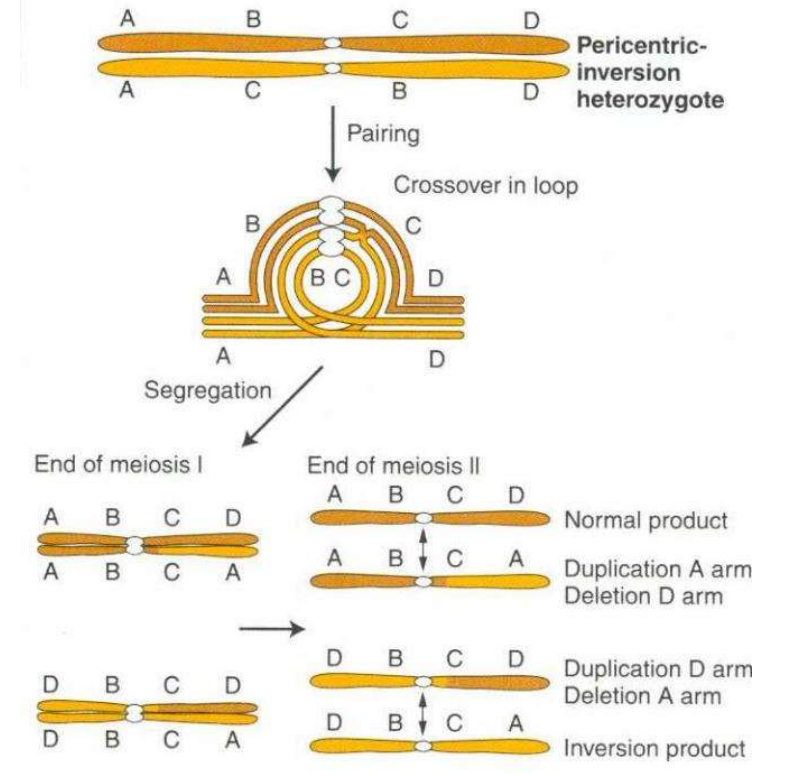
What is the cellular process and reproductive consequences of pericentric inversions?
one homologue forms loop
Offspring:
50% chromosomes with deletions and duplications. This is the part that is different to paracentric inversions
25% normal
25% inversion
What is a translocation?
Translocations: heterologous (different chromosomes) crossover
• alters size of chromosomes, position of genes
• affects gene dosage, affects function if break in gene
• Potentially no phenotypic effect, diagnosed by structures at meiosis
• visualised using chromosome sorting and painting methods (karyograms?)
What are the two types of translocations?
Reciprocal translocation most common - no loss of material (no change in chromosome number) 50% fertility reduction
Robertsonian translocation can involve loss of material (reduction in chromosome number). Occurs more with acrocentric chromosomes (uneven arm sizes)

How is fertility affected by a reciprocal translocation in a translocation heterozygote?
The Synaptonemal complex joins homologous chromosomes by linking similar sequences, so it may join different chromosomes. Usually, it joins translocation heterozygotes in a cross shape as shown in the image.

draw a diagram of and assess the viability of offspring produced by a translocation heterozygote (specifically someone who had a trivalency between Chr13, Chr14 and t(13,14)) and a normal person.
here

How do you go about diagnosing a robertsonian translocation?
1) cells cultured from blood sample
2) Treated with spindle inhibitor to arrest at metaphase
3) Stain to visualize chromatin (e.g. G-banding, C-banding)
4) Karyogram inspected & karyotyped following ISCN
How do Robertsonian translocations occur?
When acrocentric chromosomes cross over near their centromeres, this can often cause the short arms to swap together, which is OK since the short arms hold mostly duplicated DNA, which has redundancies elsewhere. The long arms often combine to make 1 chromosome of the important stuff, with two long arms, but other aneuploid stuff can happen.

What are the possible gametes that can form from a Robertsonian translocation? It may be useful to draw them using segregation lines
6 possible gamete configurations
b) normal 13 + normal 14
c) t(13/14)
d) t(13/14) + normal 14
e) Normal 13
f) t(13/14) + normal 13
g) Normal 14
Draw the genetic outcomes if gametes of a robertsonian translocation organism were fertilised by normal sperm (use chromosomes 13 and 14 for example)
