Lecture 12 - The Action Potential (General Properties of Action Potentials)
 Call Kai
 Learn
 Practice Test
 Spaced Repetition
 Match
 Flashcards
 Knowt Play
1/14

There's no tags or description
Looks like no tags are added yet.
15 Terms
What determines threshold of AP?
A large enough depolarization
Voltage sensitivity of ion channels
Increased permeability of Na+ relative to K
How do we know the ionic conductances that occur during an action potential?
voltage clamp experiments
measure macroscopic currents when use impermeant ions in solution
can also use voltage-gated ion channel blockers
Steps to firing AP:
threshold force required
all-or-none property —> stimulating neuron past threshold does not increase size of an AP
refractory phase —> cannot be another AP until Na+ channels recover
direction —> AP always travels in only one direction
How to determine threshold experimentally?
neuron will produce AP when the change in membrane potential reaches or exceeds threshold
sometimes stimulus that is just at threshold will abort or produce local response
neuron can receive postsynaptic signals from other neurons
spatial and temporal summation of these signals will influence if an AP is generated at axon hillock

All-of-none nature of APs
Subthreshold injections of current do not induce an action potential
threshold reached = additional increases in amplitude or stimulus will lead to same size of AP
increase in strength of stimulus, results in increase in frequency of AP that are generated

Absolute Refractory Period
if second stimulus is applied during or immediately after AP, no AP is triggered
1-2ms long
Na+ channels inactivated
enables propagation of closely spaced, yet discrete APs
limits number of APs that neuron can produce per unit time
Relative refractory period
if stimulus is delivered slightly later, AP may be triggered as long as stimulus is more intense
3-4ms long
amplitude of AP may be smaller
Na+ channels inactivated and greater than resting Pk
can be longer in some neurons…depending on hyperpolarization duration

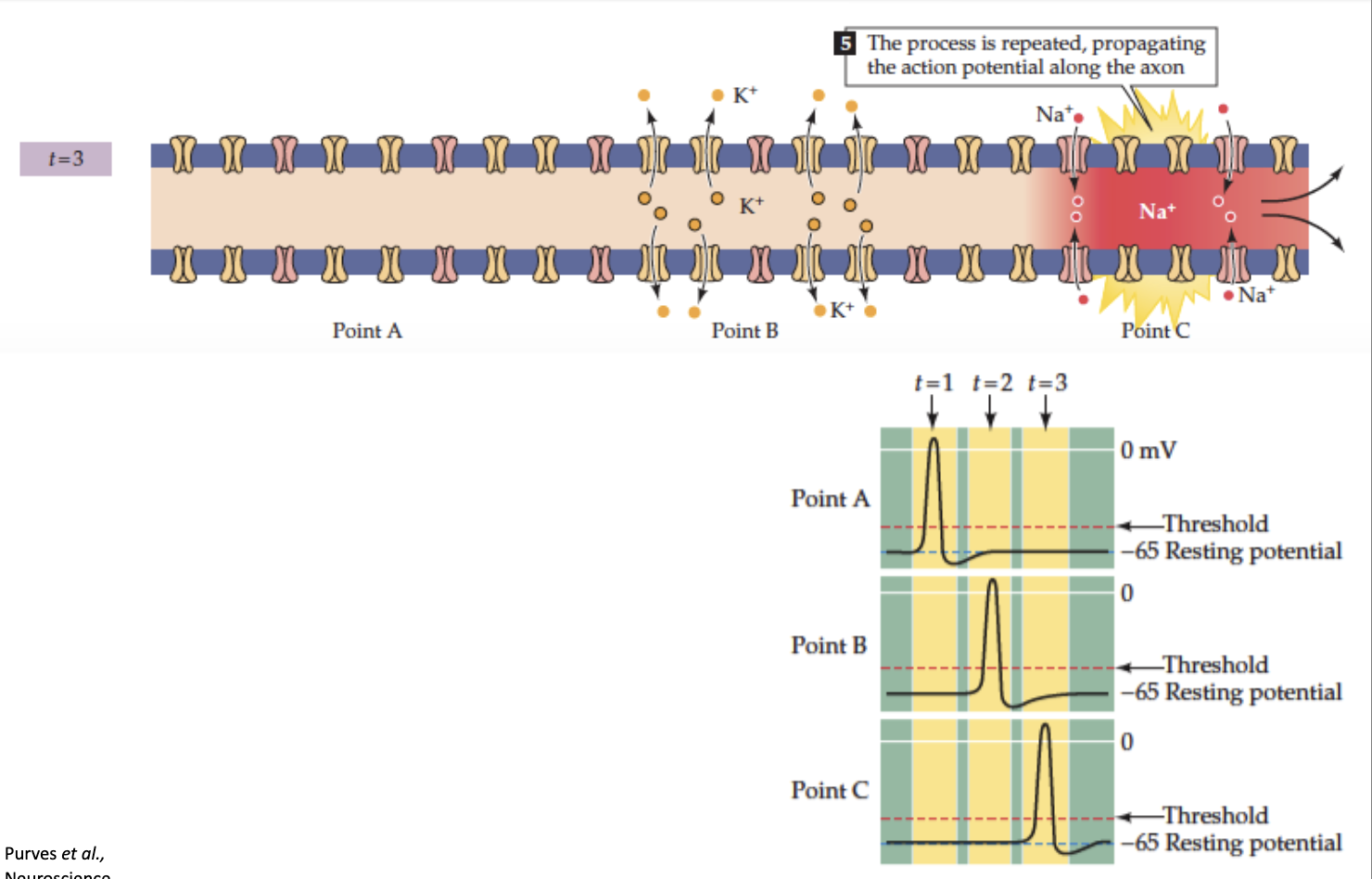
How is AP regenerative down axon?
The presence of voltage-gated ion channels along the length of the axon is what facilitates the regenerative propagation of the action potential in ONE DIRECTION down the axon
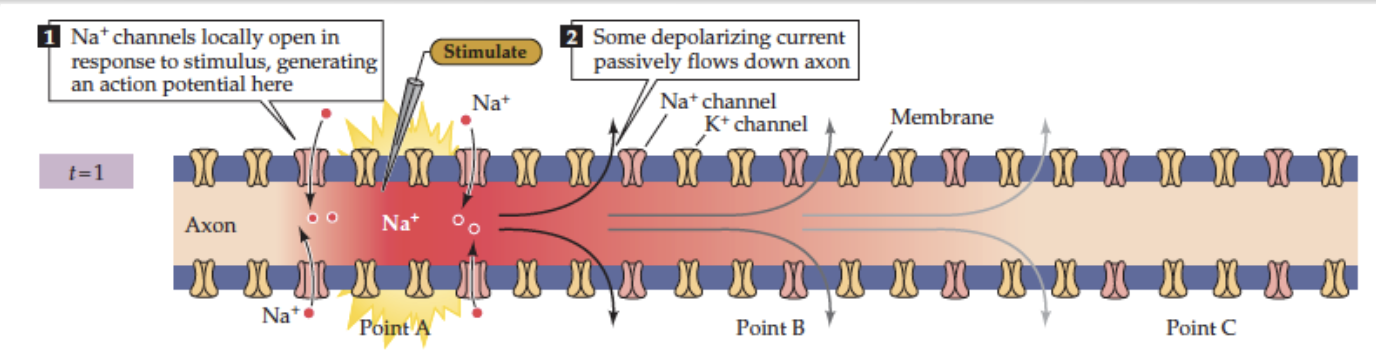
How is AP regenerative down axon?
2

How is AP regenerative down axon?
3
Conduction Velocity
time required for electrical information to travel length of neuron
What is conduction velocity affected by?
axon diameter
increased axon diameter will decrease resistance to current flow inside axon
myelinaiton
insulation of axonal membrane reduces current leak out of axon, which facilitates saltatory conduction
myelinated axons have faster conduction speed when compared to unmyelinated axons
Skeletal Muscle AP
AP in skeletal muscle is functionally similar to neurons
AP coupled to muscle contraction
sequence of permeability changes underlying skeletal action potential
AP briefer than resulting contraction in a skeletal muscle fiber
AP serves as ‘trigger’ for contraction
Cardiac AP
depolarization phase caused by voltage-gated Na+ and Ca2+ channels
inward flow
Na+ channels quickly inactivate
plateau phase caused by inward flow of Ca2+ balanced by outward flow of K+ ions
repolarization phase caused by decline in Ca2+ (less inward flow) and increase in outward K+ flow

Cardiac Potential vs Muscle Contraction
The duration of the cardiac action potential is matched with the duration of the cardiac muscle contraction
Due to the sustained calcium influx during the plateau phase of the cardiac action potential
The characteristics of the action potential can influence the duration and strength of the cardiac muscle contraction
Reason why tetanus is not possible in cardiac muscle