Week 5: Mental Health and aging
0.0(0)
Studied by 1 person Call Kai
 Learn
Learn Practice Test
 Spaced Repetition
 Match
Match Flashcards
 Knowt Play
Card Sorting
1/54

Earn XP
Description and Tags
Last updated 12:10 PM on 10/11/26
Name | Mastery | Learn | Test | Matching | Spaced | Call with Kai | Chat |
|---|
No analytics yet
Send a link to your students to track their progress
55 Terms
1
New cards
Memory information processing model
1. a person perceives information
* psychologists call this ^^sensory memory^^
2. the person acts on this information and transforms it into @@short-term memory@@
3. the person stores the information in %%long-term memory%%, the storehouse of knowledge that also includes the rules for organizing knowledge.
2
New cards
non-episodic memory
information with no reference to the time at which it was acquired, such as general knowledge of the world
3
New cards
Episodic memory
memory acquired at a specific time and place, such as the recall of a vacation in Paris).
4
New cards
Which type of memory has a steeper decline
Episodic memory shows a greater decline with age than other types of memory
* Decline occurs less or not at all in non-episodic memory
* Decline occurs less or not at all in non-episodic memory
5
New cards
Working memory
Working memory stores recent information and also manipulates this information.
* In addition, it processes new information while temporarily storing other information.
* it guides ongoing behaviour, intended actions, and longer-term plans
* In addition, it processes new information while temporarily storing other information.
* it guides ongoing behaviour, intended actions, and longer-term plans
6
New cards
processing speed
They miss late items in a list more than earlier ones, and they encode some items at the expense of others.
For example,
* due to decreased processing speed, an earlier task slows a later activity
* (e.g., if someone needs to keep some figures in memory, this will inhibit later decision-making speed).
For example,
* due to decreased processing speed, an earlier task slows a later activity
* (e.g., if someone needs to keep some figures in memory, this will inhibit later decision-making speed).
7
New cards
researchers say that ____________________ has a “cascading effect on information processing.”
slowed processing
\
Slower processing accounts for the loss of information from an earlier task as a person performs a more recent task (e.g., a person may forget figures held in memory while he or she tries to make a decision).
\
Slower processing accounts for the loss of information from an earlier task as a person performs a more recent task (e.g., a person may forget figures held in memory while he or she tries to make a decision).
8
New cards
What things are the most sensitive to the effects of aging?
* processing speed,
* executive functions,
* working memory,
* episodic memory
* executive functions,
* working memory,
* episodic memory
9
New cards
the physical brain and memory loss
* losses in prefrontal grey matter correlate with reduced performance on frontally mediated executive tasks
\
* loss in white matter integrity leads to a decline in cognitive performance
* and a decreased speed of episodic memory retrieval
\
→ loss of brain structure leads to declines in mental function
\
* loss in white matter integrity leads to a decline in cognitive performance
* and a decreased speed of episodic memory retrieval
\
→ loss of brain structure leads to declines in mental function
10
New cards
the ____________ processes information and creates long-term memory. It declines in function with age.
hippocampus
11
New cards
Brain plasticity
“long-lasting alterations in the brain’s chemistry, gray matter, and structural connectivity in support of behavior”
* can change and grow even in old age
* a lifelong developmental process
* can change and grow even in old age
* a lifelong developmental process
12
New cards
Neurogenesis
The brain creates new neurons and new neural connections
* since new neurons are being produced, brain remodelling can be induced in a large scale at any stage of life
* since new neurons are being produced, brain remodelling can be induced in a large scale at any stage of life
13
New cards
Cognitive reserve
originally referred to people with dementia who performed better than expected in everyday life
it was later extended…
* to encompass variation in healthy individuals’ performance, particularly when they must perform at their maximum capacity
* how we use our brains during our lives influences the amount of cognitive reserve that we have
it was later extended…
* to encompass variation in healthy individuals’ performance, particularly when they must perform at their maximum capacity
* how we use our brains during our lives influences the amount of cognitive reserve that we have
14
New cards
________ and ___________ in particular seem to create a large cognitive reserve
education and literature
15
New cards
Plasticity vs flexibility
__**Plasticity**__
* the growth of brain structures
* dominates in the early years of life.
__**Flexibility**__
* more stable brain structures with potential for behavioral change
* dominates in later life.
* the growth of brain structures
* dominates in the early years of life.
__**Flexibility**__
* more stable brain structures with potential for behavioral change
* dominates in later life.
16
New cards
4 patterns of psychological aging
* Successful Aging (super-normals)
* Normal aging
* Mild cognitive impairment
* Dementia
\
* Normal aging
* Mild cognitive impairment
* Dementia
\
17
New cards
Successful aging “the super-normals”
A small subgroup of older people, often with a socioeconomic or genetic advantage.
* develop through mid-life and reach a high point in late middle age.
* This group shows some decline on speeded tasks.
* generally they maintain a high level of mental function until shortly before death.
* develop through mid-life and reach a high point in late middle age.
* This group shows some decline on speeded tasks.
* generally they maintain a high level of mental function until shortly before death.
18
New cards
Normal aging
People in this group reach their mental peak in early mid-life,
* maintain their ability until their 50s or early 60s
* show modest decline through their early 80s
* show more dramatic decline in the years before death.
* Some people in this group reach a high level of mental development and maintain this even when they face physical frailty.
* A second group of normal agers reach a lower level of function in mid-life and may need more support in old age.
* maintain their ability until their 50s or early 60s
* show modest decline through their early 80s
* show more dramatic decline in the years before death.
* Some people in this group reach a high level of mental development and maintain this even when they face physical frailty.
* A second group of normal agers reach a lower level of function in mid-life and may need more support in old age.
19
New cards
Mild cognative Impairment (MCI)
In early old age, people in this group begin to experience greater than normal mental decline.
* Decline may include memory loss, but may also include the loss of other abilities such as planning and scheduling.
* Some people in this group eventually develop dementia.
* Others maintain a stable level of low function. Schaie suggested they display “*unsuccessful aging*”
* Decline may include memory loss, but may also include the loss of other abilities such as planning and scheduling.
* Some people in this group eventually develop dementia.
* Others maintain a stable level of low function. Schaie suggested they display “*unsuccessful aging*”
20
New cards
Dementia
People in this group show a dramatic decline in mental function.
* Dementia typically has a physical cause, such as brain lesions or disease.
* Alzheimer’s disease is the most common cause of dementia
* Dementia typically has a physical cause, such as brain lesions or disease.
* Alzheimer’s disease is the most common cause of dementia
21
New cards
4 findings from brain research that describe mental growth and development in later life:
1. The brain reorganizes itself in response to new information and experience.
2. Brain cells grow in later life.
3. The brain’s emotional centres grow more balanced with age.
4. Compared with younger people, older people use both halves of the brain more equally
22
New cards
Stereotype threat
an older person’s fear of failure on memory tests leads to poor performance.
eg.
* test instructions that focus on memory make people aware of declines in mental ability, and this can lower a person’s score.
eg.
* test instructions that focus on memory make people aware of declines in mental ability, and this can lower a person’s score.
23
New cards
Contextual view of memory
begins with the insight that many conditions influence memory.
* These include:
* the physical and social context
* where learning took place,
* a person’s education,
* their health, and
* their experience at learning in structured settings (such as a classroom or lab).
* These include:
* the physical and social context
* where learning took place,
* a person’s education,
* their health, and
* their experience at learning in structured settings (such as a classroom or lab).
24
New cards
2 definitions of intelligence:
1. the ability to negotiate environmental demands successfully
2. that which intelligence tests measure
25
New cards
fluid intelligence
Fluid intelligence refers to reasoning, abstracting, concept formation, and problem solving.
* It makes little use of knowledge gained through reading, school, or work.
* Fluid intelligence relies on how well the physical and nervous systems function.
\
\
* It makes little use of knowledge gained through reading, school, or work.
* Fluid intelligence relies on how well the physical and nervous systems function.
\
\
26
New cards
Crystallized intelligence
The use of stored information, acculturation, and learning.
* Verbal tests, such as a test of vocabulary or historical events, demand the use of crystallized intelligence.
\
People show stability and even improvement in crystallized intelligence with age.
* Verbal tests, such as a test of vocabulary or historical events, demand the use of crystallized intelligence.
\
People show stability and even improvement in crystallized intelligence with age.
27
New cards
How are fluid and crystallized intelligence affected by age?
* Studies show a decline in fluid intelligence with age.
* People show stability and even improvement in crystallized intelligence with age.
* People show stability and even improvement in crystallized intelligence with age.
28
New cards
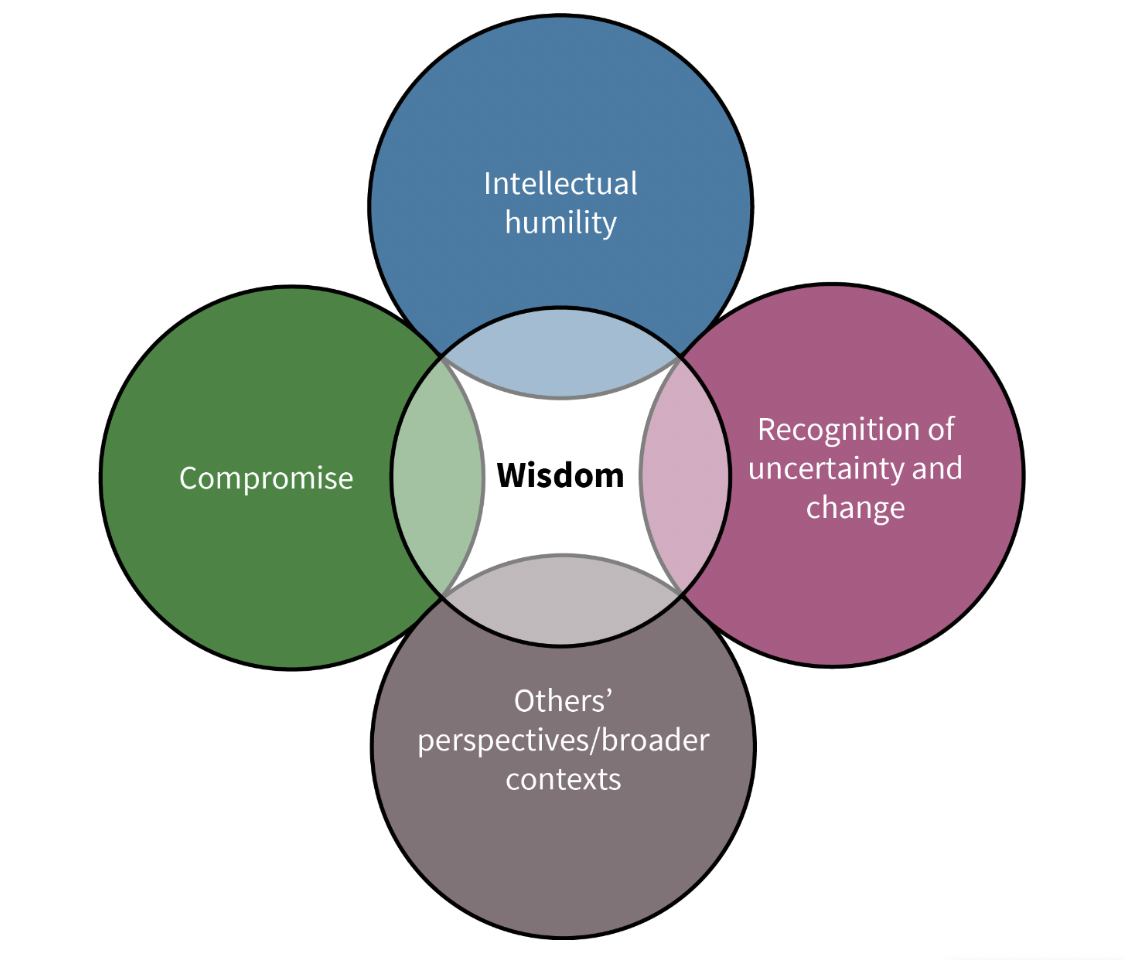
5 criteria of wisdom
1. a store of factual information about human nature;
2. rich procedural knowledge about handling life’s problems;
3. an awareness of life’s contexts and how they change over the life span;
4. understanding the relativism of values and tolerance for others; and
5. an understanding of how to deal with uncertainty.
29
New cards
advanced style of cognition (3 styles)
1. Relativistic thinking: an awareness that context can affect knowledge and understanding; an awareness that knowledge is not absolute.
\
2. Dualistic thinking: the ability to suspend judgment while trying to resolve contradictions; the ability to hold mutually exclusive ideas in the mind at the same time.
\
3. Systematic thinking: the ability to take a broad view of a situation or a system of knowledge.
30
New cards
characteristics of wise people
31
New cards
constant-probability-of-success model
This model states that the ratio of quality works to total works produced during a career stays the same at every stage of the career.
* An older person may produce fewer masterpieces, but will also produce fewer mediocre works. In other words, people can produce great works at every age.
* An older person may produce fewer masterpieces, but will also produce fewer mediocre works. In other words, people can produce great works at every age.
32
New cards
the ‘third place’
Seniors often turn to “the third place” to experience feelings of happiness.
could include:
* cafes,
* coffee shops,
* bookstores, bars,
* hair salons, and other gathering spots.
\
Third places allow people to gather informally outside the home and workplace.
Regulars make the place a home away from home.
could include:
* cafes,
* coffee shops,
* bookstores, bars,
* hair salons, and other gathering spots.
\
Third places allow people to gather informally outside the home and workplace.
Regulars make the place a home away from home.
33
New cards
Stages of decline due to Alzheimers: Stage 1
A person first shows changes in memory. He or she forgets the keys or a wallet more frequently. The person may also forget recent events or forget that he or she did a job around the house. The forgetfulness gets worse over time. The person forgets more often, takes longer to do simple jobs, or begins to recheck work already done.
34
New cards
Stages of decline due to Alzheimers: Stage 2
The second stage of the disease includes more memory decline, loss of speaking ability, and an end to normal daily activity. The ill person may wander at night, lose control of his or her bowel and bladder, and threaten others. One woman left a knife in her garden after she used it to weed the flowerbed. Her husband picked it up and stalked through the bushes into a neighbour’s yard, saying to the neighbour, “I’m going to kill you.” The neighbour ran inside and called the police. When the man’s wife came outside to finish weeding, she found the police wrestling her husband into a squad car.
\
* can put additional stress on family
\
* can put additional stress on family
35
New cards
Stages of decline due to Alzheimers: Stage 3
The person in the last stage of Alzheimer’s disease needs institutionalization and often 24-hour nursing care. The person can no longer speak or communicate. He or she may wander or move constantly unless restrained. Seizures may occur. Death occurs between two and nineteen years after the disease starts. Death often comes from an illness such as pneumonia or heart disease, but death certificates rarely mention Alzheimer’s disease as a cause of death, making it impossible to know the exact number of deaths associated with Alzheimer’s.
36
New cards
History of mental disorders
Historically, mental disorders were considered to be different from physically diseases
* Etiology: no organic/physiological cause
* High risk groups: people with some ‘fixed’ traits
* Treatment: ineffective
* Prognosis: usually no mortality
* Society reaction: isolation
* Etiology: no organic/physiological cause
* High risk groups: people with some ‘fixed’ traits
* Treatment: ineffective
* Prognosis: usually no mortality
* Society reaction: isolation
37
New cards
Depression in old age
* depresion rates are generally lower in older adults
* Earlier diagnosis, more awareness?
* Symptoms of depression in older adults are often underrecognized, underreported and undertreated (WHO, 2017; *Mental health of older adults)*
* A disease with risk factors, possible prevention and treatment
* Earlier diagnosis, more awareness?
* Symptoms of depression in older adults are often underrecognized, underreported and undertreated (WHO, 2017; *Mental health of older adults)*
* A disease with risk factors, possible prevention and treatment
38
New cards
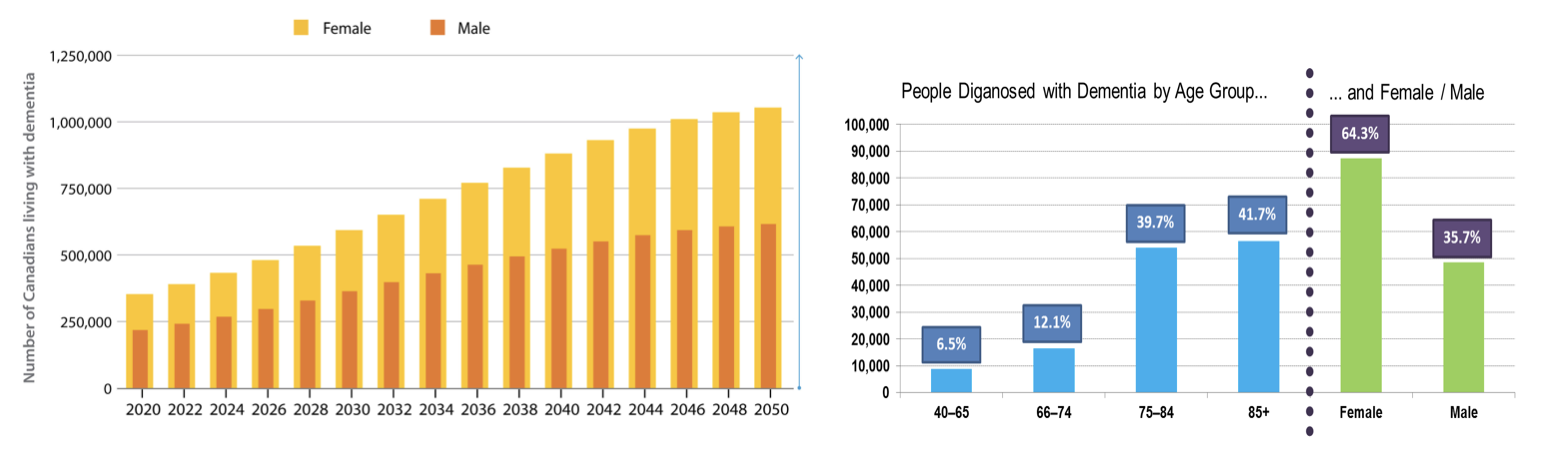
Dementia statistics
* 597,000 people in Canada lived with dementia in 2020 (**61.8% women**)
* New cases (incidence): 124,000
\
* The projected number people in Canada to be living with dementia in 2030: __***955,900***__
\
* 1 in 5 Canadians have experience caring for someone living with dementia
\
* New cases (incidence): 124,000
\
* The projected number people in Canada to be living with dementia in 2030: __***955,900***__
\
* 1 in 5 Canadians have experience caring for someone living with dementia
\
39
New cards
Individuals living with dementia
* We need to plan for near future
* Linear increase with age, more women with dementia
* Can start as early as age of 40
* Linear increase with age, more women with dementia
* Can start as early as age of 40
40
New cards
Are women twice likely to acquire dementia
* ^^2 thirds of person diagnosed with dementia are women^^
* the lifetime risk (also the frequency, or count) of dementia is greater for women, similar to other aging-related diseases
* The life expectancy for women is longer than for men, and age is the greatest risk factor
* the lifetime risk (also the frequency, or count) of dementia is greater for women, similar to other aging-related diseases
* The life expectancy for women is longer than for men, and age is the greatest risk factor
41
New cards
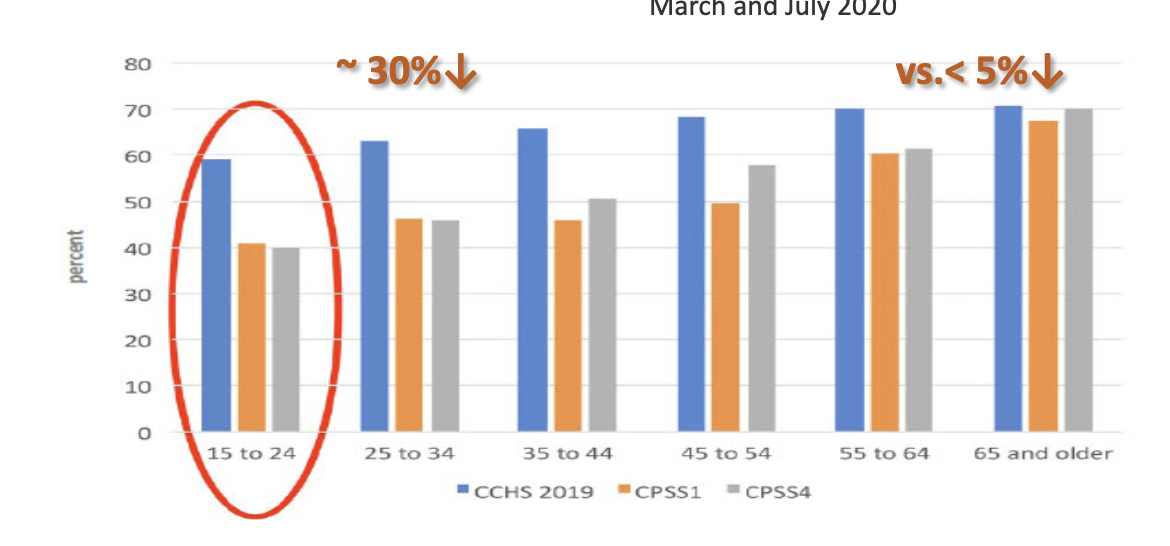
Self-perception of mental health
proportion of Canadians reporting excellent or very good mental health pre and post COVID by age group
42
New cards
2 important points about mental health of older adults:
\
\
1. improvement with age
2. resilience
43
New cards
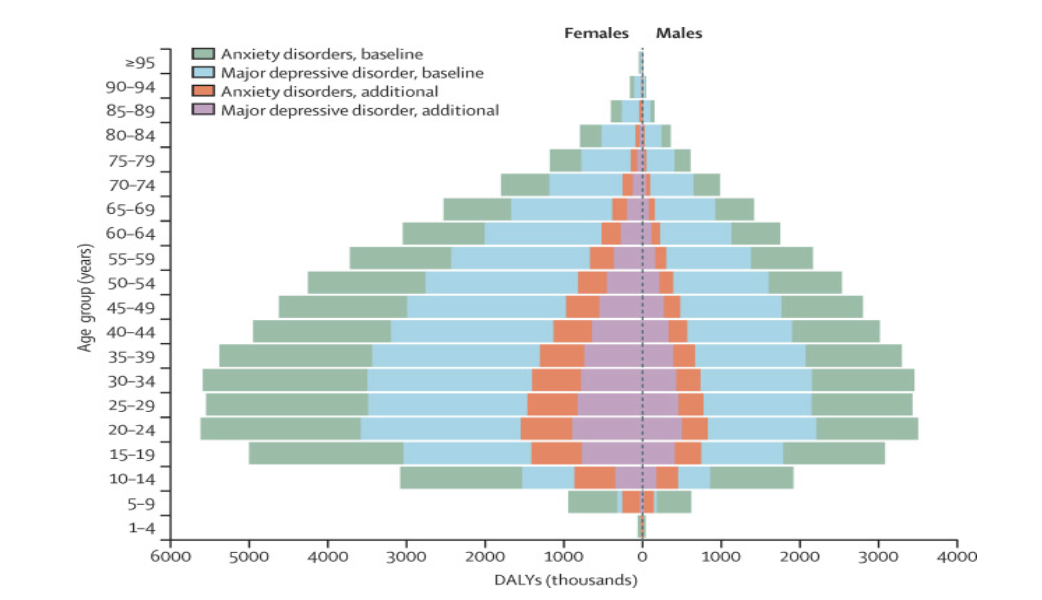
Resilience
Disability-adjusted life years (DALY) is a measure of the burden a disease imposes on person and society
* Few post COVID additional burden from depression and anxiety in older age groups.
\
\
* Few post COVID additional burden from depression and anxiety in older age groups.
\
\
44
New cards
Plasticity
**definition:**
\-long-lasting alterations in the brain’s chemistry, gray matter, and structural connectivity in support of behaviour
\
* Mental reserve capacity (not exclusive to cognition)
* Not fixed and nor determined solely by genes
* Enhancement by education, social status, stimulating lifestyle (exercise, social network, occupation)
\-long-lasting alterations in the brain’s chemistry, gray matter, and structural connectivity in support of behaviour
\
* Mental reserve capacity (not exclusive to cognition)
* Not fixed and nor determined solely by genes
* Enhancement by education, social status, stimulating lifestyle (exercise, social network, occupation)
45
New cards
Brain development later in life
1. Reorganizing in response to new information and experience.
2. Brain cells growth in later life.
3. The brain’s emotional centres becomes more balanced with age.
4. Compared with younger people, older people use both halves of the brain more equally.
\
%%Providing positive experiences throughout the life course%%
46
New cards
Brain changes later in life
* In laboratory studies speed of encoding (linking new information with already stored information) is slower in older adults
* Awareness of old information remains intact
* More use of context, clues
\
Example: thinking about novels on French revolution (new information), a 88 years old individual knows that has read many (old information)
* However, can’t remember the name of a very famous one
* *Clue#1: knows that was written by a British person (‘les Miserables’ is ruled out)*
* Clue#2: recalls the story plot was not only in France: remembers it was in London and Paris, title was somehow related
* Clue#3: the title was not a specific place or person name
* A tale of two cities
* Awareness of old information remains intact
* More use of context, clues
\
Example: thinking about novels on French revolution (new information), a 88 years old individual knows that has read many (old information)
* However, can’t remember the name of a very famous one
* *Clue#1: knows that was written by a British person (‘les Miserables’ is ruled out)*
* Clue#2: recalls the story plot was not only in France: remembers it was in London and Paris, title was somehow related
* Clue#3: the title was not a specific place or person name
* A tale of two cities
47
New cards
People show a better mental performance in _______ _____ when compared with lab studies
everyday life
48
New cards
* Generalizing the findings of the lab studies to __________can be misleading
populations
49
New cards
Intervention
… is possible
* Brain responds to stimulation and challenge as a person ages, delay or even compensation for mental decline
* Memory training
* An enriched environment
* Physical fitness training
* the key is the correct amount of challenge for a normal aging
* Brain responds to stimulation and challenge as a person ages, delay or even compensation for mental decline
* Memory training
* An enriched environment
* Physical fitness training
* the key is the correct amount of challenge for a normal aging
50
New cards
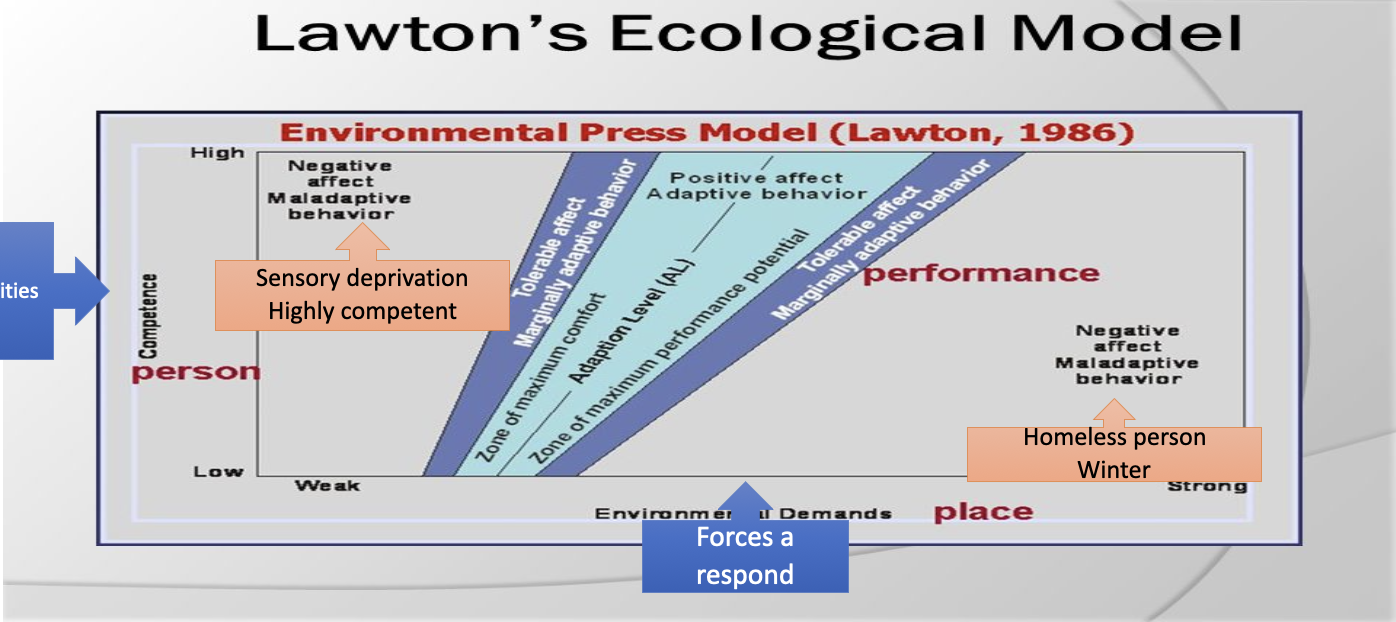
Lawtons ecological model
This model is adaptable to most age-related health issues
51
New cards
Abnormal aging
* *Functional disorders* in some people as they age: paranoia, anxiety, neuroses, and schizophrenia.
* Some *organic disorders* (disease of the brain): Alzheimer’s or Parkinson’s disease
* Confusion and forgetfulness
* Behaviours not accepted socially, especially from an old person
* Some *organic disorders* (disease of the brain): Alzheimer’s or Parkinson’s disease
* Confusion and forgetfulness
* Behaviours not accepted socially, especially from an old person
52
New cards
Dementia
* Early symptoms of Alzheimer’s disease include memory deficits, confusion, irritability, aggression, mood swings and behavioral changes
* There are etiologies, e.g. vascular changes in brain
* Risk factors for vascular diseases
* There are etiologies, e.g. vascular changes in brain
* Risk factors for vascular diseases
53
New cards
Alzheimers disease
Etiology not confirmed yet
\
* Suggested risk factors: about half of all prevalent cases of dementia are attributable to these 7 modifiable risk factors
* Preventive measures!
\
* Suggested risk factors: about half of all prevalent cases of dementia are attributable to these 7 modifiable risk factors
* Preventive measures!
54
New cards
Stigma in old age
Receiving a label, facing stereotyping
* Experiencing discrimination
* Losing status
* Limiting access to social and healthcare services
* Experiencing discrimination
* Losing status
* Limiting access to social and healthcare services
55
New cards
Legal/ethical issues
* The Loss of Competence
* People with a cognitive impairment may lose the ability to understand their situation and consequences of their decisions
\
Don’t confuse competency (a legal term) with capacity (a clinical term that refers to a person’s ability to function)
* People with a cognitive impairment may lose the ability to understand their situation and consequences of their decisions
\
Don’t confuse competency (a legal term) with capacity (a clinical term that refers to a person’s ability to function)