Biology 100: Evolution, Natural Selection, and Human Origins
 Call Kai
 Learn
 Practice Test
 Spaced Repetition
 Match
 Flashcards
 Knowt Play
1/33

34 Terms
What is absolute dating?
A method that uses radioactive isotopes to determine the age of materials.
Define a hypothesis.
A testable statement about the natural world; can be used to build more complex inferences and explanations
What does Darwin's Theory of Evolution state about related organisms?
The more closely related two organisms are, the more recently they share a common ancestor.
What is the smallest biological unit that can evolve?
Population.
How is evolution defined?
Change over time in the characteristics of populations.
What species did Darwin study on the Galapagos Islands?
Finches.
What term did Darwin use to describe the process of evolution?
Descent with modification.
What is meant by 'reproduction of the fittest'?
It favors alleles that contribute to reproductive success.
How can a trait that is advantageous today become a disadvantage?
Environmental conditions may change, rendering the trait less beneficial.
What factors contribute to natural selection?
Predation, sexual selection, and competition.
What was Lamarck's hypothesis regarding traits?
Traits acquired during an organism's life can be passed onto offspring.
What are adaptations in biology?
Changes in an organism that allow it to be better suited to its current environment.
What is divergent evolution?
The process where two or more distinct species develop from a common ancestor due to different environmental stresses.
What is convergent evolution?
The process where two or more distinct species develop similar traits to deal with similar environmental demands.
What is artificial selection?
The process by which humans modify other species by selecting and breeding individuals with desired traits.
What are homologous structures?
Anatomical features that have a shared evolutionary origin.
What are vestigial structures?
Anatomical structures that serve no apparent purpose in current species but were functional in ancestral species.
What is the heterozygote advantage?
A situation where heterozygotes (possessing a recessive harmful allele) are more fit than homozygous dominant individuals, allowing the harmful allele to persist in the population.
What is sexual selection?
Natural selection for mating success, often resulting in sexual dimorphism.
What is intrasexual selection?
Competition among individuals of one sex (often males) for mates of the opposite sex.
define adaption
provides advantages for reproductive success
What is gene flow?
movement of alleles between populations.
What is genetic drift?
changes in allele frequency
What is sexual dimorphism?
physical differences between members of a species.
What is a gene pool?
The sum of all genes in a population.
What is the bottleneck effect?
A drastic reduction in population size that leads to a reduction in genetic variability.
What is the founder effect?
When isolated colonies are founded by a small number of organisms, leading to different allele frequencies compared to the parent population.
What is a convergent evolution example?
aquatic animals, like fish, penguins, and whales all have streamlined bodies and fins or flippers for steering.
What is the genus homo?
Bipedal
Primates have what characteristics?
fingers and toes
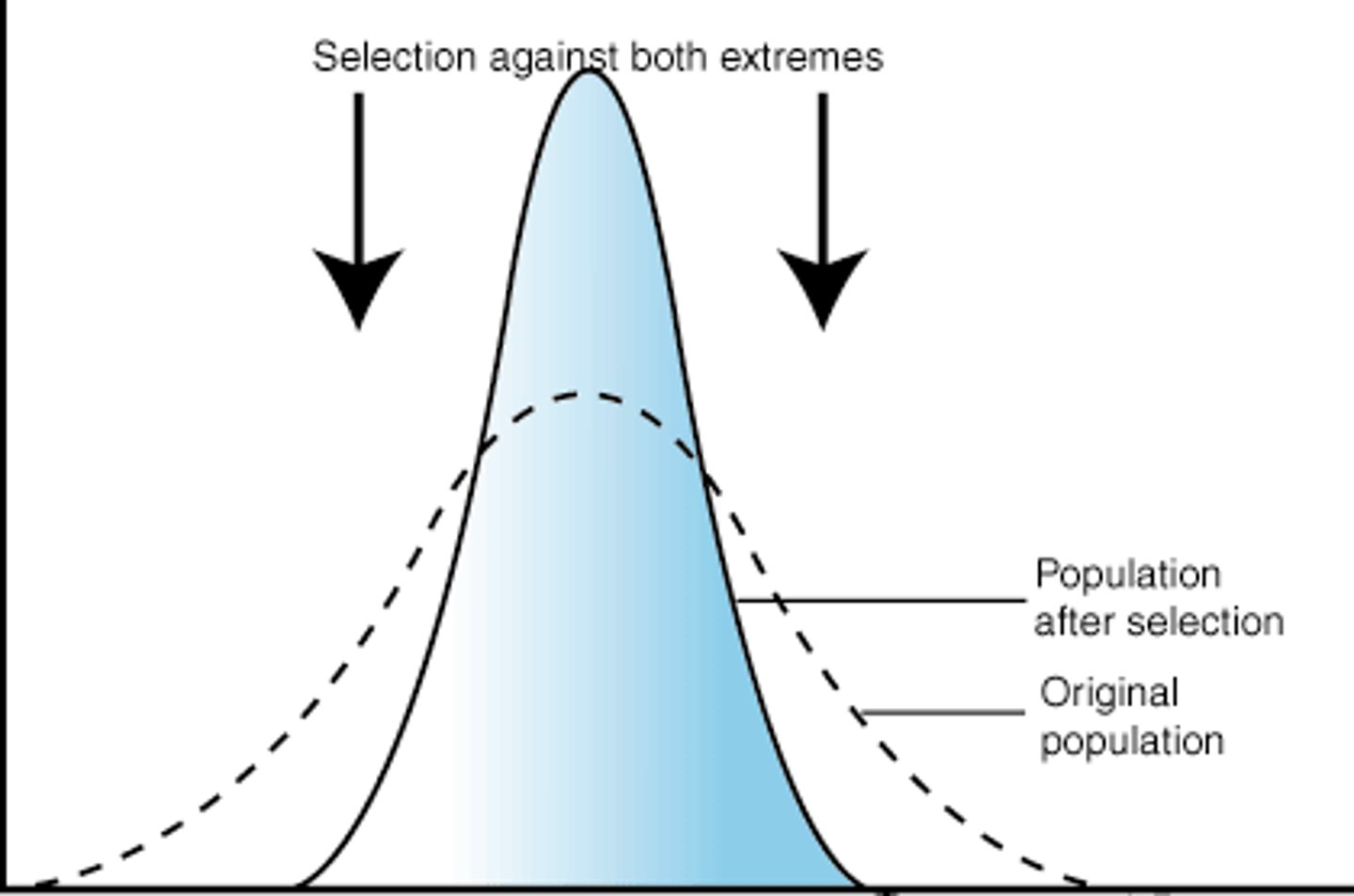
What is stabilizing selection?
natural selection that favors intermediate traits within a population, pushing it toward the average or median trait.
What does the Hardy-Weinberg principle state?
Evolution is the change of allele frequencies within a population; if allele frequencies do not change, the population is in Hardy-Weinberg Equilibrium.
What conditions must be met for Hardy-Weinberg Equilibrium?
No mutation, no gene flow, random mating, a very large population, and no natural selection.
Who is Lucy in the context of human evolution?
An ancestor species, not a Homo Sapien, with remains dating back about 3 million years.