BPSI 405
 Call Kai
 Learn
Learn Practice Test
 Spaced Repetition
 Match
Match Flashcards
 Knowt Play
1/80

There's no tags or description
Looks like no tags are added yet.
Name | Mastery | Learn | Test | Matching | Spaced | Call with Kai | Chat |
|---|
No analytics yet
Send a link to your students to track their progress
81 Terms
Which biological-structure is considered as the first (or outermost) component of the alveolar respiratory membrane?
A. Capillary basement membrane
B. Fluid containing surfactant
C. Capillary endothelial membrane
D. Thin interstitial space
B. Fluid containing surfactant
At sea level, what is the approximate partial pressure of O₂ in alveolar air?
A. 104 mm Hg
B. 40 mm Hg
C. 120 mm Hg
D. 159 mm Hg
A. 104 mm Hg
The partial pressure of CO₂ in alveolar air is approximately 40 mm Hg at sea level.?
True or False
True
Which topic is explicitly associated with the journal article review on Technosphere technology?
A. Pulmonary surfactant replacement in neonates
B. Oxygen therapy for idiopathic pulmonary fibrosis
C. Technosphere insulin for postprandial glycemic control
D. CO₂ removal using extracorporeal circulation
C. Technosphere insulin for postprandial glycemic control
Which gas has the highest percentage composition in alveolar air?
A. Co2
B. H2O
C. O2
D. N2
D. N2
The type II pneumocytes of the lungs secrete a mixture of lipids and proteins that together acts as a surfactant. The material forms a thin film on the surface of the liquid layer that lines the alveolar air sacks. What is the primary function of pulmonary surfactant?
A. Increase alveolar fluid volume exponentially
B. Thicken the alveolar epithelium to improve ability to maintain vigorous exercise for a long time period
C. Increase blood CO₂ concentration to prevent asphyxiation
D. When compressed by the decreasing alveolar surface area during exhalation, the films reduce alveolar fluid surface tension for preserving the integrity of the barrier between alveolar air and capillary blood during normal breathing
D. When compressed by the decreasing alveolar surface area during exhalation, the films reduce alveolar fluid surface tension for preserving the integrity of the barrier between alveolar air and capillary blood during normal breathing
There are approximately 300 million alveoli in the two lungs. True or False?
True
Which named famous equation relates pH to CO₂ and bicarbonate (universal physiological blood buffer) ion concentration in lung fluid/gas exchange biochemistry?
A. Nernst equation
B. Henderson–Hasselbalch equation
C. Michaelis–Menten equation
D. Fick equation
B. Henderson–Hasselbalch equation
The diffusion coefficient of oxygen is slightly more than 20 times that of carbon dioxide. True or False?
False
Approximately what is the average diameter of an alveolus, if a rough calculation of total human lung surface area based on total number of alveoli in an adult lung is similar to that of a tennis court?
A. 0.2mm
B. 20mm
C. 2mm
D. 0.02mm
A. 0.2mm
A hydrophilic drug will always have a negative food effect when taken with a high calorie meal. True or False?
False
In digestions processes occurring in the G.I. tract proteins, carbohydrates, and complex lipid esters
A. are digested by a common reaction called hydrolysis
B. are digested by a common reaction called oxidation
C. are digested by a common reaction called conjugation to glucuronic acid
D. are digested by a common reaction called reduction
A. are digested by a common reaction called hydrolysis
A hydrophobic drug will always have a positive food effect when taken with a high calorie meal. True or False?
False

In carbohydrate digestion, glucose monomers are generated, & taken up by SGLTs on cells PLBL using energy
A. from potassium influx
B. from mitochondria
C. from sodium influx
D. from ATP
C. from sodium influx

Eluxadoline, API in Viberzi, has 1.8 nM, 55 nM, and 430 nM binding affinities to mu, kappa, and delta opioid receptors
A. then it is going to only trigger the delta-opioid receptors in the gut
B. then it is going to only trigger the mu-opioid receptors in the gut
C. then it is going to only trigger the kappa-opioid receptors in the gut
D. then it is going to trigger the mu/kappa/delta-opioid receptors in the gut
D. then it is going to trigger the mu/kappa/delta-opioid receptors in the gut
Gradient of K+ from gut lumen to intestinal cell cytoplasm releases energy coupled to uphill sugar/amino acid uptake. True or False?
False
VIBERZI is a mu-opioid receptor agonist, and triggering opioid receptors slows down muscle contractility, therefore
A. it is indicated for treatment of IBS with constipation.
B. it is indicated for treatment of INFLAMMATORY BOWEL SYNROME (IBS) with diarrhea (ibs-d).
C. it is indicated for treatment of IBD with constipation.
D. it is indicated for treatment of IBD with diarrhea.
B. it is indicated for treatment of INFLAMMATORY BOWEL SYNROME (IBS) with diarrhea (ibs-d).
An infinitely water soluble drug taken orally can only have one of these food effects if any.
A. a negative food effect, if any
B. a positive food effect if any
C. no food effects are observed with highly soluble drugs
D. not enough information is given about the drug (e.g. is it ionizable?)
A. a negative food effect, if any

Gastrointestinal tract will not digest ____ because it is a ______
Substance | Chemical nature / modality | Stability in the digestive system |
|---|---|---|
GLP-1 | Endogenous peptide hormone composed of 30–31 amino acids; incretin receptor agonist. | Poor gastrointestinal stability. It is rapidly degraded by peptidases, particularly DPP-4, and is unsuitable for conventional oral delivery without protection. |
Inulin | Nondigestible fructan polysaccharide used as a soluble dietary fiber and prebiotic. | Stable against gastric acid and human digestive enzymes in the stomach and small intestine. It reaches the colon largely intact, where bacteria ferment it to short-chain fatty acids and gases. |
Semaglutide | Synthetic, lipid-modified GLP-1 analogue peptide with prolonged receptor activity and increased resistance to DPP-4 degradation. | More enzymatically stable than native GLP-1, but remains susceptible to acidic and proteolytic degradation. Oral semaglutide therefore uses SNAC, an absorption-enhancing excipient that provides localized gastric protection and facilitates absorption. |
Rifaximin | Poorly water-soluble, rifamycin-derived small-molecule antibiotic acting mainly within the intestinal lumen. | Generally sufficiently stable for local intestinal action and is minimally absorbed systemically. Its low solubility and limited permeability maintain high gastrointestinal concentrations, although dissolution and intestinal conditions can influence local availability. |
A. semaglutide, peptide derivative
B. rifaximin, small molecule
C. GLP1, peptide
D. inulin, carbohydrate
B. rifaximin, small molecule
One commonly accepted and studied pharmacokinetic characteristic that the digestive system has on orally delivered drugs is?
A. activating the drugs by chemical transformation
B. degrading the drugs before they are absorbed
C. preventing the drugs from entering the systemic circulation
D. causing a possibility of food effects
D. causing a possibility of food effects
A poorly soluble drug taken orally can only have one of these food effect possibilities if any.
A. not enough information is given about the drug
B. a positive food effect, if any
C. no food effect
D. a negative food effect, if any
B. a positive food effect, if any
Linaclotide is a adenylate cyclase/guanylate cyclase activator resulting in Cl- secretion across the gut wall hence it
A. treats diarrhea
B. treats IBD
C. Treats IBS-D
D. treats constipation
D. treats constipation
Linzess contains a ________ as its API.
A. carbohydrate
B. lipid
C. peptide
D. synthetic small molecule
C. peptide
Since linaclotide is a naturally derived molecule (from a toxin made by certain e.coli strain), if taken orally to manage one type of IBS, it will get
A. completely (100%) digested
B. digested to a certain extent but enough will survive for efficacy
C. linaclotide is administered by subcutaneous injection
D. protected from digestion by 3 disulfide bridges (see the image diagam -s-s-) introduced to the structure
B. digested to a certain extent but enough will survive for efficacy

Lubiprostone, in AMITIZA, is a prostaglandin analog that's used to treat constipation by Cl- secretion stimulation
A. therefore, it is fundamentally stomach targeted in its mechanism of efficacy
B. therefore, it is fundamentally osmosis driven in its mechanism of efficacy
C. therefore, it is fundamentally water absorption driven in its mechanism of efficacy
D. therefore, it is fundamentally inflammation driven in its mechanism of efficacy
B. therefore, it is fundamentally osmosis driven in its mechanism of efficacy
Administration of VIBERZI with a high fat meal that contained approximately 1000 total calories decreased pharmacokinetic parameters of Cmax and AUC by more than 50%
A. therefore, this drug has a negative food effect
B. therefore a >50% change is insignificant for a food effect
C. therefore, this drug has no food effect
D. therefore, this drug has a positive food effect
A. therefore, this drug has a negative food effect
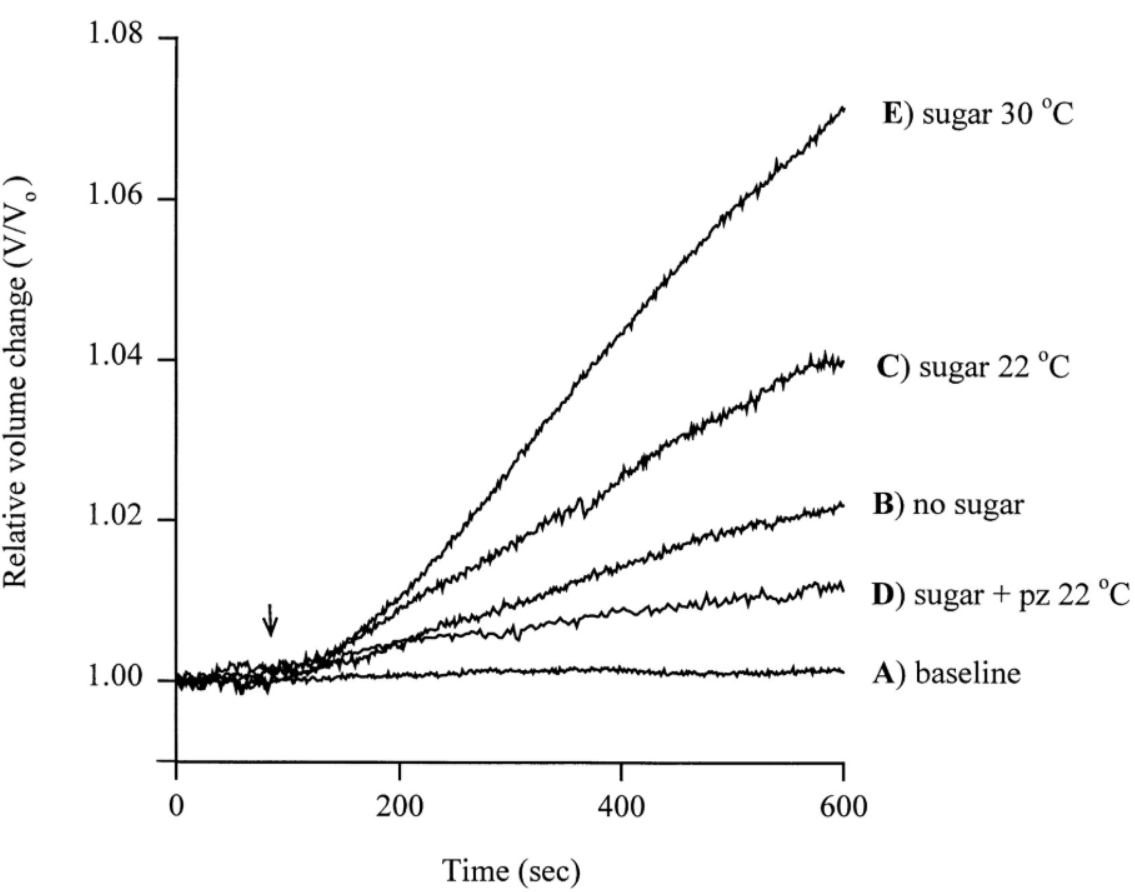
Sugar-induced water transport through human SGLT1 expressed in Xenopus laevis oocytes. Representative recordings show relative oocyte volume
as a function of time. The arrow indicates the change in external solution. The baseline trace (A) remained stable before sugar application. In the absence of sugar (B), only a small background increase in volume was observed. Addition of transported sugar stimulated oocyte swelling at 22°C (C), whereas inclusion of the SGLT inhibitor phlorizin (pz) markedly reduced the sugar-induced response (D). Increasing the temperature to 30°C enhanced the rate of sugar-induced swelling (E). These findings demonstrate temperature-dependent, phlorizin-sensitive water influx associated with Na⁺–sugar cotransport by human SGLT1.
A. by means of kidney function inhibition
B. as a function of SGLT leakage
C. by coupling the Na+ with Cl- and creating osmosis via water channels
D. by means of coupled Cl- (chloride) uptake
C. by coupling the Na+ with Cl- and creating osmosis via water channels
Respiratory acidosis
- Lower pH than normal <7, higher PaCO2 > 45, HCO3- unchanged or changing
- accumulation of CO2, impaired ventilation
- production of H+
Treatments: Naloxone for opioids treatment, Mechanical ventilation for stroke, Brochodilators
Metabolic Acidosis
- Low pH, low HCO3-
- Acid accumulation due to loss of bicarbonate, can't buffer pH
- HAGMA vs NAGMA
- calculate anion gap
- Clinical presentation:
Fatigues
Tachycardia
AMS
Fruity breath
Rapid breathing (to compensate)
Anion gap
= Na+ - (HCO3- + Cl-)
- Calculates electrical neutrality of the blood
- Positive in reality, equation is excluding certain components (K+, Mg2+)
- normal range: 3-12
The Chem 6
Sodium, potassium, Chloride, Bicarbonate, BUN, creatinine
- salty bunny
- align charges
HAGMA
- High anion gap metabolic acidosis
- Etiology: MUDPILES
NAGMA
- Normal anion gap metabolic acidosis
- Etiology: diarrhea (loss of lots of bicarb HCO3)-, renal tubular acidosis, renal bicarb wasting
Respiratory Alkalosis
- Higher pH, lower PaCO2
- Due to decreased carbon dioxide from hyperventilation
- Treatment: paper bag (re-inhale CO2), mechanical ventilation, sedatives, acetazolamide (reduce bicarb production)
Metabolic Alkalosis
- Higher pH, high HCO3-, decrease in H+
- Increase in blood pH due to excess bicarbonate
- Chloride resistant: not enough Cl- excreted from kidneys, bicarb increase, treat underlying cause
- Chloride responsive: Cl- depletion (i.e. from vomiting), treat with IV saline
Which of the following statements about oxygen transportation is false:
a. 3 oxygen molecules bound to Hb is 75% saturated
b. Each Hb can bind up to 4 Oxygen
c. Hb is the protein that bind onto red blood cells
d. Oxygen is transported by red blood cells
e, Each Hb bind to just 1 oxygen
e, Each Hb bind to just 1 oxygen
What Systolic blood pressure range is for category 2
140 or higher
Left shift in dissociation curve will indicate a
- Decrease temp
- Decrease in CO2
- Decrease in DPG
- Increase in pH
Is the dissociation dissociation curve sigmoidal?
YES
Is the x axis a partial pressure of oxygen?
YES
Is the y axis the saturation of hemoglobin?
YES
Men and women both have the most common symptom of heart attack pain of chest pain/discomfort. Whats the difference with women
Pain between shoulders
Which is not a medication for high BP
a. Diuretics
b. Beta Blockers
c. Calcium channel blockers
d. ARBS
e. Insulin
e. Insulin
A heart attack and cardiac arrest are both serious medical emergencies and are the same thing
FALSE
Cardiac arrest effects ___ system and heart attack affects ___ system
electrical, circulatory
Phase 0
Rapid depolarization (Na+ influx)
Phase 1
Early repolarization (k+ efflux)
Phase 2
Plateau
Phase 3
Repolarization (k+ efflux)
Phase 4
Absolute refractory period
Is there a resting potential in pacemaker cells?
NO
Funny Na channels are found in which cells
Pace maker cells
Pace maker action potential has three phases which are
0, 3 4
Do not have 1 and 2
Does gas exchange happen between the alveoli and blood of the:
a. pulmonary vein
b. pulmonary artery
c. pulmonary capillaries
c. pulmonary capillaries
Does the pacemaker have the absolute refractory period?
NO
Contractile cells do - 200 msec
Heart contracts during this time
What is the threshold for pacemaker cells?
a. -70 V
b. -60 V
c. -90 V
d. -40 V
d. -40 V
What is the threshold for contractile cells?
a. -70 V
b. -60 V
c. -90 V
d. -40 V
a. -70 V
The rising phase of the action potential is considered the:
Depolarization phase
What is the pace maker cell resting potential?
Does not have one
What is the absolute refractory period?
200 ms where the heart contracts
How does electrical impulse spread?
SA node to AV node
The rising phase of action potential is also called the:
a. Plateau
b. Falling phase
c. Repolarization
d. Depolarization
d. Depolarization
What are the ions involved in action potential?
Na+, K+, Ca2+
Which are Cell to cell junctions
a. Gap junctions
b. Desmosomes
c. Fascia adherens
D. All of the above
D. All of the above
Do cardiac muscles work all the time?
YES
Xenobiotics are chemicals that are foreign to our body. Which is not a xenobiotics:
a. Prescription medications
b. Non-presciription medications
c. Carcinogens and pesticides
d. Food additives
e. Hemoglobin
e. Hemoglobin
Which can inhibit CYP450
a. Apple juice
b. Chocolate
c. Grapefruit juice
d. Coffee
c. Grapefruit juice
Space between the hepatocytes and lobule is called the:
Space of Disse
After eating, there is a significance increase in blood flow to portal vein referred to:
a. Post electrolyte
b. post production
c. Prandial
d. Post-prandial
d. Post-prandial
CYP3A4 is affected by genetic polymorphism
True or False
FALSE
Which enzyme is affected by genetic polymorphism
CYP2D6
Gluconeogenesis is a metabolic process that produces glucose from
a. Sugar
b. Carbs
c. Water
d. Red blood cells
e. Non-carbohydrate sources like protein
e. Non-carbohydrate sources like protein
Glycogenesis is the process of storage excessive glucose into glycogen to use for energy at a later time
True or False
TRUE
Glycogenolysis happens when ____ is being broken down into glucose
Glycogen
Phase 2 biotransformation will use CYP450 in metabolism
True or False
FALSE
Uses transferase enzymes in the cytoplasm, not CYP450 enzymes
Phase 1 uses CYP450 to make it polar
In the liver sinusoid, what cells are responsible for stopping infection
Kupffer cells
How many lobules in the liver
100,000
Which of the following is not a function of the liver?
Eye Twitching
Phase 1 biotransformation includes:
Oxidation, reduction, hydrolysis
How many hepatocytes in the liver?
1,000,000
The process of biotransformation is making less polar xenobiotics into more polar compounds that can be excreted more easily
TRUE