HR exam 2
 Call Kai
 Learn
 Practice Test
 Spaced Repetition
 Match
 Flashcards
 Knowt Play
1/154

There's no tags or description
Looks like no tags are added yet.
155 Terms
managers
Focused more on the current.
Create efficient organizational structures.
Skills: planning, organizing, analytical thinking, informing
leaders
focused more on the future
challenge the status quo and create visions
skills: strategic thinking, innovation, creativity, inspiring
theories of leadership timeline
1900s to WWII: traits
on set of WWII to late 1960s: behaviors
1960s to present: contingency
trait theories
Do leaders possess unique traits and personal characteristics?
What are the traits of people who emerge as leaders?
What are the traits of leaders who are effective?Assumption
“great man” approach
Attempt to identify relatively stable, enduring dispositional attributes that leaders possess
Consider personality, social, physical, or intellectual traits to differentiate leaders from non-leaders
Goal: Finding the right person who has a potential as a leader.
trait approach to leadership
Trait theories of leadership focus on personal qualities and characteristics
modern trait theories
Assume that leaders do have different traits, but these traits can be developed through learning and experience (not just from birth)
positive oriented task traits
intelligence
conscientiousness
open to experience
emotional stability
positive/negative interpersonal attributes
positive:
extraversion
agreeableness
communication skills
emotional intelligence
negative
narcissism
machiavellianism
psychopathy
negate traits
Traits that are negatively related to leader effectiveness
“dark triad” traits
narcissism
machiavellianism
psychopathy
narcissism
Self-centered perspective, feelings of superiority, a drive for personal power and glory
machiavellianism
Use of manipulation, a cynical view of human nature, a moral code that puts results over principles
psychopathy
Lack of concern for others, impulsive behavior, and a lack of remorse or guilt when your actions harm others
female leaders
More relationship- oriented behaviors
Democratic or participative style
Viewed as being more effective by peers, managers, direct reports
Viewed as more cohesive, cooperative, learning-oriented
male leaders
More task-oriented behaviors.
Autocratic, directive style.
More likely to view themselves as effective.
limitations of trait approach
Traits are better predictor of the emergence of leader than distinguishing effective and ineffective leaders.
Leader emergence ≠ Leader effectiveness
No universal traits found that predict leadership in all situations.
If leaders are born, why are we here?
behavioral theories
Behavioral theories assume specific behavioral styles differentiate leaders from non-leaders.
Assumption: Leaders are made, not born.
Goal: Developing a person into the right leader.
behavioral approach (Ohio State)
Sought to identify dimensions of leadership and effects. Can be high on both
Initiating Structure (Task-Oriented)
Primary purpose: assist others in accomplishing goals and those of the work unit; ensure that resources are used in an efficient way
Initiating Structure: leader behavior that organizes and defines what group members should do to maximize their output.
Consideration (Relationship-Oriented)
Primary purpose: enhance employees’ skills and to create positive work relationships
Consideration: leader behavior that creates mutual respect or trust andprioritizes group members’ needs and desires

behavioral approach (Michigan)
Sought to identify behavioral differences between effective and ineffective leaders. Could only be high on one or the other.
Production Orientation (Task)
Focuses on the technical elements of employment and employees are a means to complete production.
Employee Orientation (People)
Focuses on the human element of employment, stressing that employees have needs that employers should address and care for.
servant leadership (relationship oriented)
service to others over service to oneself
transactions leadership (task oriented)
clarify roles and requirements and provide followers with positive and negative rewards based on performance
laissez-faire leadership (passive)
a general failure in taking take responsibility for leading
takeaways from behavioral theory
Leader behavior is more important than leader traits when it comes to effectiveness.
Leader behaviors can be improved and developed.
There is no one best style of leadership—it depends on the situation.
an integrated model of leadership
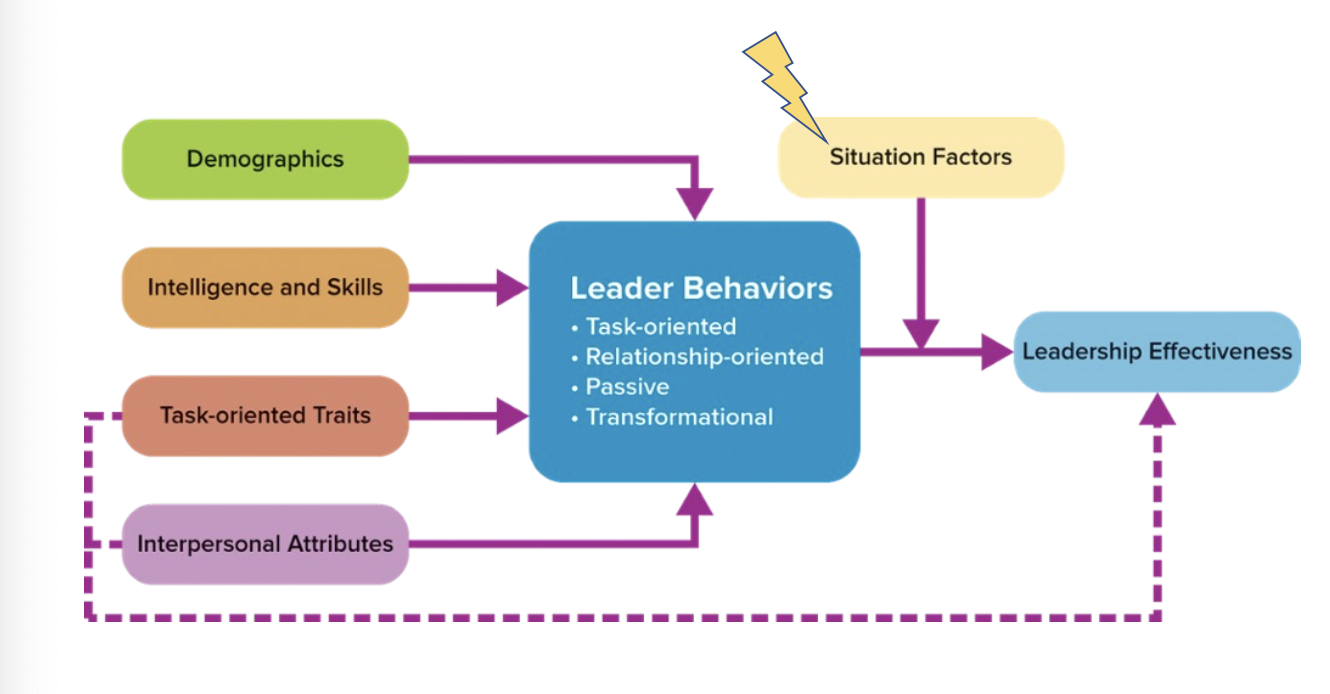
path-goal theory
Leaders seen as effective when employees view them as a source of satisfaction or as paving the way to future satisfaction.
leaders do this by:
Reducing roadblocks.
Providing guidance and support.
Linking rewards to goal accomplishment.
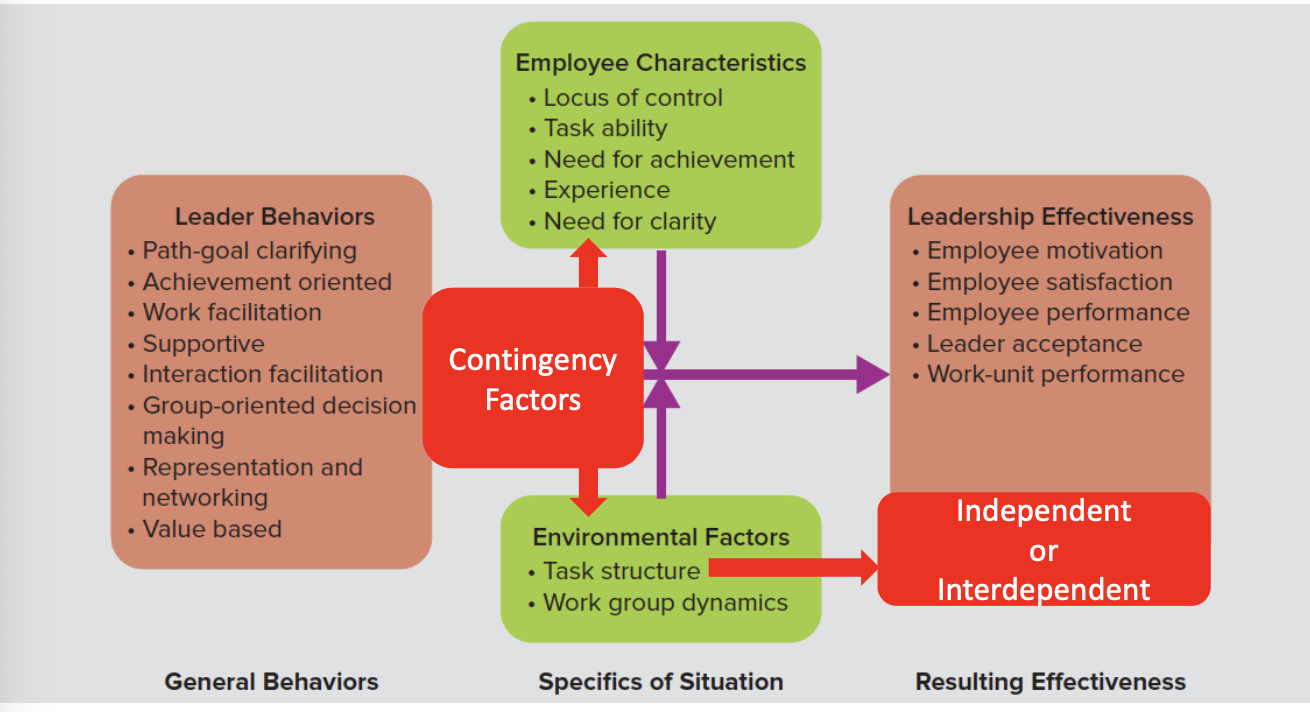
takeaways from path-goal theory
Effective leaders use multiple types of leader behavior.
Leaders are encouraged to clarify the paths to goal accomplishment and to remove any obstacles that may impair an employee’s ability to achieve his or her goals.
Leadership styles should be modified to fit various employee and environmental characteristics.
the 5 steps for leaders
Identify important outcomes
Identify relevant leadership behaviors.
Identify situational conditions.
Match leadership to the conditions at hand.
Determine how to make the match.
transformational leadership
A broad group of leader behaviors that go beyond task and relational behaviors
Transformational leaders transform their followers to pursue organizational goals over self-interests.
Has a positive effect on outcomes including employee performance, innovation, attitudes, and reduced stress and turnover
Think about MLK

the 4 I’s of transformational leadership
Inspirational motivation (charisma): develop and share an attractive vision of the future
Idealized influence: lead-by example, instill trust and pride
Individualized consideration: provide support, encouragement, empowerment, and coaching to employees
Intellectual stimulation: encourage employees to question the status quo and seek innovative and creative solutions to problems
implications of transformational leadership
Transformational leadership can be ethical or unethical.
Establishment of a positive view of the future is the first step.
The best leaders are not just transformational.
Transformational leadership affects outcomes at the individual, group, and organizational levels.
Transformational leadership works virtually.
Transformational leadership does not imply ethical leadership.
end of ch 13 leadership
power
the means to enforce your will over others.
Power is about the ability to influence others
Power relations can be reciprocal
the 5 bases of power
legitimate power
reward power
coercive power
expert power
referent power
legitimate power
Obtain compliance/influence because of formal authority (e.g., formal position)
reward power
Obtain compliance by promising or granting rewards (e.g., giving a raise)
coercive power
Make threats of punishment and deliver actual punishment (e.g., ability to fire someone)
expert power
Having knowledge or information that others need (e.g., an expert in the field)
referent power
Personal characteristics and social relationships (e.g., charisma, reputation, network of relationships)
responses to power
commitment
compliance
resistance

commitment (to the cause) (responses to power)
Those who are committed often go above and beyond to ensure its success.
Compliance (responses to power)
Those who comply do only what is expected, nothing more. They exert no extra effort and provide no extra input.
Resistance (responses to power)
Resist the influence attempt by not complying.
Unproductive arguing or outright rejection
expert and referent power (effectiveness)
generally positive effects (on employee outcomes)
reward and legitimate power (effectiveness)
slightly positive effects
coercive power (effectiveness)
slightly negative effects
when leaders have both formal and informal power
highest team effectiveness
empowerment
consists of efforts to enhance employee performance, well- being, and positive attitudes by giving employees greater influence.
Potential benefits:
Increased motivation, engagement and self-efficacy
Increased productivity and effectiveness
Better efficiency/utilization of time and resources
Better decision making
Required elements:
Information sharing
Employee development (to ensure necessary skill levels)
Allowing employees to make substantive decisions
Rewarding employees based on company performance
the evaluation of power from domination to delegation

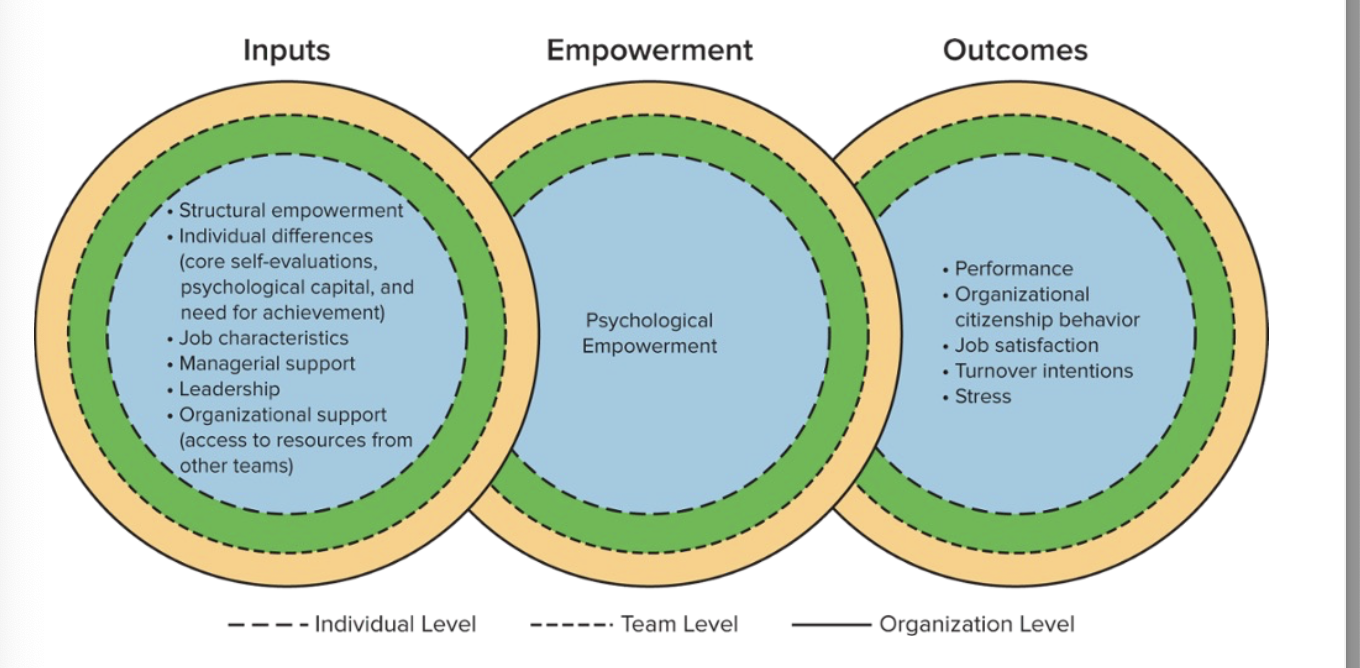
psychological empowerment
Occurs when we feel a sense of:
Meaning from our work.
Competence in our ability to perform.
Self-determination: degree of control over how we perform our jobs.
Impact at work: the difference our efforts make.
empowerment figure
ways understanding social influence will help you
Interview for a job/internship
Ask a coworker for a favor
Share your ideas for improving the department
Seek a raise or promotion
Ask for a deadline extension
Motivate others when you are a leader
“soft” tactics (influence tactics)
friendlier and not as coercive
rational persuasion
inspirational appeals
consultation
ingratiation
personal appeal
“hard” tactics
exert more pressure
exchange
coalition
legitimating
pressure
influence tactics
are conscious efforts to affect and change behaviors in others.
rational persuasion (soft tactics)
Trying to convince someone with reason, logic, or facts.
Inspirational appeals (soft tactics)
Trying to build enthusiasm by appealing to others’ emotions, ideals, or values.
consultation (soft tactics)
Getting others to participate in planning, making decisions, and changes.
integration (soft tactics)
Getting someone in a good mood prior to making a request; being friendly, helpful, and using praise, flattery, or humor.
personal appeals (soft tactics)
Referring to friendship and loyalty when making a request.
exchange (hard tactics)
Making explicit or implied promises and trading favors.
coalition tactics (hard tactics)
Getting others to support your efforts to persuade someone.
pressure (hard tactics)
Demanding compliance or using intimidation or threats.
legitimating tactics (hard tactics)
Basing a request on one’s authority or right, organizational rules or policies, or explicit/implied support from superiors.
influence tactics figure

organizational politics
Intentional acts in pursuit of self-interests that conflict with organizational interests.
Politics is found in nearly all organizations.
Goal of political behavior is to exert influence on others to serve self-interests.
Political behavior can be good or bad (though it is normally perceived negatively)
frequently used political tactics
Building a network of useful contacts
Using key players to support initiatives
Making friends with power brokers
Bending the rules to fit the situation
Self-promotion
Creating a favorable image
Praising others
Attacking or blaming others
Using information as a political tool
levels of political action
network level
cooperative pursuit of general self interest
coalition level
cooperative pursuit of group interests in specific issues
individual level
individual pursuit of general self interests

highly political individuals
Run the risk of being called self- serving
May lose credibility
May be considered poor team players
individuals who are strictly non-politcial
May experience slower promotions
May feel left out
May be considered poor team players
end of ch 12 power
human resource management
“The study of the policies, practices, and systems that influence employees’ behavior, attitudes, and performance.”
company strategy
vision/mission/goals
strategic priorities
strategic challenges
competitive advantages
HR strategy
key functions
HR planning
recruiting
staffing
training/development
compensation
org culture
org re-structuring
employees
individual level:
personal values
personalities
perception/cognition
motivation
group/team level
team dynamics
power/influence/conflict
leadership
impact of human resource management

sustainable competitive advantage
An organization is better than competitors at something and can hold that advantage over a sustained period of time.
HR give organizations advantages because Human Resources:
Are valuable.
Are rare.
Cannot be imitated.
Organized to capture value.
business competency types
critical evaluation
business acumen
consultation
leadership competencies
ethical practice
leadership and navigation
interpersonal competencies
global and cultural effectiveness
communications
relationship management
technical expertise
human resource expertise
Supervisors’ Involvement in HRM: Common Areas of Involvement
help define jobs
forecast HR needs
provide training
interview (and select) candidates
appraise performance
recommend pay increases and promotions
communicate polices
motivate. with support from pay, benefits, and other rewards
HR overview

analysis and design of work
work analysis, job design
HR planning
workforce forecasting. analytics
recruiting
job posting
selection
staffing, interviewing
training and development
orientation, career development
performance management
performance measures, feedback
compensation
pay structure, insurance
employee relations
attitude survey, labor relations
median salaries for HR positions

end of ch 1 HRM
developing a work flow analysis

work flow in organizations

very important question for HR
Do we have the kind of people we need (and in the numbers that we need) to achieve our objectives?
job analysis
the process of getting detailed information about jobs.
Used for existing jobs: HR planning, legal compliance, work redesign, staffing, compensation, training, performance appraisals, and career planning
Defines what a person in a certain position does and what qualifications are needed for the job.
2 essential parts:
job description
job specification