Pectoral Girdle Muscles: UMW Anatomy
 Call Kai
 Learn
 Practice Test
 Spaced Repetition
 Match
 Flashcards
 Knowt Play
1/48

There's no tags or description
Looks like no tags are added yet.
49 Terms

pectoralis major
origin: clavicle, sternum, first six costal cartilages. insertion: the intertubercular sulcus of the humerus. Action: produces adduction and medial rotation of the arm and assist to elevate the thorax during forces inhilation

pectoralis minor
origin: the third to fifth ribs. insertion: the coracoid process of the scapula. Action: depresses, abducts, and downwardly rotates the scapula

subclavius
origin: sternal end of the first rib. insertion: the middle third of the clavicle. action: stabilizes the clavicle with upper extremity movement, depresses the clavicle, elevates the first rib during respiration.

serratus anterior
origin: extend obliquely from the upper 8 or 9 ribs. insertion: superior angle of the scapula, medial border and inferior angle of the scapula. action: anteriorly protracts and upwardly rotates the scapula and stabilizes the scapula b olding the medial border along the rib cage.

levator scapula
origin: transverse process of c1-c4. inseriton: the medial border of the scapula. action: elevate the scapula, tilt the glenoid cavity downwards, pull the scapula in and up, laterally flex and rotate the neck to the same side.

rhomboid minor
origin: nuchal ligament and the spinous process of C7-T1. insertion: medial border of the scapula at the spine. action: adducts the scapula to stabilize the and keep the scapula fastened to the ribcage, elevates and downwardly rotates the scapula.

rhomboid major
origin: the T2-T5 and the supraspinous ligaments. Insertion: medial border of the scapula. action adducts the scapula to stabilize and keep the scapula fastened to the ribcage

trapezius
origin: occipital bone, nuchal ligament, and the spinous process and supraspinous ligaments of c7-t12. insertion: spine of the scapuls, medial margin of the acrimon, posterior margin of the lateral clavicle. action upper fibers of the trap elevate and upwardly roate the scapula, latterally flex the neck to the same side, rotate the neck to the opposite side, extend the headm retract the scapula, depress and upwardly rotate the scapula

deltoid
origin: the clavicle and the scapula. insertion: deltoid tuberosity. action: adducts the arm beyond 15 degrees, flexion of the arm, posterior region provides extension.

teres major
origin: dorsal surface of the inferior angle of the scapula. insertion: medial lip of the interturburcle groove of the humerus. action: acting with the lat, it extends, adducts, and internally rotates the shoulder

supraspinatus
origin: supraspinous fossa of the scapula. insertion: greater turburcle of the humerus. action: lateral rotation, abduction of the shoulder from 0-15 degrees, stablizes the humeral head within the glenohumeral joint.

infraspinatus
origin: infraspinous fossa of the scapula. insertion. greater turburcle of the humerus. action: laterally rotates the shoulder,

subscapularis
origin: subscapular fossa of the scapula. insertion: lesser tubercle of the humerus. action: internally rotate the shoulder, stabilizes the humeral head within the glenohumeral joint.

teres minor
origin: lateral border of the scapula. insertion: greater tubercle of the humerus. action: externally rotate and adduct the shoulder

biceps
origin: the long head, the supraglenoid turburcle of the scapula, the short, the coracid process of the scapula. insertion: radial tuberosity. action: flexion of the elbow and supination of the forearm, flexion at the glenohumeral joint

coracobrachialis
origin: coracoid process. insertion: medial surface of the humerus. action: produces flexion and adduction of the arm at the glenohumeral joint

latissimus dorsi
Origin: spinous process of inferior thoracic, and all lumbar and sacral Vertebrae, and ribs 8-12. insertion: the floor of the intertubercular sulcus of the humerus. action: adducts, medially rotates, and extends the arm at the glenohumeral joint.

brachialis
origin: humerus. insertion: tuberosity of the ulna and the coranoid process. action flexion of the elbow joint.

pronator teres
origin: the medial supracondylar ridge of the humerus, the coronoid process. insertion: lateral aspect of the radius. action: pronates the forearm at the proximal and distal radioulnar joints.

brachioradialis
origin: lateral supracondylar ridge of the humerus. insertion: styloid process of the radius. action: flexs the elbow joint assists in pronation and supination
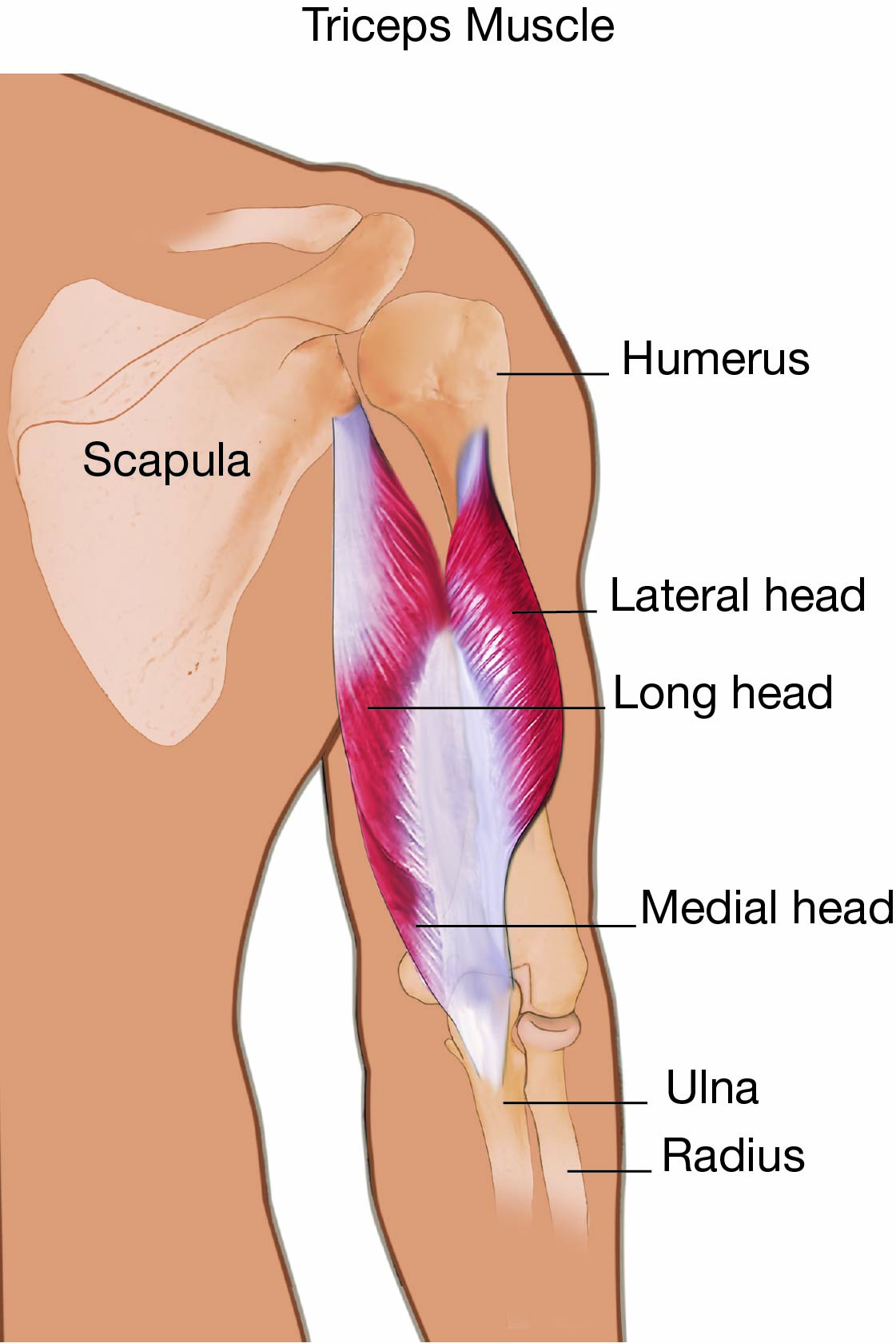
triceps
origin: the long head, the infraglenoid tubercle of the scapula, the lateral head, the lateral humerus. the medial head, the posterior humerus. insertion: olecranon process. action: extends the forearm at the elbow joint, the long head also assists in extending and adducting the arm at the glenohumeral joint.

anconeus
origin: lateral epicondyle of the humerus. insertion: olecranon process. action: extension of the elbow

supinator
origin: lateral epicondyle. insertion: the radius. action: supinates the forearm at the proximal and distal radioulnar joints.

flexor digitorum superficialis
origin: medial epicondyle, coronoid process, anterior border of the radius. insertion: digits 2-5. action: flexes the fingers and the wrist

flexor digitorum profundus
origin: anterior surface of the proximal ulna and the interosseous membrane. insertion: distal phalanges 2-5. action: produces flexion of the middle and distal phalanges 2-5

palmaris longus
origin: common flexor tendon. insertion: digital flexor retnaculum of the hand and the palmar aponeurosis. action: tenses the palmar aponeurosis

flexor pollicis longus
origin: anterior surface of the radius and the interosseous membrane. insertion: the palmar surface of the distal phalanx of the thumb. action: produces flexion of the thumb at the carpometacarpal and metacarpophalangeal joints

pronator quadratus
origin: anteromedial surface of the distal ulna. insertion: anterolateral surface of the distal radius. action: pronates the forearm the the proximal and distal radioulnar joints.

flexor carpi radialis
origin: the medial epicondyle of the humerus. insertion: the base of the second and third metacarpal. action: produces flexion and abduction of the wrist.

flexor carpi ulnaris
origin: the medial epicondyle of the humerus, the ulna, and the olecranon process. insertion: the fifth metacarpal, the pisiform, and the hook of the hamate. acion: produces flexion and ulnar deviation of the wrist.

extensor digiti minimi
origin: common extensor tendon that attaches to the lateral epicondyle. insertion: tendon of the extensor digitorum that attaches to the extensor expansior of the little finger.

extensor indicis
origin: posterior surface of the ulna and the intraosseus membrane, insertion: extension expansion of the index finger. action: extension of the index finger

abductor pollicis longus
origin: dorsal surface of the ulna and radius and the connection interosseous membrane. distal fibers insert into the trapezium, the proximal fibers insert into the base of the first metacarpal. action, abducts ans extens the thumb at the carpometacarpal joints.

extensor pollicis longus
origin: the ulna, interosseous membrane. Insertion: the distal phalanx of the thumb. action: extends the thumb

extensor pollicis brevis
origin: posterior surface radius and the interosseous membrane. insertion: proximal phalanx of the thumb. action: extension of the thumb at the carpometacarpal and the metacarpophalangeal joints.

extensor digitorum
origin: the lateral epicondyle of the humerus. insertion: the middle and distal phalanges of digits 2-5. action: produces extension of the middle and distal phalaneges at digits 2-5 at the metacarpophalangeal and interphalangeal joints

extensor carpi radialis longus
origin: the lateral supracondylar ridge of the humerus. insertion: the base of the second metacarpal action: extention and radial deviation of the wrist
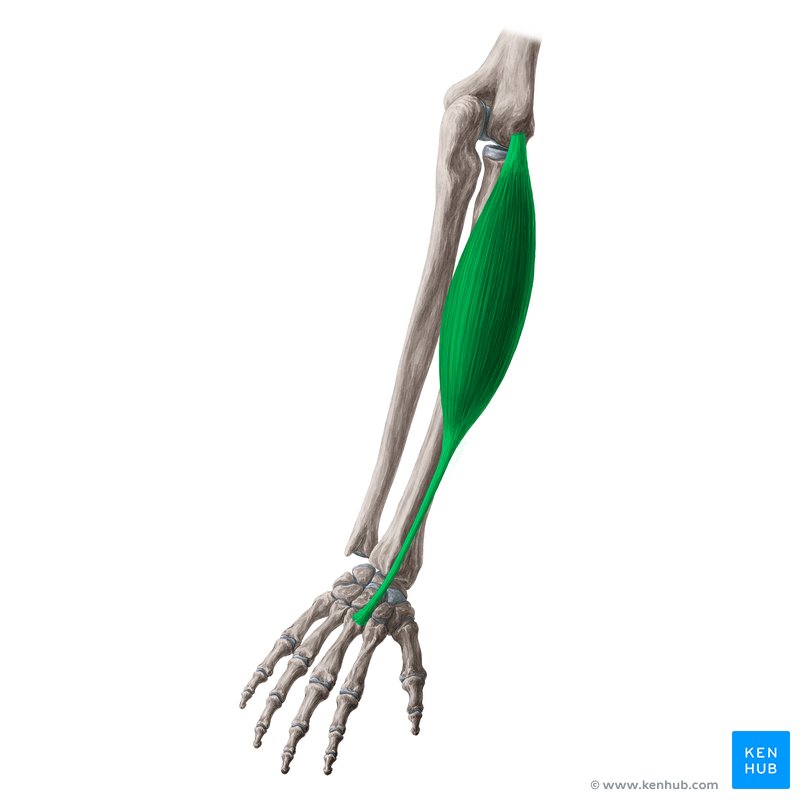
extensor carpi radialis brevis
origin: the lateral epicondyle. insertion: base of the third metacarpal bone. action: extend and adduct the wrist

extensor carpi ulnaris
origin: the lateral epicondyle of the humerus, and adjacent ulna. insertion: base of the fifth metacarpal bone. action: extends the hand and adducts the wrist

abductor pollicis brevis
origin: the scaphoid and trapezium, flexor retinaculum insertion: the thumbs proximal phalanx. action: abducts the thumb at the carpometacarpal and metacarpophalangeal joints

flexor pollicis brevis
origin: the trapezium, trapezoid and capitate bones. insertion: the proximal phalanx of the thumb. action: flexes the thumb at the carpometacarpal and metacarpophalangeal joints

opponens pollicis
origin: flexor retinaculum and the tubercle of the trapezium. insertion: lateral and radial margin and length of the first metacarpal bone. action: flexion, rotation, and medial rotation of the first metacarpal at the carpometacarpal joint, producing thumb opposition

adductor pollicis
origin: oblique head, capitate bone and palmar bases of the 2nd and 3rd metacarpals. insertion: medial side of the base of the thumbs proximal phalanx. action: adducts the thumb at the carpometacarpal joint

lumbricales
origin: 1st and 2nd Lumbrical: Unipennate; arises from the radial side of the flexor digitorum profundus tendon for digits 2 and 3. 3rd and 4th Lumbrical: Bipennate; arises from adjacent sides of the FDP tendons for the middle and ring fingers digits 3 and 4, 4 and 5. insertion: digits 2-5I nserts onto the radial (lateral) side of the extensor expansion of the respective finger. action: Metacarpophalangeal (MCP) joints 2–5: Flexes the fingers. Interphalangeal joints 2–5: Extends the fingers

dorsal interosseus
origin: lateral and medial shafts of metacarpals 1-5. insertion: Bases of the proximal phalanges and the extensor expansions. action: Abduction of the index, middle, and ring fingers away from the central axis (middle finger). Flexion at the metacarpophalangeal joints. Extension at the interphalangeal joints

palmar interosseus
origin: • 1st Palmar Interosseous: Ulnar (medial) side of the base of the 1st metacarpal (or ulnar side of the 2nd metacarpal shaft). 2nd Palmar Interosseous (index finger): Ulnar side of the 2nd metacarpal. 3rd Palmar Interosseous (ring finger): Radial (lateral) side of the 4th metacarpal. 4th Palmar Interosseous (little finger): Radial (lateral) side of the 5th metacarpal. insertion: Bases of the proximal phalanges and the extensor expansions (extensor hoods) of digits 2, 4, and 5 action: • Adduction ("PAD"): Pulls the index, ring, and little fingers toward the middle finger. Flexes the fingers at the metacarpophalangeal (MCP) joints. Extends the fingers at the interphalangeal (IP) joints

palmaris brevis
origin: flexor retinaculum and the medial margin of the palmar aponeurosis. insertion: dermis on the ulnar side of the hand. action: Wrinkles the skin of the hypothenar eminence, tightens the palmar aponeurosis, deepens the hollow of the palm to improve grip, and protects the underlying ulnar nerve and artery from compression

flexor digiti minimi
origin: hook of the hamate and the flexor retinaculum. insertion: ulnar side of the base of the proximal phalanx of the little finger. action: flexes the little finger at the metacarpophalangeal joint, lateral rotation and opposition of the little finger.
opponens digiti minimi
origin: convexity of the hamulus of the hamate bone and the contiguous portion of the transverse carpal ligament. insertion: the whole length of the metacarpal bone of the pinky. action: