ANTHR 3690 Midterm Exam
 Call Kai
 Learn
Learn Practice Test
 Spaced Repetition
 Match
Match Flashcards
 Knowt Play
1/63

There's no tags or description
Looks like no tags are added yet.
Name | Mastery | Learn | Test | Matching | Spaced | Call with Kai | Chat |
|---|
No analytics yet
Send a link to your students to track their progress
64 Terms
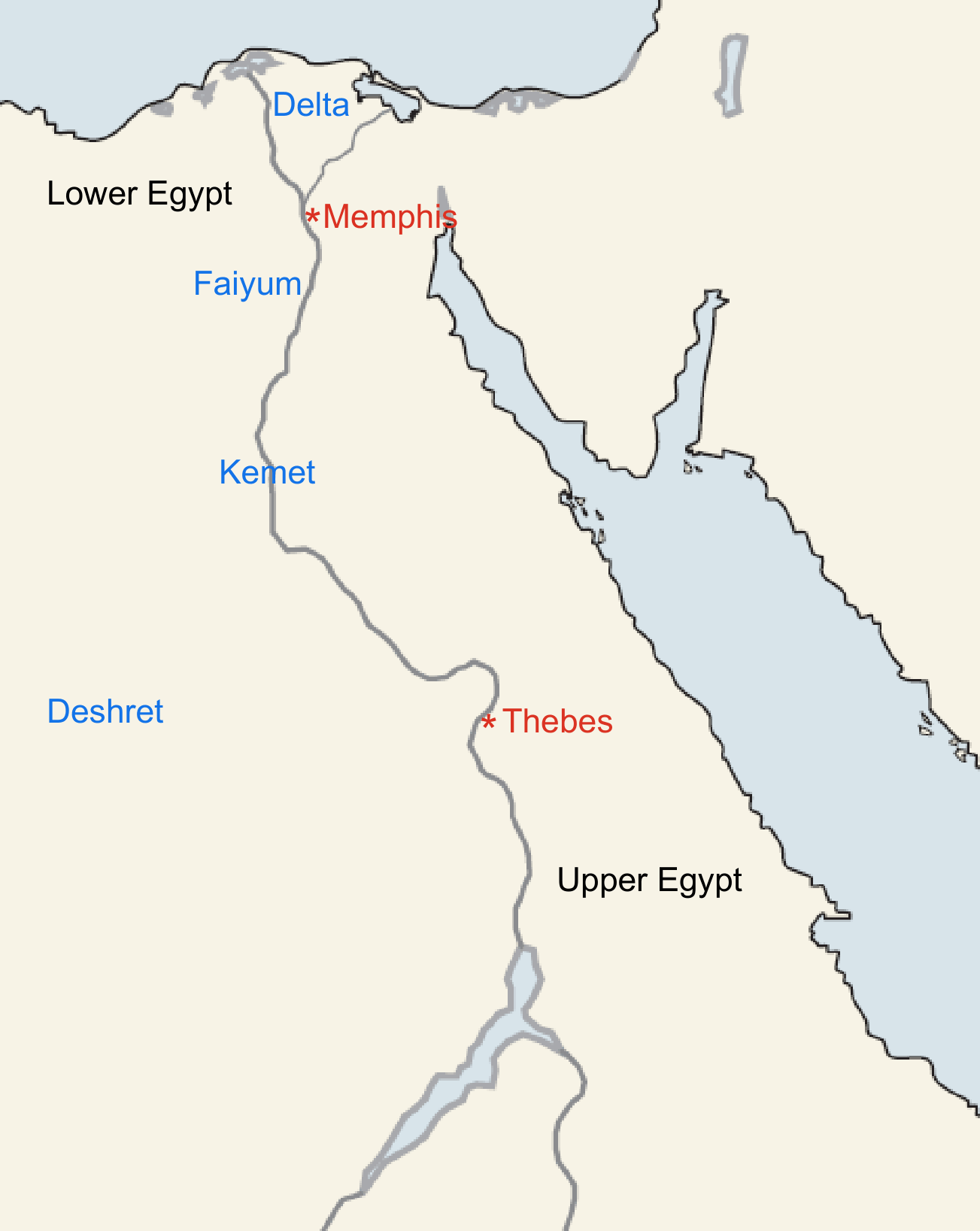
Map
Need to know:
Upper Egypt
Lower Egypt
Kemet
Deshret
The Delta
The Faiyum
Memphis
Thebes
Timeline
Need to Know:
Paleolithic (700,000-7,000 BCE)
Neolithic (c. 8800/5400-4400 BCE)
Predynastic/Naqada (c. 4400-3000 BCE)
Early Dynastic (c. 3000-2680 BCE)
Old Kingdom (2680-2160 BCE)
First Intermediate Period (2160-2050 BCE)
Middle Kingdom (2050-1650 BCE)
Dynasty 0
Upper Egypt conquering Lower Egypt
Scorpion King, Narmer
Dynasty 1
Kings of a united Egypt, underground tombs at Abydos with human sacrifice (associated with Osiris)
“Menes,” Hor-Aha, Djer/Djet/Den, and Neithhotep
Dynasty 2
Tombs buried elsewhere (possibly in the North), maybe had Set(h) as patron
Peribsen, Khasekhemwy
Dynasty 3
First monuments in stone (early pyramids)
Djoser, Sneferu
Dynasty 4
“Great,” true pyramids at Giza
Khufu, Khafre, Menkaure
Dynasty 5
Smaller pyramids with Pyramid Texts and Sun Temples
Unas
Dynasty 6
Growth of bureaucracy and economy, weakening royal power
Pepi II
Cataracts
Shallow, rocky stretches of the Nile that impeded river travel (Egypt proper ended near the First Cataract)
Oasis/Oases
Nile- or spring-fed lake in the desert (caravan stops or permanent residents)
Stratification in Ancient Egypt
The division of society into different social classes, with some groups having more power, wealth, and status than others, and Ancient Egypt was highly stratified.
Operated on a social hierarchy that began with the pharaoh → nobles/high officials → scribes → artisans/skilled workers → farmers → servants/laborers
Helped maintain political stability, reinforces the pharaoh’s authority, and reflected the Egyptian belief that society should mirror the ordered universe established by the gods
Specialization in Ancient Egypt
People performed specific occupations rather than everyone doing the same work, and as ancient Egypt became a more complex state, labor became increasingly specialized.
Some specialized occupations include, scribes, priests, architects, craftsmen, soldiers, and government officials
Relative Dating
Putting past events in a chronological sequence without finding their exact numerical age
Stratigraphy: older layers of habitation and building get buried under more recent levels
Absolute Dating
Based on ancient records (inscriptions, texts, coins with a king’s regnal year) or observation/evidence of a dateable natural event (volcano eruption, comet sighting)
Radio-Carbon Dating: measuring the amount of C-14 in organic remains and gives an approximate age before 1950
Naqada Period (c. 4000-3000 BCE)
Named after a town in Upper Egypt
Naqada I (c. 4000-3500 BCE)
Burials small, with few grave goods - circular “pit grave,” with or without a mound over it
Naqada II (c. 3500-3200 BCE)
A few burials larger with more grave goods (social stratification)
Naqada III (c. 3200-3000 BCE) = “Dynasty 0”
Long-distance trade, highly differentiated burials (rulers buried in tombs much larger and richer than any others, hence “Dynasty 0”)
3 competing city-states/confederacies centered on Upper Egyptian towns
Naqada (becomes less important in the Naqada III period)
Hierakonpolis (god Horus becomes god of kingship later)
Abydos (becomes cult center of the dead king, location of Dynasty 0 & 1 royal tombs)
Tomb U-J/Tomb of King “Scorpion”
Located in Abydos
Lots of chambers
Grave goods say where in Egypt they are from with ivory labels
Larger than other “Dynasty 0” tombs but earlier than 1st Dynasty kings’
Narmer Palette
31st BCE (5,000 years old)
Found in the “main deposit” at the temple of Horus at Nekhen/Hierakonpolis
Front side: King Narmer wields a mace about the smash the skull of a captive, wears the white crown of Upper Egypt, large in size, horus falcon, two defeated enemies
Back side: Narmer with the red crown of Lower Egypt in procession with attendants and standard bearers, ten defeated enemies, mythical snake lions, bull (=king) messes up a walled city and another defeated enemy
Djoser (and his pyramid)
3rd Dynasty king (2667-2648 BCE)
First to build his tomb entirely of stone (chief architect was Imhotep)
“Step Pyramid”
Burial chamber is below ground
North-South orientation
Surrounded by an elaborate court with temples and spaces for ritual
Sneferu (and his pyramid)
First king of the 4th Dynasty (2613-2589 BCE)
Started an ambitious pyramid, but the angle of the sides changed 2/3 of the way up (probably due to structural flaws)
“Bent Pyramid”
Changed to an east-to-west orientation and suggests increasing influences of Ra/sun religious elements
Partially collapsed Meidum pyramid could be his, but the Red Pyramid was the first “true” pyramid
Khufu (and his pyramid)
4th Dynasty king (2589-2566 BCE)
Not much is known about his reign
Largest Egyptian pyramid and has a burial chamber inside
The pyramid complex also includes a valley temple, a pyramid temple, and two 40 m-long boats
Khafre (and his pyramid)
4th Dynasty king (2558-2532 BCE)
Built his pyramid on a slight rise in the ground so it appears taller even though it is actually smaller in mass/volume
The pyramid complex includes the usual temple plus the Sphinx (head probably meant to look like him and worshipped as a form of Horus in the 18th Dynasty)
Unas (and his pyramid)
Last 5th Dynasty king (2375-2345 BCE)
First pharaoh to have the Pyramid Texts inscribed on the walls of his pyramid
Sun Temples
Growing importance of the sun-God Ra (Re) - seen in the east to west orientation of pyramid complexes
Advertise/facilitate the pharaoh’s continuing relationship with sun god in afterlife
Each 5th Dynasty king built one near their pyramid
Each temple had its own Valley Temple and Upper Temple with an obelisk, and an open court with an alter
Memphite Theology
An ancient Egyptian text that claims the god Ptah was the supreme creator of the world.
Ptah created the universe through his mind and speech, first conceiving everything in his heart, then bringing things into existence by speaking their names
Promotes memphis as a major religious center
Presents Ptah as more important than competing creator gods associated with other cities
Pyramid Texts
The oldest known religious writings from ancient Egypt, carved on the walls of royal pyramids during the Old Kingdom to help a deceased king successfully enter the afterlife.
The king does not truly die, as he is transformed into a divine being and ascends to the heavens and join the gods
Provides magical knowledge and protection needed to overcome dangers in the afterlife
Maintaining ma’at (cosmic order, balance, and justice) is essential for both earthly rule and eternal life
Osiris
God of the afterlife, underworld, and the dead
Was king but was killed by his brother Set(h)
Isis
Osiris’ wife
Represents mourning and the dead, along with magic
Strongly associated with kingship through her son Horus
Horus
God of the sky, war, and divine kingship (represented as a falcon)
Osiris and Isis’ son
Wants to be king after Osiris’ death
Represents the fertile “Black Land” of the Nile valley
Set(h)
God of deserts, chaso, violence, and foreigners
Kills his brother Osiris out of jealousy
Fights Horus for the right to be king
Represents the “Red Land” desert
Ptah
Creator god and god of Memphis
Creates by way of heart (thought) and breath (spoken word)
Later myth has him creating humans on a potter’s wheel
Atum
Primordial (self-created)/creator god of Heliopolis
Creates by means of physical processes/bodily fluids (spit or semen)
Ba
The personality part of the soul, depicted as a bird with a human head.
Ka
The “spiritual double” or life force part of the soul.
Akh
The whole/combined soul (Ba + Ka) that have to be re-combined by rituals after death.
Nomarchs
Local governors of new provinces (nomes)
Ankhtifi
Nomarch of the Third nome of Upper Egypt in the Late FIP
“Spreads his influence” to the second and then first nomes
Loyal to the kings at Herakleopolis and engaged in military conflict with Theban kings
Columns of tomb have painted scenes of daily life AND an autobiographical tomb inscription
Mastaba Tombs
A long, low rectangular superstructure with 2-40 rooms over a shaft to an underground burial chamber(s).
From the Arabic word for bench
Inside there was an entrance to a chapel for offering, usually with inscriptions and painted reliefs of offerings and daily life
Also a “false door” by which the deceased’s spirit could come and go
Also a secret sealed-off chamber called a serdab with statues of the deceased and a burial shaft to the underground burial chamber with sarcophagus
Higher-status officials had tombs that were closer to the burials of kings, larger/more elaborate, had detailed scenes of daily life, and would have included physical offerings (food, furniture, etc.)
“Democratization of the Afterlife”
The gradual change in Egyptian religious beliefs in which access to a blessed afterlife was no longer reserved exclusively for the pharaoh and royal family.
More medium-to-nice tombs with more and greater variety of grave goods
New things, like wooden models, model the benefits for the afterlife more widely available
Earliest instances of the Coffin Texts date to the First Intermediate Period
Theban saff tombs
A distinctive type of tomb built by elite rulers and officials in the Theban region during the First Intermediate Period and early Middle Kingdom.
Cut into cliffs on the west bank of the Nile at Thebes with a large open courtyard in front
Often used by local rulers (nomarchs) and early Theban kings
Montuhotep II (and his tomb)
11th Dynasty king that reigned for 50-ish years (c. 2055-2004 BCE)
Completes conquest of Lower Egypt (first Theban monarch to actually be king of Upper and Lower Egypt)
Tomb similar to a Theban saff-tomb with a burial chamber at the end of a long passage in cliff
Six women/girls with royal and/or priestess titles in smaller pyramids behind his tomb complex (all died at the same time)
Middle Kingdom works of Literature
“Khufu and the Magicians” - power of storytelling, centrality of the king, intersection of religion, magic, and power
“The Tale of the Eloquent Peasant” - health functioning of the bureaucracy and judicial system
“The Shipwrecked Sailor” - perseverance in adversity, humbleness of mankind before the gods (the serpent), authority of the king, importance of trading expeditions
Dualities in Ancient Egyptian Thought
Upper Egypt/Lower Egypt (“The Two Lands”)
Ma'at (order)/Isfet (chaos)
Life/Death
Nile Valley/Desert
Day/Night
IMEP Analysis
A way to think about how rulers build and maintain power.
I is for Ideology: religion, nationalism/patriotism, group identity and loyalty
E is for Economics: control of food and other resources, taxation, tribute, mining and exploitation of natural resources
M is for Military: (exactly what you think) controlling the use of force, for use both on your external neighbors and internally against your own people
P is for Politics: the bureaucracy needed to run a government, diplomacy with foreign powers
Unification/Formation of the Egyptian States (Dynasty 0)
Rulers of Upper Egypt (Scorpion King, Ka, Narmer) gradually conquered or absorbed rival territories
Upper Egyptian/Naqada III goods in Lower Egypt
Lower Egyptian goods in the grave of Upper Egyptian kings
Narmer is credited with completing the unification of Upper and Lower Egypt around 3100 BCE (Narmer Palette has both White and Red crowns)
Egyptian Writing (development of writing and four scripts)
Early Dynastic inscriptions - hieroglyphs primarily used to label images (Old Kingdom funerary stelae)
Egyptian scripts:
Hieroglyphs - primarily inscribed on stone but also on papyrus
Hieratic (early cursive) - faster, developed for writing with ink on papyrus
Demotic (another later cursive) - even more removed from original hieroglyphs
Coptic (even later) - now with an alphabet
Early Dynastic Tombs as evidence for kingship and society
Royal tombs were concentrated at Abydos, especially those of the earliest kings
Tombs became larger and more elaborate, demonstrating the growing power and wealth of rulers
Contained luxury goods such as jewelry, stone vessels, pottery, and imported materials
Differences between royal and non-royal tombs reveal increasing social stratification
Tombs of elites contained more wealth and better construction than those of common people
Transition from Early Dynastic (periods and tombs) to Old Kingdom
Kings strengthened centralized government and expanded royal authority
Royal tombs were primarily located at Abydos and were typically large mastaba tombs made of mudbrick
The state developed increasingly sophisticated administration, taxation, and record-keeping systems (pyramid building)
Role of pyramid-building in social and economic change in the Old Kingdom
Pyramid construction reflected the growing power and divine status of the pharaoh
Building projects required a highly organized and centralized government
The state developed large bureaucracies to collect taxes, manage resources, organize labor, and oversee construction
Stimulated economic growth by creating demand for stone quarrying, transportation, food production, and craft specialization
Workers included architects, engineers, stonemasons, artists, scribes, and laborers, demonstrating increased specialization
Key features of Egyptian art and portraiture (“Royal Style”)
Human figures were shown in composite view
Head and legs in profile (side view)
Eyes and shoulders facing forward
Important individuals were depicted larger than others (hierarchical scale)
Men were often painted with reddish-brown skin, while women were typically shown with lighter skin tones
Men wore kilts, women wore white dresses
Symmetry, balance, and order were emphasized
Figures were usually shown as idealized rather than realistic
Tomb art helped ensure survival in the afterlife
Scenes in tombs depicted offerings, agricultural work, and daily life to provide for the deceased eternally
Continuity and change in the First Intermediate Period (political, social/economic, artistic)
Changes:
Weak pharaohs and political fragmentation
Rise of powerful nomarchs
Greater regional autonomy
Wealth spread beyond the royal court
More regional artistic styles
Continuities:
Agriculture remained the economic base
Belief in kingship remained strong
Traditional religious practices continued
Egyptian artistic conventions stayed largely the same
Characteristics/activities of a good Middle Kingdom king
Build monuments, statues, and temples (especially at Karnak)
Sending stone quarrying and mining expeditions into the desert
Trading expeditions to foreign lands (especially in the Syria-Palestine area)
Sending raiding expeditions to Nubia (Senusret III is particularly harsh toward Nubia)
Patronize arts and culture
Short Answer: Compare and contrast the pyramids of Djoser and Khafre
Djoser’s pyramid consists of six mastaba-like levels stacked on top of one another, showing the early evolution of pyramid design (“Step Pyramid”)
Khafre’s pyramid has smooth sides and was part of a larger, more elaborate complex that included the Great Sphinx, demonstrating the increased resources and engineering capabilities of the Old Kingdom
Both pyramid were build as royal tombs and reflected the pharaoh’s power and connection to the gods
Short Answer: What do Egyptologists mean when they talk about “the democratization of the afterlife”?
Refers to the idea that access to an afterlife was no longer limited to the pharaoh but gradually became available to non-royal Egyptians
During the Old Kingdom, beliefs about resurrection and eternal life expanded beyond the king to include elites and eventually broader segments of society
One example is the spread of funerary texts - the Pyramid Texts were originally reserved for kings, but were adapted into Coffin Texts that could be used by non-royal elites
Another example is the increased use of elaborate tombs and funerary equipment by non-royals - wealthy officials and ordinary Egyptians increasingly included coffins, amulets, and tomb decorations designed to help them reach the afterlife, practices that had once been associated mainly with royalty
Short Answer: What marks the change or difference between the Early Dynastic Period and the Old Kingdom? And what did NOT change?
Growth of a stronger, more centralized state and the development of monumental pyramid construction
Saw increased bureaucracy, specialization, and the ability to organize large-scale labor projects
What did not change was the basic structure of Egyptian society and beliefs - continued to value kingship, the afterlife, and traditional religious practices, while social hierarchy remained a central feature of society
Short Answer: What effects did the kings’ pyramid-building have on the social and economic development of Egypt in the Old Kingdom?
Stimulated Egypt’s economy by requiring large numbers of workers, resources, and skilled specialists - quarrying stone, transporting materials, producing food, and constructing monuments created jobs and encouraged greater economic organization
Strengthened the central government and expanded the bureaucracy - officials, scribes, and administrators were needed to collect taxes and manage labor, increasing specialization and state control
Reinforced the pharaoh's authority and Egypt's social hierarchy - the ability to organize massive construction projects demonstrated the king’s power and divine status while helping unite people from different regions under a centralized state
Short Answer: What do you think happened between the early city-states of Naqada, Abydos, and Hierakonpolis in the Naqada III period? What evidence makes you think this is the most plausible historical interpretation?
Naqada, Abydos, and Hierakonpolis competed politically and militarily, with one ruling dynasty eventually conquering or absorbing the others to create a unified Egyptian state
Elite tombs became increasingly large and wealthy, suggesting growing concentrations of power, while artifacts such as the Narmer Palette depict warfare, conquest, and the unification of Upper and Lower Egypt under a single ruler
Emergence of shared royal symbols, centralized administration, and royal cemeteries at Abydos also suggests that competing city-states were gradually brought under one authority
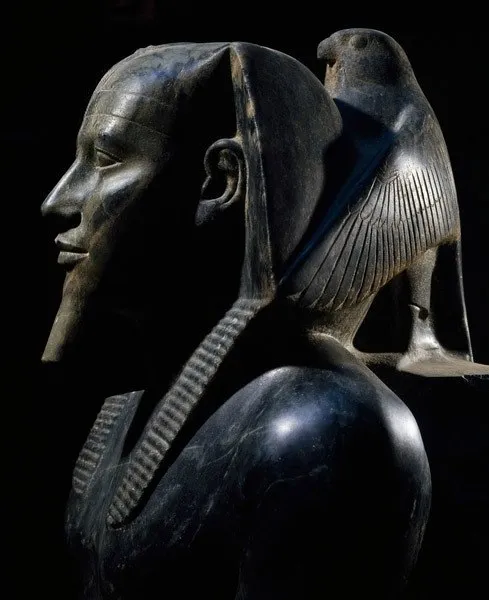
Short Answer: Explain the significance of the statue pictured below, including identifying the pharaoh and god pictured, and briefly discussing what it can tell us about Egyptian art, religion, and/or kingship.
The pharaoh Khafre and the god Horus
Designed to be a ka-statue or a backup place for the king’s soul to rest, should the mummy ever be damaged
Behind his headdress is Horus as a falcon, protecting Khafre
Also wearing the uraeus (cobra on his forehead) and a beard, which represents kingship
Seated pose is common for the Old Kingdom’s static and serene characteristics (“Royal Style”)
Short Answer: Select a work of Middle Kingdom Literature and briefly discuss what it can tell us about Egyptians living at the time OR how the themes in this work are still relevant to modern-day readers.
“The Tale of the Eloquent Peasant” tells the story of a peasant who is cheated by a wealthier man and repeatedly petitions officials for justice, and through his eloquent speeches, he argues that those in power have a responsibility to uphold fairness
Reveals how important justice and ethical leadership were to Egyptians during the Middle Kingdom
Suggests that good government was expected to protect ordinary people and maintain social order
Select a passage from the Memphite Theology or the Pyramid Texts (passage should be approx. 30-50 words). How does this passage illustrate what we’ve learned about ancient Egyptian kingship, culture, and religion so far in the class?
A passage from the Pyramid Texts discusses how the king must cross the river into heaven.
Short Answer: Discuss some ways in which the ancient Egyptian language, writing, and/or script are different from our own. How might these lead to differences in the way people encounter(ed) and use(d) the written word between ancient Egypt and today?
Ancient Egyptian writing was very different from modern alphabets because it used hieroglyphs, a combination of picture-symbols, sound signs, and determinatives (symbols that helped clarify meaning)
Writing was also much less accessible than it is today - literacy was limited mainly to trained scribes and officials, while most people encountered writing on monuments, tombs, temples, and official documents
As a result, writing often had religious and political significance in addition to communication - Egyptians viewed written words and images as powerful, sometimes even magical, whereas today writing is used much more broadly for everyday communication, education, and entertainment
Short Answer: What can the various ancient Egyptian creation myths and other foundational myths (like the Osiris, Set, Isis, Horus story) tell us about the Egyptians’ values as a culture and a society?
Egyptian creation myths and foundational stories reveal that Egyptians deeply valued order, stability, and legitimate rule
These myths also emphasize the importance of family loyalty, justice, and rebirth - Isis's devotion to Osiris and Horus's efforts to reclaim his father's throne reflect ideals of loyalty, duty, and maintaining social harmony
The stories show how closely religion and government were connected - Egyptians believed the pharaoh was like Horus on earth, responsible for upholding order, truth, and balance and protecting Egypt from the forces of chaos
Essay: Apply the “IEMP Analysis” to one particular element of Old Kingdom king’s approach to ruling. (Lydia’s version)
Centralized Bureaucracy and Tax Collection
Introduction:
Policy - development of a centralized bureaucracy and tax collection system
Pharaohs relied on officials, scribes, and administrators to govern Egypt and manage resources
The IEMP model helps explain how this system strengthened royal power
Ideological Power:
Bureaucracy supported the belief that the pharaoh was a divine ruler
Officials carried out the king's will as part of maintaining order, balance, and justice
Effective administration reinforced the idea that the pharaoh was chosen by and connected to the gods
Economic Power:
Scribes recorded harvests, collected taxes, and managed agricultural surpluses
The government redistributed resources throughout the kingdom
Tax collection funded state projects, supported workers, and helped maintain economic stability
Military Power:
Bureaucratic organization allowed the state to mobilize labor and resources efficiently.
Records and administration helped coordinate expeditions and provide supplies when needed
Strong organization increased Egypt's ability to maintain security and state control
Political Power:
Bureaucracy expanded the pharaoh's authority into provinces across Egypt
Officials governed local regions and enforced royal policies
The system reduced local independence and strengthened the centralized state
Conclusion:
The Old Kingdom bureaucracy was a major source of royal power
It reinforced the pharaoh's authority through religious legitimacy, economic control, administrative organization, and political centralization.
Using the IEMP model shows how bureaucracy helped the pharaoh maintain a stable and unified kingdom
Essay: Apply the “IEMP Analysis” to one particular element of Old Kingdom king’s approach to ruling. (Kyle verison)
Divine Kingship
Introduction:
Policy - the promotion of the pharaoh as a divine king
Old Kingdom pharaohs were viewed not only as rulers but as beings closely connected to the gods
This belief helped legitimize royal authority and unify Egyptian society
Ideological Power:
Egyptians believed the pharaoh had a special relationship with the gods and was responsible for maintaining order, balance, and justice
The king’s divine status made obedience to him both a political and religious duty
Religion reinforced the idea that Egypt's prosperity depended on the pharaoh
Economic Power:
Because the pharaoh was considered divine, people provided taxes, labor, and resources to support royal projects
Temples and royal estates accumulated wealth in the king’s name
The king’s religious authority helped justify state control over economic resources
Military Power:
The pharaoh served as the protector of Egypt against foreign enemies and internal disorder
Military campaigns and expeditions were portrayed as victories achieved through the king's divine favor
The king’s sacred status encouraged loyalty and obedience among his subjects
Political Power:
Divine kingship strengthened centralized government by placing the pharaoh above all other officials and nobles
Local leaders derived their authority from the king and served as his representatives
The belief in divine kingship helped maintain political unity throughout Egypt
Conclusion:
Divine kingship was one of the foundations of Old Kingdom society
Through religious beliefs, economic control, military leadership, and political authority, the pharaoh maintained power over Egypt
The IEMP model shows that divine kingship was not just a religious concept but a system that supported every aspect of Old Kingdom rule