Sports Psychology 139H - Midterm Study Guide
 Call Kai
 Learn
 Practice Test
 Spaced Repetition
 Match
 Flashcards
 Knowt Play
1/54

There's no tags or description
Looks like no tags are added yet.
55 Terms
Two primary situational considerations in need achievement theory
Probability of Success (how likely is that you will succeed)
&
Incentive of success (our value or satisfaction on succeeding
True or False: Attributing performances to internal, controllable factors does not often result in emotional reactions such as pride and shame
False
True or False:
When defining motivation, the direction of effort refers to whether an individual does not seek out, does not approach, or is not attracted to certain situations
False
True or False:
When defining motivation, the intensity of effort refers to how much effort a person puts forth in a particular situation
True
True or False:
Enhancing motivation through personality and situational characteristics
True
True or False:
A task orientation focused on comparing performance with personal standards and personal improvement is a task goal orientation
True
The Interactional View of Motivation claims that motivation is an interaction of which of the two following factors?
Personal Factors
Situational Factors
Attribution theory focuses on ______
How athletes explain their success and failures
When I say motivated behavior is primarily a function of individual characteristics, which view of motivation is that statement consistent with?
Trait-Centered View
What are the three factors in achievement goal theory?
Achievement goal
Perceived ability
Achievement behavior
Which theory influences feelings of self-esteem, competence, and control?
Competence Motivation Theory
The bodybuilder focuses on comparing themselves with others and defeating others. Which type of orientation is the bodybuilder showing?
Ego-Oriented Athlete
Which of the following does the concept of achievement motivation not include?
Need Achievement Theory believes behavior is influenced by the balance of:
Striving for success
Persistence through failure
Experience pride in accomplishments
No answer here so just remember that it will be whatever is not listed above
What, in addition to state anxiety, narrows a person's attentional field, decreases environmental scanning, and shifts attention toward dominant attentional styles and inappropriate cues?
Arousal
"What is the correct order of the four interrelated stages of stress, beginning with Stage 1 and ending with Stage 4
1. Environmental Demand
2. Perception of Demand
3. Stress Response
4. Behavioral Consequences
What term describes moment-to-moment changes in an athlete's perceived physiological activation?
Somatic state anxiety
What describes an athlete's general level of anxiety that remains relatively stable over time?
Trait anxiety
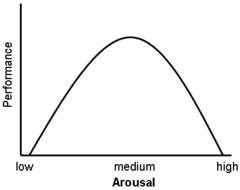
According to the inverted-U hypothesis, how does performance change as arousal increases from low levels to an optimal point?
As arousal reaches the optimal point our performance will slowly rise, however past that optimal point our performance will slowly fall off
True or False:
Increased arousal and state anxiety cause increased muscle tension and fatigue and can interfere with coordination
True
Arousal is a blend of physiological and psychological activity and refers to _____
Intensity dimension of motivation at any given moment
What term describes a substantial imbalance between demand and response capability when failing to meet the demand has important consequences?
Stress
Which of the following explains how increased arousal influences athletic performance?
Increased muscle tension, fatigue, and coordination difficulties
Changes in attention, concentration, and visual search patterns
A context-related source of stress includes ________
importance of Competitive Event
Uncertainty of Outcome
Increased arousal and state anxiety also influence athletic performance through changes in ________
Attention
Concentration
Visual search patterns
According to the textbook, high trait anxiety and ________are related to heightened state anxiety reactions in athletes
Low Self-Esteem
When an athlete looks forward to competition while another athlete dreads the upcoming competitive event, this is an example of ________
Subjective Completive Situation
Rewards that people perceive as controlling their behavior or as suggesting that they are incompetent
Decrease Intrinsic Motivation
Motivational feedback attempts to facilitate performance by enhancing ________, inspiring greater effort and energy expenditure, and creating a positive mood.
Confidence
According to the course textbook, a factor that might disrupt the occurrence of flow is ________
Lacking motivation to perform
Loss of concentration
Poor technique
Negative thinking
Loss of concentration
According to the course textbook, preventive factors that might prevent the occurrence of flow are ________
Lack of confidence, negative mental state
Loss of concentration, daydreaming, worrying about a competitor's ability
Negative referee decisions, stoppage in play
Negative talk on the field, lack of team interaction
Lack of confidence, negative mental state
According to the course textbook, which of the following factors can prevent and disrupt flow?
Self-doubt
Loss of concentration
Poor technique
Injury
All of the above
All of the above
True or False:
Harmonious passion is a strong desire to engage in an activity freely as it becomes part of one's identity
True
What is the term used to describe a fully controllable desire to participate in an activity that becomes part of one's identity?
Harmonious Passion
What is the term used to define the balance between perceived skill and challenge?
Flow
A key feature in the multimodal anxiety reduction programs is that they help participants develop a number of ________
Coping Skills
True or False:
Progressive relaxation technique involves tensing and relaxing specific muscles from one major muscle group to the next until all muscle groups are completely relaxed
True
What is the name of the response that teaches you to quiet the mind, concentrate and reduce muscle tension?
Relaxation Repones
Problem-focused coping skills
Cognitive-behavioral efforts to change for the better the problem causing the athlete to experience distress
Skills Include:
Setting short-term and long-term goals
Using good time management skills to address the problem
Gathering information and implementing problem-solving behavior → steps toward fixing it
Emotion-focused coping skills
Seek to regulate distressing emotions through the use of
certain arousal control techniques
Skills include:
Relaxation techniques
Meditation
Other cognitive efforts to change the meaning of the situation
What does cognitive restructuring attempt to do?
Identify irrational or stress-inducing self statements and change them into more positive thoughts
What is a cognitive affective stress management training program?
A skills program that teaches athletes an integrated coping response,
combining relaxation and cognitive techniques to control emotional arousal
Vividly imagined events that produce innervation in muscles is similar to innervation produced by physically practicing a specific athletic movement
Psychneuromuscular Theory
Symbolic learning theory of imagery suggests that ________
Athletic movements are encoded in the central nervous system, creating a mental blueprint for performing the skill
True or False:
When using imagery, two keys to good images are vividness and controllability
True
When an athlete imagines themselves to be in a specific setting that is highly motivating to the athlete, such as receiving a championship medal. What type of imagery is that?
Motivational-Specific imagery
What is the name of the theory that says that an image is a functionally organized set of propositions stored by the brain? An image consists of three main types of statements, response propositions, stimulus propositions, and meaning propositions
Bioinformational Theory
Internal imagery makes it easier for an athlete to experience a particular sense
Kinesthetic Sense
What is controllability in imagery, and why is it important?
Ability to manipulate mental images so they show what the athlete wants to accomplish rather than mistakes
What is an example of how an athlete can use controllability of imagery to improve performance under pressure?
An athlete mentally rehearses successfully performing a difficult skill while remaining calm and in control under pressure
Midterm Test Prompt:
Motivation feedback
Facilitates performance by:
Enhancing confidence
Inspires greater effort and energy expenditure
Creating a positive mood
Midterm Test Prompt:
Multimodal anxiety reduction techniques
Multimodal anxiety reduction techniques: combine cognitive and somatic state anxiety reduction techniques to decrease athlete's competitive state anxiety
Multimodal anxiety reduction technique programs → help athletes develop better coping skills
Midterm Test Prompt:
Psych neuromuscular theory
Psych neuromuscular theory: suggest that vividly imagined events using imagery produce subliminal neuromuscular patterns identical to those used during actual movement → without athlete physically moving
Subliminal → below the threshold of consciousness → athlete is NOT aware
Midterm Test Prompt:
Symbolic learning theory
Symbolic learning theory: suggests that athletic movements must first be encoded in the central nervous system, creating a mental blueprint
Mental blueprint → contains the movement sequences, goals, and solutions needed to perform athletic skills correctly
Unlike psychoneuromuscular theory → it does NOT require subliminal electrical activity in the muscles
Midterm Test Prompt:
Motivational specific imagery
Motivational specific imagery: athlete imagines themselves in a specific setting that is highly motivating to them
Midterm Test Prompt:
Bioinformational theory
Bioinformational theory: a mental image is an organized set of propositions or characteristics stored in the brain's long-term memory
Three types:
Stimulus propositions: describe the content or characteristics of the imagined situation
Response propositions: describe the athlete's responses to the imagined stimuli
Meaning propositions: describe the personal meaning or significance of the imagined situation