o'riordan Maths
 Call Kai
 Learn
 Practice Test
 Spaced Repetition
 Match
 Flashcards
 Knowt Play
1/46

There's no tags or description
Looks like no tags are added yet.
47 Terms
What 2 forms should a polynomial be in to graph it? What information is necessary to draw on a graph
…ax²+bx+c form is needed to find the y-intercept
(x-a)(x-b)(x+c)… is needed to find the roots (x-intercepts)
When sketching a graph you ALWAYS need to plot the points where the graph crosses the coordinate axes.
You may also have to calculate the intersection coordinates (by setting equations equal to each other) and the turning points (by differentiating and setting the gradient equation to 0)
ONLY IF ASKED


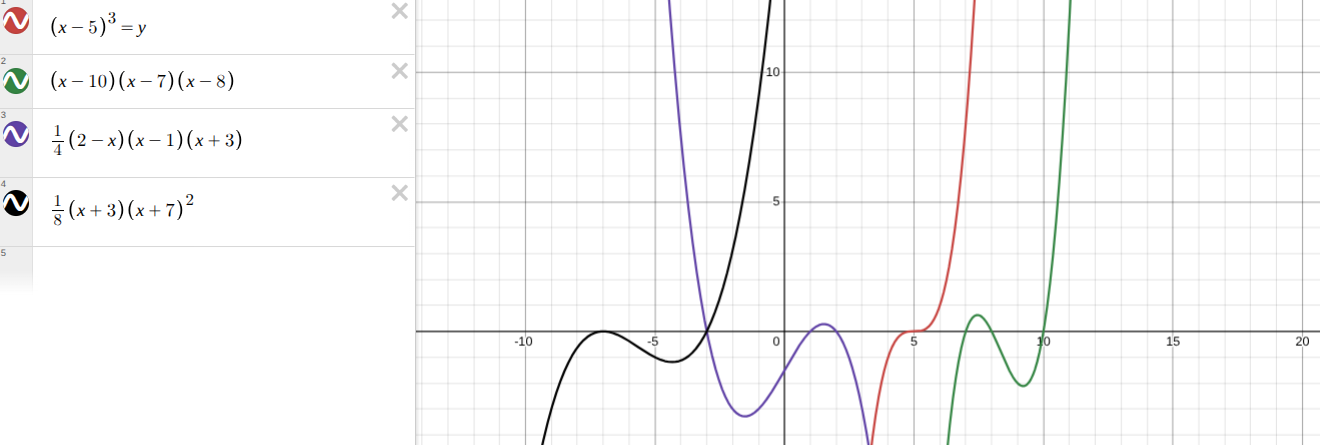
How do you sketch the cubic function y = x³-2x²-3x
y-intercept is 0, factorised form x(x-3)(x+1) tells us the x-intercepts are 0, 3 and -1
positive cubics (ax³) come from the bottom and go up
negative cubics (-ax³) come from the top and go down
If (x-p) is a factor, the graph crosses OR touches (if root is repeated) the x-axis at that point
if you have (x-a)³ you get an inflection at a.
NOTE: if you only have 2 roots, another root is imaginary so the graph still bends but doesn’t cross the x axis
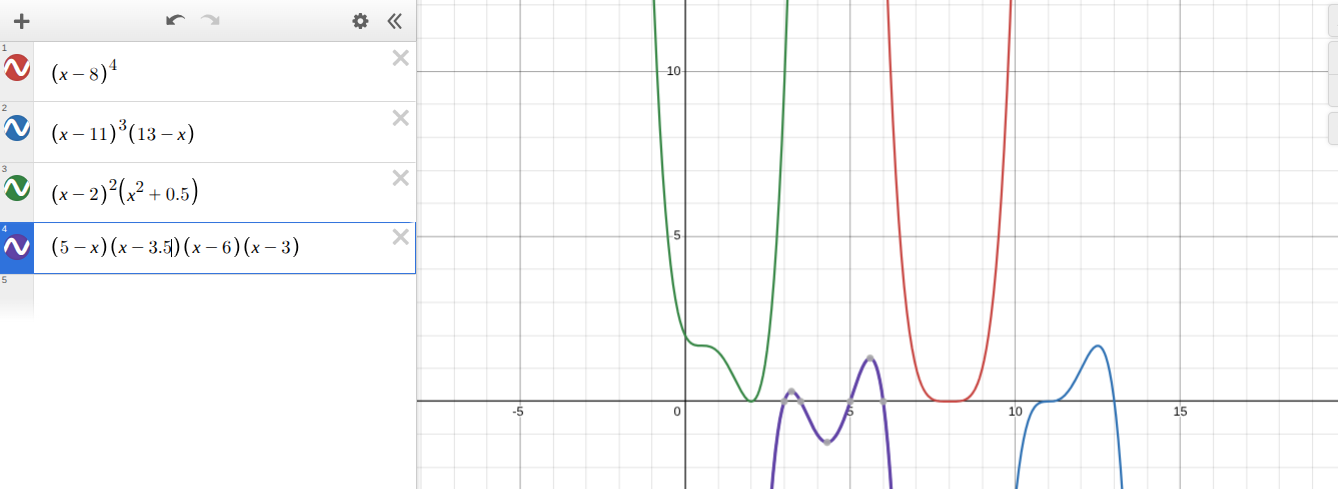
How do you draw quartic graphs?
same as a quadratic, but with a dimple.
Same rules apply as a cubic, but an inflection leads to a FLAT bowl shape, positive = W, negative = M, a lack of 2 real roots, leads to a little zig.

How do you draw reciprocal graphs?
a/x has asymptotes at the coordinate axes
a/x² causes the graph to only be positive, a/-x² causes it to be only negative
contrasting 3/x vs 12/x we see the higher the value of a, the less steep the graph/ the further it is from the coordinate axes.
NOTE: f(x+a), and f(x)+a can be used to translate the graph from there, hence it could touch the coordinate axes, but will always have an asymptote

How do we find coordinates of intersection of 2 graphs
Set their functions equal and solve for x and y.
f(x) = g(x)
NOTE: potentially, drawing them helps a lot (particularly for modulus graphs)
How do we translate graphs by a given vector?
f(x) + a is a translation of f(x) by the column vector (0, a) “up or down”
f(x+a) is a translation by column vector (-a, 0) “right or left“
-f(x) is a reflection in x-axis
f(-x) is a reflection in y-axis
NOTE: the intuition for why f(x+a) leads to a shift by -a, is imagining that the y value for any given x value is being taken from the y value for x+a. This means the future values of x dragged backwards to our function.
just remember -f(x) and f(-x) are counterintuitive (everything that happens inside brackets is opposite to what you expect)
NOTE: when you translate 1/x for example, you also translate the asymptote
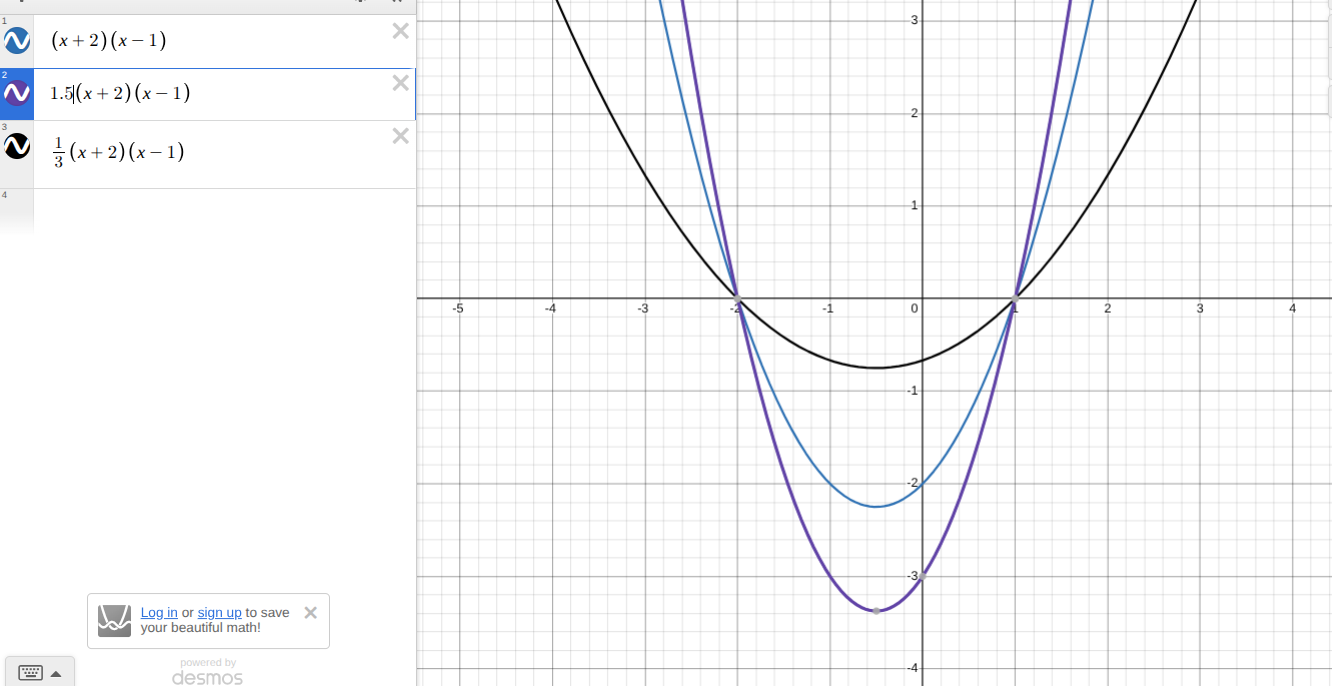
How do we stretch graphs in the y axis and the x axis? When we make these stretches, which points stay invariant, and which points are multiplied by the stretching factor? (HINT: what happens in the brackets is NOT for the values it effects counterintuitive)
y = af(x) is a stretch of the graph by a scale factor of “a” in the vertical direction.
NOTE: x-intercept is invariant, and y-intercept is multiplied by a
y = f(ax) is a stretch of the graph by a scale factor of “1/a“ in the horizontal direction.
NOTE: y-intercept is invariant, and x intercept is multiplied by 1/a
assume y = f(x)
The intuition for this is sensitivity. f(ax) means the sensitivity of x on f(x) is increased (a small increase in x leads to a big increase in y) hence the graph is elongated/squashed horizontally
af(x) means the sensitivity of y on x is increased (small increase in x leads to large increase in y) hence the graph is elongated/stretched vertically. it is literally just ay =x
What is the proof for translations?
assume f(x) = x
f(2x) means y = 2x —> 1/2y = x (every x value has ½ the effect on y)
2f(x) means 2y = x —> (every x value has 2x the effect on y)
NOTE: we are isolating x to see its corresponding effect on y since this is easier to visualise.
When translating an unfamiliar graph, what form will it come in
y = f(x) , with random bs transformations attached. This is important so we don’t mess up our proof from before, since now we replace f(x) with y and x with f(x)
hence it would look something like:
y = 2f(x), ½y = f(x) (so every change in f(x) leads to 1/2 the effect on y)
What are the 4 methods to solve a quadratic equation (one of them being graphically.
eg: x²+6x+9 = x+3
Factorisation: first get all variables to 1 side, then factorise.
x²+5x+6 = 0 —> (x+2)(x+3) = 0 —> x = -2 or -3
NOTE: this works because EITHER x+2 OR x+3 must be equal to 0 for some value of x.
Completing the square:
(x+2.5)² +6-6.25 = 0 —> (x+2.5)² = 0.25 —> x = -2.5 ± 0.5 —> x = -2 or -3
NOTE: This is derived from the idea you can turn a rectangle x(x+b) into a square missing an inner square, hence (x+b/2)² - (b/2)² .
Quadratic formula:
x = [ -b ± √(b² - 4ac) ] / 2a —> [ -b ± √(b² - 4ac) ] / 2a —> x= -2 or -3
NOTE: This is derived from completing the square of ax²+bx+c (when doing so remember to encapsulate negatives in brackets, and divide the x² and x terms by a)
Graphically:
if 2 equations are equal, simply plot them and their intersections will be the solutions for x.
NOTE: exact form means using surds and/or fractions


APPLICATION: given the equation x²+6x+9 graphically, what are the roots of x²+5x+6?
given - desired = line to plot
hence the intersections give you the solutions
NOTE: an alternative way to interpret this is find how much you need to add to the desired value to get to the given value
The proof is that since we need to find the interaction of 2 points to find the desired value, intial = B, initial - B = desired so islating B gives us the formula
What is the 2 common application of quadratics (apart from modeling)?
simultaneous quadratic equations
finding the area of compound shapes, trapeziums, etc
What is the domain of a function? What is a range? what are the roots of an equation?
Domain: set of possible INPUTS for a function
Range: set of possible OUTPUTS for a function (every input links to an output but 1 output MAY have many inputs: one-to-many)
Roots: when an equation (y) equals 0, what are the solution(s) for x
How do you solve a hidden quadratic? what are the potential applications?
x6 + 7x3 - 8 = 0 —> (x³ + 8)(x³ - 1) x = -2 or 1
hidden quadratics exist as one xn term, and one xn/2 term. Hence x and x1/2 also work.
Applications: higher power polynomials, fractional polynomials, trigonometric expressions.
What are the steps when drawing a quadratic graph? What extra point is usually required to be drawn when drawing a quadratic graph?
whether ax² is positive ( U ) or negative ( ∩ ) —> best way is to take the negative out of the equation when factorising to remember
look at c to find the y-intercept
factorise/solve the quadratic to find the roots
take the derivative equal to 0, complete the square (-p, q), or just use your calculator to find the TURNING POINT
(or line of symmetry which is whatever the x coordinate of the turning point is equal to)
What is the other application for completing the square?
translating a graph.
DON’T FORGET: How do you find the equation of a graph of a quadratic when given ONLY the roots?
y = a (x+d)(x+e)
This is because we do not know the STRETCH of the graph
What do all the solutions to the discriminant mean?
No solutions: b² - 4ac < 0 (negative - it means a graph is above is a is positive and bellow if a is negative)
1 solution (repeated root, touches the x axis): b² - 4ac = 0
2 solutions: b² - 4ac > 0 (positive)
NOTE: the discriminant is everywhere. From proving an equation only has no solutions to being given the fact an equation has only 1 solution, and using the discriminant to find a constant k, or an inequality for it if it has multiple OR no solutions.
How are quadratics used to model real life situations?
these models involve simplifications, or are exact ONLY for a specific domain
usually it involves part of a quadratic representative of something being thrown, or ball dropping. Hence it MAY start from a non 0 value.
OR it can represent a quantity, like for example ticket revenue.
What is the cosine rule (for an angle AND for a side length)?
NOTE: c is the opposite in all these examples.
c² = a² + b² - 2ab cos(C)
OR
cos(C) = (a²+b²-c²) / 2ab
NOTE: when finding an angle using the cosine rule, arccos(ans) will almost always be NEGATIVE, but this is normal.
When do we use the cosine rule? And when should we NOT use the cosine rule and instead opt for trig?
When you know SAS - 2 sides and the angle between to figure out the opposite (knowing 2 sides could also be knowing 1 side of an isosceles triangle - It is ALWAYS better to use sin rule for SSA)
OR
When you know SSS - 3 sides, and want to figure out an angle
NOTE: the cosine rule is only useful for NON-RIGHT ANGLED TRIANGLES
else trig is faster.
What is the proof for cosine rule? What happens when we try to prove it for a right-angled triangle?
Draw in the line which represents the perpendicular height, and equate the 2 triangles by using Pythagoras theorem. Find x using the Cos(A) = x/b.
If we were to do this with a right angles triangle, the line which represents the perpendicular height, is already one of the side of the triangle (b), hence there would be no equations to equate, and we would only end up with a² + b² = c²

What are the potential applications of the cosine rule in a question?
application to bearings:
Remember that angles are measured relative to NORTH perpendicular, hence the angles overlap. ALSO it is a FROM b, hence b—>a. You will need to draw the diagram yourself.
application to algebraic triangles:
given some extra information, and unknowns in lengths, you need to bring a triangle into the form of SSS or SAS. Substitute the unknown lengths calculated into the formula.
A good example is knowing 1 side and 1 angle opposite, and the other 2 sides in terms of an unknown eg: (x+2) and (2x-1)
What is the Sin rule (for a missing angle AND a missing side)?
The unknown is always on the top so…
Length: a/sin(A) = b/sin(B) = c/sin(C)
angle: sin(A)/a = sin(B)/b = c/sin(C)
When do we apply the sin rule?
SAA - you want to find the side length
SSA - you want to find the other angle
BUT sin(θ) = sin(180-θ) —> there exists an ambiguous angle when using the sine rule to find an angle, ie: 1 obtuse solution, 1 acute solution.
We can prove this as the graph of sin(x) has two x values for 1 y value between 0 and 180 degrees
COULD BE ASKED: find the 2 possible angles given 2 side lengths and an angle.
To figure this out, either the question will say the angle is obtuse OR acute
OR
you can figure it out using the cosine rule, because cosine results in only 1 correct angle

What is the proof for sin rule?
draw in the perpendicular height of the triangle.
then use trig ratios to find what h is:
h = a x sin(B)
h = b x sin(A)
hence:
a/sin(A) = b/sin(B)
etc…
What is the proof for area of a triangle?
Find the perpendicular height of the triangle.
area = ½ b x h
h = b x sin(C) —>using SOH trig rule
HENCE: area = ½ ab sin(C)
it works with SAS triangles
How do we solve problems invloving triangles?
If the triangle is right angled: Use Pythagoras and trig
If the triangle is NON-right angled: use sine rule when considering 2 sides and 2 angles.
Use cosine rule when considering 3 sides and 1 angle.
NOTE: questions may involve dissecting quadrilaterals, and working with trig in 3d spaces.
The graphs of sine, cosine an tan are periodic. How often do values repeat?
Sin and cos repeat every 360 degrees.
Tan repeats every 180 degrees, with vertical asymptotes at -90, 90, 270…
HENCE: sin θ = sin(360n+θ)
cos θ = cos(360n+θ)
tan θ = tan(180n+θ)
How do we calculate all angles for a value of sin, cos, and tan?
Sin starts from 0, hence has symmetry between 0 to 180. sin θ = sin(180-θ) —> but every 360 the graph becomes negative. Hence sin(x) is only equal every odd interval of 180:
sin θ = sin(180[2n+1] - θ) AND sin(360n + θ)
Cos starts from 1, hence has symmetry between 0 to 360. cos θ = cos(360-θ):
cos θ = cos(180[2n] - θ) AND cos(360n + θ)
Tan only has 1 repeat every 180 so:
tan θ = tan(180n + θ)
NOTE tan has asymptotes at tan(90[2n+1]) —> [2n+1] basically just means in every other section of an interval.
How do we transform trig graphs using f(x+a), f(x)+a, f(-x), -f(x)
NOTE: pay attention to the interval on which you are working. Then determine the origin, followed by the placement of x axis, y value of peaks, x values of repeating units, and points of asymptotic.
f(x+a):
move the graph “a” backwards. ie: the origin starts from -a
—> sin(θ - 45) means origin is sin(45) or 0.707.
f(x) + a:
move the graph up or down by a —> the x axis is at y = a
NOTE: moving up a graph, is the equivalent of shifting the coordinate axes down. SO cos(θ) + 1 means the lowest point of the graph is now the x-axis.
f(-x):
reflect the graph in the y-axis. For a cosine graph, this has no effect (since it is symmetrical)
For a sin or tan graph however, all positive values become negative, and all negative values become positive.
-f(x):
reflect the graph in the x-axis.
All 3 trig graphs have their negatives turn positive and via versa
NOTE: -sin(θ) = sin(-θ) AND -tan(θ) = tan(-θ)
BUT NOT cos(θ) —> cos(-x) = cos(x) (because cosine is an “even function”, similar to an even power function which turns any negative inputs into positive outputs)
How do we transform trig graphs using f(ax) and af(x)?
f(ax):
we divide all x values by a (compressed graph) and the y-intercept stays the same
this results in a graph with smaller gaps between repeating units
NOTE: for tan this repeating unit should be thought of as where the asymptotes lie.
af(x):
we multiply all y values by a (stretched graph) and the x-intercept stays the same. This results in a graph with higher amplitude.
NOTE: for the tan graph, the stretch has no visible impact on the graph, but instead changes key in-between values on the y axis.
CHALLENGE: How to we turn a trig graph into its equation?
using the general form af(bx+c) + d:
determine which trig function it is (this is usually given to you, BUT if not it highlights the fact that cos(θ - 90) = sin(θ) )
determine the height of the normal to find d (this is kind of like the new x-axis)
determine the y stretch, AFTER taking into account d. SO if the peak of the function is 3-d, then a = 3
find the true origin (root) by doing: (r-d)/a —> this tells us -c
once having identified the up to f(bx) to find a known x and y coordinate, eg: (540,-1) looking at a normal cos graph, you know the x coordinate is meant to be 180. Hence do 540/180 = 3x scale factor for the x-axis. But because this is inside the bracket, b = 1/3 (becuase x has 1/3 the sensistivity)
NOTE: you will NEVER be given all these transformations on a graph. What you WILL be given is a combination of these, and so (especially for stretches) it is important to consider the parts of the transformation which cannot be verified, eg: simply knowing the x-intercepts means we cannot tell what a is, because we don’t know the peaks of the graph.
What is cos, sin and tan representing on the radius triangle of a unit circle?
A unit circle is a circle with radius 1. If this is the hypotenuse of a triangle, for any point p on the circumference:
sin(θ) = o/h —> y/1 = y
cos(θ) = a/h —> x/1 = x
tan(θ) = 0/a —> y/x = the gradient
NOTE: tan is undefined when the gradient is a vertical line, hence at 90 degrees there is an asymptote, because cos θ = 0
Now this unit circle explains why sin and cos are periodic every 360 degrees (because the x AND y coordinates repeat after 1 full revolution of the unit circle) AND why tan is periodic every 180 degrees (because the gradient repeats in the diagonally opposite quadrant so twice every revolution)
HOWEVER, for sin and cos, you will see there are 2 solutions every revolution, because there 2 quadrants where x is positive, and 2 quadrants where y is positive. WHY IS THIS???

How can we use the unit circle to find all the angles for which a trig function is equal? How does this relate to the formulae derived previously where we discovered, cos was an even function, sin was an odd function, and tan had only 1 formula associated with it?
We turn the unit circle into a “CAST“ diagram. From the bottom left to the the bottom right —> cos is positive, all are positive, sin is positive, tan is positive
Hence lets say we have sin(+θ). We would only use the quadrants A and S (angle measured from 0 cw and from 180 ccw, to get the same y value)
For cos(+θ) We use the quadrants A and C (angle measured from 0 cw and from 360 ccw, to get the same x value - but because 0 and 360 are the same we can say that cosine is measured from 360 both cw and ccw)
NOTE: this makes sense because for sin, the function repeats every odd interval of 180, hence the way we figure it out is by finding 360+θ and 180-θ. For cosine the function is “even“ hence negative angles give positive outputs hence 360 +/- θ —> cos(-θ) = cos(θ) (because cosine is symmetric in the y-axis).
To find the values for negative angles, you simply measure the angle counterclockwise from 0 (which is the same as 360) and so -40 looks like 360+(-40) = 320.
OR
just ignore the negative sign and see it as θ, and follow the pre-memorised formulae.
Finally, to calculate all the other values of θ, find the 2 values of the angle between 0 and 360 (using the established rules for sin, cos and tan). Then to calculate smaller values, -360 from both values of θ (the equivalent of a full rotation ccw). To calculate larger values. +360 to both values of θ (the equivalent of a full rotation cw)
In both cases (+ or - 360) we end up at the same point on the circle, so our output will be the same.


prove cos(-θ) = cos(θ) using a cast diagram?
(HINT: You need to show that the x values are the same on the cast diagram for θ and -θ)
-θ is drawn ccw from 0 and θ is drawn cw from 0
the equation for the x coordinates is x = cos(θ)
AND
the x-coordinates for cos(θ) and cos(-θ) is both θ. —> hence cos(θ) = cos(-θ)
FULL PROOF:
The points θ and -θ are reflections in the x-axis,
hence the x-coordinate (which = cos(θ)) is preserved in the transformation,
hence cos(θ) = cos(-θ )

how do we derive exact trig using triangles? How do I do it?
half an equilateral triangle with side length 2 (other sides: √3 and 1 —> angles: 60 and 30)
half a square with side length 1, 1 and √2 —> angles: 45 and 90
We use trig to find the exact values from these triangles
OR we use the fingers method:
cos(x) = √(fingers above) / 2
sin(x) = √(fingers bellow) / 2
tan = FLIP HAND (makes sin to cos) —> √(fingers above) / √(fingers bellow)
What is the equation of a unit circle? What is the other trigonometric identity to do with tan?
NOTE: an identity uses ≡ to show they are always true under the given domain, whereas = may have non-solutions
x² + y² = r² —> when centre is at the origin
x² + y² = 1
x = cos(θ) and y = sin(θ)
HENCE:
cos²(θ) + sin²(θ) = 1
tan(θ) = y/x or gradient —> SO:
tan(θ) = sin(θ) / cos(θ) , where cos(θ) ≠ 0
NOTE: the easiest way to remember this is y/x, hence gradient, then also know that cos corresponds to x and sin corresponds to y
What are the range limits of sin and cos? Does tan have range limits?
tan θ = y has no maximum or minimum values
sin(θ) = k and cos(θ) = k are defined for -1 <= k <= 1
NOTE: this is especially important to keep in mind for hidden quadratics, where you need to be able to identify if certain solutions are defined.
What is the value of the angle that your calculator gives you when you use an inverse trig function called? What do we use this special angle for?
Calculators only give the “principle value” —> we + or - 360 from this value (and find to its symmetric graphical counterpart) to find the values we need between the interval we are required to.
arccos —> 0 ≤ θ ≤ 180 —> because cos is an “even function“, no negative principle values
arcsin —> -90 ≤ θ ≤ 90
arctan —> -90 < θ < 90
NOTE: you may be asked “what has a student done wrong?“ and to that end you often need to identify either ONLY a principle value has been given OR a principle value has been wrongly used to calculate a supposed additional solution (which you can prove is false be showing that the value has been taken from the negative quadrant on a cast diagram)
Solve tan²(θ) = 9
when square rooting both sides, consider a + or - solution:
tan(θ) = +3 or -3
θ = 71.6 OR -71.6 —> as well as whatever interval the angles needed are in
How do we solve sin(nθ), cos(nθ), tan(nθ)?
Assume we want to find out the values 0 ≤ θ ≤ 360 (worst case scenario you rearrange it till it looks like this)
The trick is assuming x = nθ
then multiply the given inequality by n:
0n ≤ nθ or x ≤ 360n —> ONLY once you get the solutions for this inequality using x, then divide by n
eg:
cos(3θ) = 0.766
cos(x) = 0.766
0 ≤ 3θ or x ≤ 1080
x = 40 (principle value) —> because cos in an “even function“ x = -40 as well
—> all solutions between given function + 360k —> 40, 320, 400, 680, 760, 1040
SO dividing these solutions by 3 gives:
θ = 13.3, 107, 133, 227, 252, 347
NOTE: the same thing applies if you have… say sin(2θ+45)
now x = 2θ+45 AND 45 ≤ 2θ+45 ≤ 765
—> i have done the same to θ as i have each of the bounds.
What is the form of a trigonometric hidden quadratic? What is the most important thing to remember about its solution?
Asin²(θ) + Bsin(θ) + C
you MUST remember to check sin(θ) and cos(θ) have solutions between -1 and 1. For tan(θ) it explicitly has no minimum or maximum solutions, BUT may have to contain the fact that tan(90[2n+1]) has no solutions!