Chapter 3 - Cells: The Living Unit
 Call Kai
 Learn
Learn Practice Test
 Spaced Repetition
 Match
Match Flashcards
 Knowt Play
1/144

There's no tags or description
Looks like no tags are added yet.
Name | Mastery | Learn | Test | Matching | Spaced | Call with Kai | Chat |
|---|
No analytics yet
Send a link to your students to track their progress
145 Terms
Cell metabolism
The sum of all chemical reactions in a cell; allows cells to obtain nutrients, form chemical building blocks, and harvest energy for survival.
Maintain cell shape and integrity
Maintaining the cell's structure and the boundary separating intracellular components from extracellular components.
Dispose of wastes
Removing wastes to avoid their accumulation and disruption of cellular activities.
Cell reproduction
New growth and replacement of dead or damaged cells.
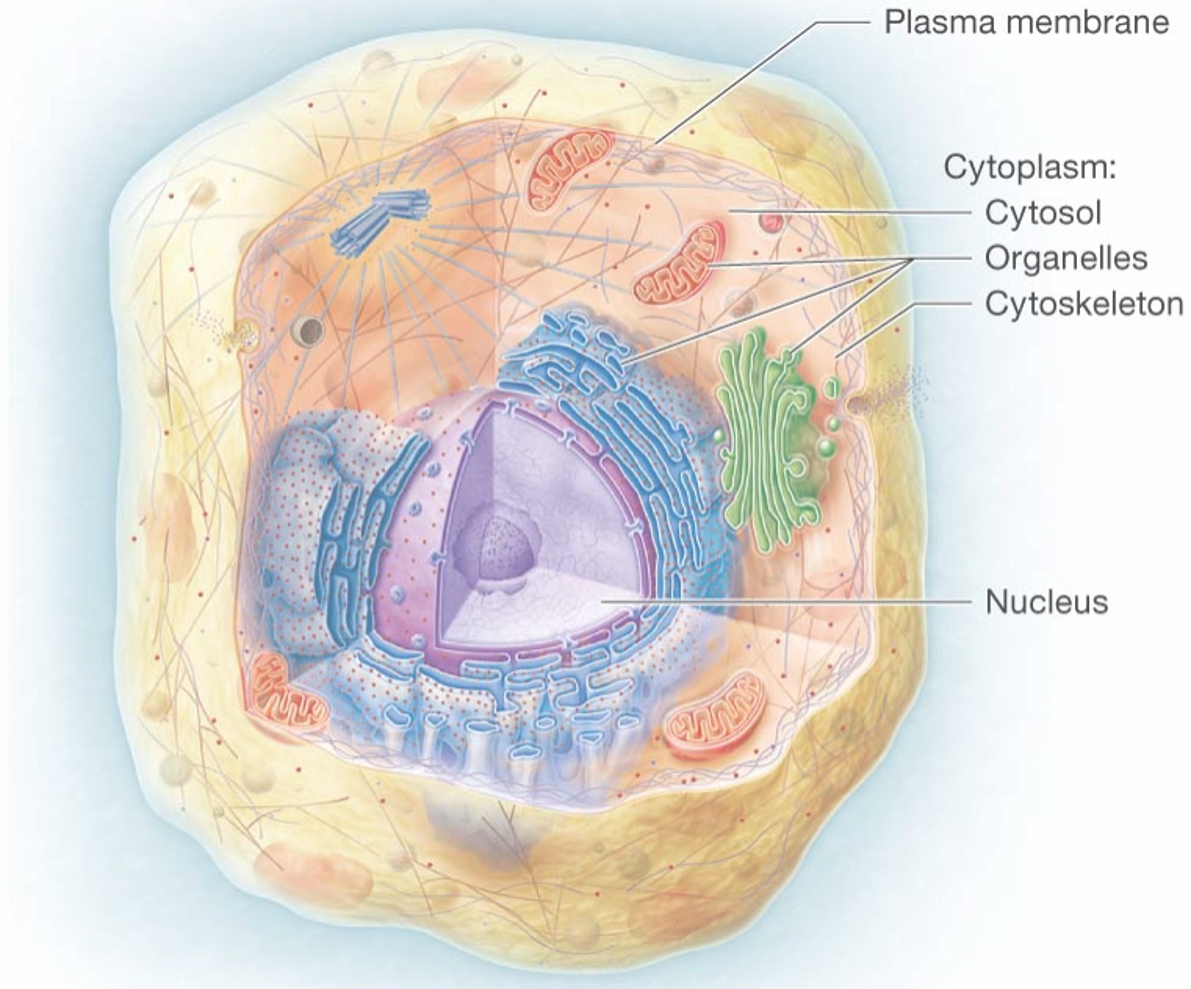
Plasma membrane
The outer limiting barrier separating the internal contents of the cell from the external environment.

Nucleus
The largest structure in the cell; contains genetic material, DNA, and is enclosed by a nuclear envelope.

Cytoplasm
The cellular contents between the plasma membrane and nucleus.

Cytosol
The gel-like intracellular fluid.

Organelles
Structures within the cell that perform specific functions.
Cytoskeleton
A nonmembranous cellular structure included within the cytoplasm.
Phospholipid
A lipid that forms the main structure of the plasma membrane.

Phospholipid bilayer
A double layer of phospholipids that forms the main membrane.

Hydrophilic head
The polar head of a phospholipid that faces the fluid on either side of the membrane.

Hydrophobic tail
The nonpolar tail of a phospholipid that faces the other tails and forms a barrier.

Cholesterol
A membrane component that gives the membrane varying degrees of temperature stability and flexibility versus rigidity.
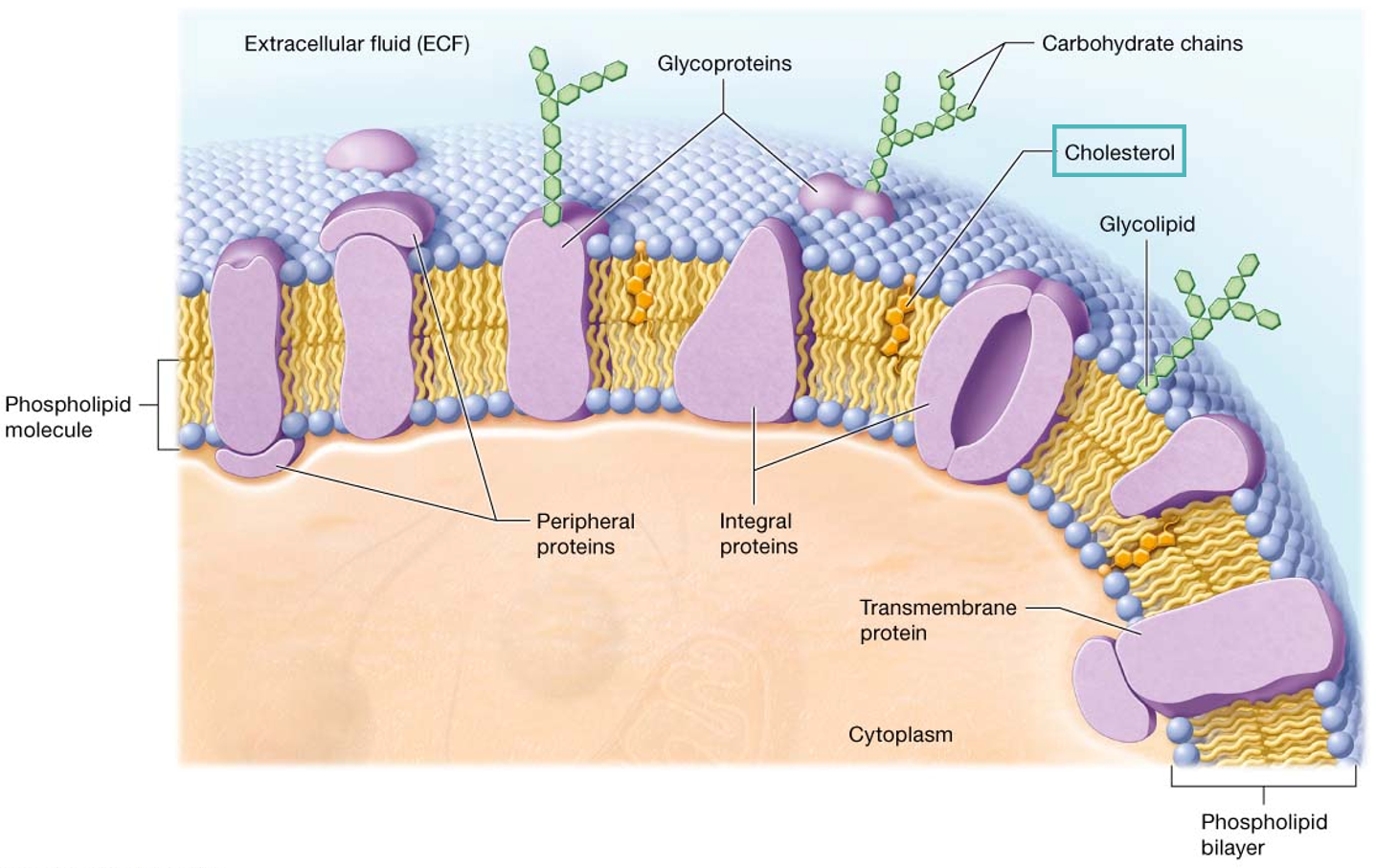
Glycolipid
A lipid with a carbohydrate component on the outer region of the membrane.

Glycocalyx
A sugar coating that enables a cell to identify itself to other body cells, primarily immune cells.
Integral protein
A membrane protein that spans the phospholipid bilayer.
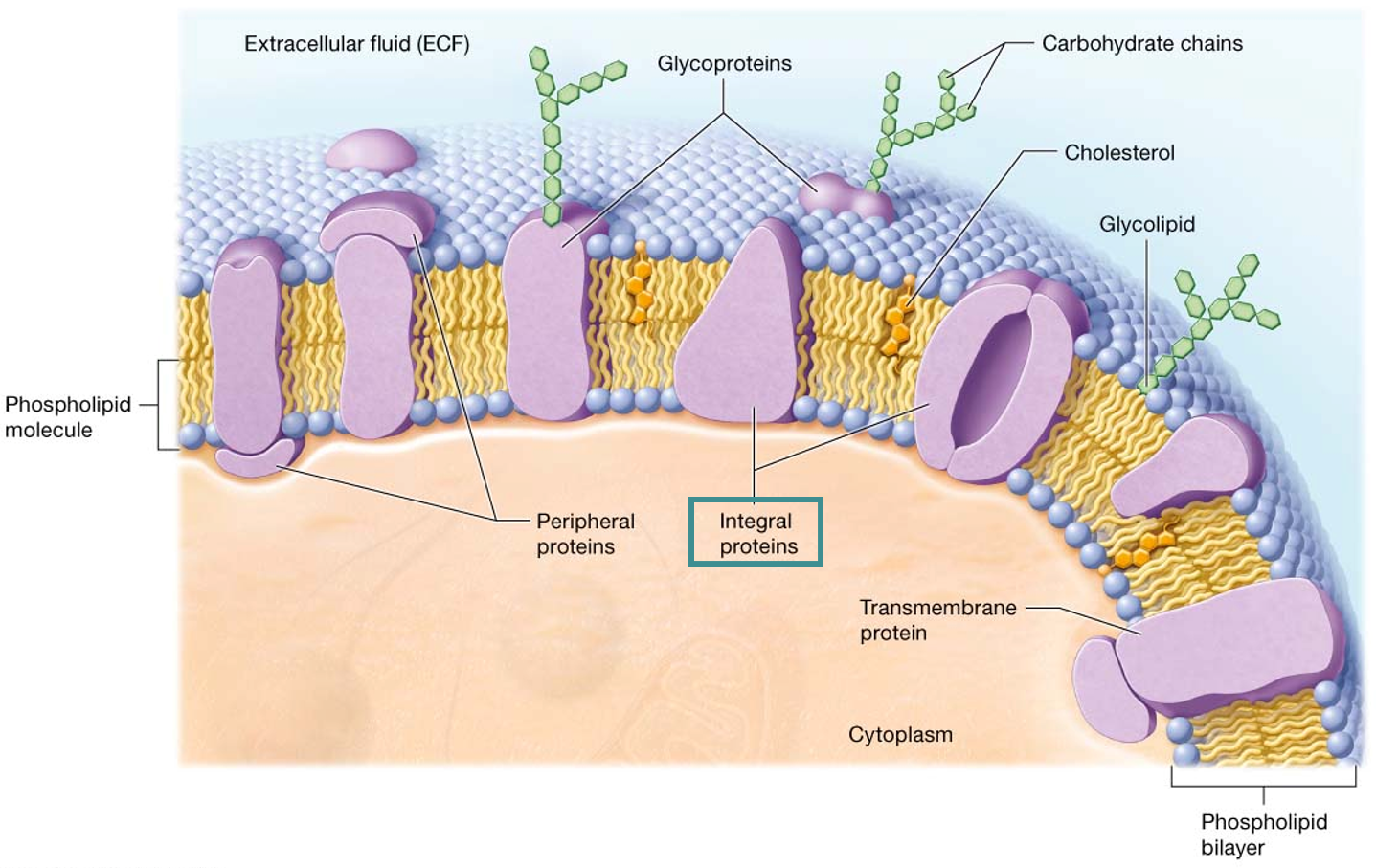
Transmembrane protein
An integral protein that spans the entire phospholipid bilayer.

Peripheral protein
A protein located on one side of the membrane that does not span the phospholipid bilayer.

Integral protein function
Integral proteins mainly function as transport proteins.
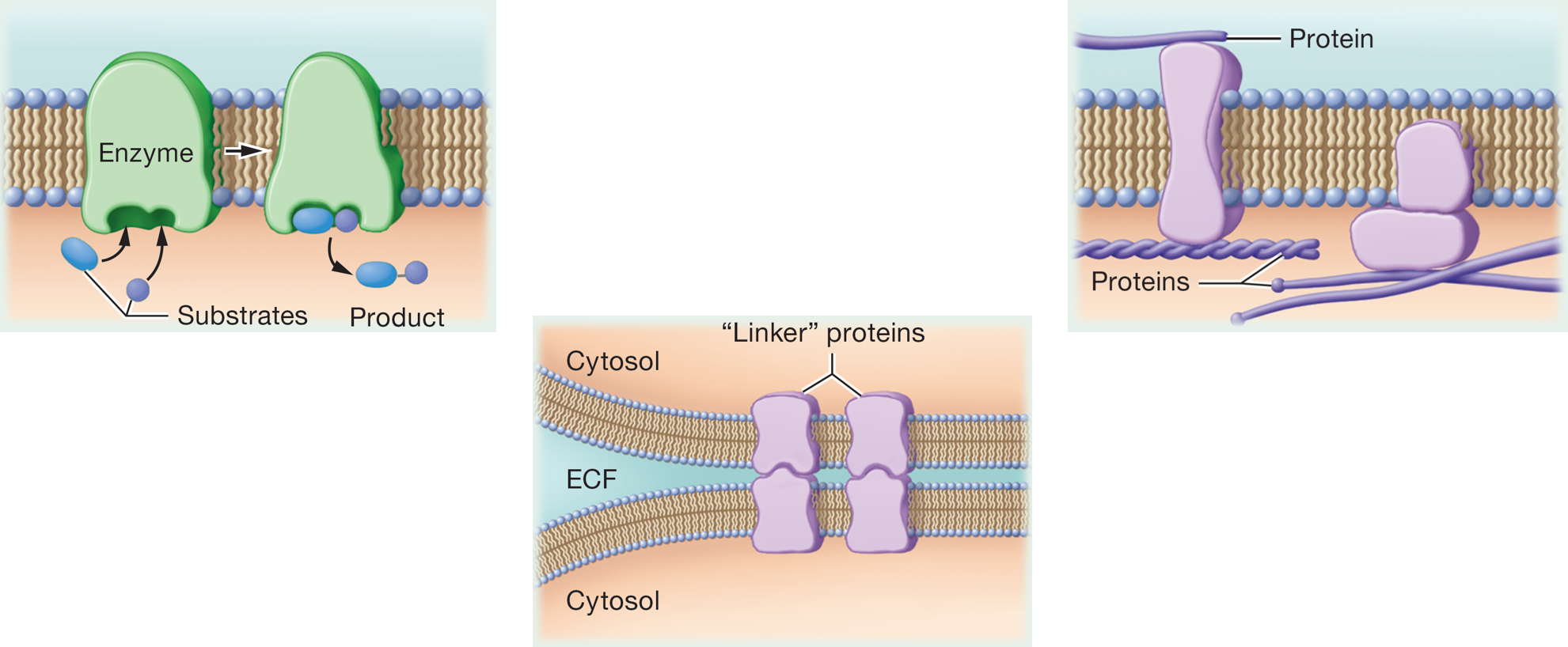
membrane protein functions
Peripheral proteins function as enzymes, cell-to-cell connections, and structural support.
Selective permeability
The ability of the plasma membrane to regulate what can move through the membrane, both into and out of the cell.
Plasma membrane functions
Separates intracellular fluid from extracellular fluid, regulates movement through selective permeability, relays messages between inside and outside of cells, and allows cell recognition.
Leaky channel
A membrane channel protein that is always open.

Gated channel
A membrane channel that opens in response to a chemical or electrical signal.

Carrier protein
A membrane protein that allows substances to pass by changing its shape.

Membrane transport
The movement of substances across the plasma membrane.
Passive transport
Transport that does not require energy and moves substances down their concentration gradient.
Concentration gradient
The difference in concentration of a substance between two areas.
High to low concentration
Movement down a concentration gradient.
Low to high concentration
Movement against or up a concentration gradient.
Diffusion
The movement of solutes from high concentration to low concentration until concentrations on both sides are equal.
Diffusion rate
Diffusion goes faster with: steeper concentration gradients, higher temperatures, larger surface areas, and smaller molecule sizes. It goes slower over longer distances.
Simple diffusion
Passive movement of substances directly through the phospholipid bilayer from high to low concentration.
Simple diffusion substance example
Oxygen (O2) enters cells by simple diffusion.
Facilitated diffusion
Passive movement of substances down their concentration gradient using a transmembrane protein.
Channel-mediated diffusion
Facilitated diffusion through a membrane channel.

Carrier-mediated diffusion
Facilitated diffusion using a carrier protein that changes shape.

Na+ leak channel
An example of facilitated diffusion in which Na+ moves through a leak channel down its concentration gradient.
Osmosis
The diffusion of water across a membrane.

Osmosis direction
Water moves toward the side with the higher solute concentration.
Aquaporin
A membrane channel that allows water to cross the plasma membrane.

Osmotic pressure
The pull on water toward an area with a higher solute concentration.

Tonicity
A solution's ability to change cell volume or pressure through osmosis.
Isotonic solution
A solution with the same solute concentration as the cell; there is no net movement of water.

Hypotonic solution
A solution with a lower solute concentration than the cell; water moves into the cell.

Hypertonic solution
A solution with a higher solute concentration than the cell; water moves out of the cell.

Lysis
Rupture of a cell caused by excessive water entering the cell.
Crenation
Shriveling of a cell caused by water leaving the cell.
Active transport
Uses energy to pump a solute across a membrane against or up its concentration gradient. low concentration to high concentration.
Three types of active transport
Primary active transport, secondary active transport, and vesicular transport.
Primary active transport
Uses ATP directly to pump substances across the plasma membrane against their concentration gradient.
Na+/K+ exchange pump
Pumps 3 Na+ out of the cell for every 2 K+ pumped into the cell.

Na+ concentration
Na+ is more concentrated outside the cell than inside.
K+ concentration
K+ is more concentrated inside the cell than outside.
Na+/K+ pump ATP use
The Na+/K+ pump uses about 40% of the body's ATP.
Na+/K+ pump function
Maintains electrochemical gradients by maintaining more Na+ outside the cell and more K+ inside the cell.
Secondary active transport
Uses energy generated by the movement of one substance across the plasma membrane to move another substance against its concentration gradient.
Na+/Glucose Transporter (Secondary Active Transport)
A transport mechanism where Na+ moves down its concentration gradient, generating the energy required to power the movement of glucose against its concentration gradient (from low concentration inside the cell to high concentration outside).

Vesicular transport
Cells form small membrane sacs called vesicles to engulf substances and bring them into or out of the cell.
Endocytosis
Vesicular transport in which substances enter the cell.
Exocytosis
Vesicular transport in which substances leave the cell.

Phagocytosis
Cell-eating; the cell membrane wraps around a large particle and forms a phagosome.
Phagosome
A vesicle formed during phagocytosis that contains the engulfed particle.
Phagosome contents
The contents of a phagosome are degraded by lysosomes.
Pinocytosis
Cell-drinking; the cell membrane forms small vesicles that bring in substances dissolved in extracellular fluid.
Receptor-mediated endocytosis
A very specific form of endocytosis in which substances bind to specific receptors before entering the cell.
Receptor-mediated endocytosis examples
LDL cholesterol, iron, and viruses.
Exocytosis steps
Vesicles containing molecules move toward the cell membrane, fuse with it, and release their contents outside the cell.

Exocytosis examples
Wastes, hormones, and neurotransmitters.
Membrane potential
The electrochemical charge difference across the plasma membrane.
Ion
An atom that has more or fewer electrons than normal and therefore has an electric charge.
Cation
A positively charged ion that has lost one or more electrons.
Cation examples
Na+ and Ca2+.
Anion
A negatively charged ion that has gained one or more electrons.
Anion example
Cl−.
Electrochemical gradient
A difference in charge and concentration of ions across the plasma membrane.
Resting membrane potential (RMP)
The electrical charge difference across the plasma membrane under normal functioning conditions.

Normal resting membrane potential
Usually around −70 mV.
RMP condition 1
Unequal distribution of ions and molecules across the plasma membrane.
RMP condition 2
Unequal relative amounts of positive and negative charges.
RMP ion distribution
There is more K+ in the cytoplasm than in interstitial fluid and more Na+ in interstitial fluid than in cytoplasm.

RMP charge distribution
There are more positive charges outside the cell, producing a negative potential inside the cell.

RMP maintenance
Na+/K+ pumps maintain ion gradients, while negatively charged proteins are trapped inside the cell due to selective permeability.
Importance of membrane potential
Maintaining membrane potential is critical for cells; changing membrane potential allows cells to receive communication and get things done, especially muscle cells and neurons.
Mitochondria
Double-membrane organelles that harvest energy from organic molecules to produce ATP through aerobic cellular respiration.

Mitochondrial inner membrane
The inner membrane is extensively folded into cristae to increase surface area.

Cristae
Folds of the mitochondrial inner membrane that increase surface area.
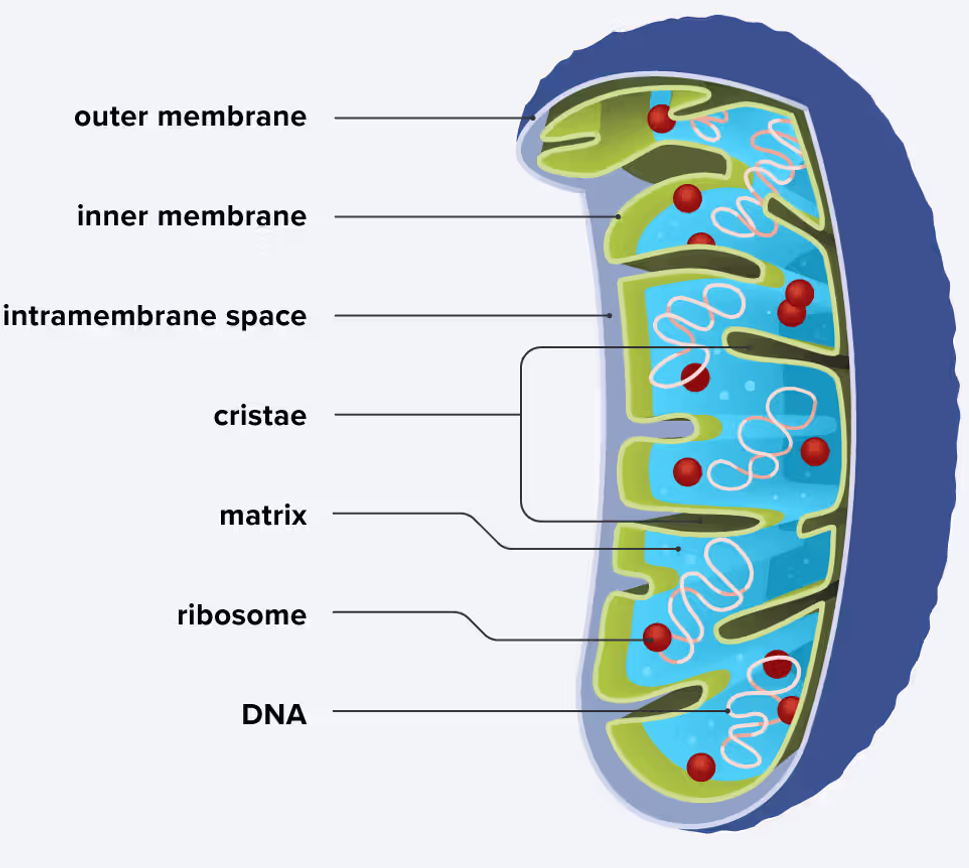
Mitochondrial DNA
Mitochondria contain their own DNA and RNA.

Mitochondria evolution
mitochondria evolved from bacteria.
Ribosome
A nonmembranous organelle composed of protein and RNA that performs protein synthesis.

Ribosome structure
Ribosomes contain a large subunit and a small subunit.

Bound ribosome
A ribosome attached to the endoplasmic reticulum.
Free ribosome
A ribosome suspended within the cytosol.
Endoplasmic reticulum (ER)
A membrane-bound organelle involved in protein or lipid-related cellular processes, with rough and smooth regions.
Rough ER
A series of interconnected cisterns continuous with the nuclear envelope and containing ribosomes.

Why rough ER looks rough
It contains ribosomes on its surface.

Rough ER function
Protein synthesis and modification.
Smooth ER
Folded tube-like structures called tubules that do not contain ribosomes.
