Kinese Exam 4
 Call Kai
 Learn
 Practice Test
 Spaced Repetition
 Match
 Flashcards
 Knowt Play
1/94

There's no tags or description
Looks like no tags are added yet.
95 Terms
15-20
At what ages does the pubis fully ossify?

inferior, lateral, anterior
What 3 directions does the acetabulum face?
smaller, greater
coxa vara is ______ than the normal angle. Coxa valga is ______ than the normal angle
anteversion

retroversion

extension, abduction, internal rotation
the closed packed position of the hip
cam deformity
bone overgrowth on the femoral neck

pincer deformity
Acetabular overcoverage causing it to be too deep.

iliofemoral ligament
one of the strongest ligaments in the body that prevents hip hyperextension. Inverted y ligament on the hip
flexion, external rotation, abduction
greatest articular contact of the ligaments of the hip position
convex, concave
At the hip the femur is ______ and the acetabulum is ______
spin
what motion is flexion and extension of the hip in open chain?
hip flexion, hip extension
Anterior pelvic tilt is the same as _______. Posterior pelvic tilt is the same as hip ______
abduction
Hip hike on the unsupported side is the same as ______
adduction
Hip drop on the unsupported side is the same as ______
ipsidirectional rhythm

contradirectional rhythm
Happens during anterior/posterior pelvic tilt, and hip hikes and internal and external rotation

anterior tilt
If the femur is fixed, what do the hip flexors do at the pelvis?
extension
Anterior tilt of the pelvis causes spinal ______
adductors
What muscles are controlling the pelvis in the image on the right?

hip flexion and extension
In the sagittal plane what are the roles of the hip adductors?
hip extensors
Posterior tilt of the pelvis when the femur is fixed is caused by the ______
hip extensors
Anterior tilt of the pelvis is controlled eccentrically by what muscles?
external rotators
What muscle group help to increase the congruence of the hip joint (similar to rotator cuff)
none
Name the primary internal rotators
decreases, lower
The cane on the contralateral side ________ the weight and _______ the hip abductor activity.
lowers
Carrying a load on the ipsilateral side increases the weight overall and _______ the hip abductor activity/JRF
Superior acetabulum
Where is the most degeneration in the hip articular cartilage after age 55? Due to less compression in that area
convex
The femoral condyles are (convex/concave?)
lateral, medial
The _____ femoral condyle appears longer anteriorly but the _____ femoral condyle is actually longer
medial
The ______ femoral condyle extends further distally
5-10 degrees
Normal amount of genu valgus?
medial
What menisci is c shaped and more stable
inner zone
where do meniscus tears happen most often (what portion)
lateral
What menisci has a lower risk of injury?
semimembranosus
What muscle does the medial meniscus attaches to?
deep layer
What part of the extensor retinaculum is more longitudinally oriented?
posterolateral
what part of the lateral capsule is harder to rehab due to the high volume of structures in the area?

plica syndrome
Chronic irritation of the synovial tissue around the patella resulting in a tender fibrotic band usually medial to the patella
full extension, 30 flexion
What two positions of the knee should you assess the medial collateral ligament?
30 flexion
What position should you assess the LCL?
MCL, LCL
The _____ assists more with ACL restrictions while the ____ assists more with PCL restrictions
30 degrees flexion
Where is the ACL and PCL both relatively slack?
posterior, inferior
What direction does the axis of rotation move during knee flexion
superior, anterior
What direction does the axis of rotation move during knee extension
same
If the tibia is moving on the knee, the roll and glide are in ____ directions
opposite
if femur moving on the tibia (closed chain), the roll and glide are in ______ directions
ACL, PCL
The _____ can facilitate that anterior glide of the femur, while the _____ facilitates the posterior glide of femur
The screw-home mechanism in open chain is the ______ rotation of the tibia which takes the tension off the cruciate allowing them to unwind a little
internal
The screw home mechanism in closed chain is the _____ rotation of the femur.
medial, lateral
During external tibial rotation/internal femoral rotation, the posterior _____ meniscus and anterior ______ meniscus is stressed
lateral, medial
During internal tibial rotation/external femoral rotation, the posterior _____ meniscus and anterior ______ meniscus is stressed
Full extension
Where is the greatest torque output for the knee flexors?
45 degrees
Greatest torque output for knee extensors?
superior
When extending the knee, which way does the quads pull the patella?
lateral facet
What side of the patella is larger and extends higher?
extension
What position should the knee be in for maximal patellar mobility? This is due to least amount of contact
extension
What position of the knee provides the least amount of compressive forces on the patella?
q-angle
Line of pull between the quads and patellar tendon is called the ______? 15 degrees is normal
lateral dislocation
A large q-angle can increase the likelihood of what to the patella?
ACL, MCL, medial/lateral meniscus
Unhappy triad injury of the knee?
mcl
Can the mcl or lcl take more force before failure?
internal
Dynamic valgus causes _____ rotation of the femur
external rotation
what direction should you rotate the tibia to cause less stress on the acl?
proximal-distal
The proximal tibiofibular joint is a flat joint that is stable and doesn't have much movement besides some rotation and a ________-______ glide
tibia, fibula
At the distal tibiofibular joint, the______ is concave while the____ is convex
tibia
What bone does most of the weight bearing go through between the tibia and fibula?
wider
The anterior side of the talus is _____compared to the posterior side
same
In closed chain at the talocrural joint, the roll and glide are in the ______ direction
inferior, superior
At the tibiofibular joint, when the ankle goes into dorsiflexion, there is a slight _____ glide. In plantar flexion there is a slight ______ glide.
10-15
How much dorsiflexion is needed during functional gait?
15-25
How much plantarflexion is needed during functional gait?
eversion, dorsiflexion, abduction
What are the three main components of foot pronation?
inversion, plantarflexion, adduction
What are the three main components of foot supination?
concave, convex
The posterior facet of the subtalar joint, the talus is _____ while the calcaneus is ______
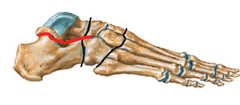
convex, concave
The anterior and middle facet of the subtalar joint, the talus is _____ while the calcaneus is ______
subtalar
Does the subtalar or talocrural joint contribute more to eversion-inversion?
dorsiflexion, eversion, abduction
Pronation movements for non-weight bearing of the calcaneus:
plantar flexion, inversion, adduction
Supination movements for non-weight bearing of the calcaneus:
plantarflexion, adduction
Pronation movements during weight bearing for talus:
dorsiflexion, abduction
Supination movements during weight bearing for talus:
internally
During pronation of the foot the leg tends to ______ rotate in weight bearing
supination, pronation
_____ will lead to the axes of the foot to become more oblique. ________ will make them more parallel.

supination
Does supination or pronation "lock" the forefoot and decrease mobility?
Lisfrancs
tarsometatarsal joints are also called the ______. Connects tarsals with cuneiforms and cuboid
transverse tarsal, TMT
What joint keep the toes on the ground during subtalar motion? If this does not work, what joint must kick in?
same
The MTP, and PIP joints of the foot, the roll and glide occur in _____ directions
big toe
What toe has the most stability in the foot?
windlass effect
Extension of the toes creates tension on plantar fascia and causes the 1st metatarsal and calcaneus to move closer together, height of arch increases , gives elastic energy when walking. Makes foot more rigid
spring
main ligament that supports the arch of the foot
pronation
does pronation or supination flatten the arch and separate the attachments increasing tension?
fibularis longus, tibialis posterior
What extrinsic two muscles supply the arch support in the foot on the plantar side
medial
what side of the midfoot gets the most force through it?
supination
When push off phase of gait, the foot is more in _______ which is due to the insertion of the triceps surae muscles on the calcaneus
pronation, supination
If rearfoot is in varus, must fall into _____ to get toes to ground. If rearfoot in valgus, must _____ to get toes to ground