Unit 2: Mendel, Extensions to Mendel, Inheritance and More!
 Call Kai
 Learn
 Practice Test
 Spaced Repetition
 Match
 Flashcards
 Knowt Play
1/97

Earn XP
Description and Tags
Biology is fun
98 Terms
Spermists/Spermism
The belief there was a little human in each sperm
Ovists/Ovism
Belief that the human was born in an egg
Why is the blending theory proven to be wrong?
After so many generations, we should all look the same, or similar as we would all be a mix of the same genes. But obviously, we don’t
Why did Gregor Mendel work with pea plants?
They have a small size, short generation time, and there is a lot of variability.
What is a true breed?
Having the same alleles for one gene. (Homozygous dominant and homozygous recessive)
Summarize Mendel’s experiment
Start with true-breeding varieties for each character h was studying
Cross-fertilize true-breeding strains having alternate forms of a trait
Creates hybrids
Hybrid offspring self-fertilize for several generations and count the # of offspring showing each form of trait
Can a homozygous recessive individual ever carry the dominant allele for that trait? Why or why not?
A homozygous individual can never carry the dominant allele as both of their genes are recessive. They both have recessive allele, and cannot show the phenotype or genotype of a dominant allele.
Using Mendel’s law of segregation, explain this statement, “Gametes only have one allele for each gene.”
Two alleles for a character separate during anaphase 1 and end up in different gametes
When in meiosis do alleles separate?
Anaphase 1
If you were asked to determine the probability of picking two blue M&Ms from a package, would you use the multiplication rule or the addition rule?
Multiplication
What if you were asked to determine the probability of picking a Christmas color (red or green) M&M from a package? Would you use the multiplication rule or the addition rule?
Addition
Why is it possible to be a carrier of a recessively inherited disorder that does not have the disease?
You can be a carrier for a recessively inherited disorder as having a dominant allele causes you to have that phenotype. So an individual with phenotype Aa does not show the recessive disorder, but can still pass the a to their children.
Why is it NOT possible to be a carrier of a dominantly inherited disorder that does not have the disease?
If you have a dominant disorder, just one dominant allele is needed to have the phenotype. You cannot be a carrier because you either have the disorder or you don’t.
In peas, yellow seed color is dominant to green seed color. I have a yellow seed and I plant it and let it grow in to a pea plant. How can I figure out the genotype of my yellow-seeded pea plant?
Perform a testcross by breeding it with a homozygous recessive green plant (yy). If all offspring have yellow seeds, the parent is homozygous dominant (YY); if the offspring show a 1:1 phenotypic ratio (50% yellow, 50% green), the parent is heterozygous (Yy).
What happens at the molecular level when genes are passed on to offspring? (When genes are passed down)
Alleles that code for different traits code for different things in DNA. For example, with purple flowers, the involvement of a cytosine leads to production of an enzyme which creates a purple flower. If a different allele is used instead, the enzyme for purple petals would not be produced, creating a different color.
Mendel’s First Law (What is it? And what does that mean?)
Law of Segregation
Two members of a gene pair (alleles) separate from each other during formation of gametes
What is a testcross?
Testing an unknown with a homozygous recessive to predict the results of the offspring.
What can we do from Mendel?
Predict phenotype
Determine parental genotype
Create pedigrees
Three parts of the chromosomal theory?
Genes located on chromosomes
Chromosomes undergo segregation and independent assortment during meiosis
Meiosis and fertilization account for inheritance patterns
How did Thomas Hunt Morgan contribute to genetics?
Determined that a specific gene was on a specific chromosome
Demonstrated that genes on sex chromosomes show unique inheritance patterns
Wild type vs mutant alleles?
Wild = Most common in population
Mutant = other variations
What is homogametic and heterogametic sex
Homogametic sex = sex determined by two of the same chromosomes (XX)
Heterogametic sex = sex determined by two of the same chromosomes (XY)
Which sex chromosome determines sex and what is the name of the gene locus which switches the sex during gametic development?
The Y chromosome determines sex. SRY gene switches on development of testes, which create testosterone which encourage sexual development.
How can a female be born with XY or a male with XX?
The SRY gene could have been deleted (for the XY female) or added to one of the X chromosomes (for the XX male).
Sex determination in other species
Most mammals use XX-XY
Birds, snakes, fish, amphibians, and butterflies use ZZ-ZW (Opposite to humans)
Male is ZZ
Grasshoppers use XO-XX (Only one sex chromosome)
Male is XO (Or X)
Bees, wasps, ants use haploidy
Males are haploid (Unfertilized eggs), females are diploid
Temperature can play a role
Define hemizygous
Traits on the X chromosome for males. Males only have one X, so they are considered hemizygous.
Why are men more likely to have an X-linked recessive disease?
Men only have one X. Getting the disease on their one X = having the disease
Define Barr bodies
What is left in the cell after X inactivation. One X is shut off in females.
Define carrier (for a disease)
Individual does not have the trait but can pass it on to the next generation.
Define sex-linked gene
Gene found on the X or Y chromosome
Why can women be carriers for an X-linked disorder but men can’t?
Women have two X chromosomes. They have the ability to be heterozygous. Men only have one X. Inability to be heterozygous.
Can women get X-linked traits?
Yes, but the individual must inherit two copies of the gene.
Mendel’s 2nd Law (What is it? What does it do?)
Principal of Independent Assortment. Different traits assort independently of one another. Alleles of different gene behave differently in gamete production.
Phenotypic ratio for Aa x Aa
3:1
Genotypic ration for Aa x Aa
1:2:1
Phenotypic or genotypic ration for Aa x aa
1:1
Phenotypic ratio for AaBb x AaBb
9:3:3:1
Phenotypic or genotypic ratio for AaBb x aabb
1:1:1:1
Mendel’s Third Law (What is it? What does it mean?)
Law of dominance. Some alleles are dominant, some are not. The dominant allele masks the effect of the recessive allele.
Probability rules: Multiplication rule; AND rule (What is it?)
Probability of two independent events happening at the same time
Probability rules: Addition rule; OR rule (What is it?)
Probability of an event that has two different causes
Turner Syndrome
A female only having 1 X chromosome. Can cause a short stature, affect the cardiovascular and genitourinary system
Triple X Syndrome
A female with XXX. Little effect.
Klinefelter Syndrome
Males born with an extra X chromosome. Causes learning problems, tall stature, small testes, infertility, and other issues.
Mosaicism
When an organism has two sets of unique cells in their body. This can cause spots or different parts of the fur/body to be different colors. Like a

Why is Mendel’s law not true with linked genes?
Linked genes are found on the same chromosome. This will likely cause them to be found in the same gametes. Unless crossing over occurs.
Why are alleles with linked genes inherited together?
The alleles are found on the same chromosome. And if they are close together, it is unlikely crossing over will occur and separate them.
How to determine parental and recombinant offspring from a genetic cross? What are the ratios if they are linked?
Parental phenotypes = the same as one of the parents
Recombinants = mix and match
If linked, parental phenotypes will be the most
If not linked, equal phenotypes
Coupling vs Repulsion
Coupling = Two dominant alleles located on the same chromosome, two recessive on the other
Repulsion = Each chromosome has a dominant and recessive allele

Why would A and C, two genes that are 70 cM apart, only have 50% recombination?
At this distance they are considered unlinked because they are so far apart.
How is the sickle cell anemia pleiotropic?
The mutation causes a lot of issues phenotypically. Due to the blood cell shape being awkward, it increases the risk of blood clotting, infections, and pain. One gene = many phenotypic traits
Give an example of an epistatic interaction between genes and explain how that interaction would affect phenotype. When two organisms, both heterozygotes for both genes mate, why don't you find a 9:3:3:1 phenotypic ratio in the offspring?
Fur color in mice: one gene determines pigment color, while a second gene controls pigment deposition. If deposition is blocked, the color gene is masked. The 9:3:3:1 ratio is altered because this masking combines phenotypic classes into a modified ratio (such as 9:3:4).
How is one gene able to mask the phenotype of another gene?
One gene could encode for fur color, while another determines if the fur is actually deposited in the fur
One gene might code for an enzyme that produces a substrate of the next enzyme
Dominant epistasis (Define and ratio)
When epistatic gene = dominant, it masks the hypostatic gene
Ratio - 12:3:1
Recessive epistasis (Define and ratio)
Epistatic gene = recessive, masks hypostatic gene
Ratio - 9:3:4
How is the inheritance of eye color polygenic inheritance?
Many genes code for this trait. That is why there is so much variety
Define multifactorial inheritance
Traits controlled by many genes and the environment
Why does epistasis often include genes involved in the same metabolic pathway?
The output of one gene is often needed for the input of the next step. If the last step is not working, the subsequent enzymes on the pathway will not act/work.
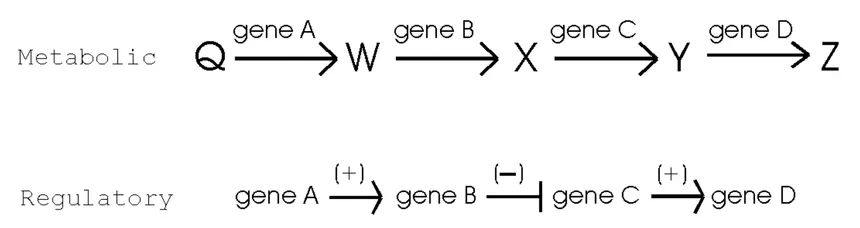
Duplicate recessive epistasis (Define and ratio)
If either gene is recessive, it will mask the other
Phenotypic ratio - 9:7
Duplicate dominant epistasis (Define and ratio)
If either gene is dominant, it will mask the other
Ratio - 15:1
Duplicate interaction
Ratio - 9:6:1
Dominant and Recessive epistasis
Ratio - 13:3
Codominance
Heterozygous form is a combination of both traits (Checkered, not blended)
Incomplete dominance
Heterozygous form is a blending of dominant and recessive phenotypes (Not checkered)
Penetrance
How many of those who have the gene will express the phenotype
Expressivity
How severe the phenotype is
How does penetrance affect pedigree charts?
Someone who has a trait might not show the phenotype, making it difficult to predict genotype. Might cause a dominant trait to look recessive if a parent has it but not the kid
How does expressivity affect pedigree charts?
Does not affect pedigrees that much
Example of anticipation
Myotonic dystrophy. The severity develops each generation
How do lethal alleles affect expression, genotypic, and phenotypic ratios?
You remove the lethal combination, which could affect the ratio
Example: Manx Cats
M^LM^L aborts early, causing a 1:2 ratio normal to tailless cats
How are penetrance and expressivity similar?
Both deal with a dominant allele in a heterozygous pair
Example of variable expressivity (Think of a term, not a condition)
Anticipation
How can someone have both penetrance and variable expressivity?
Someone may have the gene, and not show the phenotype. Someone may have the gene, have the phenotype, but is affected differently than others.
Genotypes for all ABO blood types (not including + or -)
A – IAIA or IAi
B – IBIB or IBi
AB – IAIB
O - ii
Why must someone receive the right blood type during a transfusion?
If the wrong blood is received, antibodies will agglutinate the blood cells from the donor
Type A has B antibodies – can’t give them B or AB
Type B has A antibodies – Can’t give them A or AB
Type AB has neither antibodies – can give them all types
Type O has both A and B antibodies – can’t give them any other type
Universal donor (Blood)
O
Universal recipient (Blood)
AB
Genotypes for positive and negative blood types
Positive - DD or Dd
Negative - dd
What type of epistasis is demonstrated by the Bombay gene. What is the hypostatic gene?
Recessive epistasis. H gene is epistatic, I gene is hypostatic
Let’s imagine that for gene X, there are multiple alleles, Xa, Xb, Xc and Xd. Find the 16 different genotypes that could arise from those alleles. Remember that each individual can only have two alleles for any gene. (Grab a paper) ***
XaXa, XaXb, XaXc, XaXd, XbXb, XbXc, XbXd, XcXc, XcXd, XdXd, Xax, Xbx, Xcx, Xdx, xx
What does Multiple alleles mean?
There are multiple types of alleles that could be mixed to create different characters
Example of multiple alleles?
Blood type
Which alleles are codominant in blood types? Dominant?
IA and IB are codominant
IA and IB are dominant to i
What are antibodies?
Proteins that bind to foreign substances which help fight infections
Four qualities of antibodies
Highly specific
Can produce Abs for every possible antigen
No self-recognizing antibodies produced
Unless a person has an autoimmune disease
Antibodies only produced in presence of antigen
What kind of dominance does the Rh factor have?
Complete dominance
What happens if a mother is Rh- and a baby is Rh+
Mother develops antibodies to protect against Rh+ blood. If another kid is born, antibodies will attack the blood cells in the fetus.
RhoGAM prevents this from happening by preventing the B cells from activating
How are phenotypes of maternal effect determined. Why is there no paternal effect trait?
Phenotypes are determined by genotype of the mother. Maternal effect traits are passed on by the environment that the baby is growing in.
What cell structure is passed on by the mother in maternal inheritance? Why can men not pass on this form?
The mitochondria is passed on. Men can not pass it down as the sperm delivers DNA, but not the mitochodria
How does methylation affect gene expression?
Deceases expression
What are maternal and paternal imprinting? Whose gene is expressed in each scenario?
Maternal – maternal gene is turned off, paternal is only one expressed
Paternal – paternal gene is turned off, maternal is only one expressed
What does a low recombination frequency tell you about the location of two particular genes? Explain your answer fully.
A low combination is due to genes being extremely close to each other on the chromosome. Due to recombination happen from crossing over, genes that are extremely close to each other have a lower chance of crossing over as there is less room for it to occur
In 1950, a stray dog with purple dots was found on the Butler campus. Hundreds of descendants of the dog have since been born, and Butler alumni want to develop the purple-dot Butler dog into a show breed. Suppose you owned the first purple-dot Butler dog and wanted to develop a true-breeding variety. How would you determine whether the purple-dot gene is dominant or recessive? How would you select for true-breeding dogs? How would you know they are true-breeding?
To figure out if the trait is dominant or recessive, you could perform a test cross using a dog with a skin color that has a known genotype and looking at the offspring. If the purple dots show up in the next generation, the purple dots are dominant, if they don’t the purple dots are recessive. To select for true-breeding dogs, you would mate the purple-dot dog with another purple dot dog and continue doing this for several generations until only purple dot dogs are produced in the crosses.
How do the events of meiosis explain Mendel’s law of segregation? (Start by explaining Mendel’s law of segregation). Diagram a generic monohybrid cross between two heterozygotes (Aa x Aa) with a Punnett square and explain how you used the law of segregation to make the Punnett Square.
Law of segregation says that the two alleles for a character separate during meiosis and end up in different gametes. This happens in anaphase I of meiosis. For example, if you are heterozygous for a character (Aa) some of your gametes will end up with a big A and some will end up with a little a. A gamete isn’t going to have both.
How do the events of meiosis explain Mendel’s law of independent assortment? (Start by explaining Mendel’s law of independent assortment). Diagram a generic dihybrid cross between two heterozygotes (AaBb x AaBb) with a Punnett square and explain how you used the law of independent assortment to make the Punnett Square.
The law of independent assortment says that each allele segregates independently during meiosis. Two characters aren’t necessarily inherited together (yellow and wrinkled can be inherited together or separately). This happens in metaphase I of meiosis. Every time metaphase I happens, the chromosomes line up in a different order (not all of the blue chromosomes are on the same side).
How is genomic imprinting inheritable?
Different genes are epigenetically silenced, then all imprints (In sperm) are erased and rewritten with the paternal pattern. Even the genes from the mother. Same thing with the eggs, just with the maternal genes
What is failed imprinting?
instead of switching off the gene, the DNA is deleted from the mother/fathers side
How is imprinting an epigenetic modification?
Alterations to DNA and how gene is expressed
Some changes are stable and can be inherited
Some changes impact a single gene, others are can affect more