Bio Module 1
 Call Kai
 Learn
Learn Practice Test
 Spaced Repetition
 Match
Match Flashcards
 Knowt Play
1/129

Earn XP
Description and Tags
Lectures 1-7
Name | Mastery | Learn | Test | Matching | Spaced | Call with Kai | Chat |
|---|
No analytics yet
Send a link to your students to track their progress
130 Terms
Evolution
Changes in the heritable traits of a biological population over generational time
Genotype
Information stored in DNA
Gene
A segment of DNA that contains the instructions for building a specific protein or preforming a particular function
Phenotype
All structures, processes, and behaviors of an organism
Trait
Facet of the phenotype
Heritable trait
A trait encoded by genes that is inherited across generations
Population
A group of organisms from the same species, existing at the same time in the same space
Evolution acts on __, individual organisms __ evolve
Populations, do not
Generation
Organisms within a population that consist of a single step in line of descent from an ancestral cohort
Evolution happens __ __ as __/__ generate and accumulate within a population
Over time, variations/changes
Altered DNA sequence (mutation)
A random change in the sequence of an organism’s DNA. The only source of new genes, which only sometimes affects the phenotype.
Gene flow
Migration of random individuals (and their genes) between populations
(ex. no antlers vs antlers)
Genetic drift
Random changes in the gene pool of a population
(ex. bottleneck)
Natural selection
Differential survival of individuals with certain heritable traits, but not others
(ex. eaten/starved)
Sexual selection
Differential reproductive success of individuals with certain heritable traits but not others
Evolution has no goal or conscious intention. T of F
T
What limits evolution?
Trade-offs
Trade-offs
Limitations of energy and materials
What limits evolution?
Genetic lineage
Genetic lineage
Limited to modifying pre existing traits in population
Homologous structures
Structures that share the same evolutionary and developmental history
Analogous structures
Structures that look similar and/or perform similar functions, but have different evolutionary and developmental histories
Is it an organism? Virus
Cooperating biological units (proteins/nucleic acids)
Cannot grow
No metabolism
Cannot reproduce w/o host
Can evolve
NO
Is it an organism? Bacterium
Single cells & Cooperating biological units (proteins,nucleic acids,some organelles)
Can grow
Has a metabolism
Most can reproduce w/o host
Can evolve
YES
Is it an organism? Jellyfish
Multicellular & cooperating biological units (cells,tissues)
Can grow
Has a metabolism
Can reproduce w/o host
Can evolve
YES
Is it an organism? Siphonophore
Colony of indv & cooperating biological units (zooids)
Can grow
Has a metabolism
Can reproduce w/o host
Can evolve
NO
Zooid
Single, multicellular animal that forms part of a larger colonial organism where multiple indv are physically or physiologically connected
Evolution
Changes in heritable traits of a biological population over generational time
Evolution charcteristics
Has NO goal or conscious intention
Happens over time within a population
Limited by trade-offs and genetic lineage
Phylogenetic tree
Hypothesized evolutionary relationships based on shared derived traits
Derived trait
A new trait that evolved from an old trait
Phylogenetic trees characteristics
Gives extinct groups same worth as living
No implied goal
Can be biased

Operational taxonomic units (OTUs)
A,B,C,D,E,
*purple box

Nodes & branches
Show relationships; trees can rotate around nodes
*Green circle | Blue box
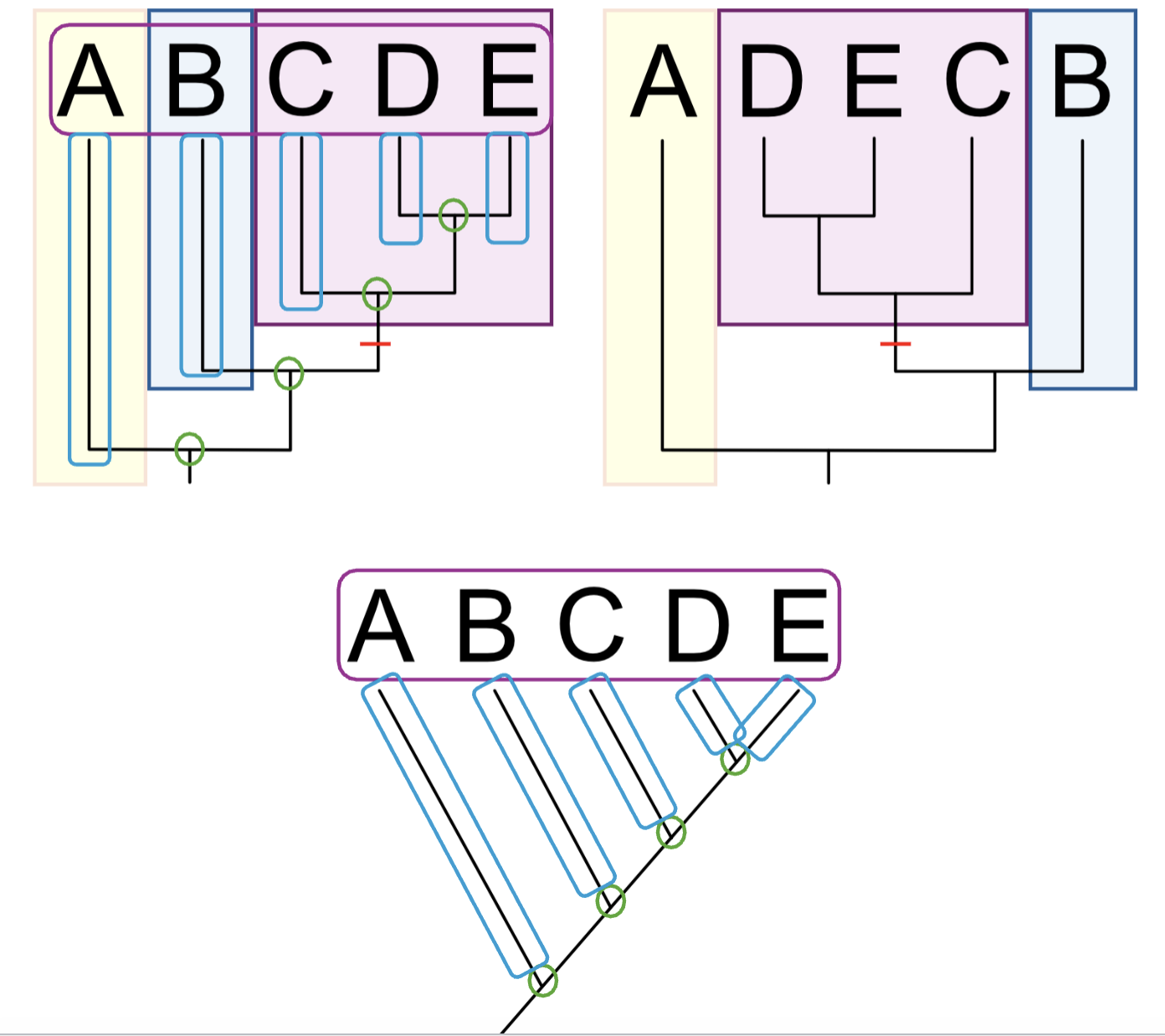
Synapomorphy
A shared derived character; can be mapped onto branches & distinguishes a clade from another organism
*Red line

Monophyletic group
A single common ancestor and all descendants
*Purple shaded box

Sister taxa
The next most closely related group to a monophyletic group
*Blue shaded box

Out group
Most distantly related out of all groups
*Yellow shaded box
Parasomy
Preferred explanation for patterns in data is the simplest explanation
3 domains in the phylogenetic tree: Eukaryota
Eukaryotic
Varying sizes
Some single cells, some colonies, some multicellular
3 domains in the phylogenetic tree: Archaea
Prokaryotic
Small
Single cells, some colonies
3 domains in the phylogenetic tree: Bacteria
Prokaryotic
Small
Single cells, some colonies
Diffusion
Net movement of particles from an area of higher concentration to an area of lower concentration
*Passive, move materials within and in & out of cell
Viscous
Fluid that is thick, sticky, and resists flowing easily
Diffusion depends on 4 key factors:
Distance needed to travel between two points
Difference in concentration of material
Surface area where transport can occur
“Diffusion coeff” other affecting factors
Fick’s Law equation

What is x in Fick’s Law
Distance needed to travel between two points
*Larger distance = slower rate of diffusion
What is A in Fick’s Law
Surface area where transport can occur
*More SA = faster rate of diffusion
What is delta concentration in Fick’s Law
Difference in concentration of material
*Bigger difference = faster rate of diffusion
Fick’s Law definition
Regulates the movement of nutrients and waste in both single-celled organisms as well as between cells in multicellular organisms
Prokaryote: Def
Organism composed of cells that lack a membrane bound nucleus and other membrane bound organelles
Prokaryote: How do cells divide
Binary fission (asexual)
Prokaryote: Characteristics
Small
Unicellular
No membrane bound organelles
Lateral/Horizontal gene transfer
Transfer of genetic information from one individual to another
Bacteria: Characteristics
Cell wall
contains peptidoglycan
Movement
Flagella
Diversity
Limited morphological diveristy
High biochemical diveristy
Flagellum
Long, whip-like structure that extends from the cell and propels it
Archaea: characteristics
Structures surrounding cell membrane
Protein surface layer
Pseudopeptidoglycan
Movement
Archaellum
Diversity
Limited morphological diversity
High biochemical diversity
Are archaea monophyletic
NO
Eukaryotes evolved from within archaea
Eukaryote: characteristics
Size and organization
some unicellular, some from colonies, some multicellular
Cell structure
NO peptidoglycan cell wall
YES membrane-bound organelles
Diversity
LESS biochemically diverse
HIGH morphological diversity
Endosymbiosis
One cell engulfs another without digesting it (gives rise to a symbiotic relationship)
Eukaryote: Origin
Arose from an endosymbiotic event between archaea and bacteria
Eukaryote: Characteristics
Cell walls
DO NOT contain peptidoglycan
Movement
Cilia or flagella
Cell structure
HAVE membrane bound organelles
Diversity
High morphological diversity
Low biochemical diversity
Reynolds numbers
Dimensionless number (no units) that describes how an object or organism moves through a fluid
Low reynolds number
Very small organisms and/or slow movement
Forces dominated by viscosity
Flow orderly and reversible
High reynolds number
Larger organisms and/or fast movement
Forces dominated by velocity
Flow disoriented
Rate of diffusion depends on __
Surface area
Surface area (2) and volume(3) __ grow at the same rate
DO NOT
Modifying supply and demand: Increased supply (SA)
Changes overall shape to inc SA : V ratio
*Spheres’s lowest SA/V ratio
Modify supply and demand: Decreased demand (V)
Slow down metabolic processes but, leads to slower growth and reproduction
Bulk flow
Movement of fluid that carries dissolved materials with it, driven by pressure differences
Multicellular organism
Cells physically and functionally integrated
Cell-cell connections help cells adhere and communicate
Cells differentiate into specialized cell types
Specialized cells organize into tissues
Unicellular colony
Multiple cells live together but remain independent
Communication occurs external to cells w/little coordination
Cells nearly identical
No true tissues
Aggregation
Previously independent cells come together and become functionally integrated
*Less common
Clonal development
Serial division without separation of cells
*More common
Body plane
General structure of an organism
Life history
Lifetime pattern of growth, reproduction, and survival for an average indv
Cytoskeleton
Network of protein fibers that gives a cell its shape and support and helps move the cell and materials within it
Photoautrophic
Obtain energy from sunlight
*Requires chloroplasts and derivitices
Heterotrophic
Obtain energy and nutrients from preformed, external source
What happens if a single cell gets larger
Volume increases faster than surface area
How to overcome the problem of cell size?
Multicellularity: Subdivide volume into smaller volumes
*Using spheres
__ eukaryotes have mitochondria
ALL
Unicellular eukaryotes ex
Some protists, algae, fungi
Multicellular eukaryotes ex
Plants & animals
Some protists, algae, fungi
Protists
Diverse group of eukaryotes that are not animals, fungi, or land plants
*MOST unicellular
Animal cell characteristics
NO cell wall
Contain mitochondria
Plant cells characteristics
Independently derived cell wall containing cellulose
Contain mitochondria
Cells contain chloroplasts
Fungi cells characteristics
Have independently derived cell walls containing chitin
Contain mitochondria
Mitosis
Cell division in eukaryotes that results in 2 genetically identical daughter cells
Cell-cell co-operation: Animals
Tight junctions, adherens junctions and desmosomes, gap junctions
Tight junctions in animal cells
Seal between cells, restrict movement of water between cells
Adherens junctions & desmosomes in animal cells
Anchor cells connect via cytoskeleton
Gap junctions in animal cells
Channels between cells, allow cell-cell communication and movement of small molecules
Cell-cell co-operation: Animals
Apoplast, symplast
Apoplast in plant cells
Space between cell wall and middle lamella between adjacent cells
Symplast in plant cells
Cytoplasm inside cells connected through plasmodesmata
Cell-cell co-operation: Fungi
Some cells separated by septa
Septa in fungi
Divide fungal hyphae (filaments) into individual, compartmentalized cells
Tissues in animals
Epithelial, contractile, nervous, connective
Epithelial tissues in animals
Body surfaces; protection/exchange with environment