memory and performance psych - newer terms
 Call Kai
 Learn
 Practice Test
 Spaced Repetition
 Match
 Flashcards
 Knowt Play
1/37

There's no tags or description
Looks like no tags are added yet.
38 Terms
Atkinson and Shiffrin’s multi-store model

It's one of the earliest models of memory, proposing that memories are formed sequentially (information passes from one component to another in a straight line.)
The model represents memory as consisting of three separate components: sensory register, short-term store and long-term store.

Fill in the blanks

Sensitivity (or relative sensitivity)
The ability to access information that has been stored in memory.
A very sensitive measure of retention is more likely to detect information that has been learned and stored in memory than a not so sensitive measure.
Repeatability
Same results by the same person- same sample
Reproducibility
Same results by different people- different sample
Internal Validity
Accuracy of the experiment itself.
External Validity
How applicable the results are to the real world.
Confidentiality
Privacy! results are not released without consent and participants have a right to not be identified.
Voluntary participation
– cannot pressure participants to participate.
Informed consent procedures
It includes seeking written permission and fully informing the participant.
Withdrawal rights
– able to pull out at any time
Deception
– consider if deceiving participants to avoid biased results is essential
Debriefing
Participants are informed of true nature of experiment and potential harm
Explain Integrity
When you’re committed to the research and approach it with honesty.
Respect for persons
When the participants and researchers are regarded as people not as subjects.
Justice
Its: fair selection, the fair distribution of benefits and burdens, and no discrimination.
Loftus and Palmer (1974 – experiment 1)
45 volunteer university students (‘the eyewitnesses’) were each shown a video of a car accident.
Group 1
Participants were asked: ‘How fast were the cars going when they collided with each other?’
Group 2
Collided was changed to one of the following verbs, creating a leading question:
‘Hit’
‘Bumped into’
The most ‘intense’ verb (smashed) brought about the highest estimate of speed.
The least ‘intense’ verb (contacted) brought about the lowest estimate of speed.
Results could be due to participants memories being distorted by the verbal label that had been used to characterise the intensity of the crash.
One week later, all participants were asked questions about the accidents.
The critical question ‘did you see any broken glass’ was asked to all 3 groups.
There was no broken glass in the film.
Loftus and Palmer Conclusions
In the first part of the experiment participants formed a memory of the car crash as they viewed the film.
Additional new information about how the cars either ‘smashed’ or ‘hit’ each other, was provided after the event in a leading question.
Later when they were asked again about the car crash what they recalled was not the actual original experience, but a reconstruction of the event.
Conclusion: memory retrieval is a reconstructive process whereby the memory trace can be updated with false information.
Social learning theory
It suggests that social behaviour is learned by observing and imitating the behaviours of others. Think of ‘watch and learn’.
Attention:
Noticing and paying attention to the behavior you are watching.
Retention:
Consolidating and remembering what you saw so you can use it later.
Reproduction:
Being able to copy the behavior. This depends on skills and abilities.
Motivation:
Having a reason to copy or not to copy a behavior. This often comes from seeing someone rewarded and believing the behavior will help you or seeing someone punished and believing the behavior will not help you.
What is Reinforcement?:
Receiving what motivates you act as a reinforcer, this encourages you and increases the likelihood of you demonstrating the behaviour again.
Social Learning Theory - Example
Mia has just made the first scrambled egg by herself. In order to perform this task correctly, she needed to carry out each of the following stages.
Attention:
Mia watched and listened intently to her brother as he demonstrated how to make scrambled eggs and in the correct order. Mia would have completed this step several times.
Retention:
Mia then consolidated the knowledge in her memory so that she could recall how to do it when given the ingredients and tools, e.g., eggs, pans, utensils etc.
Reproduction:
Mia needed to have the physical and cognitive ability to carry out the task, e.g., crack eggs, use the pans and stoves. She was old enough to remember the components to scrambled eggs and her muscles were strong enough to hold the pans and utensils.
Motivation:
Everyone needs an incentive (something to motivate people to perform the task) in order to carry out the behaviour. For Mia, her desire to become a chef when she is older was her internal motivation and the hope of receiving praise from her brother who taste test her dish would have been her external motivation.
Reinforcement:
If Mia makes the dish successfully, she will receive praise which will lead to a higher likelihood of her performing the same task again in future, and more practice means it will be one step closer for her to reach her goal.
Mirror Neurons
A neuron that fires when: an animal or a person performs a task OR observes someone else performing the same task.
What is Visualisation? And how does it help?
When you mentally rehearse a planned movement to learn skills or enhance performance.
How does it help?
Visualisation helps to rehearse performances before completing it.
Operational hypotheses
It is expected that ______ (population) who ________ (first level of IV) will
_________________ (first DV) whereas the ________ (population) who
______________ (second level of IV) will _________________ (Second DV).
Narrative chaining
Linking otherwise unrelated items to one another (‘chaining’) to form a meaningful story (‘narrative’).
Memory Fallibility
Memory is NOT an exact copy of the world or what happened.
Memory includes some exact details and some additions that are logically plausible
Beware that confidence in memory is no guarantee of its accuracy, in fact there is little correlation.
Leading questions
Leading question
A question that has content or is phrased in such a way as to prompt or encourage a desired answer.
Leading questions make it possible for ‘misinformation’ to be implanted into a witness’s memory
They may incorporate information from the leading question into their memory
The suggested information could become a genuine memory –
It becomes a part of their reconstruction of the memory.
Marginal gains
the concept that small improvements in many individual processes can lead to a significant improvement when combined.
Example: a student trying to improve their academic performance, what are some little things a student can focus on to achieve a better result?
30mins more sleep every night
More hydration every day
Review the notes for 10mins at the start of each day
20mins more exercises every day
Asking teacher for help when a question comes up
Spend 20mins in a study group to review the content
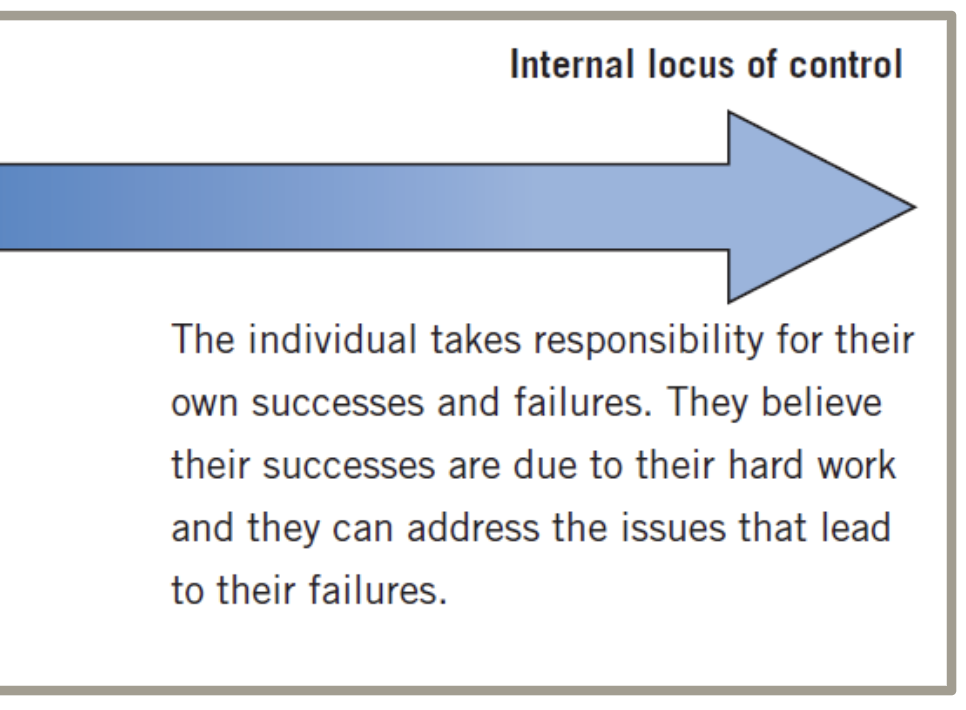
Locus of control
the degree to which a person believes they can control the outcome of events in their lives.
External locus of control

Internal locus of control
External locus of control is more likely to…
to believe they are not responsible for what happens
to not show perseverance and resilience when things get hard
look for external factors to blame.
be unlikely to acknowledge their own contributions when succeeding
important to note that external factors can be influential, but they do not determine how the person chooses to respond to the situation.
Internal locus of control is more likely to…
to believe they are responsible for what happens
to show perseverance and resilience when things get hard
to acknowledge their own contributions when succeeding
important to note that having a strong internal locus of control can result in a person being too critical of their own performance and abilities, and not acknowledge that some elements are beyond their control.
Superstitions
actions that performers engage in due to the irrational belief that unrelated objects, events or actions can negatively influence an unrelated outcome.