Chapter 4 - Tissues
 Call Kai
 Learn
Learn Practice Test
 Spaced Repetition
 Match
Match Flashcards
 Knowt Play
1/85

There's no tags or description
Looks like no tags are added yet.
Name | Mastery | Learn | Test | Matching | Spaced | Call with Kai | Chat |
|---|
No analytics yet
Send a link to your students to track their progress
86 Terms
Epithelial Tissue
cover/lining glands
→ acts as barrier function = controls what goes IN/OUT
exocrine
secrete products through ducts
endocrine
no ducts releases hormones
cell polarity (apical/basal surfaces)
cell junctions (cell come together and form sheets)
avascular (no blood vessels)
attachment (proteins bind to basal lamina)
regeneration (regularly shed = new growth)
5 functions of epithelial tissue
2 neighboring cells membranes come close together and connect
“to keep things out”
→ not strong but brings close
protein - zonula occludins
tight/occluding junction
brings together neighboring cells not as tight but strong
BIND TO ACTIN
protein - cadherin
e-cadherin (can grab other cells making epithelia)
strong/adheren junction
acts as tiny protein tunnels between 2 epithieal cells
allows for the transport of ions, H20, molecules from 1 cytoplasm to the other
protein - connexons
gap jucntions
connect to intermediate filaments
→ act as localized spot weld between 2 epithelial cells tieing them down together
protein - CAMS
(cell adhesion molecules)
spot desmosomes
attached to the basal lamina
protein - intergin
hemidesmosomes
simple - flat
cuboidal - cubes
columnar - column like
what are the shape of epithial tissue?
simple - 1 layer
stratified - 2 layers
what are the layers called of epithiela?
to absorbed, secrete, and diffused → let things pass through
what is the MAIN purpose of simple layer?
protection, prevent friction, and act as barrier
what is the MAIN purpose of stratified layer?
mesothelium
lines body cavities
endothelium
lines heart and blood vessels
allows for diffusion and absorptions
lining of the heart
simple squamous epithelium location/ function
protects against physical attacks
has keratin adds strength and water resistance
lining of the mouth
stratified squamous epithelium location/ function
has keratin top layer
top cells are dead
tougher and prevents h20 loss
what do we mean when stratified squamous is keratinized?
no keratin layer
cell ALIVE
stays moist
what do we mean when stratified squamous is non- keratinized?
secretion and absorption
lining of kidney tubules
simple cuboidal epithelium location/ function
protection, absorption, secretion
lining of some ducts (rare) → mammary/sweat ducts
stratified cuboidal epithelium location/ function
protection, absorption, secretion
lining stomach, gallbladder
simple columnar epithelium location/ function
protection, secretions
has cilia movement
lining of nasal cavity
pseudo stratified ciliated columnar epithelium location/ function
protection
small areas of pharynx
stratified columnar epithelium location/ function
allows for stretching and recoiling W/O damage
lining of urinary tract
transitional epithelium location/ function
Merocrine
Apocrine
Holocrine
What are the 3 types of exocrine secretions?
Merocrine
releases products cell remains in tact
sweat and salivary glands
where do we see merocrine at?
product releases and top of cell breaks off
apocrine
mammary glands
Where do we see apocrine?
“whole” cell breaks apart to release product
holocrine
sebaceous glands
where do we see holocrine at?
SIMPLE glands
what kind of glands are these called?

simple tubular
what gland is this called?

simple coiled tubular
what gland is this called?

simple branched tubular
what gland is this called?

simple alveolar (acinar)
“round”
what gland is this called?

simple branched alveolar (acinar)
“round”
what gland is this called?
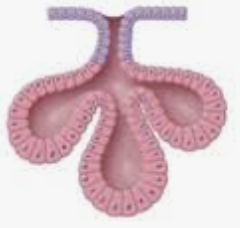
COMPOUND glands
what kind of glands are these called?

compound tubular
what gland is this called?

compound alveolar (acinar)
“round”
what gland is this called?

compound tubulaveolar
what gland is this called?

Connective Tissue
This includes:
Bone
cartilage
fibrous connective tissue
adipose tissue
blood
What tissue is this?
Fibrous Connective Tissue
This is under general connective tissue
It forms tendons (M to B), ligaments (B to B), and dermis
supportive connective tissue
This Connective tissue includes:
Bone
Cartilage
Blood
connects epithelium to rest of the body (basal lamina)
provide structure (bone)
stores energy (fat)
transports materials (blood)
have NO contact with environment
What are the functions of general connective tissue?
loose, dense
general connective tissue an be ______ or ________. This is determines on how many # of fibers run through it
areolar
adipose
reticular
What are the 3 types of loose connective tissue?
areolar
has collagen, elastic, recticular fibers
wraps/cushions organs, binds to tissues and holds tissue fluids
adipose
deep to the skin (buttocks/breasts)
provides padding, stores energy, serves as insulted function..
reticular
liver, kidney, spleen
provides support for framework
Dense regular
Dense irregular
Elastic
What are the 3 types of dense connective tissues?
dense regular
fibers run in the same directions = lots of strength
provides firm attachment, conduct pull of muscle, reduces friction between muscle
dense irregular
provides strength to our skin (dermis) → many different directions
helps prevent over expansion in organs, provides strength to resist forces applied from many direction
Elastic
stretches and recoils
cushion shocks, stabilizes positions of vertebrae
between vertebrate of spinal column
bone and cartilage
What makes up of the special “supportive” connective tissue?
bone
osteon - functional unit of compact bone
has blood vessels = heals quickly
cartilage
“chondro”
has NO blood vessels to heal
Hyaline
Elastic
Fibrocartilage
What are the 3 types of cartilage?
hyaline
secrete brown (tough, supportive tissue, hard but not as hard as bone)
prevents bone on bone grinding
provides stiff yet somewhat flexible support
covers ends of long bones
elastic
flexible
supports and allows distortion w/o damage and return to OG shape
ears, nose
fibrouscartilage
lots of collagen fibers → strongest
resist compressions, prevents B to B contact
found in areas with lot of pressure
~ pads within knee joints
blood and lymph
to be a transport for your body (nutrients, antibodies, etc..)
Fluid connective tissue involves what and what is the function?
Mucous
Serous
Cutaneous
Synovial
What are the 4 types of membranes?
epithelia and connective tissue
what does membranes make up?
mucous
produces mucous
→ traps particles/pathogens
serous
produces fluid transudate
→ reduces friction as organs move against one another
cutaneous
skin
→ papillary layer: areolar
→ reticular layer: dense irregular
protection
external covering
synovial
secrete fluid that wraps around joints
allows for movement
prevents B to B grinding
Muscle Tissue
What tissue is known for contraction and produces all body movement?
Skeletal
Cardiac
Smooth
What are the 3 types of muscle?
Skeletal
voluntary
large muscle responsible for movement
striated
→ long and mutil-nucleated
→ combined with CT and neural tissue
~moves/stabilizes position of skeleton
cardiac
involuntary [controlled at a level of reflexes]
only found in the heart
striated, short branched
→ single nucleus
→ interconnected intercalated disc [gap junctions]
~circulate blood and maintains BP
smooth
involuntary
found in many parts of body’s wall
non striated
→ small, spindle cell shaped
→ 1 nucleus
~move food, urine, reproductive tract secretion, regulate diameter of blood vessels
Neural tissue
What tissue:
conducts electric impulses
rapidly sense internal/external environment
processes info and controls response
Neurons
Neuroglia (Glial Cells)
What are the 2 cells of neural tissue?
neurons
nerve cells
perform electrical communication
Neuroglia (Glial Cells)
supporting cells
repair/supply nutrients to neurons
homeostasis
Tissues respond to injuries to maintain ________
inflammation
regeneration
What are the 2 processes that cells restore homeostasis?
inflammation
inflammatory response
the tissue’s first response to injury
swelling
redness
heat
pain
signs/symptoms of inflammatory response
trauma (physical injury)
infection (the presence of harmful pathogens)
inflammatory response can be triggered by what?
Healing (regeneration)
When the injury or infection is cleaned up what begins?
slower rate of energy consumption (metabolism)
hormonal alterations
reduced physical activity
Speed and efficiency of tissue repair DECREASES with age because:
thinning epithelia & CT
increased bruising and bone brittleness
joint pain and broken bones
muscle atrophy (thinning)
cardiovascular disease
mental deterioration
What are some chemical/structural tissue changes?