Bio 180-271 - Unit 4: Nervous System - Week 1: Slides 1-15
 Call Kai
 Learn
 Practice Test
 Spaced Repetition
 Match
 Flashcards
 Knowt Play
1/50

There's no tags or description
Looks like no tags are added yet.
51 Terms
Define Nervous System
The system that contains all neural tissue in the body.
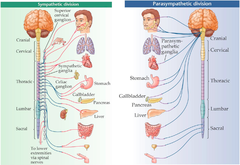
Name the two different cell types that the Nervous System is made up of.
1. Neurons
2. Neuroglia

Function of Neurons
cells that send and receive signals

Function of Neuroglia
cells that support and protect neurons

What are the two main divisions of the nervous system?
1. Central Nervous System (CNS)
2. Peripheral Nervous system (PNS)

What is the Central Nervous System made up of?
The brain and spinal cord

Function of the Peripheral Nervous System
Delivers sensory information to the CNS, AND transmits motor information from the CNS
What are the four regions of a neuron?
1. Cell Body
2. Dendrites
3.Axon
4. Telodendrion

Role of the cell body of a neuron
Contains the perikaryon (cytoplasm) and nucleus

Function of Dendrites
Receive information from other neurons

Function of the Axon
Carries electrical signal (action potential) towards target

Define Telodendria
Extensions of the axons that end in synaptic terminals

What do telodendria come into contact with?
The target of the signal
How many main neuron types are there?
Four
Name the four main neuron types
1. Anaxonic Neuron
2. Bipolar neuron
3. Unipolar neuron
4. Multipolar neuron

Where is the action potential converted into a chemical signal?
The synapse

What is a synapse called when it involves a muscle?
A neuromuscular junction

What is a synapse called when it involves a gland?
A neuroglandular junction

What are the most important neuroglia involved with?
Myelination
Define myelination
A process that increases the velocity of an action potential

How does myelination occur?
By wrapping around the axon to increase the functional diameter.

Name the two Neuroglia cells that support neurons through myelination
1. Oligodendrocytes
2. Schwann Cells

Which neuroglia cells myelinate the CNS? The PNS
Oligodendrocytes - Central Nervous System
Schwann Cells - Peripheral Nervous System
True or False: One Schwann cell can interact with many different Axons.
False: Schwann cells are dedicated to particular axon
True or False: there can be many Schwann Cells per Axon
True

Why is Myelin important?
Without myelin, the action potential would not travel quick enough from one side of a neuron to the other side of the neuron, leading to a loss of signal

Role of Myelin Sheaths
To increase the velocity of the action

Define Action Potential
The electrical propagation through a neuron to initiate a response

Name the two factors that allow action potential to function:
1. Permeability
2. Electrochemical Gradient
What is the millivoltage of an action potential at rest?
-70 mV

What are the two channels that action potentials work through?
1. The Sodium Voltage Gated Ion Channel (VGIC)
2. The Potassium Voltage Gated Ion Channel (VGIC)

What is the millivoltage of an action potential when sodium passes through the Sodium VGIC?
30 mV
What is the millivoltage of an action potential when sodium passes through the Potassium VGIC?
-90 mV
Define Polarization
Making the membrane potential more negative

Define Depolarization
Making the membrane potential less negative

When is the membrane of a neuron not very permeable to sodium, and slightly more permeable to potassium?
At rest
What happens when an electrical stimulation causes a threshold to be reached?
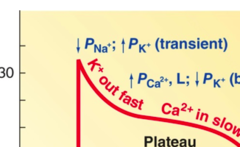
Sodium voltage gated channels open, allowing an influx of sodium
What happens after the peak of an action potential?
Sodium voltage gated channels inactivate and then potassium voltage gated channels open, causing a release of potassium
When is the resting potential re-established?
After a short afterhyperpolarization
Define Excitability
The chances of generating an action potential

Define the absolute refractory period
An amount of time in which under no circumstances another action potential can be triggered

Define the relative refractory period
an amount of time in which an increased stimulus can trigger an action potential

In what ways is an action potential an all-or-none phenomenon?
• If the threshold is reached, an action potential has to occur
• If the threshold is not reached, an action potential never occurs
Define saltatory propagation
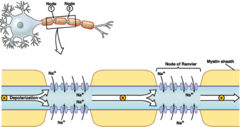
Propagation along a myelinated nerve

What happens during Saltatory Propagation?
• the velocity of the action potential is quicker in myelinated segments
• then restoration and slowing of the action potential in unmyelinated segments

What are unmyelinated segments called?
Nodes of Ranvier

Why must Saltatory Propagation occur?
Because you must reach threshold once again to propagate a new action potential
Role of the Node of Ranvier
Allows a spot on the axon for Sodium VGICs to work
What is the Length Constant
How far a signal can go without myelin before it is lost

Name an example of a demyelinating disease that causes action potential loss.
Multiple sclerosis (MS)
What happens when an action potential reaches the synapse?
The electrical signal is changed into a chemical signal with the help of vesicular transport, which are then used in the synaptic cleft to introduce the desired effect on the target tissue.
