BIOE 370 General Ecology - Exam 3
 Call Kai
 Learn
 Practice Test
 Spaced Repetition
 Match
 Flashcards
 Knowt Play
1/77

There's no tags or description
Looks like no tags are added yet.
78 Terms
What are ecological communities?
The species living in the same place at the same time
ex: all the trees, birds, insects, and fungi in a rainforest
What does community ecology focus on?
the living components (species) of an area and the interactions among them
What makes up ecosystems?
both the ecological community and its physical environment
ex: The same rainforest community plus its soil, water, and climate conditions
What does ecosystem ecology emphasize?
the flows of energy and cycling of nutrients between organisms and their environment
What is diversity?
the variety of species and how evenly individuals are distributed among those species
Why can diversity either be a response variable or a predictor variable?
Ecologists often measure diversity, and they also often ask how diversity affects other community or ecosystem properties
What is the simplest metric of diversity?
species richness
What is species richness?
the number of species in an area
What is the evenness of abundance?
how equally individuals are distributed among the different species in a given community or ecosystem

Which community is more diverse?
Community 2 is more diverse because it has a more even composition of trees
What does the Shannon-Weiner index measure?
species richness and evenness
What is alpha diversity?
the number of species at a local site
What is beta diversity?
turnover in species composition from one site to the next
What is gamma diversity?
how many species there are in the whole region

What is the alpha diversity of this site?
2

What is the gamma diversity in regions 1 and 2?
7, 5
What is the “equation” for beta diversity?
gamma diversity - average alpha diversity

What’s the beta diversity in regions 1 and 2?
4, 2
What is taxonomic diversity?
diversity according to species, genus, or family, etc.
What is the functional diversity?
the diversity of ecological functions that the species perfoem

How are these communities different in their functional diversity?
The communities have the same species richness, but community B is much more diverse in terms of what the species are doing in their environments
What is phylogenetic diversity?
the diversity of evolutionary lineages

How are these communities different in terms on phylogenetic diversity?
Both communities have 4 species, but in A they’re all very closely related (in a single lineage), while in B they represent much more accumulated evolutionary history

What is this type of abundance distribution called?
histogram of abundances

What is this type of abundance distribution called?
rank-abundance curve
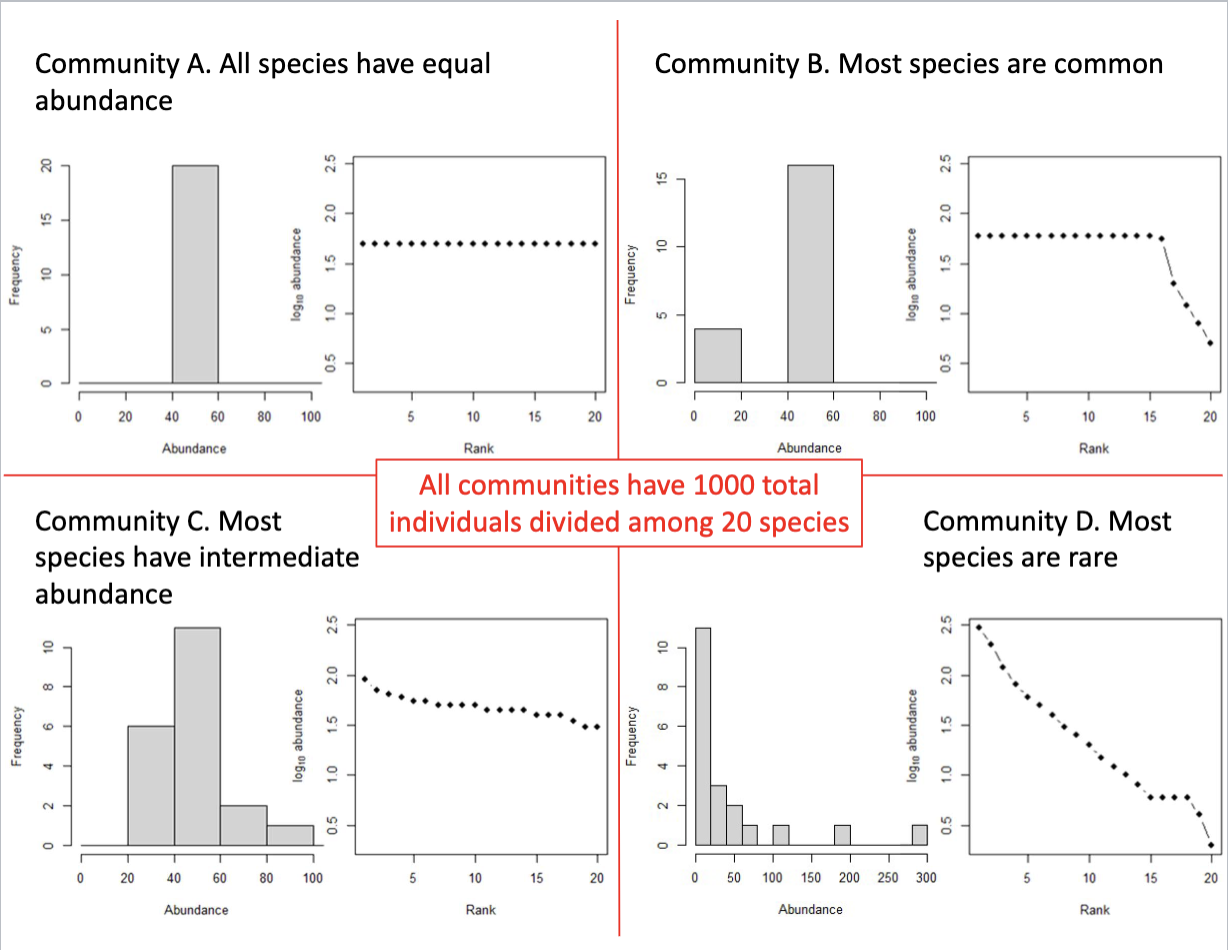
Which of these communities actually exist in nature?
only communities C and D naturally occur — never A or B
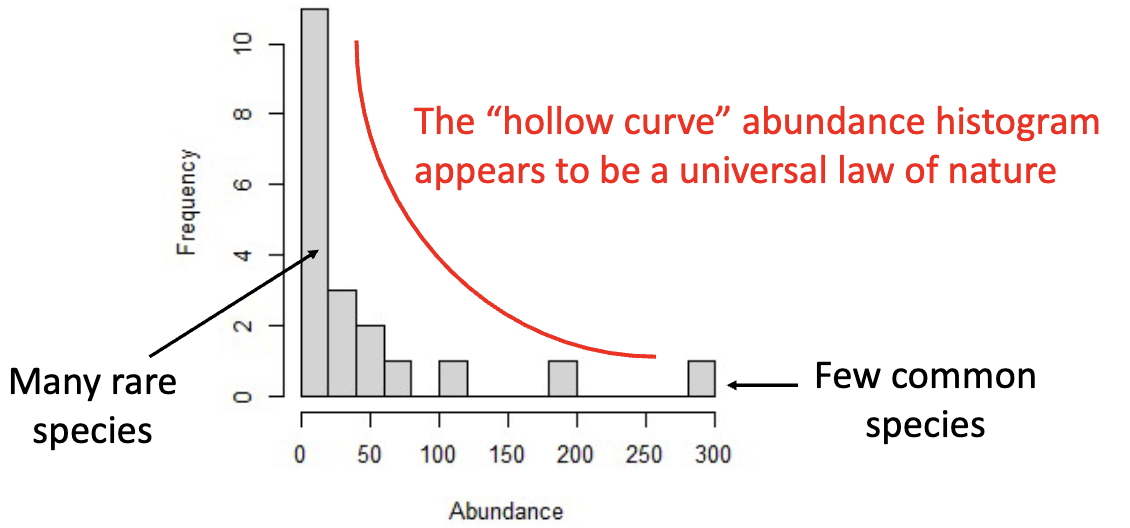
Across ecosystems and taxa, do communities consistently show more rare or intermediate abundance species than common ones?
rare or intermediate species
What is disturbance?
A punctuated event that results in wide-spread mortality and rearrangement of resource distribution
What is the competition-colonization tradeoff?
Some species recolonize quickly following disturbance
Others recolonize more slowly but are better competitors

What level of diversity occurs when there is infrequent disturbance in an ecosystem?
low diversity due to competitive exclusion
What level of diversity occurs when there is frequent disturbance in an ecosystem?
low diversity because only a few weedy species can survive
What level of diversity occurs when there is intermediate disturbance in an ecosystem?
highest levels of diversity
What is the fundamental question of ecology?
What determines how many & which species from the regional species pool live in any given local community?

What is dispersal limitation?
not all species found in the region might be able to get to a particular community

What is habitat filtering?
some of those that do get there (disperse) might not be able to survive/reproduce there due to abiotic conditions

What is biotic limitation?
some of those that do get there (disperse) might not be able to survive/reproduce there due to interactions with other species
What would happen to the number of species in a community if dispersal limited them?
they would be proportional to the number of species in the region
they would increase if dispersal to that community increased


What happens if there is unlimited dispersal and no other limits to diversity?
local richness = regional richness → very unlikely
(red line, 1:1 line)
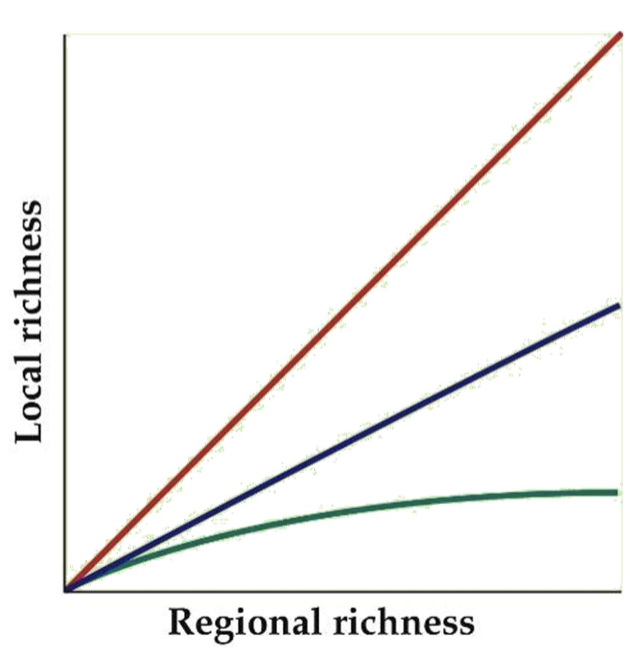
What happens if there is limited dispersal and no other limits to diversity?
local richness is proportional to regional richness
(blue line, unsaturated)

What happens if other limits to diversity are more important than dispersal?
local richness is largely independent of regional richness
(green line, saturated)
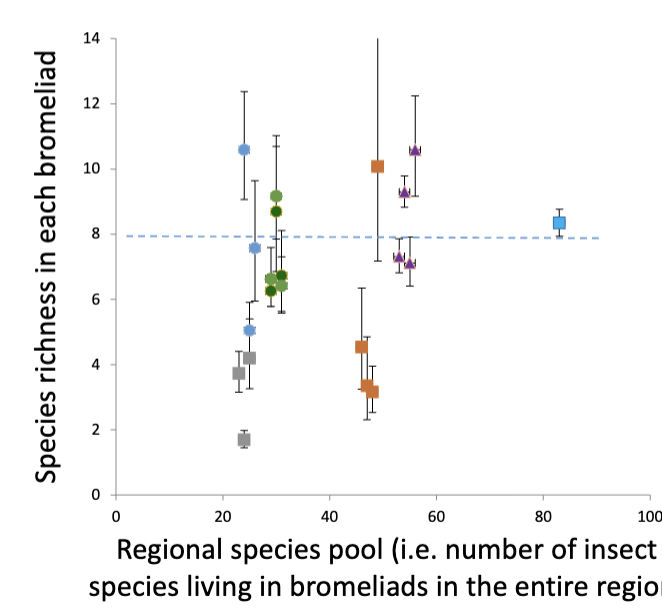
Based on these data, invertebrate communities inside bromeliad tanks could best be described as:
Having no relationship between local richness and regional diversity

Based on these data, subtidal rock wall communities could best be described as:
Dispersal limited & unsaturated
What is the ecological niche?
where an organism lives, what it does, what resources it uses, who eats it, etc.
often described in terms of niche “axes”
What is an example of a two-dimensional niche?
2 axes/variables (e.g. moisture vs. temperature)

What is an example of a three-dimensional niche?
3 axes/variables (e.g. temperature vs. moisture vs. pH)

How many axes can a niche have?
lots of axes → describes as N-dimensional hypervolume
What is N-dimensional hypervolume?
the number of niche axes
What does Gause’s competitive exclusion principle state?
two species with identical niches cannot coexist

What is this graph showing?
when the two cultures were in their own separate spaces, they grew very similarly
when they were combined, the red species outcompeted the blue species
coincides with Gause’s competitive exclusion principle
What is Tilman’s resource ratio hypothesis?
as resources get more plentiful, the reproductive rate in species A increases
the mortality rate of species A is independent of resource level


Where are the equilibria in Tilman’s model?
the equilibria are at the origin (0,0) and the intersection point

Are the equilibria stable or unstable in Tilman’s model?
unstable
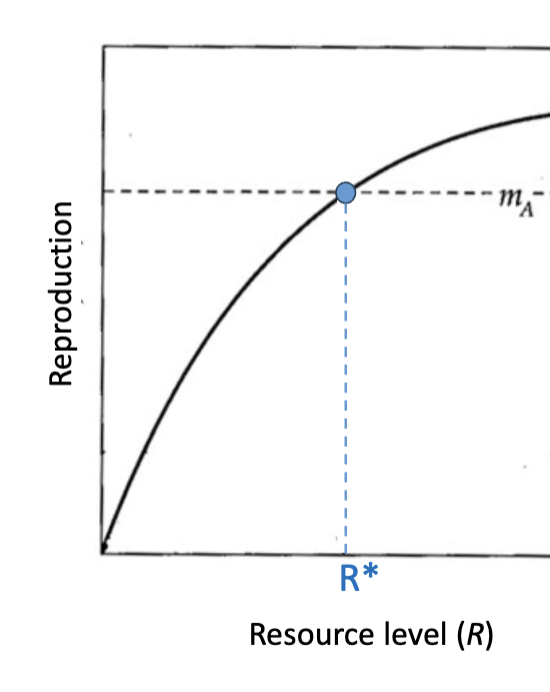
What will happen as long as the resource level is equivalent to R*?
the population will persist
What happens when two species, A and B, compete?
whichever species can draw the resource level down lower (has a lower R*) will outcompete the other


Now there are two species and two resources. Who wins if they are competing over resource 1?
species A wins because it has a lower R*

Now there are two species and two resources. Who wins if they are competing over resource 2?
species B wins because it has a lower R*
What does the R* hypothesis explain?
how two species can coexist (avoid competitive exclusion)
What are the conditions for the R* hypothesis to work?
needs to be at least 1 resource axis for every species
each species needs to be able to persist at lower levels of a particular resource than all other species
What is a fundamental niche?
the full range of environmental conditions, resources, and habitats in which a species could theoretically survive, grow, and reproduce in the absence of biotic limitations like competition, predation, or disease → defined by abiotic factors

What is an example of fundamental niche?
habitat filtering → may or may not be able to survive due to abiotic conditions
What is a realized niche?
the actual set of environmental conditions, habitats, and resources that a species occupies and uses in nature, constrained by biotic pressures such as competition, predation, and parasitism

What is an example of realized niche?
biotic filtering → biotic factors determine who can survive and reproduce
What two mechanisms does the Modern Coexistence Theory use?
stabilizing mechanisms
equalizing mechanisms
What do stabilizing mechanisms do?
reduce competition among species via niche differentiation → reduce niche overlap
What is resource partitioning as an example of stabilizing mechanisms?
competing species use limiting resources (such as food, water, space, or time) in different ways

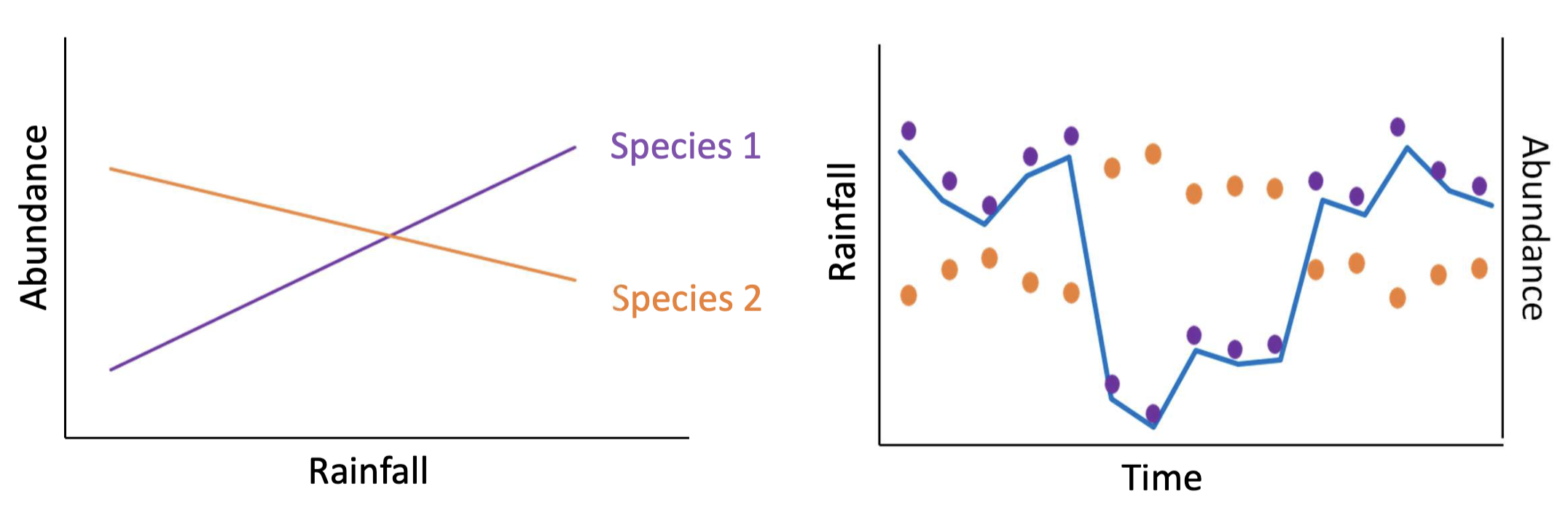
What is the storage effect as an example of stabilizing mechanisms?
populations "store" the resilience they accumulate during favorable environmental periods to survive harsh periods
What is an example of the storage effect?
Annual plants in the desert have lots of live seeds in the soil (“seed bank”) that germinate when conditions are right. So they can “wait out” conditions when they might be outcompeted.
What do equalizing mechanisms do?
reduce fitness among species such that none is a stronger competitor → reduce fitness differences despite overlapping niches

What is an example of an equalizing mechanism?
Animals with similar body sizes have similar abilities to procure resources, similar reproductive rates, etc, meaning neither will outcompete the other
A population of red beetles lives on an isolated island. At some point a small group of blue beetles gets blown to the island in a storm. The two species eat the same plants but red beetles are superior competitors. The blue beetles will either:
go extinct → competitive exclusion
evolve to:
be equal competitors → equalizing mechanism
eat different plants → niche partitioning
become active during seasons when red beetles are dormant → storage effect
What do neutral models do?
allow us to predict how many species might live somewhere, but not which species → predicts diversity and abundance
What is ecological drift?
the random fluctuation of species abundances in a community due to chance events in births and deaths,rather than differences in fitness or environmental adaptation (no competition)
Are impacts of ecological drift stronger in smaller or larger populations?
Small populations → In tiny communities, a random death can wipe out an entire rare species, whereas large populations absorb random losses more easily
Is competitive exclusion a type of Niche Theory or Neutral Theory?
niche theory
Is ecological drive a type of Niche Theory or Neutral Theory?
neutral theory
Does competitive exclusion and ecological drift lead to communities continuously getting less diverse over time?
No! The lost species are replaced by new ones arriving (immigration) or evolving (speciation)
What is competitive assembly?
how many and which species occur in a local community, and how abundant they are
What four processes is community assembly donated by?
selection
drift
immigration
speciation