armenia mditerm studying
 Call Kai
 Learn
 Practice Test
 Spaced Repetition
 Match
 Flashcards
 Knowt Play
1/13

There's no tags or description
Looks like no tags are added yet.
14 Terms

name, region, period, date, material + main idea + 3 parts
Karnut · ID | Hearth, Karnut, Bronze Age, 27th-26th century BCE, Terracotta |
|---|---|
Karnut · Thesis | The Karnut hearth shows the highlands as a crossroads before any empire: (1) it belongs to a culture shared far beyond Armenia, (2) it speaks that culture in a distinct local style, and (3) puts to a regional sacred function. |
Karnut · STEP 1 Shared culture | The hearth's form comes from a material culture spread across the region. |
Karnut · 1a Kura-Araxes |
|
Karnut · STEP 2 Local style | Within that shared culture, the highlands had their own idiom. |
Karnut · 2a Karnut-Shengavit type | Local vessels:
|
Karnut · 2b Ram table |
|
Karnut · 2c Stylization |
|
Karnut · STEP 3 Local ritual | The shared form takes on a local meaning. |
Karnut · 3a Farm village | Karnut was unfortified, on an artificially leveled terrace (p. 6) ⇒ an agricultural settlement with no fortress and no visible king. |
Karnut · 3b Ritual | Animal imagery suggests "a ritual function, perhaps in connection with agricultural rites" (p. 6) ⇒ household fire joined to herd fertility. |
Karnut · 3c Compare Karashamb | Karnut's clay rams serve community ritual; Karashamb's silver registers serve an elite performing political order (p. 8) ⇒ the highlands move from village ritual toward the elites who will later negotiate with empires. |
Karnut · Summary | A regionally shared form, made in a local style, used for local ritual. |
Karnut · Conclusion | Before empires arrive, the highlands are already in-between: open to wide networks while giving shared forms local meaning, the baseline for every later negotiation. |

Name (includes region), era, material; main idea + 3(2,3,2) parts
Karashamb · ID | Karashamb goblet, Middle Bronze Age, Silver |
|---|---|
Karashamb · Thesis | The goblet shows a highland elite creating political order before any state existed: (1) its silver marks it as the luxury of a warrior elite, (2) its registers build a hierarchy rising from beasts to king, and (3) feasting with it performed that order in a language shared across the Caucasus. |
Karashamb · STEP 1 Elite luxury | The goblet belongs to a new class of armed rulers. |
Karashamb · 1a Era | Middle Bronze Age (c. 2500–1500 BCE): mobile pastoralism, wheeled vehicles, a metallurgical boom, weapons in graves = a martial elite (p. 7) ⇒ herders ruled by warriors need ways to display rank. |
Karashamb · 1b Material |
goblet is meant to delineate luxury and power |
Karashamb · STEP 2 Hierarchy | Its six registers climb from chaos to kingship — literal hierarchy |
Karashamb · 2a Foot | Rows of lions and leopards (p. 7) ⇒ wild, dangerous nature at the base. carnal, beastlike, etc… |
Karashamb · 2b Middle | Combat, punishment, banqueting, hunting; a frontal winged deity with lion paws beside decapitated bodies (p. 7) ⇒ violence turned into order: enemies punished under divine sanction. |
Karashamb · 2c Top | Armed men and a large enthroned figure before a table of offerings, with servants and musicians, a "visual catalogue of costume, furniture, and weaponry" (p. 8) ⇒ kingship crowns the order. |
Karashamb · STEP 3 Shared performance | Using the goblet enacted power in a regional idiom. |
Karashamb · 3a Function |
|
Karashamb · 3b Compare Trialeti | Goblets from Trialeti (southern Georgia) match it in size, shape, organization and themes = "shared tastes and practices of elites across the region" (p. 8) ⇒ a Caucasian elite idiom, not an isolated invention.
|
Karashamb · Summary | Precious silver lays out a hierarchy from beasts to king, and feasting with it performed that order in a language shared with neighbors. |
Karashamb · Conclusion | Before Armenia stood between empires, its elites already built authority through a vocabulary held in common with neighbors: local power, regional idiom. |

name, date, period, material
Helmet · ID | Helmet of Argishti, 786–764 BCE, Urartu, bronze |
|---|---|
Helmet · Thesis | The helmet turns a rival's language of power into Urartian authority: (1) a new state formed against Assyria needed symbols of legitimacy, (2) the helmet borrows Assyria's exact imagery of war and divine protection, and (3) its inscription claims that imagery for the Urartian god Haldi and king Argishti. |
Helmet · STEP 1 Need for legitimacy | Urartu was a young state defined against Assyria. |
Helmet · 1a Born vs. Assyria | Nairi tribes merged "possibly in response to the growing threat of the Assyrian Empire";
|
Helmet · 1b Fortress ideology | Hilltop fortresses on carved bedrock, earlier sites razed;
|
Helmet · STEP 2 Assyrian imagery | Its form and scenes come straight from Assyria. |
Helmet · 2a Crown shape |
|
Helmet · 2b Army + genii |
|
Helmet · 2c Compare Nimrud | Ashurnasirpal's palace reliefs at Nimrud show the same genii, buckets, Tree of Life, two-wheeled chariots and weapons (p. 14); ideas crossed via shared temples at Kumme and Musasir (p. 16) ⇒ a precise, deliberate borrowing. |
Helmet · STEP 3 Urartian claim | Words redirect the borrowed images. |
Helmet · 3a Inscription | votive dedication "To the god Haldi, his master, Argishti, son of Minoua, offers this helmet" (p. 16) ⇒ Assyrian forms dedicated to a Urartian god by a Urartian king. |
Helmet · 3b Language shift | Urartu's first royal inscriptions were in Assyrian; Urartian took over under Ishpuini (pp. 15–16) ⇒ the helmet speaks in Urartu's own tongue, inscription written in cuneiform: the moment of appropriation. |
Helmet · 3c Compare Rusa stele | Rusa II's cuneiform stele was later found at Christian Zvartnots (pp. 13, 43) ⇒ Urartian royal display outlived Urartu and entered Armenian memory. |
Helmet · Summary | A young state in need of legitimacy took Assyria's imagery of order and protection and signed it over to Haldi and Argishti. |
Helmet · Conclusion | Not inferiority but "a deliberate appropriation of an elite vocabulary of power" (p. 16): Urartu negotiated with Assyria by speaking its language for its own god and king. |

name, date, period, material, main idea + 3 key parts
Achaemenid rhyton · ID | Rhyton, 5th c. BCE, Achaemenid period, silver |
|---|---|
Achaemenid rhyton · Thesis | The rhyton turns submission into status: (1) Armenia entered history as a Persian province, (2) the vessel reproduces the empire's own image of the Armenian tribute-bearer, and (3) in Armenian hands at Erebuni that image became a symbol of local elite rank. |
Achaemenid rhyton · STEP 1 Persian province | Armenia sat inside the largest empire of its day. |
Achaemenid rhyton · 1a Satrapy | By 550 BCE Armenia was an Achaemenid satrapy; "Armenia" and "Armenian" are first attested on Darius's Behistun inscription, 518 BCE (p. 17) ⇒ Armenia first named as an imperial province. |
Achaemenid rhyton · 1b Columned halls | Urartian Erebuni was reused with a columned hall, not a Persepolis copy (enclosed, few entrances) but likely a council hall giving "a sense of participation within the empire" and "the making of local authority" (Khatchadourian, p. 18) ⇒ imperial forms already serving local power. |
Achaemenid rhyton · STEP 2 Imperial image | The rhyton shows Armenia as the empire saw it. |
Achaemenid rhyton · 2a Horse |
⇒ locally bred horses were Armenia's tribute (p. 19). |
Achaemenid rhyton · 2b Rider | Almond eyes, long nose, beard, tall brimmed hat with an eagle, tunic, trousers, boots, knife; calm, in harmony with the horse (p. 18) ⇒ an ideal of refined, controlled nobility, tribute-bearers at persepolis. |
Achaemenid rhyton · 2c Compare Persepolis | The apadana staircase reliefs in Persepolis show "the same types of hats, beards, and stocky horses with submissive attitudes" (p. 19) ⇒ this is Persepolis's picture of the Armenian as tributary. |
Achaemenid rhyton · STEP 3 Local status | At Erebuni the same image meant prestige. |
Achaemenid rhyton · 3a Feasting vessel | A rhyton is a drinking vessel; this unique horse-and-rider form may have been made in Armenia (p. 18) ⇒ its images were seen by local elites at their own feasts. |
Achaemenid rhyton · 3b Orontes? | The detailed face may portray Orontes, who led the Armenian satrapy in rebellion (p. 19) ⇒ the tributary image might honor a leader who defied Persia. |
Achaemenid rhyton · 3c Erebuni hoard | rhyton was most likely enjoyed and admired by local elites, drawing them "into the visual culture and social practices of the wider Achaemenid world" (pp. 18–20) ⇒ at Persepolis the Armenian gives; at Erebuni he feasts, he is the one in control. |
Achaemenid rhyton · Summary | Persia's image of the Armenian tributary became, at Erebuni, a symbol of local rank, perhaps even of a rebel. |
Achaemenid rhyton · Conclusion | Participation in the empire produced local authority: Armenian elites used Achaemenid culture to raise themselves, not just to submit. |

name, date, period, material, main point, 3 parts
Yervandid rhyton · ID | calf’s head Rhyton, 4th c. BCE, Yervandid period (Hellenistic), silver |
|---|---|
Yervandid rhyton · Thesis | The calf's-head rhyton refuses the divide between Classical and Near Eastern: (1) its frame is a Persian luxury form, (2) its frieze is filled with Greek drinking culture, and (3) the two are fused in a single scene, down to one gesture. |
Yervandid rhyton · STEP 1 Persian frame | The object begins as Achaemenid. |
Yervandid rhyton · 1a Yervandids | A local dynasty, Achaemenid vassals, then autonomous after the empire fell to Alexander and the Seleucids (pp. 21–22); this rhyton was made "within the contact zone between the Greek and Achaemenid worlds" (p. 20) ⇒ Armenian rulers facing both Persian memory and Greek power. |
Yervandid rhyton · 1a Calf's head |
|
Yervandid rhyton · STEP 2 Greek content | The frieze above is a Greek drinking party. |
Yervandid rhyton · 2a Frieze | A curly-haired man reclines on an elaborate chair with a snake or staff; a woman plays a double pipe; another offers a shallow bowl (phiale); a seated woman plays a lyre, kithara (p. 21) ⇒ symposium imagery inside a Persian vessel. |
Yervandid rhyton · 2b Who is he? | A dead satrap at a funeral feast, Asclepius with his family, or Dionysos at a symposium (p. 21) ⇒ readable as Persian or Greek; the ambiguity is the point. |
Yervandid rhyton · 2c Greek objects |
|
Yervandid rhyton · STEP 3 Fusion | Greek and Persian meet inside one scene. |
Yervandid rhyton · 3a Mixed dress | The musicians wear Greek costume; the bowl-bearer wears Persian dress with richer sleeves and hems (p. 21) ⇒ woven together, not placed side by side. |
Yervandid rhyton · 3b Fingertip gesture | The phiale is held on the fingertips, a Persian gesture "remarked upon by Xenophon" (p. 21) ⇒ a Greek object offered the Persian way. |
Yervandid rhyton · 3c Compare Achaemenid rhyton | Same Erebuni hoard: the horseman is purely Achaemenid; the calf is Persian and Greek at once ⇒ after Alexander, Armenia's horizon widens westward. |
Yervandid rhyton · Summary | A Persian vessel carries a Greek party, with figures in mixed dress and a Greek bowl held in a Persian gesture. |
Yervandid rhyton · Conclusion | Armenian elites didn't choose between Greece and Persia; they used both to project refinement. The rhyton "productively defies the binary conceptualizations of Classical/Ancient Near East" (p. 21). |

Goddess · ID | Figurine of a goddess, 2nd–1st c. BCE, Artaxiad period, marble |
|---|---|
Goddess · Thesis | The goddess shows Hellenism chosen, not copied: (1) a new dynasty in a cosmopolitan capital wanted Greek prestige, (2) the figure delivers fully up-to-date Hellenistic style, and (3) she stood among Iranian gods, so her Greekness was a selected tool, not a change of identity. |
Goddess · STEP 1 Prestige-seeking dynasty | The Artaxiads needed and courted Greek culture. |
Goddess · 1a Artaxias the king |
|
Goddess · 1b Artaxata the caoital |
|
Goddess · STEP 2 Hellenistic style | The figure is current Mediterranean art. |
Goddess · 2a Contrapposto | Weight-bearing and resting legs, strongly sloping shoulders and hips, "elegant and graceful" (p. 23) CONTRAPPOSTO ⇒ the signature pose of Greek sculpture. |
Goddess · 2b Wet drapery | A thin chiton from the right shoulder, corded below the breasts; a heavy himation from the left arm, held between the thighs; "typical of Hellenistic sculpture of the second century BCE" (p. 23) ⇒ up-to-date workmanship, not a provincial copy. |
Goddess · 2c Raised arm | The missing right arm probably held a spear or scepter, "both assertive and erotic" (p. 23) ⇒ beauty plus power, fit for a royal capital. |
Goddess · STEP 3 Selected, not imitated | Greek form, Iranian world. |
Goddess · 3a Anahit | Local gods had Zoroastrian parallels (Aramazd, Vahagn, Mihr, Anahit); statues of Anahit were brought to Artaxata (pp. 22–23); her function (cult image, votive, palace decoration) is unknown (p. 23) ⇒ a Greek "Aphrodite" here could carry Anahit; "Hellenistic Armenia" is "potentially misleading" (p. 22). |
Goddess · 3b Compare Armavir + stelae | The Yervandids rebuilt Urartian Armavir with Hellenistic swallowtail clamps (p. 22); Artaxias's boundary stelae used Aramaic (the old achaemenid language) on an Urartian shape (pp. 23–24) ⇒ the same layering: Greek, Persian and Urartian pasts chosen as needed. |
Goddess · Summary | A prestige-seeking dynasty commissioned a fully Greek goddess who may have stood for an Iranian deity. |
Goddess · Conclusion | Armenian Hellenism was "not a slavish imitation of classical Mediterranean forms, but a tradition that selected strains of Hellenism for particular purposes, while also drawing from other visual worlds, including Iran and the deep past of Urartu" (p. 25). |

name, region, date, era, main idea, 3 key ideas
Garni · ID | The Temple or Tomb of Garni, Rep. of Armenia, c. 66 CE, Arsacid |
|---|---|
Garni · Thesis | Garni stages Armenia's balance between Rome and Iran: (1) its patron was a Zoroastrian, Parthian-descended king crowned by Rome, (2) the building is fully Roman in plan, ornament and workmanship, and (3) it is rooted in Armenian ground and later absorbed by Christian Armenia. |
Garni · STEP 1 The patron paradox | A buffer-state king with a foot in each empire. |
Garni · 1a Buffer state | Tigran's empire dissolved in 66 BCE;
|
Garni · 1b Royal fortress |
|
Garni · STEP 2 Fully Roman | The building speaks Rome's architecture fluently. |
Garni · 2a Plan | A tall podium, nine steep steps to the south, a hexastyle peripteral colonnade (6 by 8 columns) around an inner chamber, a pitched roof with pediments and acroteria (p. 27) ⇒ the complete grammar of a Roman temple. |
Garni · 2b Ornament | Unfluted Ionic columns with volutes; an architrave of three fasciae (bead-and-reel, rope, leaf-and-dart); an acanthus frieze; lion-head spouts; kneeling nude youths on the buttresses raising their arms like Atlases (p. 27) ⇒ precise, high-end classical work. |
Garni · 2c Compare Roman monuments | Proportions match Roman tombs;
|
Garni · STEP 3 Armenian ground | Local material and later history claim the building. |
Garni · 3a Local basalt |
|
Garni · 3b Church next door | A round church stands centimeters from its west wall; tradition links Garni to Khosrovidukht, sister of the converting King Trdat III (pp. 28–29) ⇒ it "escorts us from pagan to Christian Armenia." |
Garni · Summary | A Roman temple in Armenian basalt, built perhaps by Roman workmen for a Zoroastrian king crowned in Rome, later claimed by Christian Armenia. |
Garni · Conclusion | Garni doesn't prove Armenia became Roman. It shows an Iranian-rooted dynasty using Rome's most prestigious architecture to stage its standing between two empires. |

name, region, date, era, main idea, 3 key points
Aghdzk · ID | The Tomb of Aghdzk, Rep. of Armenia, 4th c. CE, Arsacid era |
|---|---|
Aghdzk · Thesis | Aghdzk lets a newly Christian dynasty face both empires at once: (1) it is a Christian royal tomb, built in a Syrian mode to protect the kings from Persia, (2) its reliefs speak the Mediterranean language of salvation, and (3) its boar hunt claims Persian-style kingship while celebrating the defeat of Persian religion. |
Aghdzk · STEP 1 Christian tomb vs. Persia | A royal burial shaped by the frontier. |
Aghdzk · 1a Context |
|
Aghdzk · 1b Architecture |
|
Aghdzk · 1c Compare Syria |
|
Aghdzk · STEP 2 Mediterranean salvation | The reliefs promise the kings’ resurrection in a symbolic Christian manner. |
Aghdzk · 2a Daniel | Daniel in the Lion's Den on the south panel (p. 32) ⇒ Old Testament rescue from death. |
Aghdzk · 2b Cross + vine | A cross in a medallion and a grapevine with feeding birds on the north panel (p. 32) ⇒ heavenly paradise, "characteristic of Christian funerary art across the contemporary Mediterranean." |
Aghdzk · STEP 3 The boar, read two ways | One image speaks to both empires. |
Aghdzk · 3a Boar = Persian kingship |
|
Aghdzk · 3b Boar = Trdat |
|
Aghdzk · 3c Compare Talin stele | At Talin (7th c.), Trdat is carved explicitly with a boar's head beneath Gregory (p. 48) ⇒ ambiguous at Aghdzk, explicit at Talin: the boar becomes Armenia's conversion symbol. |
Aghdzk · Summary | A Syrian-style Christian tomb with Mediterranean salvation imagery also carries the Persian royal hunt, rereadable as the pagan king's defeat. |
Aghdzk · Conclusion | Built to hide royal bones from Persia, Aghdzk keeps Iranian-style kingship but rejects Iranian religion: a dynasty negotiating both empires in a single panel. |

name, region, date, era
Ereruyk · ID | The Basilica of Ereruyk, Rep. of Armenia, 5–6th c., Early medieval |
|---|---|
Ereruyk · Thesis | Under Persian rule, Ereruyk claims membership in an eastern Christian world while laying Armenian roots: (1) its architecture is Syrian, (2) its inscription speaks the Greek of the Christian East, and (3) its setting and meaning are Armenian. |
Ereruyk · STEP 1 Syrian architecture | The building belongs to a Syrian family. |
Ereruyk · 1a Massing |
|
Ereruyk · 1b Sculpted exterior |
|
Ereruyk · STEP 2 Greek Christian East | Its words align Armenia with eastern Christians, not Persia. |
Ereruyk · 2a Greek psalm | Psalm 92/93:5 in Greek on the south wall, "Holiness befits your house, O Lord," the earliest biblical inscription on an Armenian church, matching Greek texts in Syria, Cilicia and the Holy Land (p. 34) ⇒ Greek = belonging to the eastern Christian community. |
Ereruyk · STEP 3 Armenian roots | Local setting and theology make it Armenian. |
Ereruyk · 3a Cemetery south | A walled precinct with a necropolis to the south explains the south wall's two portals and inscription (p. 34); built in Armenian rubble masonry, not Syrian ashlar (pp. 32–33) ⇒ international forms serving a local community of the dead. |
Ereruyk · 3b Gregory's vision | Gregory saw a building of fire, cloud and light whose columns joined in "marvelous vaults"; a church could be "a dense embodiment of theological meaning" (p. 35) ⇒ Syrian form, Armenian theology of architecture. |
Ereruyk · 3c Compare Mren | A century later, Mren repeats the same psalm in Armenian, inside (pp. 41–42) ⇒ Greek gives way to Armenian as the language of Armenian sacred space. |
Ereruyk · Summary | A Syrian plan and sculpted exterior with a Greek psalm, built in Armenian masonry beside a local cemetery and read through Gregory's vision. |
Ereruyk · Conclusion | Armenians under Persian rule defined themselves through an eastern Christian network, not through Persia or Constantinople, and began making that network's forms their own. |

name, region, location, date, main idea + 3 parts
Talin · ID | Christian stele with Virgin and Child and King Trdat, Rep. of Armenia, Talin village, 7th century |
|---|---|
Talin · Thesis | The Talin stele writes Armenia into sacred history: (1) it rests on the universal Christian image of the Virgin and Child, (2) above it, it tells Armenia's own conversion through a boar-headed Trdat in Iranian noble dress, and (3) it does so in a distinctly Armenian outdoor monument set in a holy landscape. |
Talin · STEP 1 Universal image | The base speaks the shared Christian language. |
Talin · 1a Virgin + angels |
|
Talin · 1b Abstraction |
|
Talin · STEP 2 Armenian conversion story | The pier above tells Armenia's own story. |
Talin · 2a Boar myth |
|
Talin · 2b Gregory + Trdat |
|
Talin · 2c Compare Mren princes |
|
Talin · STEP 3 Armenian monument + landscape | Form and setting are Armenia's own. |
Talin · 3a No parallels |
|
Talin · 3b Sacred landscape | Outdoors, the sacred was met in the landscape:
|
Talin · Summary | A distinctive Armenian monument joins the universal Virgin and Child to Armenia's conversion, told through a boar-headed king in Iranian noble dress, set in a holy landscape. |
Talin · Conclusion | The stele "argues for the inclusion of Armenia's conversion history within the context of sacred tradition" (p. 48): Armenia's Iranian past and Christian present held together beneath the Virgin. |
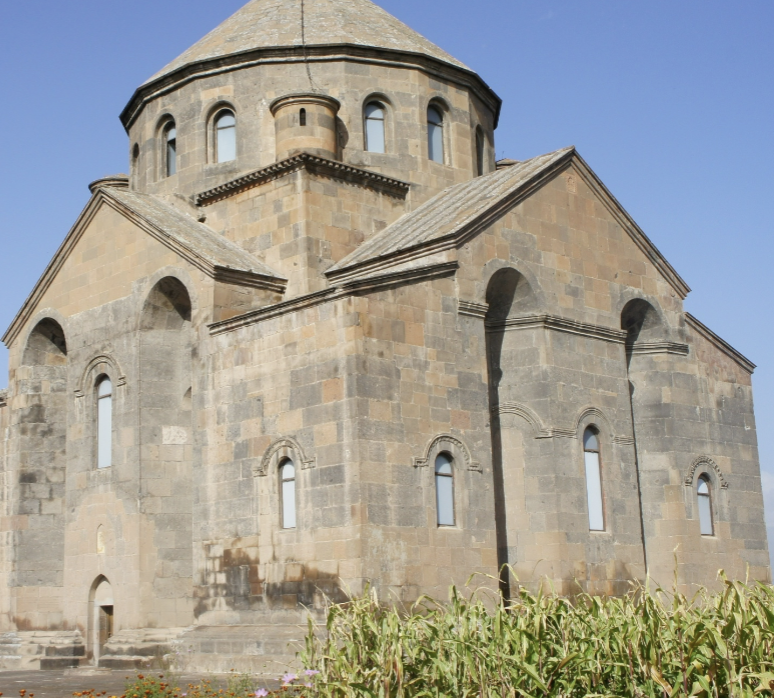
name, region, date, period, main idea + 3 parts
Hripsime · ID | Church of Hripsime, Rep. of Armenia, 618 CE, Early medieval |
|---|---|
Hripsime · Thesis | Hripsime turns the international domed church into an Armenian statement: (1) an Armenian patriarch built it over a Roman-born martyr while empires warred around him, (2) its architecture is distinctly Caucasian, and (3) it realizes Armenia's own conversion theology in stone. |
Hripsime · STEP 1 Armenian initiative | Built by Armenians, for an Armenian story, between empires. |
Hripsime · 1a Context |
|
Hripsime · 1b Martyr's tomb |
|
Hripsime · STEP 2 Caucasian architecture | The dome is international; this version is regional. |
Hripsime · 2a Plan |
|
Hripsime · 2b Compare Mtskheta + Ateni | The same type appears at churches like Ateni in Georgia, ⇒ a Caucasian, not Byzantine, solution. |
Hripsime · 2c Exterior vs. interior | Outside (SUPER PLANAR)
Inside,
Result:
|
Hripsime · STEP 3 Conversion theology | The church builds Armenia's founding vision. |
Hripsime · 3a Gregory's vision |
|
Hripsime · 3b Compare Zvartnots |
|
Hripsime · Summary | A Roman martyr's tomb receives a Caucasian domed plan and a masterful interior that realizes Gregory's vision. |
Hripsime · Conclusion | Hripsime absorbs outside elements (a Roman saint, the international dome) into a self-confident Caucasian architecture, grounding Armenian Christianity in its own story while empires fought around it. |

name, region, date, period, main idea, 3 parts
Mren · ID | Church of Mren, Rep. of Turkey, c. 638, early medieval |
|---|---|
Mren · Thesis | Mren lets Armenian lords ally with Byzantium without being absorbed: (1) it proclaims their alliance with Heraclius, (2) it places the Armenian princes themselves inside sacred authority, and (3) it bends Byzantine forms to an Armenian rite and language. |
Mren · STEP 1 Alliance with Heraclius | The church advertises Byzantine ties. |
Mren · 1a Context |
|
Mren · 1b Inscription |
|
Mren · 1c Humble Heraclius | North lintel:
|
Mren · STEP 2 Princes in sacred space | Local lords share the frame with Christ. |
Mren · 2a Tympanum |
|
Mren · 2b Lintel |
|
Mren · STEP 3 Armenian rite + language | Byzantine forms serve Armenian worship. |
Mren · 3a Procession |
|
Mren · 3b Compare Ereruyk psalm |
|
Mren · Summary | An Armenian text naming the emperor beside local lords, princes in Persian coats beside Christ, and Byzantine forms serving an Armenian rite and language. |
Mren · Conclusion | The Kamsarakan and Saharuni lords used Byzantine prestige to raise themselves. Mren turns in-betweenness into leverage: allied with empire, not absorbed by it. |

name, region, date, period,
Zvartnots · ID | Church of Zvart‘nots‘, Rep. of Armenia, c. 641–661, early medieval |
|---|---|
Zvartnots · Thesis | Nerses III's Zvartnots addresses competing audiences at once: (1) it speaks Byzantium's language of plan and insignia, (2) its Greek monograms send a risky Chalcedonian signal, and (3) it balances that by rooting itself in Armenia's sacred past and landscape. |
Zvartnots · STEP 1 Byzantine language | The church borrows Byzantium's holiest models and emblems. |
Zvartnots · 1a Jerusalem plan |
|
Zvartnots · 1cb Eagle capitals | A sculpted eagle with outstretched wings atop each dome pier; eagle plus cross monogram match Constantinopolitan officials' lead seals, so these may be "Nerses' own" seal (p. 44) ⇒ the patron signs in the emblem of Byzantine officialdom. |
Zvartnots · STEP 2 Chalcedonian signal | The language choice divides Armenians. |
Zvartnots · 2a Greek monograms | Ionic basket capitals carry Greek monograms, "Narsou" (of Nerses) and "Katholikou" (of the catholicos), when Armenian was already the standard (pp. 43–44) ⇒ likely Chalcedonian sympathies, "a position that caused dissent" among local clergy (p. 44). |
Zvartnots · 2b Compare Mren | At Mren, local nobles wrote in Armenian and wore Persian-style coats; here the catholicos writes in Greek with Byzantine seals (pp. 37, 44) ⇒ two Armenian answers to Byzantium: alliance on local terms vs. open alignment. |
Zvartnots · STEP 3 Armenian roots | Local past and landscape balance the Byzantine message. |
Zvartnots · 3a Local surface | Blind arcades with grapevines and pomegranate trees; spandrel figures with building and planting tools; a sundial with an Armenian inscription; an Urartian stele of Rusa II found on site (pp. 13, 43) ⇒ Armenian text and the deep Urartian past still present. |
Zvartnots · 3b Gregory + Ararat | Dedicated to the angels Gregory saw in his pit; built where Gregory met the converted Trdat; from the north, "perfectly contained within the outlines" of Ararat, its tiers creating "a mountainous effect" (pp. 44–45) ⇒ rooted in a sacred landscape no Byzantine could claim. |
Zvartnots · Summary (TALK ABOUT POWER) | A Jerusalem plan, Byzantine eagles and Greek monograms signal Chalcedonian alignment, balanced by Armenian inscriptions, Urartian memory, and Gregory's story framed by Ararat. |
Zvartnots · Conclusion | "Fusing together traditions known from Syria, Mesopotamia, Byzantium, and Jerusalem, Nerses may have intended to communicate his authority and piety to multiple and competing constituents" (p. 45), much as the Dome of the Rock later staked its claim. |

name, material + subject, date, era
Magi · ID | Etchmiadzin Gospels, painting of the Adoration of the Magi, 7th century, early medieval |
|---|---|
Magi · Thesis | The Adoration retells a Byzantine scene in Armenian terms: (1) it starts from a Byzantine composition arranged for Armenian liturgy, (2) it dresses the Magi as Zoroastrian priests so Armenia's Iranian past kneels to Christ, and (3) it adds an Armenian apocryphal text and Armenian doctrine. |
Magi · STEP 1 Byzantine baseline, Armenian use | The form is shared; the program is Armenian. |
Magi · 1a Epiphany set | One of the earliest Armenian paintings, bound in 6th-c. Byzantine ivory covers; its four scenes share Epiphany readings (birth and baptism together on Jan. 6), reflecting "the specific needs of the Armenian liturgy" (Mathews, p. 49) ⇒ an Armenian program in a Byzantine-wrapped book. |
Magi · 1b Composition | The Virgin with Christ dominates from a jeweled throne, towering over three kings offering gifts (pp. 49–50) ⇒ the scheme "reflects the already established iconography" of Early Christian and Byzantine art (p. 50). |
Magi · 1c Precious frame | A golden architectural frame studded with chunky jewels; deep blue, purple and red zones, like "a precious vessel," "an optical evocation of the scene's themes of royalty and richness" (p. 50) ⇒ the page itself becomes a royal gift. |
Magi · STEP 2 Iranian past kneels | The Magi become Armenia's own ancestors. |
Magi · 2a Context | Armenian society was "deeply Iranized" (p. 49); at Avarayr (451) Armenians fought Zoroastrian Persia for the right to be Christian (p. 31) ⇒ Zoroastrianism is both Armenia's past and its rival. |
Magi · 2b Compare Roman Magi | Mediterranean kings wear floppy Phrygian caps, short tunics and loose trousers like Roman barbarians; the magi here wear upright domed hats with pearls, fluttering bands and pearl earrings, like Zoroastrian priests on Sasanian seals (p. 51) ⇒ the kings recast as Iran's actual magi. |
Magi · 2c Old bows to new | "In depicting the kings as practitioners of the pre-Christian religion of Armenia, the religion of the old world thus paid homage to that of the new" (p. 51) ⇒ to an Armenian viewer, their ancestors' priests kneel to Christ. |
Magi · STEP 3 Armenian text + doctrine | Two more additions make the scene Armenian. |
Magi · 3a Gabriel | Half hidden behind the throne, Gabriel looking at the viewer, between the Virgin and a king; not in Matthew (a star guides the Magi) but in the Armenian Infancy Gospel, where he goes to the Magi (pp. 50–51) ⇒ an Armenian text rewrites a Byzantine scene. |
Magi · 3b Mandorla | The Virgin holds not the child but a light-filled oval mandorla containing him, "so that even his all-pure mother cannot hold him" (p. 51) ⇒ Christ divine from birth: "a potent visual argument against the Nestorian heresy," suggesting christ later became divine which Armenia condemned. |
Magi · Summary | A Byzantine Adoration, arranged for Armenian liturgy, rewritten with Zoroastrian Magi, an apocryphal Gabriel and an anti-Nestorian mandorla. |
Magi · Conclusion | The page uses the Mediterranean's visual language to tell Armenia's own story: its Persian past submits to its Christian present, much like the speared boar at Aghdzk. |