p4 waves
 Call Kai
 Learn
 Practice Test
 Spaced Repetition
 Match
 Flashcards
 Knowt Play
1/56

There's no tags or description
Looks like no tags are added yet.
57 Terms
what is the direction of energy transfer in waves
the energy transfer is the way their traveling
what is amplitude in a wave
amplitude is the maximum displacement of a point on the wave compared to the undisturbed position
what is wavelength in a wave
the distance between the same point on 2 adjacent waves
what is frequency in a wave
the amount of times a complete wave completely passes a point in 1 second
what are longitudinal waves
a wave where the oscillations are parallel to the direction of travel, meaning the wave consists of compressions and rarefactions like sound waves
what are transverse waves
waves where the oscillations are perpendicular to the direction of energy transfer. waves like the EMF spectrum and ocean waves
formula for speed of a wave
wave speed(m/s) = wavelength(m) x frequency(Hz)
what is the law of reflection
the law of reflection states that the angle of incidence(i) is equal to the angle of refraction{r)
what is the normal
an imaginary line drawn perpendicular to the surface that is being reflected of
how would a demonstration of a ripple tank work
you set up a ripple tank with a barrier inside and watch to see the water get reflected

how does the virtual image appear after reflection
it appears as the same size, and the same distance away as the object from the mirror,
how do you draw the virtual image formed by a mirror.
first, you measure a normal and draw a virtual image. then you draw lines to link the eye to a single point on the virtual image. then where the lines cross the surface you draw lines to the same point on the real object

what are wavefronts
when multiple waves are moving together in the same direction, you make imaginary planes one wavelength apart to show the movement of a lot of waves in the same direction
what is refraction
when a wave crosses a boundary to another medium(or shallower water) it can change speed based on the density of the mediums, and of the boundary is at an angle the wave changes directions
how do you investigate refraction using water
in a ripple tank make the water shallower in one section by adding a block, and observe how the wave changes speed/direction when it comes over the block
how do you investigate refraction using light
you shine a beam at a transparent object and observe how the beam is refracted as it goes through it

what is the refractive index of an object
the refractive index is the ratio of the speed of light in a vacuum compared to in the material
what is the refractive index of air water and glass
air is 1.00 water is 1.33 and glass is 1.52 to 2 dp
how do you calculate the refractive index of an object
since the speed of light in air is almost the same as a vacuum, refractive index(n) = sin(angle of incidence in air(i)) / sin(angle of refraction in medium(r)) - n = sin i / sin r
what is internal reflection
when a ray tries to leave a material and go into air some of that ray stays in the medium and is reflected, the reflected ray still follows the rule i = r
what is the critical angle of a material
the angle of incidence at which the angle of refraction would be equal to 90 degrees
what is total internal reflection
when the angle of incidence is grater than the critical angle there is no refracted ray and the entire beam in totally internally reflected
what happens to a beam when leaves the medium at and angle of incidence less than/exactly at/greater than the critical angle
when it is less than the ray is refracted based on the refractive index and a bit of the ray is internally reflected. when it is exactly the refracted ray is parallel to the boundary and there is a stronger internally reflected ray. when it is more then there is no refracted ray, all of the light in internally reflected
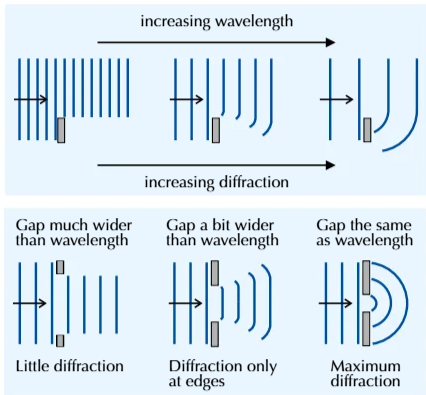
what is diffraction
is when waves spread out as they ‘bend around’ obstacles
how does wavelength affect diffraction
a general rule is that the bigger the wavelength the more the wave is diffracted. when going through a gap, when the gap is the same size as the wavelength it will be diffracted fully, diffraction decreasing a hole size goes up
what does a converging lens do
it brings parallel rays to a focus
what are the three rules for converging lenses
parallel rays will go towards the focal point once they hit the lens, rays going through the center of the lens will go straight, rays that go through the focal point come out parallel
what do diverging lenses do
they make parallel rays spread out
what are the properties of an image formed by converging lenses
the image is flipped, but it is a real image, formed on the opposite side of the lens and can be projected onto a screen
what are the properties of an image formed by diverging lenses
the image is virtual and on the same side of the lens and the rays don’t converge so the image cant be displayed on a screen. the image is diminished
what lenses are used for what seeing disorders
for people with short sightedness diverging lenses are used to allow them to focus on objects in the distance
what images are formed by converging lenses in terms of the focal point
objects further than 2F form diminished and flipped images, from F to 2F an enlarged flipped image, and closer than F the light wont converge and a virtual image is formed, upright and enlarged
what is the focal point
the point where parallel rays converge when going through a converging lens
how and what lenses do magnifying glasses use
they use converging lenses, where when an image is placed closer than F it becomes an enlarged virtual image
what are the 7 colors of light sorted by increasing wavelength
violet, indigo, blue, green, yellow, orange, red. white is a mixture of all the lights combined
what does a glass prism do to a beam of light
if the beam is not monochromatic(made up of one wavelengths) then the prism will disperse the light and allow you to see the spectrum of light inside
what are the 7 types of electromagnetic waves
radio waves, micro waves, infra red, visible light, ultraviolet, x rays, gamma rays
what are the 3 main uses for radio waves
astronomers use them in radio telescopes to determine composition and motion of objects in far away galaxies, they are used for radio and TV transmissions, used in RFID tags for identification
what are the 2 main uses for microwaves
microwaves are used in phones for wireless communication like wifi and bluetooth, and they are used at a higher intensity in microwaves to heat food.
what type of electromagnetic waves do satellites use
microwaves
what are the 2 types of satellites
low orbit satellites that orbit the earth at low altitudes (1000km) but quickly. geostationary satellites are thousands of kilometers high and rotate with the earths spin meaning they are constantly over the same spot relative to the eath
what types of satellites do satellite phones use
they use both geostationary and low orbit satellites to transmit microwaves to and from the satellites which then relay that data to on ground stations.
what types of satellites do satellite tv broadcasts use
they use geostationary satellites by pointing a satellite dish to a spot in the sky where they receive relayed data from a ground station via a geostationary satellite
how do infrared security systems work and why are they used
since infrared radiation is always emitted, unlike visible light, cameras observe the changes in infrared radiation levels in a room and if there are drastic spikes it determines that something emitting infrared radiation is there
how do electric space heaters work
they heat a metal wire using electricity which emits a lot of infrared radiation that gets absorbed by the surrounding particles and gets transferred to their internal energy stores, making them hotter
2 ways infrared waves are used to transmit data
they can be used in stuff like remote controllers to transmit data over short distances with line of sight by using pulses, or they can be used in optical fibre since low wavelength infrared passes through glass meaning it can be used to transmit data through optical fibre
what are the 2 way sound signals can be transmitted
they can be transmitted as analogue(AM and FM radio waves) or as digital(through wires and in devices)
what are the advantages(4) and disadvantages(1) of digital compared to analogue transmission
digital signals can be sent amplified and therefore sent over greater distances, regenerating the signal is also more accurate on digital signals since it only has a certain bit depth, digital transmission allows for computers to interpret the sound, digital signals are transmitted faster, but sound loses quality when it becomes a digital signal.
how does sound work
it is a wave of vibration that hits your eardrum and allows your brain to interpret it as sound
what are the peaks and troughs of sound waves called
compressions are the peaks of sound waves, areas with high compression. rarefactions are the throughs of sound waves and are areas of low density
how do sound wave speed vary per medium
the denser the medium the faster the sound travels, so they travel the slowest in gas and the fastest in solids.
what is the speed of sound in air
330-350 m/s in air, 1235 km/h is considered the speed of sound (mach 1)
how do frequency and amplitude affect how a sound sounds like
higher frequency means a high pitched sound and a high amplitude means a loud sound
how do echoes happen
when sound waves reflect of flat surfaces and bounce back to the source
what is ultrasound
sound over 20 kHz, one that humans cant hear since human ears can hear from 20Hz - 20kHz
what are 2 implication of sound waves, industrial/medical
they can be used to look inside the body, since ultrasound waves are partially reflected when crossing into a different medium, and when they are reconstructed by a computer then can be used to create an image of something inside the body, they can be used to detect cracks in materials since ultrasound would pass through a perfect material but would get reflected of any imperfections
how is echoing used in submarines
it is used in sonar that sends out pulses of sounds and base on how long they take to get back they can determine if there are how for away on object is from them