Chapter 15: Mutations and DNA Damage Repair
 Call Kai
 Learn
 Practice Test
 Spaced Repetition
 Match
 Flashcards
 Knowt Play
1/77

There's no tags or description
Looks like no tags are added yet.
78 Terms
What are mutations?
Changes in DNA sequence that cannot be repaired
Mutations can occur in both ____ and ____ cells, but only ____ mutations will be passed to progeny
germline; somatic; germline

Somatic mutations can be propagated through ____ in plants
grafts
Mutations are the source of all ____ genetic variation, which is the raw material that ____ by ____ ____ acts on
new; evolution; natural selection
Transitions
Purine to purine and pyrimidine to pyrimidine

Transversions
Purine to pyrimidine and pyrimidine to purine
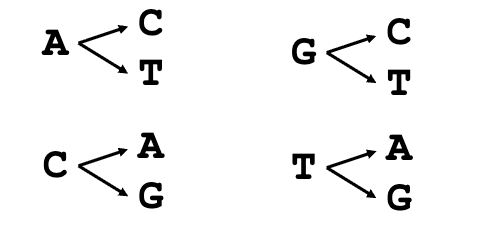
True or false: substitutions in the 3rd codon position often (but not always) result in no changes to amino acid
True
Synonymous substitution
No change to amino acid
Missense substitution
Substitution to amino acid
Conservative
Substitution with biochemically similar amino acid
Nonconservative
Substitution with biochemically different amino acid
Nonsense substitution
Substitution to a STOP codon
Indels in multiples of ____ or ____ base pairs can cause frameshift mutations
1; 2
Indels in multiples of ____ base pairs will not cause frameshift mutations, but will result in insertion or deletion of amino acids
3
Point mutations in noncoding sequence are more/less likely to have severe consequences?
Less
What two places are sensitive to point mutations?
Cis-regulatory regions (enhancers and promoters) and splice sites
Mutations in highly conserved bases are more likely to result in ______
disruption of gene function

Mutations in poorly conserved bases are more likely to _____
be tolerated
Mutations can occur ____ and are usually ____
in any cell at any time; random
Spontaneous mutations
Occur through mistakes in DNA replication or through DNA damage from the cellular environment
Induced mutations
Caused through the action of external chemical or physical agents known as mutagens
What are the two errors in DNA replication?
Alternative base pairing and strand slippage
Base tautomers
Molecule with same atoms and similar structure but altered proton positions and double bonds (reversible shifts in hydrogen atoms)

____ of a base can lead to unconventional base pairing during replication
Tautomerization, ionization, wobble base pairing
Base ionization
Protons are gained or lost, resulting in charged state
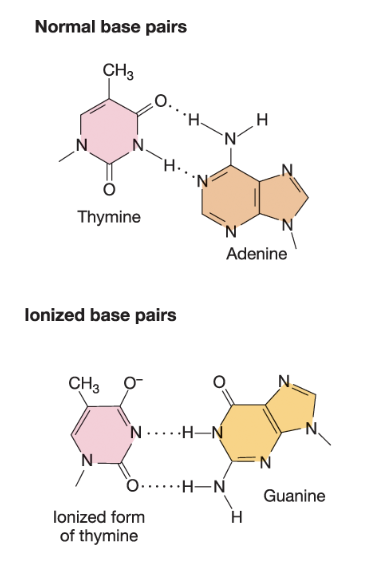
Wobble base pairing
T = G

Repetitive sequences may loop out during replication, resulting in ____ of the newly synthesized or template strands. Repeat bases may be added or deleted

Expansion of CGG repeats in the 5’ UTR of FMR1 rresults in methylation of FMR1 promoter and subsequent inactivation
Fragile X syndrome

What are the two spontaneous mutations caused by the cellular environment?
Hydrolysis of bases and oxidative damage
What is hydrolysis?
A reaction with water
Depurination
Removal of a purine

Deamination
Removal of an amino group

What can depurination result in?
Random base substitutions

Oxidative damage
Damage from reactive oxygen species that are metabolic byproducts (hydrogen peroxide, superoxide radicals)

What do oxidative damage mutations result in?
Alternative base pairing
Induced mutations can result in (3)?
Replacement of a base
Mispairing with another base
Base damage which prevents base pairing
What are the 4 chemical mutagens?
Alkylating agents
Bulky adducts
Base analogs
Intercalating agents
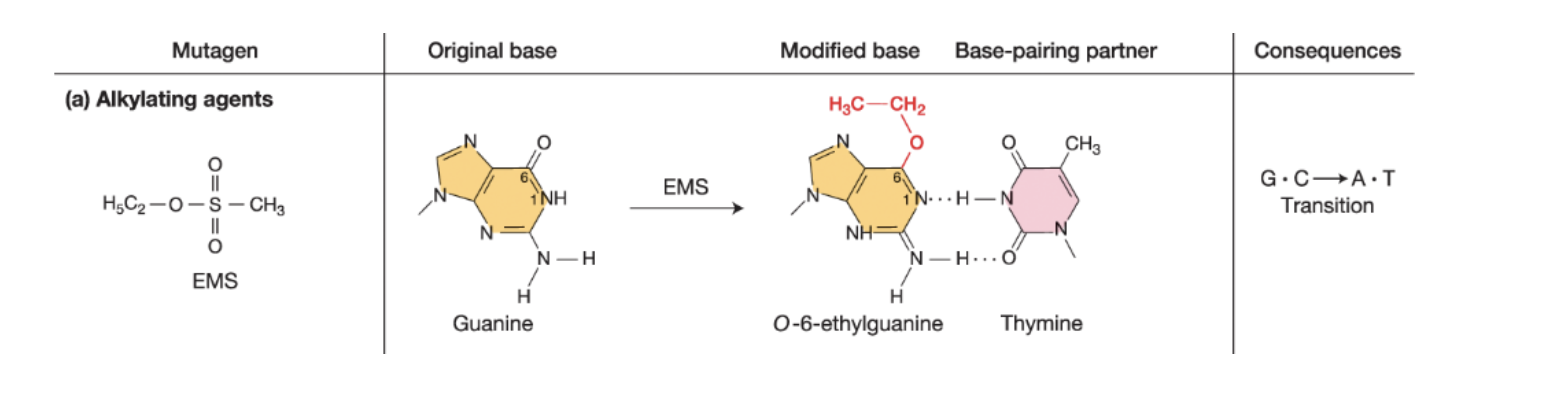
Alkylating agents
EMS (ethyl methanesulfonate) adds an alkyl group to guanine that results in a G to A transition
Bulky adducts
Bulky adducts like Aflatoxin B1 bind to bases, blocking hydrogen bonding and preventing replication and transcription

Base analogs
Base analogs, which have similar structures as naturally occurring bases, can be misincorporated during DNA replication
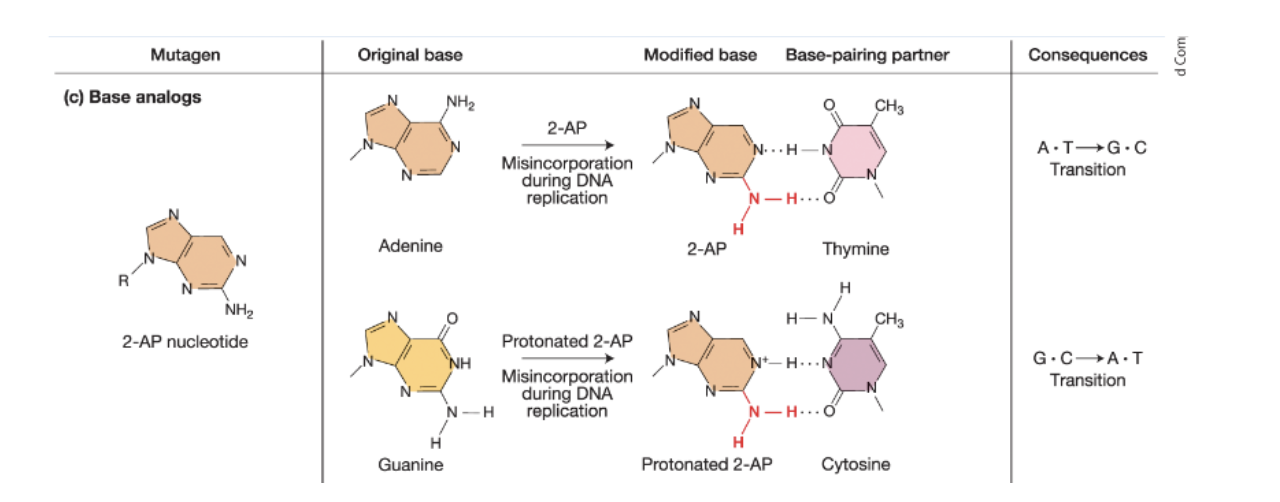
2-aminopurine (2-AP) can bind to either ____ or ____
Thymine (unprotonated); cytosine (protonated)
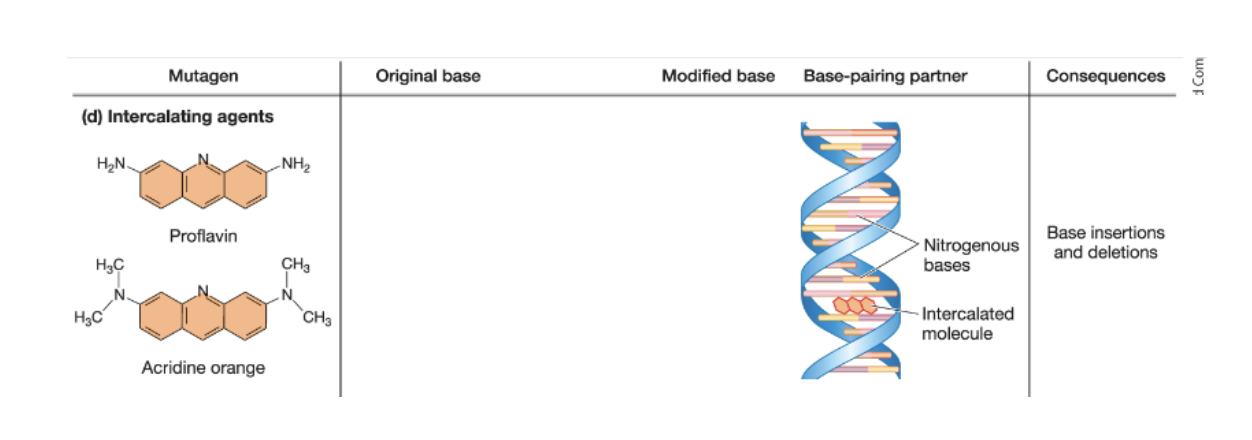
Intercalating agents
Mimic base pairs and can insert in between stacked bases within the double helix
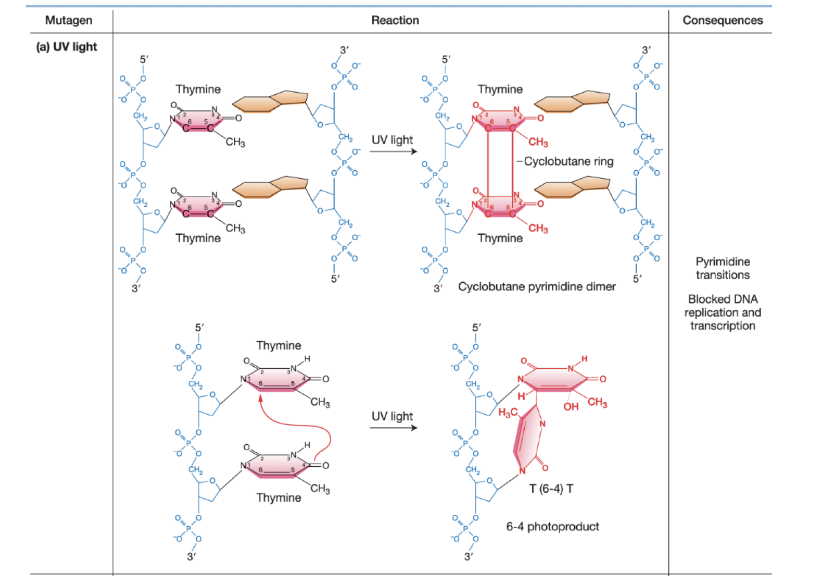
____ can result in pyrimidine dimers (covalent bonds between adjacent thymines)
UV light
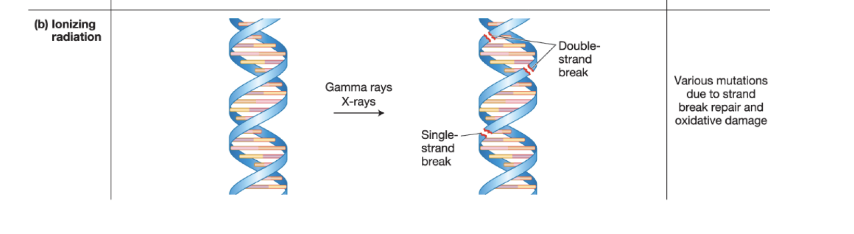
____ can result in DNA strand breaks, which can trigger cell death if not repaired
Ionizing radiation
What kind of mutation can lead to cancer?
Somatic
____ is a group of diseases characterized by uncontrolled growth and spread of abnormal cells
Cancer
What are the three key features of cancer?
Uncontrolled cell growth
Invasiveness
Genetic abnormalities
Uncontrolled cell growth
Rapid cell division while ignoring typical checkpoints
Invasiveness
Goes into surrounding tissues and spreads (metastasis)
Genetic abnormalities
Arise from genetic mutations that disrupt normal cell cycle regulation
Cancer progression and metastasis

G2 Checkpoint checks for
Cell size
DNA replication
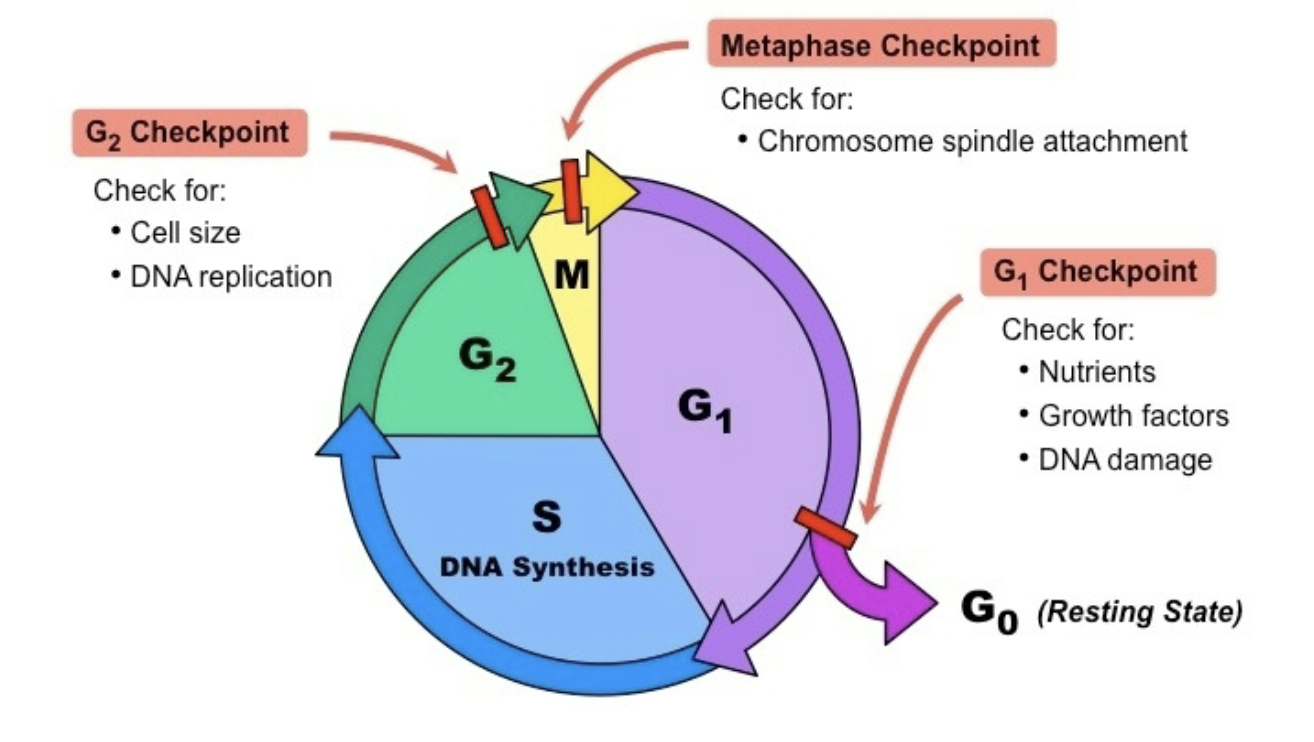
Metaphase Checkpoint checks for
Chromosome spindle attachment

G1 Checkpoint checks for
Nutrients
Growth factors
DNA damage

Proto-oncogenes
Promote cell cycle

Tumor suppressors
Inhibit cell cycle or promote apoptosis
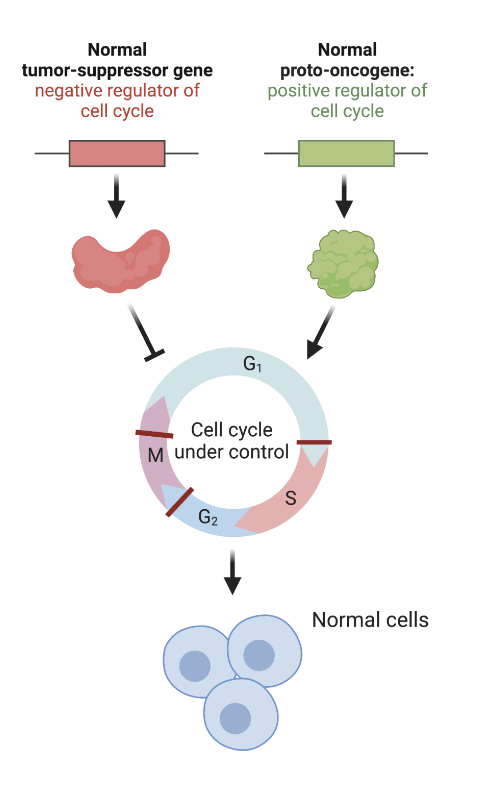
Mutations in either proto-oncogenes or tumor suppressor genes will result in ____
Cancer
Mutations in ____ are typically ____ mutations which promote unregulated cell cycle
oncogenes; gain of function
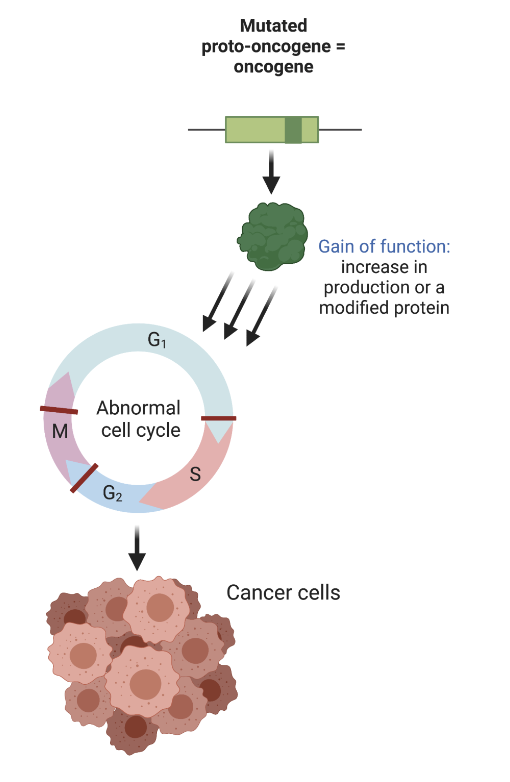
What are the types of oncogenic mutations?
Perpetually active proteins
Regulatory mutants that result in overexpression
Amplification of proto-oncogenes
Translocations of proto-oncogenes next to active promoters
____ copy of the ____ mutation is sufficient to promote cancer for oncogenes
1; dominant
Mutations in ____ are typically ____ and remove the blocks in the cell cycle
tumor suppressors; loss of function

____ copies of these ____ mutations are typically necessary to promote cancer in mutated tumor suppressors
2; recessive
Mutations in ____ and ____ are often found together in cancer cells
oncogenes; tumor suppressors

Incorrect base pairing is eliminated via ____ proofreading during ____
DNA polymerase; replication
Which two DNA polymerases have 3’ → 5’ proofreading activity?
I and III

There is ____ error in every ____ bases added for incorrect base pairing
1; 107
What are commonalities in single-strand DNA damage repair mechanisms?
Incorrect bases are first recognized and removed
The other strand of DNA is used as a template for correction via complementary base pairing
Replication factors (DNA polymerase and ligase) are re-deployed to fill in removed bases
Mismatch repair (MMR) pathway
Reduces error rate further 100-fold in E. coli
____ in GATC sequences are methylated shortly after replication in E. coli
Adenines
____ error in every ____ bases added in MMR pathway
1; 109
What is the MMR pathway?
MutS recognizes a mismatch
MutH makes a nick in the unmethylated (newly replicated strand)
Exonuclease chews up the mismatched strand
correct bases are filled in by DNA Pol III and ligase

Base excision repair pathway
Removes damaged bases
What are the steps to the base excision repair pathway?
Glycosylase removes the damaged base
AP endonuclease nicks the damaged strand of DNA (AP = apurinic or apyrimidinic)
DNA phosphodiesterase removes the damaged sugar-phosphate

Nucleotide excision repair pathway
Removes bulky adducts
What are the steps to the nucleotide excision repair pathway?
UvrA recognized the bulky adduct and recruits UvrB
UvrB is a helicase that unwinds the DNA and recruits UvrC
UvrC is an endonuclease that cleaves phosphodiester bonds 4-8 bases upstream and downstream
UvrD removes the damaged strand

Double-strand breaks are repaired via what two mechanisms?
Non-homologous end joining
Homology-directed repair
Non-homologous end joining
Rejoins the ends of a double-strand break without a template
This repair often results in indels at the double-strand break site

Homology-directed repair
Can repair a double-strand break using the sister chromatid as a template, perfectly recreating the sequence
Or, homology-directed repair can be used to insert additional bases, which is the bases for genome modification via CRISPR/Cas9
