AP Psychology Unit 1: Neuroscience
 Call Kai
 Learn
Learn Practice Test
 Spaced Repetition
 Match
Match Flashcards
 Knowt Play
1/65

There's no tags or description
Looks like no tags are added yet.
Name | Mastery | Learn | Test | Matching | Spaced | Call with Kai | Chat |
|---|
No analytics yet
Send a link to your students to track their progress
66 Terms
Lesioning
Removal or destruction of some or all of the brain.
EEG
Detects brain waves through their electrical output (measured by electrodes placed on the scalp).
CAT Scan
3-D x-ray of the brain; shows us "pictures" but cannot show us the functioning of the brain (could show tumors, etc.).
MRI
Commonly called "MRI"; more detailed picture of brain using magnetic field.
FMRI
Shows actual functioning, not just brain structure; tracks blood flow in the brain by taking MRI scans less than one second apart.
PET Scan
Measures glucose consumption in areas of the brain.
Neuroscience
The study of the nervous system and the brain.
Multiple Sclerosis
Involves breakdown of Myelin Sheath, and the axon can not send messages.
Sensory (afferent) Neurons
Carries messages from the body's tissue and sensory organs to the brain and spinal cord.
Sensory Receptors
In our skin and organs that perceive stimulation.
Interneurons
Located within the brain and spinal cord; communicate between sensory and motor neurons.
Motor (efferent) Neurons
Carries outgoing messages from the brain and spinal cord to muscles and glands (sometimes called effectors).
Action Potential
The brief electrical charge that travels down the axon that delivers a message.
Resting Potential
Sodium-Potassium pumps keep sodium ions out of the cell (creates positive charge) while allowing some potassium cells inside the cell (keeping it negative outside).
Excitatory Message
Tells neuron to fire.
Inhibitory Message
Tells neuron to hold back.
Threshold
The minimum level of stimulation of an excitatory message.
Depolarization
Sodium ions from outside flood in, causing an electrical charge.
All or Nothing Response
The idea that the neuron either fires or it does nothing at all (like a gun!).
Refractory Period
Neuron cannot fire during this time.
Repolarization
Pumps channel sodium back outside the membrane, allowing cell to become polarized again.
Acetylcholine
Enables muscle action, learning, and memory; too little results in Alzheimer's disease.
Dopamine
Plays a role in movement, learning, attention, emotion, pleasure centers; too much leads to schizophrenia and too little leads to Parkinson's disease (muscle tremors).
Serotonin
Affects mood, hunger, sleep, and arousal; too little results in depression.
Norepinephrine
Plays a role in alertness and arousal; too little lowers mood.
GABA
Inhibitory and involved in sleep; too little causes seizures, tremors, insomnia
Schizophrenia
Involved with too much dopamine.
Parkinson's disease
Seen with too little dopamine.
Depression and bipolar disorders
Seen with not enough serotonin or norepinephrine.
Alzheimer's Disease
Seen with too little acetylcholine.
Anxiety Disorders
Seen with too little GABA.
Peripheral Nervous System
Carries information to and from the Central Nervous System; contains the somatic and autonomic nervous systems.
Somatic Nervous System
Controls voluntary body movements and actions (involves our muscles and receptors).
Autonomic Nervous System
Controls the glands and muscles of the internal organs-those that work involuntarily; broken into the sympathetic and parasympathetic nervous system.
Sympathetic Nervous System
Arouses the body to prepare it for actions and stress.
Parasympathetic Nervous System
Brings body back down to "normal" homeostasis.
Endocrine System
The body's slow chemical communication system.
Pituitary Gland
Regulates growth and controls other glands.
Thyroid Gland
Affects metabolism.
Adrenal Glands
Release epinephrine and norepinephrine to stimulate sympathetic and parasympathetic nervous system.
Pancreas
Regulates blood sugar level in the blood.
Pineal Gland
Secretes the hormone melatonin, which helps regulate our sleep cycle.
Brainstem
Oldest region of the brain involved in basic bodily functions.
Medulla
Controls heart beat and breathing.

Pons
Coordinates movements with the cerebellum and helps regulate sleep.
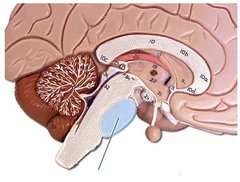
Reticular Formation
Netlike formation of nerves that plays an important part in arousal and filtering messages to the thalamus.
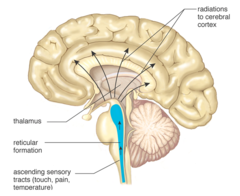
Thalamus
The "switchboard" of the brain; receives all sense (except smell) and relays messages to rest of brain.

Cerebellum
Bottom rear of the brain; coordinates fine muscle movements; involved in procedural memory.

Limbic System
The emotional center of the brain involved in feeling emotions, drives, and desires.
Amygdala
Involved in how we process emotions.

Hippocampus
Involved in the processing and storage of memories.

Explicit Memory
Processes our facts about people, places, time, and events in the hippocampus.
Hypothalamus
It controls the pituitary gland and regulates body temperature, creates sexual arousal, hunger, thirst, and the endocrine system (signals the pituitary gland to secrete hormones).

Basal Ganglia
Located at the base of the brain and is involved in voluntary control of muscles and procedural tasks (may be linked to parkinson's disease)

Frontal Lobe
Enables judgement, planning, and processing new memories
Motor Cortex
Sends signals to our body controlling muscle movement; located in the frontal lobe.
Broca's Area
Responsible for controlling muscles that produce speech (left frontal lobe).
Parietal Lobe
Responsible for all our sensations.
Sensory Cortex
Receives incoming touch sensations from rest of body.
Association Areas
Involved in higher mental functions such as learning and remembering.
Auditory Cortex
How we hear things; in the temporal lobe.
Wernicke's Area
Interprets spoken speech.
Angular Gyrus
Involved in reading aloud; transforms visual representations (words) into auditory codes.
Corpus Callosum
Thick "band" that divides the two hemispheres of the brain.
Left hemisphere
Responsible for logic and sequential tasks like spoken language.
Right hemisphere
Responsible for spatial and creative tasks like art, music, insight, imagination.