3. Visual Acuity and Monocular Fixation - Clinical Binocular Vision Fall 2026
 Call Kai
 Learn
 Practice Test
 Spaced Repetition
 Match
 Flashcards
 Knowt Play
1/142

There's no tags or description
Looks like no tags are added yet.
143 Terms
Why is the assessment of visual acuity important?
to identify the best corrected visual acuity in each eye
True or False:
Visual acuity may vary greatly depending on the type of target used
true
What type of targets are generally used to measure VA?
Full chart
Single line
Single letter
What were the results of the study that evaluated the difference in acuity results between full chart, single line, and single optotype visual acuity?
-Children with amblyopia were compared to normal age-matched children
-LogMAR acuity improved when full chart substituted with a single line, and improved by a similar increment with single optotypes in BOTH GROUPS
-Amblyopes improved more than controls when going to single optotypes
Monocular VA Measurements in Amblyopes have what speed of response?
slow and irregular
True or False:
When monocular VAs are measured on amblyopes, some letters will be reported correctly while others are missed over a large range of acuities
true
When monocular VAs are measured on amblyopes, can some letters be skipped or read out of order?
Yes
When monocular VAs are measured on amblyopes, when is acuity better?
With isolated letters or line/chart
isolated letters
When monocular VAs are measured on amblyopes, what letters are read more accurately?
Letters in the middle of the line or at the edge
Letters at the edge of the line
Is there potentially poor repeatability when testing monocular VAs in amblyopes?
Yes
Why is taking acuity in amblyopic patients difficult?
-Sensitivity to contour interactions
-Anormal spatial distortion
-Unsteady fixation
-Poor tracking
Which type of amblyopes have a greater sensitivity to contour interactions?
Refractive or strabismic
strabismic -- 90% of these patients have sensitivity to contour interactions. These abnormal interactions cause confusion.
What is wrong with the Snellen chart when taking acuities on amblyopes?
-Different number of letters per line of VA depending on the acuity level
-Letters have different degrees of difficulty
-Differing influences of visual resolution
-Differing surrounding contours on different lines
-Assignment of acuity is based on arbitrary numbers of letters missed

What chart should we use to evaluate VA in amblyopic patients?
-LogMAR progression
-Crowding bars
-Full chart

What optotypes should be used to test VA on amblyopic patients?
-LEA or HOTV
-ETDRS or SLOAN

What protocol is usually used to test acuity on patients with amblyopia?
ATS protocol

Why is the ETDRS optotype used for patients with amblyopia?
-The Early Treatment of Diabetic Retinopathy Study Chart
-Standardized crowding
-Equal number of letters per line
-More intervals of acuity

_____ optotype should be used for younger patients with amblyopia
HOTV

Should a single optotype with crowding bars be used for patients with amblyopia when testing their VA?
Yes

Why should a single letter optotype with crowding bars be used to test VA in patients with amblyopia?
Increase sensitivity for amblyopia

Describe the different phases of the ATS Protocol for VA Measurement in Amblyopes
-Screening Phase
-Phase 1
-Reinforcement
-Phase 2

How to determine final VA from the ATS protocol?
Lowest acuity from Phase 1 and 2
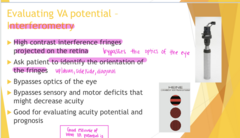
How is interferometry used to evaluate the potential VA in patients with amblyopia?
-High contrast interference fringes projected onto the retina
-Ask patient to identify the orientation of the fringes

What is the benefit of using interferometry to evaluate the potential VA in patients with amblyopia?
bypasses the optics of the eye and bypasses sensory and motor deficits that might decrease acuity

What is interferometry testing good for when testing VA in patients with amblyopia?
good for evaluating acuity potential and prognosis
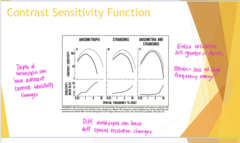
What does the contrast sensitivity function (CSF) assess for patients with amblyopia?
assesses visual resolution over the entire spatial frequency and contrast range
How to perform the contrast sensitivity function test for patients with amblyopia?
-Sine wave gratings in a forced choice test design
-Graph is plotted by the highest numbered gratng that the patient can see at each spatial frequency
What is the benefit of contrast sensitivity testing in patients with amblyopia?
May show gains before VA during therapy

Contrast Sensitivity Function (Pic)
Contrast Sensitivity Function (Pic)

Contrast Sensitivity Function (Pic)
Contrast Sensitivity Function (Pic)

Entire contrast sensitivity function loss is greater is (anisometropic/strabismic) amblyopia
anisometropic

High contrast sensitivity function loss is greater is (anisometropic/strabismic) amblyopia
strabismic
True or False:
Different amblyopes can have different spatial resolution changes
true

Can the depth of amblyopia can be related to the contrast sensitivity changes that a patient experiences?
Yes
What is a diagnostic strategy to VA measurement in amblyopes?
-Overall VA assessment strategy designed to establish a reliable initial VA
-Baseline for diagnosis and development of a treatment plan
Is vision fully developed at birth?
No
Visual experience dictates ________
visual outcomes

Normal Fixation Development and Monocular Viewing Conditions (Pic)
Normal Fixation Development and Monocular Viewing Conditions (Pic)

Right Esotropia and Nasal Eccentric Fixation (Pic)
**OD fovea is not on the target when the eye is strabismic. The fovea does not develop correctly and some eccentric point on nasal retina will be the target
Right Esotropia and Nasal Eccentric Fixation (Pic)

Right Esotropia and Central Fixation (Pic)
**OD fovea is not on the target when the eye is strabismic. When the patient is monocular, the patient will use the fovea to fixate on the target and thus eccentric fixation is not formed
Right Esotropia and Central Fixation (Pic)
What is MONOCULAR Fixation?
the ability of a single eye to aim at and focus independently on a stationary or moving target
If the fovea is used to fixate a target, what type of fixation will form?
central fixation
If a non-fovea is used to fixate a target, what type of fixation will form?
Eccentric fixation
Is anomalous correspondence the same as eccentric fixation?
No

Right Exotropia and Central Fixation (Pic)
**OD fovea is not on the target when the eye is strabismic. When the patient is monocular, the patient will use the fovea to fixate on the target and thus eccentric fixation is not formed
Right Exotropia and Central Fixation (Pic)

Right Exotropia and Temporal Eccentric Fixation (Pic)
**OD fovea is not on the target when the eye is strabismic. The fovea does not develop correctly and some eccentric point on temporal retina will be the target
Right Exotropia and Temporal Eccentric Fixation (Pic)
Eccentric fixation is a (binocular/monocular) phenomenon
monocular
Is eccentric fixation seen in all amblyopic eyes?
Not all -- but most of them
Is eccentric fixation seen in anisometropia?
Rarely but not impossible
When is eccentric fixation most commonly seen?
In strabismic amblyopia (60-80%)
Eccentric fixation is almost always (bilateral/unilateral)
unilateral
Will eccentric fixation impact ANY TEST that uses monocular fixation?
Yes -- VA, CT
When describing eccentric fixation, what do you need to specify?
-Which eye
-Location (direction)
-Magnitude
-Stability

What is the LOCATION of eccentric fixation?
-What part of the retina (relative to the fovea) is used for fixation)
-Nasal, Temporal, Superior, or Inferior
-Generally will be associated with the direction of the strabismus

Esotropes will generally use (nasal/temporal) retina for eccentric fixation
nasal

Exotropes will generally use (nasal/temporal) retina for eccentric fixation
temporal
The MAGNITUDE of eccentric fixation is measured in what?
prism diopters
Most eccentric fixation is ____ prism diopters or less
3
Is eccentric fixation associated with the magnitude of the strabismus?
No
The amount of eccentric fixation found is generally (more than/less than) the magnitude of the strabismus
less than
How to describe the stability of eccentric fixation
Steady vs unsteady
More periphery eccentric fixation is more (steady/unsteady)
unsteady
How to assess the stability of eccentric fixation?
Do measurements multiple times and then take an avg of these measurements
How do we evaluate eccentric fixation objectively?
visuoscopy
How do we evaluate eccentric fixation subjectively?
-MITT Box
-Brock Givner After Image Transfer
What is the most common method for evaluating eccentric fixation?
visuoscopy
How to perform visuoscopy?
-Direct ophthalmoscope
-Using the foveal light reflex
-Project calibrated target onto the retina
-Easiest when the patient is dilated

Visuoscopy Targets (Pic)
Visuoscopy Targets (Pic)
Visuoscopy is a _____ Test
monocular -- the other eye needs to be occluded
What is Visuoscopy objectively evaluating?
which part of the retina the patients uses to fixate
How to perform Visuoscopy?
project a calibrated target on the retina, ask the patient to fixate the center of the target
Which eye should be testing first when performing visuoscopy?
Test the fixating eye first
What should the examiner observe when performing visuoscopy?
Observe the area of the retina the patient uses to fixate

Visuoscopy Right Eye (Pic)
Visuoscopy Right Eye (Pic)

Visuoscopy Left Eye (Pic)
Visuoscopy Left Eye (Pic)
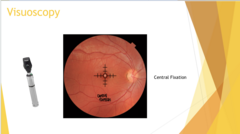
Visuoscopy Central Fixation (Pic)
Visuoscopy Central Fixation (Pic)

Determine the magnitude and direction of eccentric fixation in this pic?
2pd nasal eccentric fixation OD

Determine the magnitude and direction of eccentric fixation in this pic?
2pd temporal eccentric fixation OD
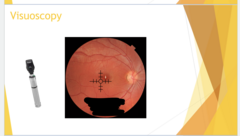
Determine the magnitude and direction of eccentric fixation in this pic?
2 pd temporal and 2pd inferior eccentric fixation OD

Determine the magnitude and direction of eccentric fixation in this pic?
1pd nasal eccentric fixation OS
REVIEW: Should you occlude the other eye while performing visuoscopy?
Yes
REVIEW: Should you demonstrate to the patient in space the visuoscopy target and to the non-amblyopic eye first?
Yes
REVIEW: Should you perform visuoscopy several times?
Yes
REVIEW: When performing visuoscopy, evaluate ____ before _____
location, magnitude
REVIEW: visuoscopy is easier if the patient is ____
dilated
REVIEW: What should you instruct the patient to do during visuoscopy?
Look at the center of the target

What type of fixation does this patient have if it is the RIGHT EYE fixating?
2pd superior, 2 pd nasal eccentric fixation OD

What type of fixation does this patient have if it is the RIGHT EYE fixating?
2 pd inferior, 2 pd nasal eccentric fixation OD
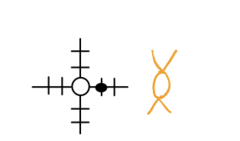
What type of fixation does this patient have if it is the RIGHT EYE fixating?
2 pd temporal eccentric fixation OD

What type of fixation does this patient have if it is the LEFT EYE fixating?
2 pd nasal eccentric fixation OS

What type of fixation does this patient have if it is the LEFT EYE fixating?
3 pd superior eccentric fixation OS

What type of fixation does this patient have if it is the LEFT EYE fixating?
3 pd nasal, 1 pd inferior eccentric fixation OS
MITT Box and Brock-Givner After Image Transfer Testing for eccentric fixation use _______
foveal tags

What does the Macular Integrity Tester (MITT) Box use to check for eccentric fixation?
-Rotating polarizer
-You will see a propeller where the fovea is located d/t orientation of the macular pigments and fibers

A _____ will make MITT BOX (Hadinger Brush) easier to see
blue filter

Using MITT, you can view entopic phenomenon of _________
Haidinger's brishes
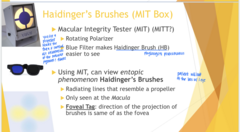
What are Haidinger's brushes?
Radiating lines that resemble a propeller
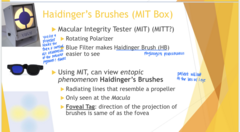
Where are Haidinger's brushes seen?
only at the macula

What is a foveal tag related to Haidinger's brushes?
Direction of the projection of the brushes is the same of as the fovea
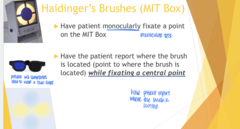
How to perform MITT BOX testing w/ Haidinger's Brushes?
-Have the patient MONOCULARLY fixate a point on the MITT BOX
-Have the patient report where the brush is located (point to where the brush is located) while fixating a central point