AQA A level Chem 3.11 Amines
 Call Kai
 Learn
 Practice Test
 Spaced Repetition
 Match
 Flashcards
 Knowt Play
1/11

There's no tags or description
Looks like no tags are added yet.
12 Terms

Two steps in the synthesis of an aromatic amine are shown.
State a possible use for the amine formed in Step 2. (1)
Manufacture of dyes/surfacetants/fabric softeners (1)

This question is about the reaction scheme shown.
Name the reagent for step 4
State a necessary condition for step 4 (2)
Chlorine (1)
UV light (1)

Amine A is formed in step 2 and amine B is formed in step 5
Explain why amine B is a stronger base than amine A (2)
In B alkyl group is electron donating OR positive inductive effect (1)
lone pair on N more available (1)

Amine A is formed in step 2 and amine B is formed in step 5
Explain why the yield of B in step 5 is less than the yield of A in step 2 (2)
In step 5 further substitution may occur/gives other amine products (1)
In step 2 only one amine is produced (1)
Complete the mechanism for the reaction of ammonia with 6-bromohexylamine to form 1,6-diaminohexane. Suggest the structure of a cyclic secondary amine that can be formed as a by-product in this reaction. (4)
(4)

1,6-Diaminohexane can also be formed in a two-stage synthesis starting from 1,4-dibromobutane. Suggest the reagent and a condition for each stage in this alternative synthesis. (3)
Stage 1 reagent KCN or NaCN (1)
Stage 1 condition aqueous alcohol(1)
Stage 2 reagent & condition H2 and Ni or Pt or Pd (1)
Explain why 3-aminopentane is a stronger base than ammonia. (2)
In 3-aminopentane (1)
Lone pair on N more available or Lone pair on N accepts H+better (1)
because of alkyl electron pushing/inductive effect (1)
Primary amines can be prepared by the reaction of halogenoalkanes with ammonia or by the reduction of nitriles.
Justify the statement that it is better to prepare primary amines from nitriles rather than from halogenoalkanes. (2)
With halogenoalkane :
further reaction (of primary amines) (1)
With nitriles
No further reaction OR single product/higher atom economy (1)
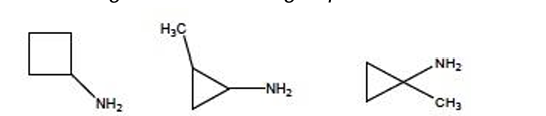
Draw the structure of a primary amine with four carbon atoms that cannot be formed from a nitrile (1)
(1)
Phenylamine can be prepared by a process involving the reduction of nitrobenzene using tin and an excess of hydrochloric acid.
Explain why an aqueous solution is obtained in this reduction even though phenylamine in insoluble in water (1)
C6H5NH2 present as ionic salt (1)

This question is about the three amines, E, F and G.
Amines E, F and G are weak bases.
Explain the difference in base strength of the three amines and give the order of increasing base strength (6)
(Strength depends on availability of) lone pair on N (atom) (1)
E N (next to ring) : lone pair delocalised into ring (1)
lone pair less available (to donate or to accept a H+ ) (1)
F or G : N (next to alkyl) : (positive) inductive effect (1)
lone pair more available (to donate or to accept a H+ ) (1)
order of increasing base strength E< G<F

Amine F can be prepared in a three-step synthesis starting from methylbenzene.
Suggest the structures of the two intermediate compounds.
For each step, give reagents and conditions only. Equations and mechanisms are not required. (5)
Intermediate compounds
Product of step 1 : C6H5CHCl
Product of step 2 : C6H5CH2CN
reagents/conditions
step 1
Cl2 & UV
step 2
KCN alcoholic and aqueous
step 3
H2/Ni