Thermo Exam 2
 Call Kai
 Learn
 Practice Test
 Spaced Repetition
 Match
 Flashcards
 Knowt Play
1/86

Earn XP
Description and Tags
Chapters 1-7 with a focus on 6-7
87 Terms
General Mass Balance Rate Form

Steady-State Mass Balance

Mass Flow Rate Definition

Boundary Work (General)

Boundary Work (Constant Pressure / Isobaric)

Polytropic Process Path

Polytropic Boundary Work (n ≠1)

Polytropic / Isothermal Ideal Gas Work (n = 1)
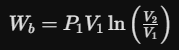
General Open System Energy Balance (Rate Form)

Steady-Flow Energy Equation (1 inlet/exit)

Nozzles & Diffusers Energy Balance

Turbine Energy Balance

Compressor / Pump Energy Balance

Throttling Valve Energy Balance

Transient / Filling Tank Energy Balance

Clausius Inequality

Entropy Change of a System

Closed System Entropy Balance

Control Volume Entropy Balance (Steady-State)

Entropy Generation Criterion

Exergy Destruction / Lost Work

Exergy
the maximum useful work you can get from a system as it reaches thermodynamic equilibrium with its environment (known as the dead state)
Entropy Change of Incompressible Substance

Ideal Gas Entropy Change (using Temperature & Pressure)
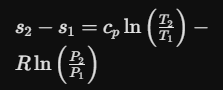
Ideal Gas Entropy Change (using Temperature & Volume

Isentropic Ideal Gas (T and P)

Isentropic Ideal Gas (T and v)

Isentropic Ideal Gas (P and v)

Control Volume (Open System)
A region in space chosen for study where both mass and energy can cross the boundaries (e.g., a turbine, compressor, nozzle, or pipe).
Steady-State
A condition where properties at any given point inside the control volume do not change with time. (Inputs equal outputs; nothing is accumulating).
Enthalpy (h)
The total energy of a flowing fluid. It combines internal energy (u) plus the "flow work" required to push the fluid through a system (h = u + Pv).
Entropy (s)
A thermodynamic property that measures molecular disorder, randomness, or lost potential. Energy tends to degrade into unusable entropy.
Entropy Generation (Sgen)
The amount of entropy created inside a system due to real-world imperfections like friction, sudden expansions, or heat transfer.
Can Sgen ever be negative or decrease?
NO. By the Second Law of Thermodynamics, entropy generation can never be less than zero for any actual process.
What does Sgen>0 mean?
The process is irreversible (real-world process with friction, heat loss, or turbulence). Sgen increases or is positive.
Sgen = 0 meaning?
The process is internally reversible (idealized, frictionless, lossless process).
Sgen < 0 meaning?
Impossible! Any calculation or multiple-choice option where Sgen is negative means the process violates the Second Law and cannot happen in real life.
Can the entropy of a system decrease?
YES. A system's entropy can decrease (for example, if you cool down water or freeze it into ice, extracting heat lowers its internal disorder). But the total entropy generation of the universe/isolated boundary (Sgen) still goes up or stays zero.
How to find Sgen in an equation?
Use the entropy balance:

Closed System (Control Mass)
A system where mass cannot cross the boundary, but energy (heat/work) can.
Intensive Properties
Properties independent of the size or mass of the system (e.g., temperature, pressure, density).
Extensive Properties
Properties that depend on the total mass or size of the system (e.g., total mass, total volume, total energy).
Heat (Q)
Energy transfer driven strictly by a temperature difference between a system and its surroundings.
Work (W)
Energy transfer associated with a force acting through a distance (or any energy transfer that is not heat).
Boundary work (Wb)
The mechanical work done by or on a moving boundary (such as a piston expanding or compressing).
First law
There is an equation of state of the system called internal energy (U). In an adiabatic system, the change in internal energy (Δu) is equal to the work done ON the system (w_on). In a system in thermal contact with its surroundings, the heat flow or absorbed (Q) is given by Q=Δu-w.
• The first law does not describe the direction a natural process takes during a reaction
• The first law describes heat as a form of energy
• The first law is a statement on the conservation of energy (cannot be created/destroyed)
Second law
There is an equation of state of the system called entropy (s). In an isolated system, ΔS=(see photo), where ΔS is greater than or equal to zero. If the systematic process is reversible, then ΔS = 0.
• The second law does describe the direction a process takes (in terms of increase/decrease in entropy)
• Entropy is a measure of disorder (“pessimistic view”)
• Entropy is a measure of the number of options (“optimistic view”)
• S=Kb ln (omega), where omega= number of accessible states

Third law
In a homogenous system in complete internal equilibrium, the entropy approaches zero as the absolute temperature approaches zero.

Zeroth law
If two bodies are in thermal equilibrium with a third body, then they are also in equilibrium with each other.
Saturated Liquid
A liquid that is right on the verge of vaporizing (boiling).
Saturated Vapor
A vapor that is right on the verge of condensing into a liquid
Vapor quality (x)
The mass fraction of vapor in a saturated liquid-vapor mixture
• x=(y - y_f) / (y_g - y_f)
• x ranges from 0 to 1
• the closer x gets to one, the more vapor is present in the mixture
Energy quality (x)
The capacity of an energy source to do useful macroscopic work (related to exergy).
Why is work (like a spinning shaft or electricity) considered a higher quality form of energy than heat?
Work can be converted into heat with 100% efficiency (via friction), but the Kelvin-Planck statement dictates that heat can never be converted into work with 100% efficiency.
What makes energy higher quality?
How easily and completely a form of energy can be converted into useful work. High quality is ordered and concentrated.
High or low quality energy? Electricity
HIGH. Electrons move uniformly in the same direction, making it nearly completely convertible into mechanical work, light, or heat
High or low quality energy? Mechanical energy
HIGH. Ordered macroscopic motion or kinetic/potential energy (such as rotating turbines or a compressed spring) can directly perform work
High or low quality energy? Chemical energy (batteries/fuels)
HIGH. Stored in well-ordered atomic and molecular bonds (e.g., gasoline, coal, natural gas, or food) that can release concentrated work through reactions.
High or low quality energy? Nuclear energy
HIGH. Concentrated energy stored in the nucleus of atoms that can be released via fission or fusion.
High or low quality energy? Low-temp thermal energy (heat)
LOW. The random, microscopic kinetic motion of atoms and molecules in matter. Heat cannot be converted 100% into work; its quality depends heavily on how hot the source is relative to its
High or low quality energy? Wind energy (diffuse air motion)
LOW. Individual air molecules move in chaotic, random directions; only their net vector represents usable wind energy.
What makes something low quality energy?
Low quality energy is disordered, dispersed (diffuse), and chaotic. It has high entropy and cannot be fully converted into work, meaning its capacity to do work is low.
What factor determines the quality of heat energy?
Its absolute temperature. The higher the temperature of a heat source, the higher its maximum thermal efficiency and the higher its quality.
When heat spontaneously flows from a hot object to a cold object, what happens to energy quantity versus energy quality?
Quantity: same (via 1st law consv. of energy)
Quality: Decreases, because the heat is now at a lower temperature and has a lower capacity to produce work.
Specific heat (Cv and Cp)
The energy required to raise the temperature of a unit mass by one degree under constant volume (Cv) or constant pressure (Cp).
Closed System Energy Balance
Total energy in minus total energy out equals the change in total internal energy of the system (Q - W = ΔU).
Specific Heat Approximation
Treating Δu and Δv as linear changes using average specific heats (Δu = Cv ΔT)
Polytropic Process
Process where pressure and volume follow the path relation

Steady-state
A condition where properties inside the control volume do not change over time (inputs equal outputs).
Mass Balance
Total mass entering a control volume must equal the mass leaving it during steady-state

Nozzle / Diffuser
Flow devices designed to change fluid velocity. Nozzles speed up fluid (drop pressure); diffusers slow it down. Both are adiabatic with zero work (Qdot=0 and W=0)
Turbine
A work-producing device where high-pressure fluid expands across blades to generate power. Treated as adiabatic with negligible kinetic/potential energy changes.
Compressor / Pump
Work-consuming devices used to raise the pressure of a gas (compressor) or liquid (pump).
Throttling Valve
A restriction in flow (like a constricted valve) that causes a major pressure drop. It is isenthalpic (h2=h1)
Isenthalpic
No change in enthalpy (h)
Thermal Energy Reservoir
A hypothetical body with a large thermal capacity that can supply or absorb heat without changing its temperature.
Heat Engine
A device that converts heat into useful work (e.g., power plants).
Kelvin-Planck Statement
No heat engine can convert 100% of its input heat into work; it must reject some waste heat to a low-temperature sink.
Refrigerator / Heat Pump
Devices that transfer heat from a low-temperature medium to a high-temperature medium using external work input.
Reversible Process
An idealized process that can be reversed without leaving any trace on the surroundings (frictionless, lossless).
Carnot Cycle
The most efficient theoretical heat engine cycle operating between two constant-temperature reservoirs.
Clausius Inequality
The cyclic integral is always less than or equal to zero

Isentropic Process
Constant entropy (S2=S1). It is both reversible and adiabatic.
Isentropic efficiency
A metric comparing the actual performance of a device (like a turbine or compressor) to its ideal/isentropic counterpart.
Exergy Destruction (Xdes)
The amount of work potential lost forever due to irreversibilities, calculated as

Decrease in energy quality results in?
Increase in entropy
Decrease in entropy also means?
Increase in energy quality