lecture 15 - resting membrane potential
 Call Kai
 Learn
 Practice Test
 Spaced Repetition
 Match
 Flashcards
 Knowt Play
1/34

There's no tags or description
Looks like no tags are added yet.
35 Terms
what are membranes made of?
phospholipid bilayer
what is an important feature of the phospholipid bilayer
things can’t easily move through it (so you can control what goes in and out)
transport proteins
proteins that move specific ions/molecules across the membrane

what makes neurons electrically excitable?
they have a polarized membrane (charge difference on either side of the membrane)

the electrical properties of neurons result from what?
ion gradient
[ ] gradient
permeability of membrane

concentration gradient
difference in concentration of a certain substance across a distance/membrane

with a concentration gradient, substances always want to move from areas of ____ [ ] to an area of ___ [ ]
high, low

how do we created a polarized plasma membrane?
separate +ve and -ve charges, making them want to get back together

the outside of the cell membrane is typically ___, while the inside is typically ___
+ve, -ve

membrane potential
potential difference b/w ions (charge + [ ]) on outside vs inside of the cell

oscilloscope
tool used to measure voltage

in a resting condition, the inside of an axon is more ___ than the outside
-ve
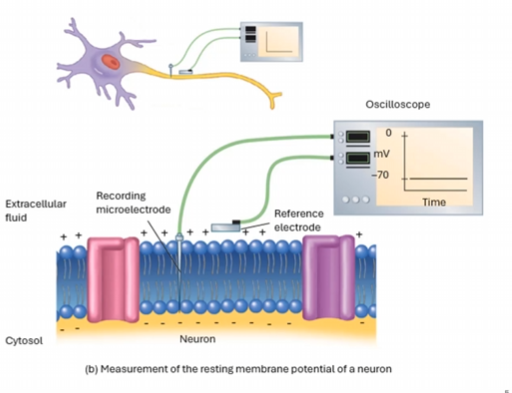
the voltage difference (membrane potential) at rest on the inside of an axon is ___mV
-70

resting membrane potential
voltage difference across membrane when cell is not active

ECF (outside of cell) has higher [ ] of:
chloride (-ve)
sodium (+ve)
calcium (+ve)
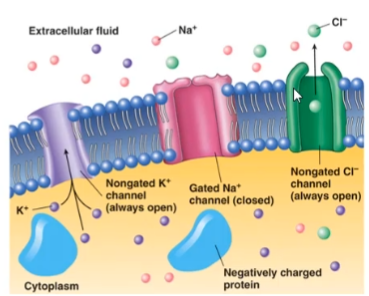
cytosol (inside of cell) has higher [ ] of:
potassium (+ve)
proteins (-ve)

on the immediate inside/outside of the plasma membrane, there are clumps of what
+vely or -vely charged ions
2 ways in which ion gradient are created
sodium/potassium pump
membrane permeability

sodium-potassium (Na+/K+) pump
helps create [ ] gradient for sodium and potassium
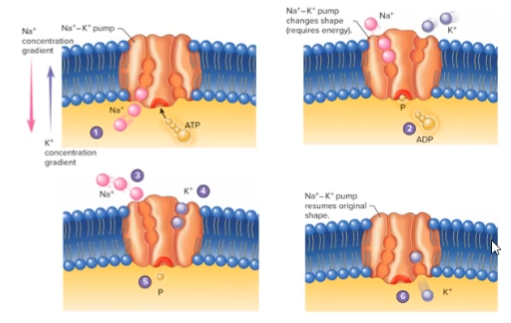
actively transports 2 K+ into the cell and 3 Na+ out of the cell

sodium-potassium (Na+/K+) pump process
Na+ molecules on the inside of cell drawn to pump
ATP binds to pump
ATP → ADP + Pi
pump changes shape and moves the Na+ to the outside of cell
Pi stays with pump
site where K+ can enter into the pump is now open
K+ on outside of cell drawn to pump
Pi leaves pump, changing the pump back to its og shape and moving the K+ to the inside of the cell
active transport
requires ATP

if you are moving something against its [ ] gradient, do you need E?
yes

leak channels
protein channels that allow the Na+ to ‘leak’ into the cell and K+ to ‘leak’ outside the cell
would eventually allow equilibrium of Na+/K+ ions on either side of the cell

2 types of ion channels
leak (non-gated) ion channels
gated ion channels
leak (non-gated) ion channels
type of ion channel
always open
each leak channel is specific to an ion (e.g. only K+ ions can move through K+ leak channels)

true or false: Na+ leak channels are more numerous than K+ leak channels
false

gated ion channels
type of ion channel
can open + close (have gates) on demand
3 types

3 types of gated ion channels
ligand-gated
mechanically-gated
voltage-gated

ligand-gated ion channel
type of gated ion channel
require a ligand/chemical signal to bind onto the ion channel to open the gates

mechanically-gated ion channel
type of gated ion channel
gates are physically opened

voltage-gated ion channel
type of gated ion channel
gates open in response to changes in membrane potential

what is important in determining permeability?
how many channels are open at once
size of ions + specificity of channels

the more ____ ion channels we have, the more on-demand changes we can make to the membrane potential
gated

establishing resting membrane potential
K+ move to the outside of the cell via K+ leak channels (bc of [ ] gradient)
net +ve charge on outside of cell and net -ve charge on inside of cell
-vely charged proteins are drawn towards cell membrane
K+ ions drawn back inside the cell (bc of ion gradient)
eventually get to a point where the amt of K+ ions being drawn in and out are the same
resting membrane potential reached

the -ve charge on the inside of the membrane is caused by what?
-vely charged proteins