History of Western Art Exa
 Call Kai
 Learn
 Practice Test
 Spaced Repetition
 Match
 Flashcards
 Knowt Play
1/209

There's no tags or description
Looks like no tags are added yet.
210 Terms
What two cultures is Test 2 about?
Greeks and Romans.
What four phases of Greek art are listed?
Geometric, Archaic, Classical, and Hellenistic.
What three Greek architectural orders are listed?
Doric, Ionic, and Corinthian.
What characterizes the Doric order?
Oldest and heaviest; described as masculine and from mainland Greece.
What does the PowerPoint say about the Ionic order?
It has roots in the Aegean and comes from the Ionian mainland Greeks.
What characterizes the Corinthian order, according to the PowerPoint?
Described as feminine; appeared in the 5th century and first appeared inside before being used outside.
Which Greek buildings are named in the PowerPoint?
Parthenon, Erechtheion, Propylaea, and Greek theater.
What does contrapposto mean? Give the example from the PowerPoint.
To set against or counterbalance; example: the Kritios Boy.
What was the Parthenon built as?
A Greek temple to Athena Parthenos.
What later uses did the Parthenon have?
It became a Byzantine church, then a Catholic cathedral, and finally a mosque.
What happened to the Parthenon in 1687?
It became a ruin after gunpowder exploded.
Who removed much of the Parthenon's sculpture in 1801–1803?
Lord Elgin.
What is the naos of the Parthenon?
The main room of the temple.
What was unusual about the Parthenon's naos?
It had a double row of columns and possibly a second-story gallery.
What is the pronaos?
The front porch of a temple.
Why was the center of the Parthenon's floor the highest point?
To allow for drainage.
what is propylaea?
gataway onto acropolis
Why were the middle columns of the Propylaea spaced farther apart?
To allow horses and chariots to pass through.
What architectural orders were used in the Propylaea?
Doric on the outside and Ionic on the inside.
What was another purpose of the Propylaea?
It provided an area for displaying art.
What is a kouros?
A free-standing sculpture of a young man, almost always nude.
Who or what did kouroi typically represent?
Gods, warriors, and victorious athletes.
How were kouros figures typically depicted?
Standing or walking forward, shown in the round, with the body serving as the portrait.
What is a kore?
A sculpture of a young woman, typically clothed.
Who did kore figures typically represent?
Deities or priestesses.
What does the PowerPoint say about the production of kouroi and korai?
They were produced by the hundreds, kept a consistent shape for centuries, and were painted.
What makes the Kritios Boy important?
It shows a transition from the Archaic to the Early Classical period.
What pose does the Kritios Boy demonstrate?
A nonsymmetrical pose with a shift in weight, known as contrapposto.
Who created the Discobolus?
Myron.
What similarities does the PowerPoint identify between Egyptian statues and kouroi?
A foot-forward stance, similar pose, and viewing from 360 degrees.
Who rebuilt the Acropolis?
Pericles.
What does Acropolis mean?
High city.
What are the three basic elements of Greek architecture listed in the PowerPoint?
Platform, column, and entablature.
What is a stylobate?
A continuous base that supports a row of columns.
What is a volute?
A spiral scroll used in Ionic and also Corinthian/Composite capitals.
What is a Greek portrait typically?
A full-body sculpture.
How does a Roman portrait typically differ from a Greek portrait?
A Roman portrait can be a bust or just a head.
What is a cornice?
The uppermost projecting section of an entablature.
What is necking?
The section between the shaft and capital of a column.
What is an abacus?
The flat slab at the top of a column capital.
What is a capital?
The top element of a column.
What is a frieze?
The middle section of an entablature, between the architrave and cornice.
What is a pediment?
The triangular space at the end of a classical building, usually beneath a pitched roof.
What is a metope?
A panel between triglyphs in a Doric frieze.
What is a flute?
A vertical groove cut into a column shaft.
What is acanthus?
A plant motif commonly used in Corinthian capitals.
What is a boss?
A raised or projecting decorative feature.
What is a dentil?
A small, tooth-like block used in a row as architectural decoration.
What pottery forms are listed in the PowerPoint?
Amphora, Kantharos, Hydria, Aryballos, Krater, Pelike, Kylix, Skyphos, and Volute Krater.
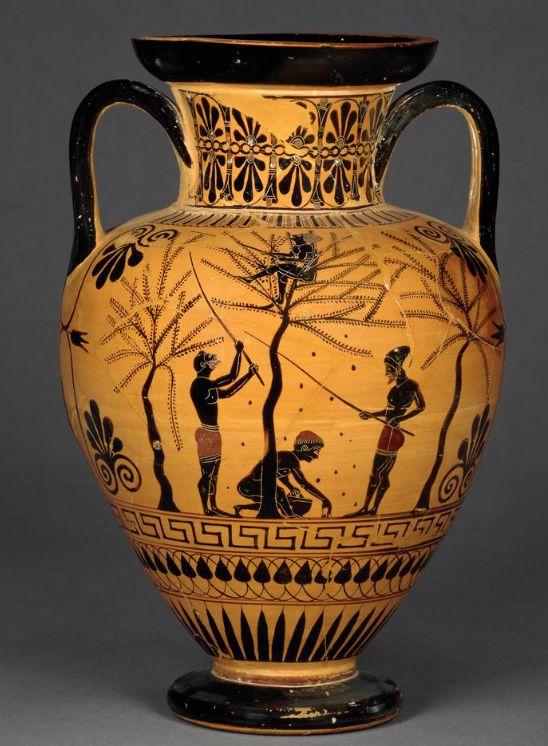
What is this piece and function?
amphora, A two-handled vessel commonly used for storing or transporting liquids or other goods.

What is piece and function?
kantharos, A deep drinking cup with two high handles.
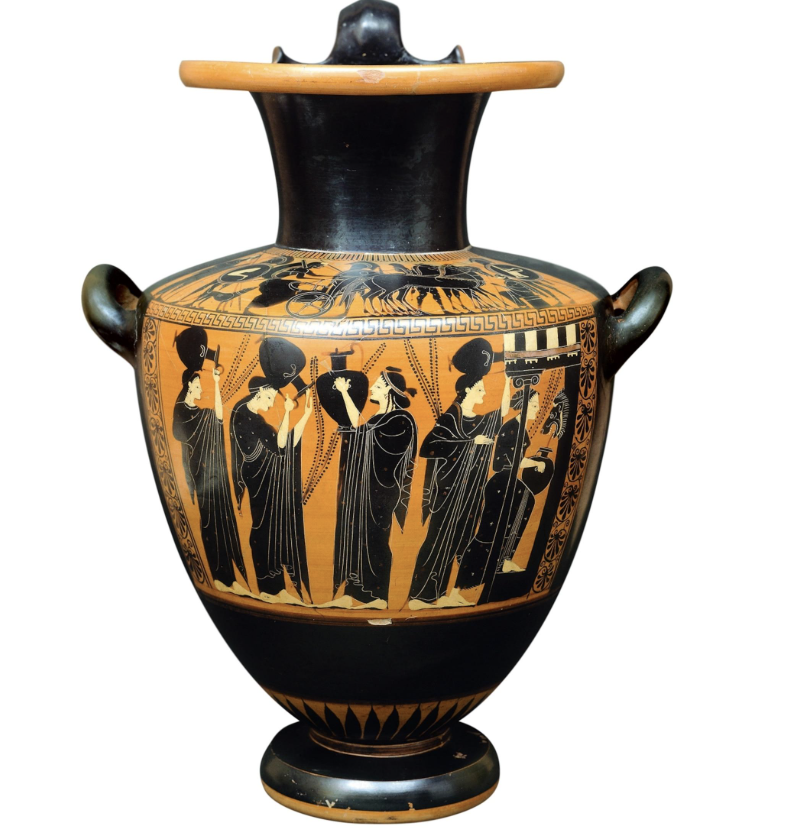
What is this piece and function?
hydria, A vessel used for carrying water.

What is piece and function?
aryballos, A small vessel used for holding oil or perfume.

What is piece and function?
krater, A large vessel used for mixing wine and water.

What is piece and function?
pelike, A vessel commonly used for storing liquids.

What is piece and function?
kylix, A shallow drinking cup with a stem and two handles.

What is piece and function?
skyphos, A deep drinking cup with two handles.
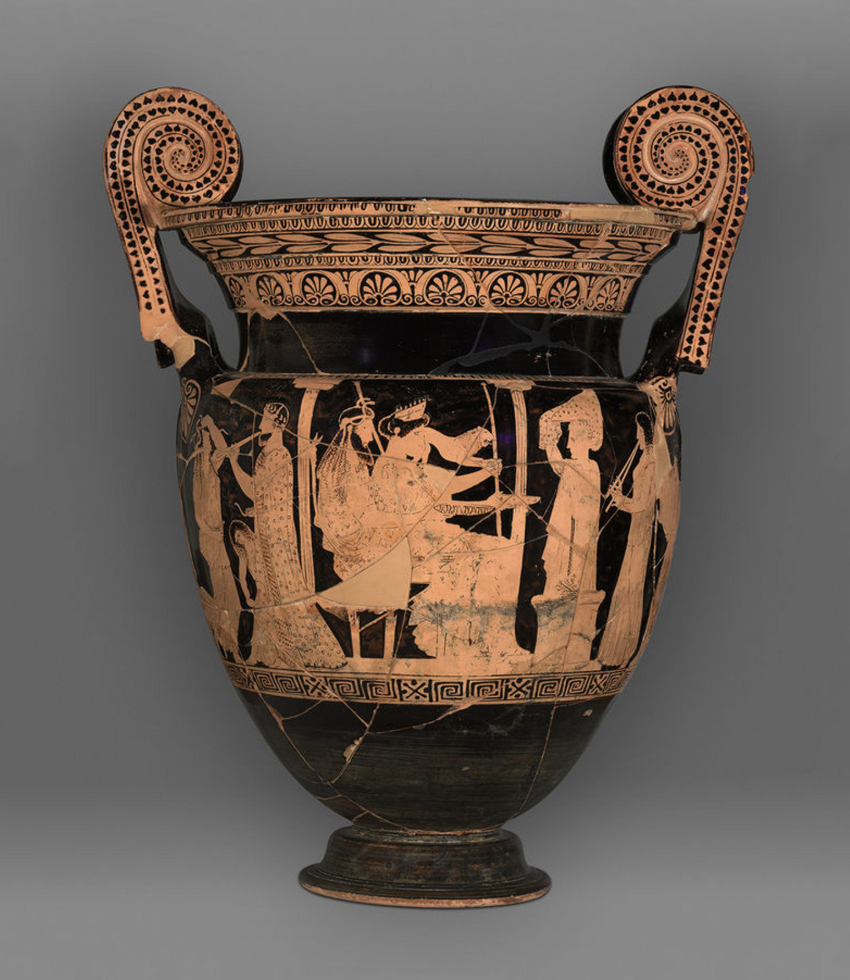
What is piece and function?
volute krater, A large mixing vessel with handles that curl like scrolls.
What are the basic features of a Greek theater shown in the PowerPoint?
A stage at the bottom, tiered seating, a half-circle layout, and sloped terrain.
What is the saying included in the Greek Art section?
"Men pass away, but mankind remains."
Which Greek structure features female columns?
The Erechtheion.
What is the Temple of Portunus also called?
The Temple of Fortune.
What is the Temple of Portunus known for?
It is the oldest preserved Roman temple.
What Greek influences are seen in the Temple of Portunus?
Ionic columns and a peripteral style.
What is a major Roman architectural feature of the Temple of Portunus?
Its high podium.
What are engaged columns?
Columns attached to a wall rather than standing completely free.
What is the Colosseum?
A large Roman amphitheater.
What is the Pantheon known for?
Having the largest dome for approximately 1,800 years.
What ceiling feature is found in the Pantheon?
Coffers.
What are the three phases of Aegean art listed in the PowerPoint?
Cretan, Cycladic, and Helladic.
Who was King Minos?
A king associated with Minoan Crete.
What is the formal name for the civilization discussed in the Aegean Art section?
Minoan.
What type of painting is associated with Minoan art?
Fresco painting.
How does the PowerPoint describe Aegean architecture?
Complex, comfortable, and massive.
How does the PowerPoint describe palace life?
Communal.
Where was most Aegean art found, according to the PowerPoint?
In tombs and palaces.
What was the palace considered to be?
A temple.
What is fresco-secco?
A painting technique in which pigment is applied to dry plaster.
what is a naos
main room in a temple or simply the main room
greeks built temples in terms of (3)
platform
column
entablature
what are the figurative columns called on the erecthion?
caryatids
the gateway to the acropolis is called?
propylaea
how would you best describe peripteral style
columns all around the building
the wall is painted to imitate masonry blocks. no figure scenes
incrustation
characteristically featuring illusionistic architectural vistas
architectural
which emperor notoriously put his portrait on currency
julius caesar
for this roman painting style typically vistas here gave way to a delicate decorative scheme, concentrating on formal ornament
ornate
a more extravagant painterly style, parading the whole range of styles
intricate
__ means to set against; counter balance. visual weight shift
contrapossto
__ is a term for extreme naturalism. for example: over emphasis on wrinkles in the face
verism
what is pozzolana?
volcanic material used in concrete to help in set underwater
__ is the study of body motions. we see much more motion in these types of sculptures. rather than posing in traditional upright forward pose, we see bending and stretching in the bodies
kinesthetics
__ is excellence in form, the balancing of limbs to each other, a complex of forms
rhythmos
what is the name of the circular opening on the roof of the pantheon?
occulus
what structure brought fresh water into the city
aquaducts
the __ had several different types of concrete and stones in order to show the expanse of the empire
pantheon
what are 3 architectural elements developed by the romans?
cement
vaulting
arches
what is it called when 2 barrel vaults intersect each other?
groin vault

name the piece and the time period it is from
seated boxer, hellenistic period

name the piece and the time period it is from
hermes and dyonisus, classical