Prairies Unit Co
 Call Kai
 Learn
 Practice Test
 Spaced Repetition
 Match
 Flashcards
 Knowt Play
1/77

There's no tags or description
Looks like no tags are added yet.
78 Terms
Water as a medium for life
Water provides the fluid environment necessary for metabolic reactions and internal transport in living organisms.

Hydrogen bonds in water
Weak bonds formed between the slightly positive hydrogen of one water molecule and the slightly negative oxygen of another, resulting from polar covalent bonds.

Cohesion of water molecules
The binding together of similar molecules (water-to-water) due to hydrogen bonding, creating high surface tension.

Adhesion of water to polar surfaces
The binding of water molecules to polar or charged materials, aiding processes like capillary action in plants.

Solvent properties of water
Water dissolves polar and ionic substances, making it an ideal medium for metabolism and transport in plants and animals.

Physical properties of water in aquatic habitats
High specific heat capacity and density anomalies provide thermally stable environments and buoyancy for aquatic animals.
Cells as basic structural units
Cells are the fundamental structural and functional units of all living organisms.
Calculating actual size and magnification
Determined using the formula Magnification = Size of image / Actual size of specimen.
Developments in microscopy
Advanced techniques like electron microscopy, freeze fracture, cryo-EM, and fluorescence staining enable high-resolution cellular analysis.

Universal cell structures
Structures common to all living cells include a plasma membrane, cytoplasm, genetic material (DNA), and ribosomes.
Prokaryote cell structure
Simple cells lacking a nucleus and membrane-bound organelles, typically featuring a nucleoid, 70S ribosomes, and a cell wall.

Eukaryote cell structure
Complex cells containing a distinct nucleus and membrane-bound organelles compartmentalizing cellular functions.

Processes of life in unicellular organisms
Unicellular organisms carry out all life functions—metabolism, response, homeostasis, growth, reproduction, and nutrition—within a single cell.
Eukaryotic cell differences (animals, fungi, plants)
Plants have cell walls and chloroplasts; fungi have chitin cell walls and lack chloroplasts; animals lack cell walls entirely.
Atypical cell structures in eukaryotes
Exceptions to typical cellular organization, such as multinucleated skeletal muscle fibers, aseptate fungal hyphae, and anucleated red blood cells.

Organelles
Discrete subcellular subunits adapted to perform specific metabolic functions within a cell.
Cytoplasmic compartmentalization advantages
Increases metabolic efficiency by maintaining different local environments and concentrating specific enzymes.
Lipid bilayers as membrane basis
Phospholipids spontaneously form a bilayer with hydrophilic heads facing outwards and hydrophobic tails facing inwards.

Lipid bilayers as barriers
Act as impermeable barriers to polar and charged molecules while allowing small, non-polar molecules to pass freely.
Simple diffusion across membranes
Net passive movement of particles from a region of higher concentration to lower concentration down a gradient.
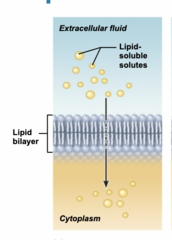
Integral and peripheral proteins
Integral proteins are permanently embedded in the lipid bilayer; peripheral proteins are loosely bound to membrane surfaces.

Osmosis and aquaporins
Passive movement of water across a partially permeable membrane, facilitated by specialized channel proteins called aquaporins.

Channel proteins for facilitated diffusion
Provide hydrophilic pores allowing specific ions or polar molecules to cross membranes passively down a concentration gradient.

Pump proteins for active transport
Transport substances across cell membranes against their concentration gradient using energy derived from ATP.

Glycoproteins and glycolipids
Proteins and lipids with carbohydrate chains attached, playing key roles in cell recognition, signaling, and adhesion.

Fluid mosaic model
Describes membrane structure as a fluid lipid bilayer with a dynamic mosaic of mobile proteins floating within or upon it.

Solvation with water
The process where water molecules surround and interact with solute particles through hydrogen bonding or electrostatic attraction.
Water movement direction
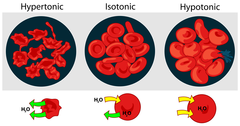
Water moves passively from regions of lower solute concentration (hypotonic) to higher solute concentration (hypertonic).
Plant tissue in hypotonic and hypertonic solutions
In hypotonic solutions, plant cells become turgid; in hypertonic solutions, they undergo plasmolysis as water leaves.

Water movement in cells lacking cell walls
Animal cells swell and lyse in hypotonic solutions, or shrink and crenate in hypertonic solutions.
Populations
Interacting groups of organisms of the same species living in a particular area at the same time.

Random quadrat sampling
Method used to estimate population size and distribution of sessile organisms using square frames.

Capture-mark-release-recapture (Lincoln Index)
Method used to estimate population size for motile animals using marked individuals and proportional ratios.

Carrying capacity
The maximum population size that a particular environment can sustainably support over time.

Density-dependent negative feedback
Factors (e.g., disease, competition) whose negative impact on population size increases as population density rises.
Sigmoid population growth curve modeling
Mathematical representation of population growth leveling off at carrying capacity due to limited resources.


Intraspecific competition vs cooperation
Competition involves individuals of the same species fighting for resources, while cooperation involves mutual aid.
Ecological community
All of the interacting populations of different species living and sharing an ecosystem.

Interspecific relationships
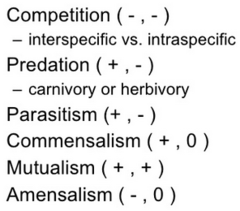
Categories of interactions between species, including herbivory, predation, competition, mutualism, parasitism, and pathogenicity.
Mutualism
An interspecific relationship that provides fitness benefits to both participating species.

Resource competition (endemic vs invasive)
Competition between native species and non-native invasive species often threatens local biodiversity.

Tests for interspecific competition
Experimental or observational studies designed to determine if two species compete for the same limiting resources.
Chi-squared test for association
A statistical test used to determine whether a significant association exists between the distributions of two species.

Predator-prey relationships
Cyclic population fluctuations where predators and prey exert density-dependent control over each other's numbers.

Top-down and bottom-up control
Top-down control is driven by predation limiting lower trophic levels; bottom-up control is driven by nutrient availability.

Allelopathy and antibiotic secretion
Chemical inhibition of one species by another through the release of secondary metabolites or antibiotics.


Photosynthesis
The conversion of light energy into chemical energy stored in carbon compounds during photosynthesis.
Chromatographic separation of pigments
Technique used to separate and identify different photosynthetic pigments based on their solubility and molecular properties.

Absorption of light by pigments
Photosynthetic pigments absorb specific wavelengths of light (primarily blue and red) while reflecting green.

Absorption vs action spectra
Absorption spectra show light absorbed by specific pigments; action spectra show overall photosynthetic rate across light wavelengths.

Limiting factors in photosynthesis
Experimental manipulation of carbon dioxide concentration, light intensity, or temperature to identify factors limiting photosynthesis.

Carbon dioxide enrichment experiments (FACE)
Experiments used to predict future rates of plant growth and photosynthesis under elevated atmospheric CO₂ levels.
ATP as energy distributor
Adenosine triphosphate serves as the primary molecule for distributing accessible chemical energy within cells.

Life processes fueled by ATP
ATP supplies energy for active transport, protein synthesis, muscle contraction, and cell division.
Cell respiration
The controlled release of energy from carbon compounds inside cells to produce ATP.


Anaerobic vs aerobic respiration in humans
Aerobic respiration yields high ATP using oxygen; anaerobic respiration produces lactate and minimal ATP without oxygen.
Variables affecting respiration rate
Temperature, substrate availability, and oxygen concentration can alter the rate of cell respiration.
Sunlight as primary energy source in ecoystems
Solar radiation serves as the principal energy input sustaining most life on Earth.

Flow of energy through food chains
Chemical energy is transferred sequentially from producers to primary, secondary, and tertiary consumers.
Food chains and food webs
Diagrams representing feeding relationships and energy flow among species in an ecological community.

Energy supply to decomposers
Decomposers obtain energy from carbon compounds contained in the dead organic matter of organisms.

Autotrophs
Organisms that synthesize complex carbon compounds from simple inorganic substances using external energy sources.
Photoautotrophs vs chemoautotrophs
Photoautotrophs use light energy; chemoautotrophs use energy derived from inorganic oxidation reactions.
Heterotrophs
Organisms that obtain required carbon compounds by consuming other organisms.
Trophic levels
Feeding positions occupied by organisms in a food chain or web (e.g., producers, primary consumers).
energy pyramids
Diagrams showing the relative amount of energy or biomass at each trophic level in an ecosystem.

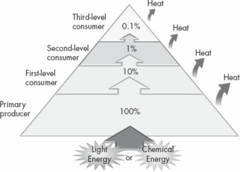
Reduction of energy availability (10%) rule
Energy decreases at each successive trophic level due to large metabolic and heat losses.
Heat loss in respiration
Chemical energy converted during cell respiration is eventually lost to the environment as metabolic heat.
Restriction of trophic levels
Energy losses at each trophic level limit the total number of trophic levels an ecosystem can support.

Carbon cycle
Models showing the movement of carbon among the atmosphere, oceans, soil, and living organisms.
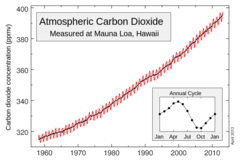
Keeling Curve
A graph showing atmospheric CO₂ concentration over time, fluctuating seasonally and rising due to fossil fuel combustion.
Recycling of chemical elements
Essential chemical elements are continuously recycled among biotic and abiotic components of ecosystems.
Ecological niche
The specific role, position, and functional status of a species within an ecosystem.

Aerobic vs anaerobic organisms
Obligate anaerobes cannot survive in oxygen; facultative anaerobes can switch; obligate aerobes require oxygen.
Modes of nutrition in organisms
Includes photosynthesis in plants/algae, holozoic nutrition in animals, and saprotrophic nutrition in fungi/bacteria.
Diversity of nutrition in Archaea
Archaea display diverse metabolic strategies, including methanogenesis, chemoautotrophy, and extreme environmental adaptations.
Fundamental vs realized niches
Fundamental niche is the full theoretical range a species can tolerate; realized niche is the actual range occupied due to competition.

Competitive exclusion and niche uniqueness
Two species competing for the exact same resources cannot coexist indefinitely; no two species share identical niches.
