Bioenergetics & Respiration
 Call Kai
 Learn
 Practice Test
 Spaced Repetition
 Match
 Flashcards
 Knowt Play
1/122

There's no tags or description
Looks like no tags are added yet.
123 Terms
What 3 things limit cell size?
SA:V exchange across membrane
diffusion rates (too big → take months to move accross membrane)
needs to be highly concentrated so biochemistry can occur
What are the 5 functions of the cell membrane?
transport in/out
permeability barriers
location of specific functions
signal detection
cell to cell interactions + movement
What is the Fluid Mosaic Model? Why/how does it work?
for membrane structure and function
polar heads on outside, tails on inside
proteins can move around
What are the 3 main ideas of membrane lipids?
movements
3 classes (structures)
membrane asymmetry
What are the 3 classes of membrane lipids?
phospholipids
glyco-lipids
sterols
What is the structure of phospholipids?
phosphate head (and add-ons)
non-polar tails
What is the structure of glyco-lipids?
carbohydrate head
fatty acid tails
What is the structure of sterols?
ring structure head
hydroxyl (OH) group tail
What is membrane asymmetry?
unequal distribution of membrane components
in vs. out of cell
What are the 2 types of lipids? What do the levels affect?
unsaturated and saturated
affects fluidity, key to function
Describe saturated lipids…
tightly packed
straight
rigid
Describe unsaturated lipids…
crooked
loosely packed
more gel like
What is the rigidity/fluidty of the mosaic dependent on?
temperature dependent
temperature responsive (senses temp. and desaturates enzymes)
orientation of proteins w/in bilayer
What are the 3 main types of Membrane proteins?
integral (majority)
Peripheral
lipid-anchored proteins
What are integral proteins? Hydrophillic or hydrophobic?
1+ regions that are hydrophobic (embedded to interior)
1+ regions that are hydrophilic (extend into aq. environment)
hard to remove (tear w/ detergent)
What are the 2 types of integral proteins?
monolayer
transmembrane
What are monolayer proteins?
integral
one side, not the other
What are transmembrane proteins? 2 types?
integral proteins
single-pass (receptors)
multi pass (channels)
What are peripheral membran proteins?
no hydrophobic portion
associate w membrane through electrostatic interactions or non-covalent bonds w phosphate heads, polar heads, or other membrane proteins

What are Lipid-anchored proteins?
have a fatty acid anchor (tail) in the bilayer

What is diffusion?
movement of solute down its concentration gradient from high conc. to lower conc.
as you increase gradient, you increase rate of diffusion
What is diffusion through membranes hindered by?
size
charged (won’t move through easily)
polarity
What diffuses easily? What is it called?
small
non-polar molecules
simple diffusion
What is passive diffusion?
concentration gradient (higher/bigger difference will move faster)
rate is correlated with concentration gradient
What is facilitated diffusion?
passive transport
doesn’t use energy and is still passing through
What is the result of these molecules trying to pass through membrane: small, nonpolar, uncharged, polar (slight)?
some molecules simply diffuse
What is the result of these molecules trying to pass through membrane: Larger, uncharged, polar, ions?
metabolites and ions are trapped!
What are transporters?
membrane proteins that bind selected molecules and move them from one side to the other by a conformational change (revolving door)

What are channels?
membrane proteins that form a selective pore allowing for diffusion of molecules that fit through pore

What are the driving forces of facilitated diffusion?
electrochemical gradient
concentration gradient
electrical gradient (charged ions)
What are the 2 types of transporter proteins?
uniports
coupled
What are uniports?
transports one molecule at a time
What are coupled transporters? 2 types?
symport
antiport
it is a way to move one solute against its conc. gradient by moving another solute down its conc. gradient
What are symport coupled transporters?
transports 2 molecules at the same time from the same side
What are antiport coupled transporters?
transports 2 at a time but in different directions
What are the 4 types of ion channels? What can they be?
they can be gated
voltage-gated
ligand-gated (extracellular)
ligand-gated (intracellular)
stress-gated
What are some ion concentrations inside the cells? (Ca+2, K+, Na+)
Outside
Large Na+ and Ca+2
Small K+
Inside
Small Na+ and Ca+2
Large K+
What allows cells to maintain large gradients of ions? Where does it get its energy from? Ex?
active transport allows large conc. gradients of certain ions Na+, K+, Ca2+, H+
uses energy from ATP hydrolysis
Ex: H+ ATPase (proton pump)
What does ATP release during ATP hydrolysis?
electron
phosphate
What is an example of a uniport?
glucose uniport
Transports glucose across one at a time
binds and changes shape, like a revolving door
moves down facilitated diffusion
one direction
What is an example of a symport?
glucose-Na+ symport
transports glucose and sodium ion simultaneously across the membrane, both moving in the same direction
What are voltage-gated channels?
Protein channels that open or close in response to changes in membrane potential, allowing specific ions to flow in or out of the cell.

What are ligand-gated (extracellular ligands) channels?
Protein channels that open or close in response to the binding of specific molecules (ligands) to their extracellular domain, enabling ion flow across the membrane.
What are ligand-gated (intracellular) channels?
Protein channels that open or close in response to the binding of specific molecules (ligands) to their intracellular domain, enabling ion flow across the membrane.
What are the two types of active transport?
indirect
direct
Compare indirect and direct active transport? How do they work together? (important)
Direct active transport: Uses ATP directly to move substances against their concentration gradient.
Indirect active transport: Uses energy stored in an ion gradient (created by direct active transport) to move another substance against its gradient.
What is an example of direct active transport?
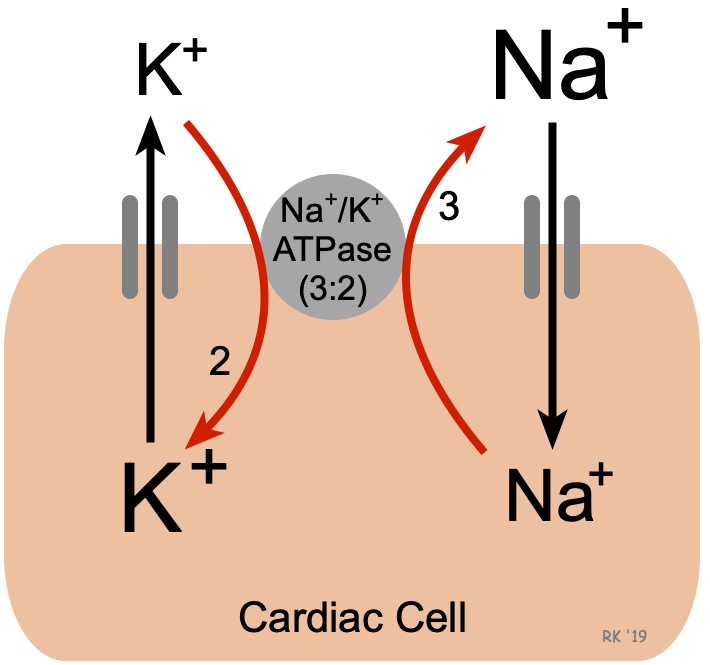
Na+/K+ pump
Uses ATP directly to move 3 Na⁺ out of the cell and 2 K⁺ into the cell against their concentration gradients
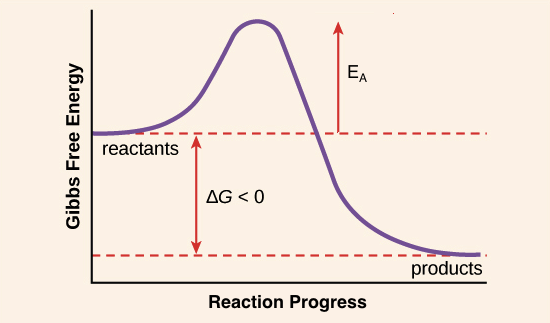
What does -ΔG mean?
exergonic
can happen w/o energy input
What does +ΔG mean?
endergonic
never happens w/o energy input
What happens during Oxidation-Reduction (Redox) reactions? (definitions)
e- donor is oxidized (loses electrons)
e- acceptor is reduced (gains electrons)
at disequilibrium
How do catalysts affect activation energy of reactions?
they make reactions easier by…
lowers activation energy needed for reaction
couple endergonic reactions w/ exergonic reactions
What is EA, the activation energy barrier?
represents a transition state b/w reactants and products
What is an example of a catalyst?
enzymes have cofactors
Asp tails w/ Mg+ that pulls an e- on O- from phosphate, neutralizes the charge, easier for H2O to react with ATP
An enzyme that uses a Mg²⁺ cofactor to help ATP hydrolysis by stabilizing negative charges on phosphate groups, making ATP easier to react with water.
How can you catalyze a reaction from a test tube?
heat up the test tube
helps molecules collide and get over energy hump
Fill in the blank about ATP Hydrolysis:
Phosphate charge repulsions _______
_______ _______ (after hydrolysis)
Phosphate charge repulsions relieved
resonance stablization (after hydrolysis)
An enzyme that uses a Mg²⁺ cofactor to help ATP hydrolysis by stabilizing negative charges on phosphate groups, making ATP easier to react with water.
What is an enzyme active site?
cavity/grove surrounded by clusters of amino acids
What is the shape of active site and chemistry (side chains) specific to?
reactants/substrates in a enzyme catalyzed reaction
substrate specific!
Ex:
shape - phosphates
chemistry - amino acids sticking into active site
How do ATP and H2O react?
they randomly run into each other, if it’s right, they will react w/ each other
What is the induced fit model for enzymes? What does high affinity mean?
Substrate binding causes the enzyme’s active site to change shape to fit the substrate better and help catalyze the reaction.
E + S → ES and ES → E + S
E + S → ← ES → E + P
holds substrate in a disordered fashion, pulled, then it dissociates and falls away
What is the equation for Enzyme kinetics? What does each part mean?
ΔG = ΔH - TΔS
ΔG → free energy
ΔH → energy w/in a system
T → temp
ΔS → entropy (disorder)
How can you drive an endergonic reaction forward?
increase substrate conc.
What is an example of an exergonic reaction? Why doesn’t this happen right away?
glucose
overall process is exergonic
C6H12O6 releases e- and produces CO2 + H2O + -ΔG
b/c there is still a barrier that needs to be overcome, that’s why we don’t burn all of our sugars right away
In enzyme kinetics, what are the 2 main defining factors of rates of reactions? (and the other 2)
Main
increase conc. of substrate (increase=increase rate)
enzyme = fixed maximum turnover rate (how fast it can work)
Others
temperature (doesnt exist in cells)
pH → affect active site chem, can inhibit
Describe the Monkey and Peanut analogy…
can increase peanuts up until a certain amount until it reaches Vmax
Monkeys = E
Peanuts = [S]
1 peanut/min = 9s to find = 1 to shell = 0.1 peanut/s
3 peanut/min = 3s to find = 1 to shell = 0.25 peanut/s
9 peanut/min = 1s to find = 1 to shell = 0.5 peanut/s
What is a Mienaelis-Menten plot?
velocity vs. [S]
shows how enzyme activity changes as more substrate is added.

What 2 things does a Michaelis-Menten plot help determine?
at a low conc. of substrate, rate will increase rapidly as we increase substrate conc.
at higher conc. of substrate, rate becomes limited by enzyme turnover rate
What is the Vmax?
maximum turnover rate of enzyme when conc. of substrate isn’t limited
What is the Km?
the conc. of substrate where velocity is ½ Vmas
a measure of the affinity of enzyme for substrate
What does a higher Km mean?
lower affinity

What does a lower Km mean?
higher affinity

What do Michaelis-Menten experiments give us?
Vmax and Km
How do competitive inhibitors affect Vmax and Km? What are they?
Compete with the substrate for the enzyme’s active site.
Vmax = stays the same
Km = increases (just takes longer)
How do normal inhibitors affect Vmax and Km? What are they?
Bind to a site other than the active site, reducing enzyme activity.
Vmax = lowers
Km = same (in pure noncompetitive inhibition)
How does heat help speed up reactions?
helps moleculed collide and get over energy hump
What are substrates?
reactants in an enzyme catalyzed reaction
What are autotrophs?
plants, algae
makes their own food from sunlight energy
What are heterotrophs?
animals, bacteria, fungi
require external sources of food
What 2 things do food provide? (chemical)
energy (ATP, chemical)
carbon skeletons
What does it mean that ATP is an energy intermediate?
right in the middle of something
can STORE energy from exergonic rxtns
can RELEASE energy for endergonic rxtns
What are phosphotransfer reactions?
when a phosphate from one bond is transferred to a different type of bond that’s lower in energy
bond energy transfer w/o hydrolysis but w/ a phosphate transfer!
What is oxidation?
loss of electrons, releases G
lose H
What is reducition?
gain electrons
gain G/energy
recieves H
Give equation for controlled oxidation of glucose… what is oxidized?
C6H12O6 + O2 → 6CO2 + 6H2O
O2 is oxidized by phosphorylation
electrons go to mobile electron carriers like NADH
What is the initial step of metabolism of glucose? What is it?
glycolysis
partial oxidation → 2 pyruvates → 2 ATP, NADH (x2)
How does glycolysis proceed if O2 is present?
respiration (in mitochondria)
complete oxidation (>30 ATP)
electrons passed to NADH (eventually to O2)
energy stored as ATP
What does the system of transporting glucose from intestine to blood rely on?
relies on pumping of sodium out of the cell
allows for passive efflux of glucose against gradient
What are the 3 phases of glycolysis?
investment phase → uses 2 ATP to add phosphate bonds
splitting phase
pay-out phase → oxidation to make NADH, produce 4 ATP (net 2), product: 2 pyruvates
What 2 things can happen to a pyruvate? What does it depend on?
Respiration or fermentation
O2
What does fermentation do?
So we can recycle NAD+ and allow glycolysis to continue (or else we’d run out)
Regenerates NAD⁺ from NADH so glycolysis can continue producing ATP without oxygen
What does it make? (fermentation)
EtOH (ethanol) or lactic acid
What are enzymes controlled by?
phosphorylation
allosteric binding
What is NAD+ needed for?
An electron carrier that accepts electrons (and H⁺) during glycolysis and other metabolic reactions, becoming NADH
It allows glycolysis to continue by accepting electrons.
What happens if there was no O2? What would happen to glycolysis?
NADH would not be oxidized to NAD+
glycolysis would stop
How does fermentation recycle the NAD+?
by donating the electron in NADH back to the pyruvate
Lactate and/or ethanol + CO₂
what does pyruvate hydrogenase do? why is it important?
might not need to know
converts pyruvate into acetyl-CoA, producing NADH and releasing CO₂.
Connects glycolysis to the citric acid cycle so glucose can be further broken down to produce ATP.
Why don’t we get drunk when we eat bread?
ethanol evaporates
Explain how the Trp operon works… (regulation)
inhibited early in pathway until Trp levels are low, then is removed

Are steps in glycolysis reversible or irreversible?
many steps are readily reversible
some steps aren’t b/c they are so exergonic (ATP-driven)
tend to be regulated
What happens if a cell has enough energy? How does it stop glycolysis?
high ATP = abundant energy
ATP inhibits PFK, a key regulatory enzyme in glycolysis, reducing the breakdown of glucose.
What molecule represents an energy need?
AMP
ATP → ADP → AMP
each step releases energy and phosphate