Unit 1 - Muscle Physiology and Contraction
 Call Kai
 Learn
Learn Practice Test
 Spaced Repetition
 Match
Match Flashcards
 Knowt Play
1/24

There's no tags or description
Looks like no tags are added yet.
Name | Mastery | Learn | Test | Matching | Spaced | Call with Kai | Chat |
|---|
No analytics yet
Send a link to your students to track their progress
25 Terms
What is the structure of muscle designed for?
Contraction and relaxation
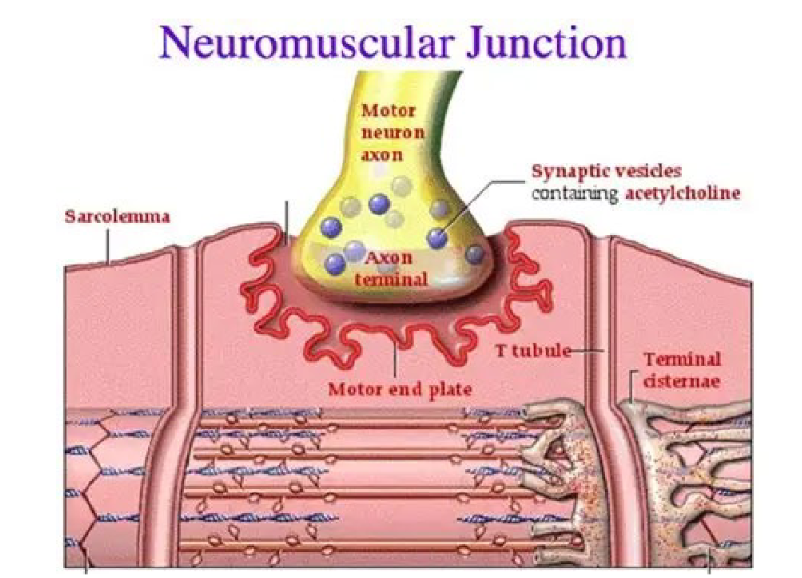
What is the neuromuscular junction?
The neuromuscular junction is the site where a motor neuron communicates with a muscle fiber to stimulate muscle contraction
What is a motor unit?
A single motor neuron and all the muscle fibers it controls
Even during heavy lifting, what percentage of our motor units are working?
Only ~20%!
What is the purpose of Adenosine Triphosphate (ATP)?
To stimulate muscle contraction
What is the purpose of Creatine Phosphate?
To act as a short-term storage of energy within a muscle
Can quickly turn ADP → ATP
What does Magnesium2+ do?
Needed to turn ATP → ADP for storage in the Creating Phosphate
What are the two pathways in the metabolism of glucose?
Anaerobic
Aerobic
What does the anerobic pathway of the metabolism of glucose entail?
Occurs in the cytoplasm
Requires little to no oxygen
Only moderately efficient
What does the aerobic pathway of the metabolism of glucose entail?
OIccurs in the mitochoindria
Requires oxygen
Greatest release of energy / most efficient
What pathway does Anaerobic metabolism use?
Glycolysis
Little to no oxygen
Consume 2 ATP per glucose
Less efficient
What pathway does Aerobic metabolism use?
Krebs Cycle
Requires oxygen
Doesn’t consume ATP!
More efficient
For each glucose that enters the muscle, how many ATPs can be generated?
36
Both aerobic and anaerobic
Fat is a (bad/great) energy source.
Great
How is the nerve impulse from the brain transmitted to the muscle fiber?
Via transmembrane potentials
During the resting state of a nerve fiber, where are the charges located? What does this result in?
Fluids inside the neuron are negatively charged
Fluids outside the neuron are positively charged
Results in a resting membrane potential
What causes a nerve fiber to depolarize and repolarize?
Action potentials (AP)
When an AP travels down a nerve, what happens?
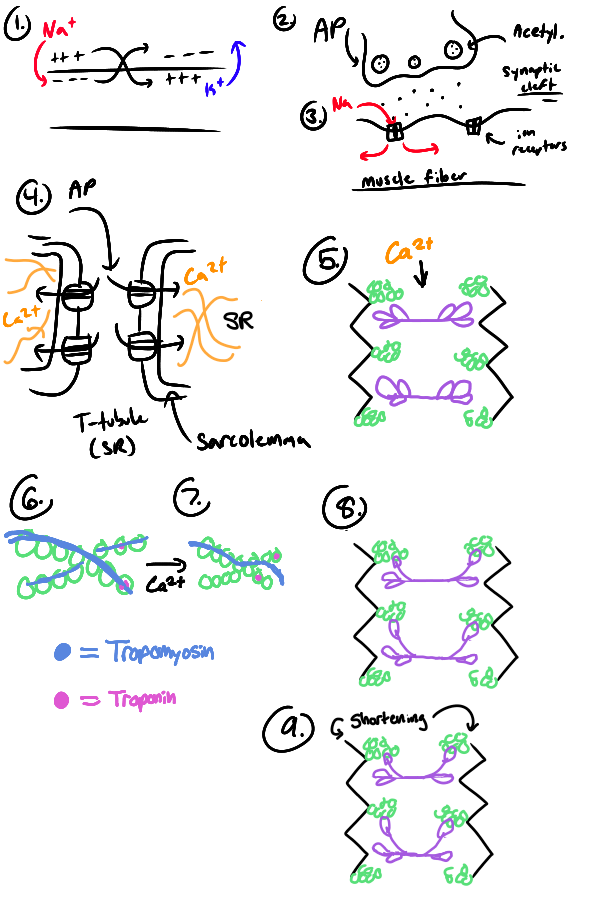
Na⁺ floods in → inside becomes positive → K⁺ rushes out → inside becomes negative → recovery

Where does AP terminate at in the steps for muscle contraction?
The myoneural junction
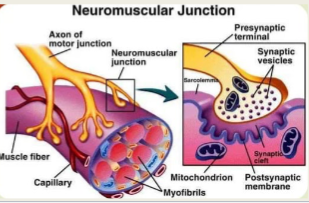
What happens when AP reaches the myoneural junction?
Causes the release of the neurotransmitter acetlycholine, which crosses the synaptic cleft to bind to sites on the sarcolemma
What is acetlycholine responsible for?
Muscle contraction
What is acetlycholinesterase responsible for?
Muscle relaxation
How do APs communicated in a inner muscle cell?
Via the T-tubule system
Steps of Muscle Contraction
Begins with the resting state
AP travels down the motor neuron to the myoneural junction (motor end plate)
Acetlycholine is released; the sacrolemma and membranes depolarize (Na+ flux into fiber)
AP is transmittee via the T-Tubules to the sarcoplasmic reticulum (SR)
Calcium2+ is released from the terminal cisternae of the SR into the sarcoplasm
Ca2+ binds to troponin
Tropomyosin moves to expose myosin binding sites on actin
Actin-myosin bridges form (actomyosin)
Myostin ATPase activated, ATP is hydrolyzed and the myosin head rotates
Repeated over and over; filaments slide causing shortening of sarcomere
What is rigor mortis?
The stiffening of joints and muscles after death; permanent muscle contraction