04muscle geometry
 Call Kai
 Learn
 Practice Test
 Spaced Repetition
 Match
 Flashcards
 Knowt Play
1/11

There's no tags or description
Looks like no tags are added yet.
12 Terms
[A]How do fusiform and pennate muscle architectures differ in fiber arrangement and functional trade-offs?
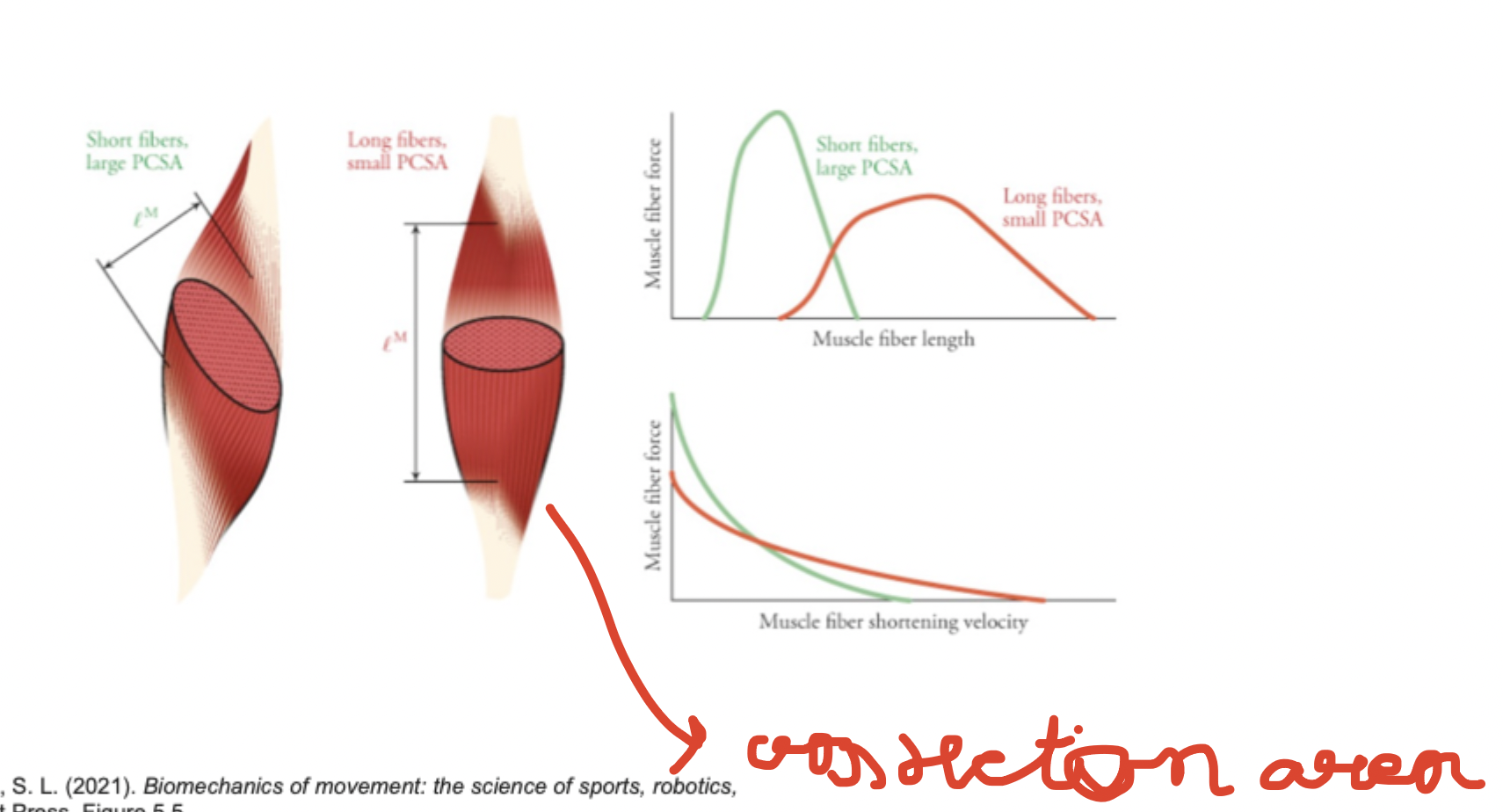
Fusiform (Parallel): Fibers run parallel to the line of pull. Long fibers, small PCSA → optimized for large displacement (ΔL ↑) and high contraction velocity (v_max ↑), but lower force output (F ↓).
Pennate (Angled): Fibers attach obliquely to the tendon (unipennate, bipennate, multipennate). Short fibers, large PCSA → optimized for high force production (F ↑), at the expense of range of motion (ΔL ↓) and velocity
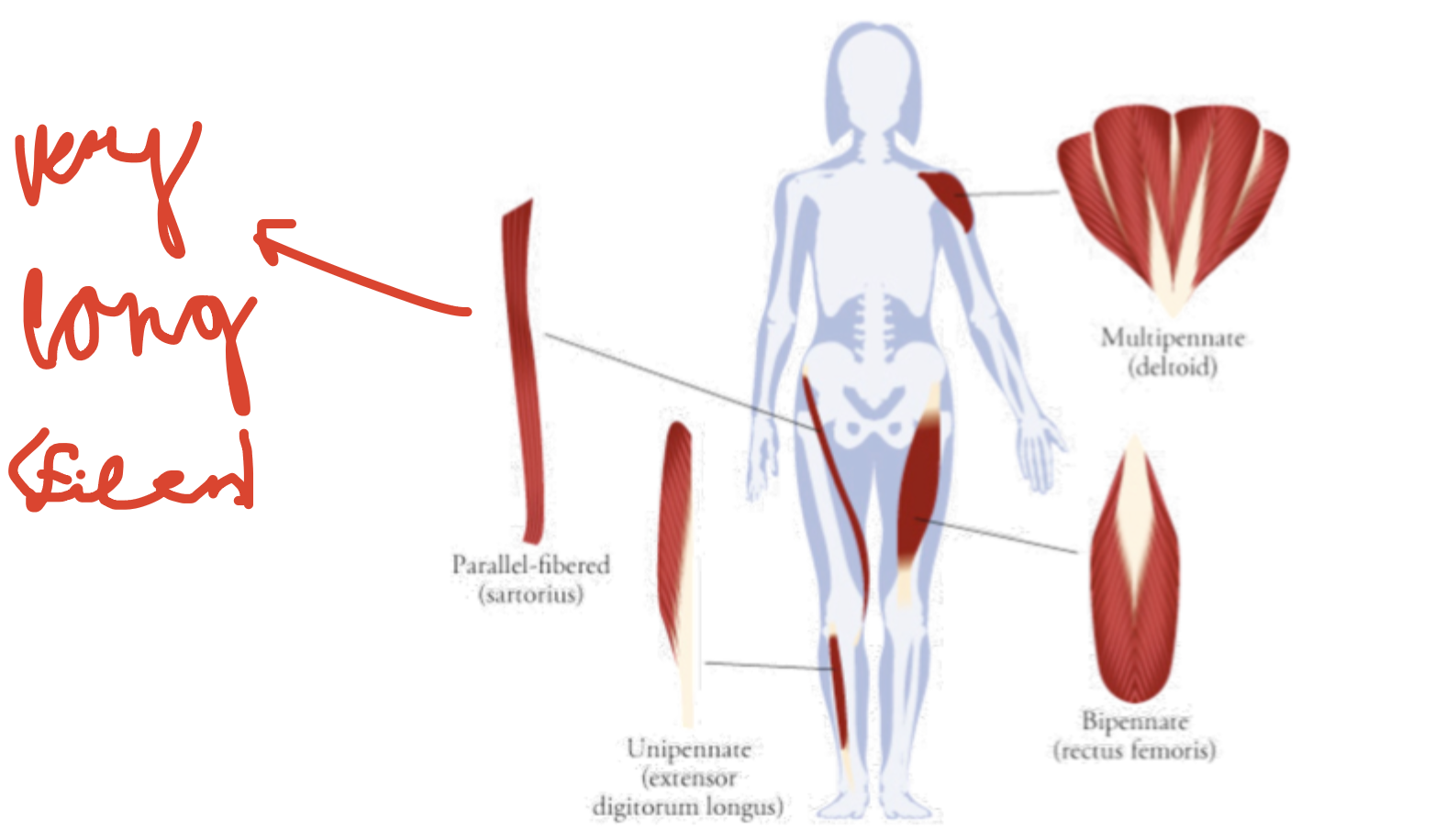
[A] What are the four buildtypes of muscles?
Parallel-fibered / Fusiform: M. sartorius (lange Fasern)
Unipennate: M. extensor digitorum longus
Bipennate: M. rectus femoris
Multipennate: M. deltoideus
[A]What is the crucial difference between Anatomical (ACSA) and Physiological Cross-Sectional Area (PCSA), and why does ACSA underestimate pennate muscle force?
ACSA (Anatomical Cross-Sectional Area): A slice perpendicular to the muscle's overall longitudinal axis. In pennate muscles, it cuts through fibers at an angle and misses many fibers entirely (some fibers are not included because it is cut above them).
PCSA (Physiological Cross-Sectional Area): The sum of all fiber cross-sections cut perpendicular to their individual fiber orientation: PCSA = (Muscle Volume / Fiber Length) * cos(α). PCSA directly determines maximal isometric force.
[A] Why do longer muscle fibers achieve higher absolute shortening velocities than shorter fibers?
Serial Sarcomere Summation: Sarcomeres arranged in series add their individual shortening speeds together.
Lecture Note Analogy: If a 1-meter muscle section contracts at 2 m/s, a 2-meter muscle contracts at 4 m/s total in the same time frame.
Exam key point: Longer fibers achieve higher absolute contraction velocities (v_max ↑) over larger displacements (ΔL ↑)
[A] How do the M. biceps brachii and M. gastrocnemius illustrate the "Form Follows Function" principle based on your notes?
M. biceps brachii (Fusiform): Long fibers, low PCSA. Does not need to generate massive forces, but requires a large range of motion (ΔL ↑) to move the forearm rapidly through wide angles.
M. gastrocnemius (Pennate): Short fibers, very large PCSA. Small displacement (ΔL ↓), but generates immense force (F ↑) to support and propel total body weight while standing, walking, and jumping.
[B] What do the activation dynamics and force-time curve of the triceps (TLA/TLG) show under isometric conditions?
Anatomy: Involves Triceps laterales (TLA) and Triceps longum (TLG).
Stimulation Frequency: Rapid activation/deactivation cycles (e.g., 2 Hz / 120 per min).
Isometric State: Velocity is zero (v = 0). Force rises steeply upon stimulation, plateaus at maximum isometric force (F_iso), and gradually decays after deactivation
[2Hz (Hertz) = genau 2 Aktivierungs- und Deaktivierungszyklen pro Sekunde (was umgerechnet 120 Impulsen pro Minute entspricht)]

[B] What is "Stretch-Induced Force Enhancement" in skeletal muscle and how long does it persist? (History Effect)
Phenomenon: When an activated muscle is stretched (eccentric phase) and subsequently held isometric at a constant final length, it produces ~10% more isometric force than a purely isometric contraction at that same final length.
Persistence: The enhanced force level persists for several seconds (e.g., ~8 seconds)

[B] What is "Shortening-Induced Force Depression" in skeletal muscle and how does it alter subsequent isometric force?
Phenomenon: Active shortening followed by isometric holding decreases isometric force below the normal isometric reference level at that same final length.
Key Takeaway: Shortening reduces subsequent force production, acting as the exact opposite history effect of active stretch.

[B]Why is Ig-domain unfolding of Titin NOT the physiological explanation for force enhancement? (History effect)
Ig-Domain Unfolding: Unfolding of proximal and distal Ig-domains occurs only under extreme, non-physiological forces and extensions (>100-300pN)
Lecture Note Exclusion: Ig-domain unfolding cannot explain physiological history effects ("This cannot be an explanation for the history effects experiment") because forces during physiological active stretch (<10pN) are too low to unfold these domains.

[B] How does the "Sticky-Spring" model explain Titin-induced force enhancement during muscle stretch? (History effect)
Mechanism: Upon Ca²⁺ activation, Titin binds to the Actin filament ("sticky spring").
Effect: Binding shortens the remaining free elastic segment of Titin, making it significantly stiffer during subsequent stretching. This generates additional passive/active tension ("get an additional extra force because of these titins")

[B] How do modern 3D muscle models capture history-dependent force behaviors? (history effect)
3D Integration: Continuum mechanical finite element models (Seydewitz, Siebert & Böl, 2019) map cellular history-dependent mechanisms (force enhancement/depression) onto realistic 3D muscle geometries, accurately predicting spatial stress distributions over time.

[B] What is the biomechanical rationale behind packing 7 (fusiform), 14 (unipennate), or 28 (bipennate) fibers into a muscle, and why does nature use pennation?
Volume Constraint: Anatomical space in human limbs is physically limited.
Parallel / Fusiform (7 fibers): Long fibers span the full length. Only few fibers fit side-by-side → Large displacement (ΔL ↑), low maximal force (F ↓).
Pennate Arrangement (14 or 28 fibers): Slanting fibers allows 2x to 4x more fibers to attach in parallel to the tendon within the exact same muscle volume.
Biological Purpose: Pennation maximizes the Physiological Cross-Sectional Area (PCSA) in restricted anatomical spaces to generate immense force (F ↑, e.g. calf muscle), accepting a reduced range of motion (ΔL ↓)
