Chem 201 - Definitions and Concepts(Chapters 1 and 2)
 Call Kai
 Learn
 Practice Test
 Spaced Repetition
 Match
 Flashcards
 Knowt Play
1/71

There's no tags or description
Looks like no tags are added yet.
72 Terms
Pure substance
A substance composed of only a single type of atom or molecule. Have definite (constant) composition and distinct properties. They are either elements or compounds
Mixture
A combination of two or more substances in which each substance retains its own distinct identity. Composition varies from sample to sample. Components are chemically different. Don’t melt or boil at a definite temperature.
Homogenous mixture
One in which components are uniformly mixed
Heterogeneous mixture
One in which components are not uniformly mixed.
Physical properties
Properties that can be measured without changing identity and composition of a substance
Chemical properties
How a substance changes or reacts to form a new substance
Intensive properties
Are properties that don’t dependent on the amount
of the substance that is present
Extensive properties
Are properties that depend on the amount of the substance present
Physical v. Chemical Changes
Physical changes don’t result in new substances, while chemical changes do.
Separation of mixtures
Filtration, distillation, chromatography
Giga
G, 10^9
Mega
M, 10^6
Kilo
k, 10³
Deci
d, 10^-1
Centi
c, 10^-2
Milli
m, 10^-3
Micro
μ, 10^-6
Nano
n, 10^-9
Pico
p, 10^-12
Femto
f, 10^-15
SI units of mass, length, and temp
kg, m, K
Volume units
SI = m³. 1 L =1 m³, 1 mL = 1 cm³
units for Density
g/mL or g/cm³
Accuracy
the proximity of a measurement to the true value of a quantity
Precision
the proximity of several measurements to each other
Ernest Rutherford
Discovered the nucleus and protons.
J. J. Thompson
Discovered the electron and put forward the “plum pudding” model
John Dalton
formulated modern atomic theory
Robert Millikan and Harvey Fletcher
Used the oil drop experiment to measure an electron’s charge. 1.602 x 10⁻¹⁹ C was the charge of a single electron.
Henri Becquerel
First observed radioactivity
Gold Foil Experiment
Since some alpha particles shot at gold foil deflected at large angles, plum pudding model incorrect.
Cathode Ray Experiment
Discovered: Rays bend towards a positively charged plate. Rays impart a negative charge to objects they strike. All cathode ray tubes produced rays with the same properties. Rays bend near magnets.
Law of Definite Proportions
the elemental composition of a pure substance never varies
Three charges discovered by Rutherford
α particles
β particles
γ rays
α particles
positively charged
β particles
negatively charged
γ rays
neutrally charged
James Chadwick
discovered neutrons
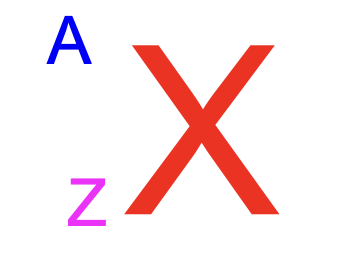
What does X stand for?
elemental symbol

What does A stand for?
Atomic mass
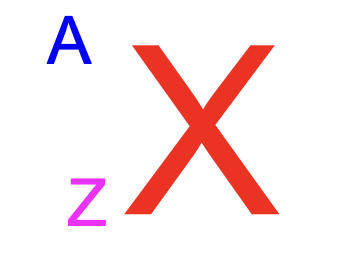
What does Z stand for?
Atomic number
Isotopes
atoms of the same element with different masses and different numbers of neutrons
Atomic mass
The mass of a single atom. Found by adding the protons and the neutrons
Metals
shiny, ductile, malleable, good conductors of heat and electricity. Solids at room temperature except mercury
Metalloids
Have properties between metals and nonmetals.
Nonmetals
dull, non conductors of heat and electricity, solids, liquids, and gases at room temperature.
Periods or Series
Rows on the periodic table
Groups or families
Columns on the periodic table.
Alkali metals
Group 1A
Alkaline earth metals
Group 2A
Chalcogens
Group 6A
Halogens
Group 8A
Noble gases
Group 8A
Molecular Compounds
compounds generally composed of only nonmetals
Diatomic molecules
Occur naturally as two atoms
Empirical formula
give the lowest whole-number ratio of atoms of each element in a compound
Molecular formula
give the exact number of atoms of each element in a compound
Ions
atoms of the same element with different numbers of electrons
Anions
Negatively charged ions caused by electron gain. Nonmetals tend to form these
Cations
positively charged ions caused by electron loss. Metals tend to form these
Ionic compounds
generally formed between metals and nonmetals
Writing Formulas of Ionic Compounds
The charge on the cation becomes the subscript on the anion and the charge on the anion becomes the subscript on the cation. Divide by GCF
Polyatomic ions
ions composed of more than one element
Naming of Cations with only one possible charge
metal name followed by ion
Naming of cations with more than one possible charge
write the charge as a Roman numeral in parentheses
Naming of cations formed from nonmetals
names end in -ium ion
Naming of monatomic anions
names end in -ide ion
Naming of polyatomic ions
Simply add ion to the end
Naming of oxyanions
The oxyanion with less oxygens ends in -ite, while the one with more oxygens ends in -ate
Naming of Ionic compounds
cation name followed by anion name
Naming of acids
remember common acid names and prefixes
Naming of Binary molecular Compounds
remember Greek prefixes(mono, di, tri, tetra)