PP 1: Frameworks of Terrestrial Ecology: Site and Physiography
 Call Kai
 Learn
Learn Practice Test
 Spaced Repetition
 Match
Match Flashcards
 Knowt Play
1/24

There's no tags or description
Looks like no tags are added yet.
Name | Mastery | Learn | Test | Matching | Spaced | Call with Kai | Chat |
|---|
No analytics yet
Send a link to your students to track their progress
25 Terms
what is bio-ecology
ecosystems are centered on organisms, added to a non-specific abiotic environment
what is the geo-ecological approach to terrestrial ecology?
focuses on geographic spaces/physical units where organisms live, while considering the whole ecosystem and its parts
What are the four characteristics of an ecosystem?
climate, physiography, soil, and biota
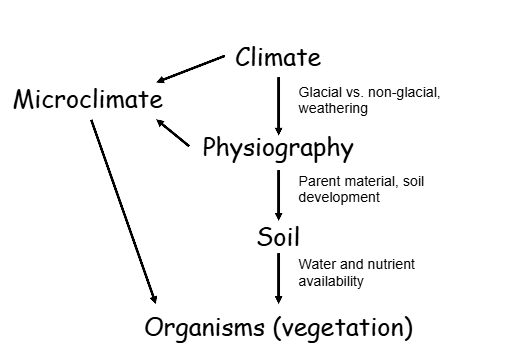
what are the two broad categories of ecosystem factors?
abiotic and biotic factors
what are abiotic factors?
physical factors that make up the envrionment
what is a “site”?
the sum total of all physical factors of a specific place; it is non-organic
what are biotic factors
the organisms themselves
How are site and biota related?
they are convenient to separate, but inseparable in reality because they interact and affect each other
along what gradient is a site defined?
by moisture because that’s where the nutrients are
dry → dry-mesic → mesic → wet-mesic → wet

Why is moisture important in defining a site?
plant nutrient uptake depends on water, making moisture a limiting factor
What is physiography?
the physical geography of an area, including its surface features, form, and substance
What are the two components of physiography?
form = shape of the land
substance = parent material
What are some characteristics used to describe physiography
physiographic setting
specific landform
parent material
landscape position
position relative to other landforms
What does physiography indirectly affect or control?
climate
moisture flux
water table position
nutrient status
What ecological processes can physiography directly or indirectly influence?
disturbance
species occurrence and composition
growth and biomass accumulation
how ecosystems change (succession)
variation within and among species
What are the four major physiographic systems in glaciated terrain?
Outwash plains
Ice contact terrain
moraines
lake plains
outwash plains info
water laid
both dry and wet
stratified drift

Ice contact terrain
water laid
includes kames, kettles, and eskers
semi-stratified drift

Moraines information
ice laid
includes end, ground, and interlobate moraines; unstratified drift

lake plains information
lacustrine
sand or clay
stratified drift
What factors affect moisture availability in dry/upland areas?
water table position
capillary fringe
perched water table
soil texture and structure
soil organic matter
aspect
slope position
slope percent
spatial relationship to other features
What are important ecological factors in wetlands?
aeration, nutrients, and microclimate
Why can oxygen become limiting in wetlands?
heavy moisture and poor drainage limit oxygen during the growing season
how does water movement affect wetlands
it affects aeration and nutrient availability
how does landscape position affect wetland microclimate
wetlands tend to occur low in the landscape, making them colder