Ch. 21 - Electrochemistry
 Call Kai
 Learn
 Practice Test
 Spaced Repetition
 Match
 Flashcards
 Knowt Play
1/53

There's no tags or description
Looks like no tags are added yet.
54 Terms
Slide 20
How do we use spontaneous reactions to generate electrical energy?
Voltaic/Galvanic cells
Which electrode goes on the right?
Cathode (ex. Cu)
Which electrode goes on the left?
Anode (ex. Zn)
Reduction occurs at the ___.
cathode (red cat)
Oxidation occurs at the ___.
anode (an ox)
Reduction goes on the __.
right.

Oxidation goes on the __.
left.

Voltaic or Galvanic cell
Uses a spontaneous reaction to produce electricity; does work on the surroundings
Electrolytic cells
Uses electrical energy to drive a nonspontaneous reaction; the surroundings do work on the system
Why and how long does a voltaic cell work?
Why? Because the reaction is spontaneous
How long? Until the reaction is no longer spontaneous (G = 0)
A positive cell potential means delta G is…
negative → spontaneous

At equilibrium, Ecell (cell potential) is…
0

You must only put ___ potentials into the Eknot cell formula.
reduction → negative sign flips it to oxidation potential
Oxidizing agents are all on the ____ of the reaction arrow.
Left
If the reduction potential is negative, does it want to be reduced?
No!
SHE
Standard Hydrogen Electrode → Set arbitrary standard = 0.00V
Reactions with strong reducing agents and strong oxidizing agents can result in…
explosive reactions due to their difference in electrochemical potential.
If E° is bigger, is the reduction easier or harder?
Easier

Are these reducing agents?
No, they have already been oxidized! Instead, Zn, H2, Cu
The general rule of relative strengths of oxidizing and reducing agents
Strength of reducing agent increases as E°half‑rxn becomes smaller or more negative.
Strength of oxidizing agent increases as E°half‑rxn becomes bigger (more positive).
What makes precious metals “precious”?
They are not easily oxidized (bad reducing agents) → They avoid tarnishing.
Which is a better oxidant? Cl2 or I2
Cl2 because it has higher reduction potential.
When E° = -1.10, is the reaction spontaneous?
No → Using the equation, a negative cell potential gives a positive Gibbs free energy.

Any metal below the standard hydrogen electrode, will get ____.
oxidized by the hydrogen → will make bubbles, metal will corrode
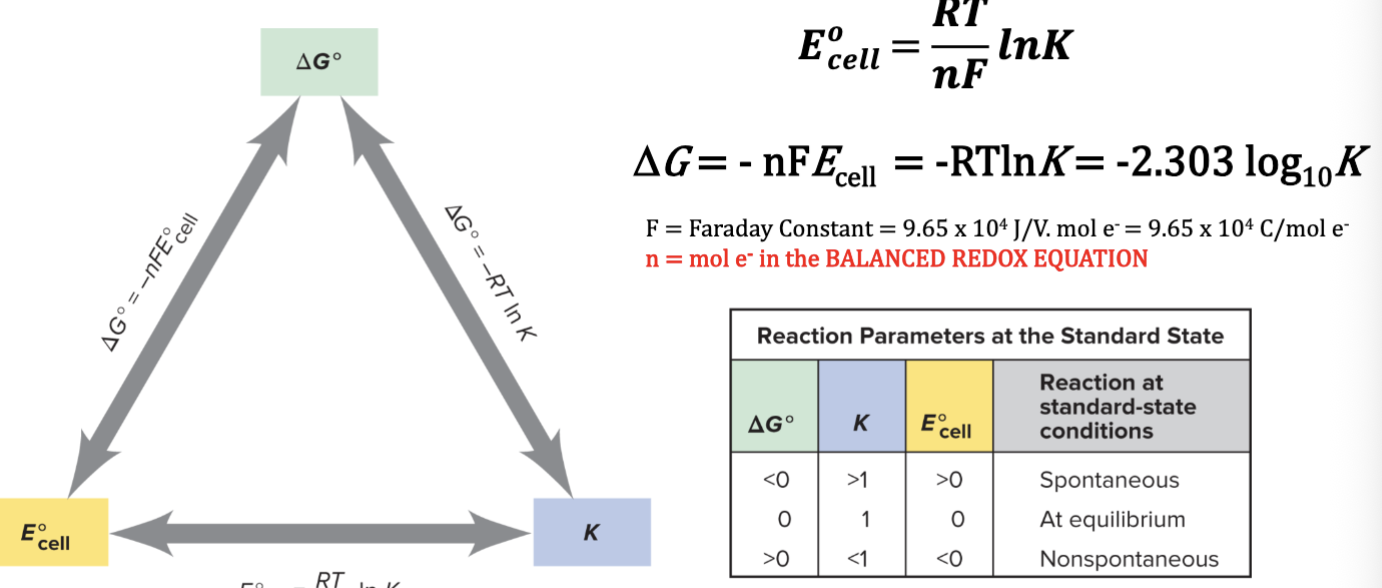
What three quantities are always thermodynamically related?
Gibbs free energy, K, cell potential
The anode is ____ in an electrolytic cell because….
positive; the external power supply is forcibly removing electrons from the anode
Electrolysis
The splitting of a substance by the input of electrical energy; often used to decompose a compound into its elements
For pure molten salts, the cation is ___, and the anion is ___.
reduced; oxidized
What periodic trends do we use to decide which elements will be oxidized or reduced in electrolysis?
Ionization energy and electronegativity
Ampere (A) times volt (V) =
Watts (W)
Faraday’s Law of Electrolysis
The amount of substance produced at each electrode is directly proportional to the amount of charge (electrons) flowing through the cell.
Current =
amount of charge moving per unit time → Usually measured in amps
Potential for the electrolysis of water
-1.23 V
The most ___ reduction potential still gets reduced in electrolysis.
positive
Why are there kinetic barriers for the electrolysis of water?
It requires an overpotential.
“Discharge” is used when cell is __.
voltaic
“Recharge” is used when cell is ___.
electrolytic
When electrochemical cells are connected in series…
their voltages sum.
Rechargeable battery =
Secondary battery; ex. Lead acid/lead storage battery; nickel-metal hydride battery
A more stable form of Li is…
LiC6
Fuel cell
Generating electricity through controlled combustion (oxidation) of the fuel
Iron is both ____ and, later, ____ to form ___.
an anode; a cathode; to form rust
2 steps of iron corrosion
Loss of iron
Formation of rust
Sacrificial anodes
Get oxidized in place of the metal you do not want to corrode