Plant Diversity II
 Call Kai
 Learn
Learn Practice Test
 Spaced Repetition
 Match
Match Flashcards
 Knowt Play
1/60

There's no tags or description
Looks like no tags are added yet.
Name | Mastery | Learn | Test | Matching | Spaced | Call with Kai | Chat |
|---|
No analytics yet
Send a link to your students to track their progress
61 Terms
The gametophytes of seed plants are microscopic. They develop within the walls of spores that are retained within tissues of the parent sporophyte. This arrangement protects the developing gametophyte from __
environmental stress and enables it to obtain nutrients from the sporophyte
Ferns and other close relatives are ___;
homosporous
seed
plants are ____
heterosporous
Homosporous
plants produce one kind of spore, which usually
produces a bisexual gametophyte
Heterosporous
plants produce two types of spores, which
develop into either male or female gametophytes
Megasporangia produce megaspores that give rise to
female gametophytes and develop on modified leaves called megasporophylls
Microsporangia produce microspores that give rise to
Male gametophytes and develop on microsporophylls
An ovule consists of a
megasporangium, megaspore, and one or more protective integuments

Gymnosperm megasporangia have__ integument
one
Angiosperm megasporangia usually __ integuments
two
A microspore develops into a __ that consists of a male gametophyte enclosed within the pollen wal
pollen grain

Pollination
The transfer of pollen to the part of a seed plant containing the ovules
A germinated pollen grain produces a pollen tube that
carries sperm into the ___ gametophyte
female
Pollen eliminates the need for a film of __ and can be dispersed great distances by air or animals
water

If a sperm fertilizes the egg of a seed plant, the ovule will develop into a __
seed

A seed is a ___, along with its food supply, packaged in a protective coat
sporophyte embryo

Seeds provide some evolutionary advantages over spores
They may remain dormant for days to years, until conditions are favorable for germination
They have a supply of stored food
They may be transported long distances by wind or an animal
Origins of characteristics found in living seed plants
date back to the ___
late Devonian period (380 million years ago)
A 360-million-year-old fossil from the genus ___
provides the earliest evidence of seed plants
Elkinsia
Living seed plants can be divided into two clades
gymnosperms and angiosperms
Gymnosperms appear early in the fossil record,
about
305 million years ago
Gymnosperms means
naked seeds

Gymnosperms seeds are exposed on___ that form cones
sporophylls
Angiosperm seeds are found in ___, which are mature ___
fruits, ovaries
Gymnosperms dominated terrestrial ecosystems during the ___ era
Mesozoic era, 252 to 66 million years ago
The gymnosperms consist of four phyla
Cycadophyta (cycads)
Ginkgophyta (one living species: Ginkgo biloba)
Gnetophyta (three genera: Gnetum, Ephedra, Welwitschia)
Coniferophyta (conifers: pine, fir, and redwood)
Phylum Cycadophyta Have
large cones and palmlike leaves

Unlike most seed plants Cycadophyta have
flagellated sperm

Phylum Ginkgophyta consists of a single living species ___
Ginkgo biloba

Like the cycads Phylum Ginkgophyta also have ___.
flagellated sperm

Phylum Gnetophyta
Species vary in appearance, and some are tropical, whereas others live in deserts

Phylum Gnetophyta is comprises three genera
Gnetum
Ephedra
Welwitschia
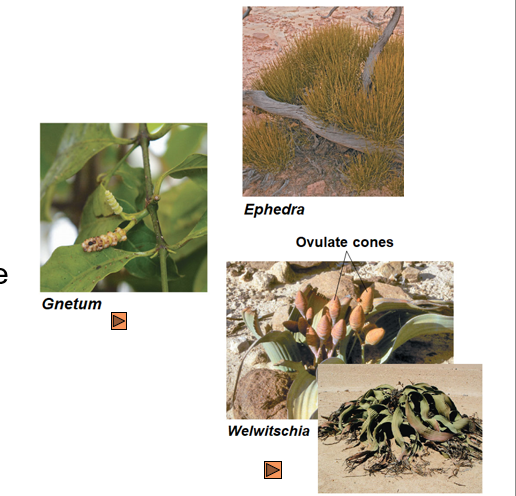
Phylum Coniferophyta, this phylum is the __ of the gymnosperm phyla
largest
Most ___ species have woody cones, but a few have fleshy cones
Coniferophyta
Most __ are evergreens and can carry out photosynthesis all year round
conifers
The pine tree is a ___ sporophyte producing _ in modified leaves, the male and female cones
sporophyte, sporangia
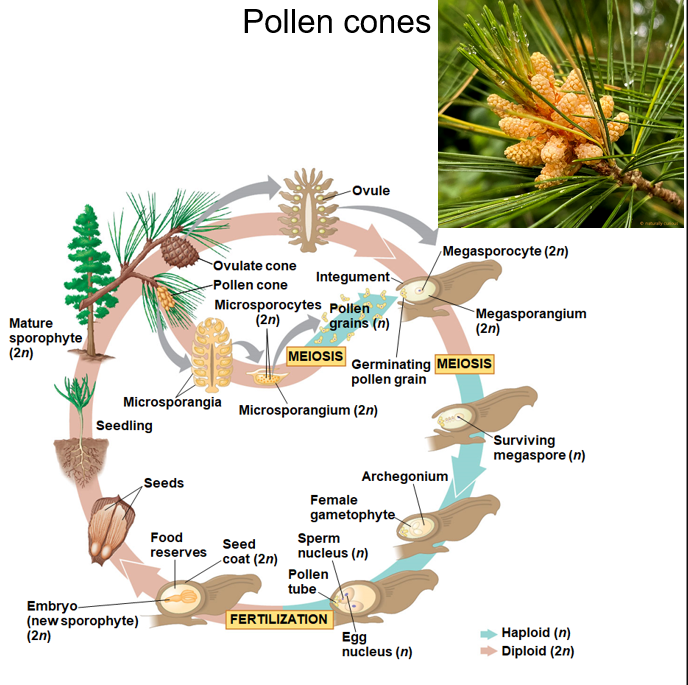
pine tree pollen cones are small and consist __ that bear microsporangia
microsporophylls
pine tree cells ___ undergo meiosis to produce haploid microspores (pollen grains) inside the microsporangia
microsporocytes
Pine trees Ovulate cones are larger and consist of __ bearing megasporangia (ovule)
megasporophylls

Within each ovule, ___ undergo ___ to produce ___ megaspores which develop into __ gametophytes
megasporocytes , meiosis , haploid , female
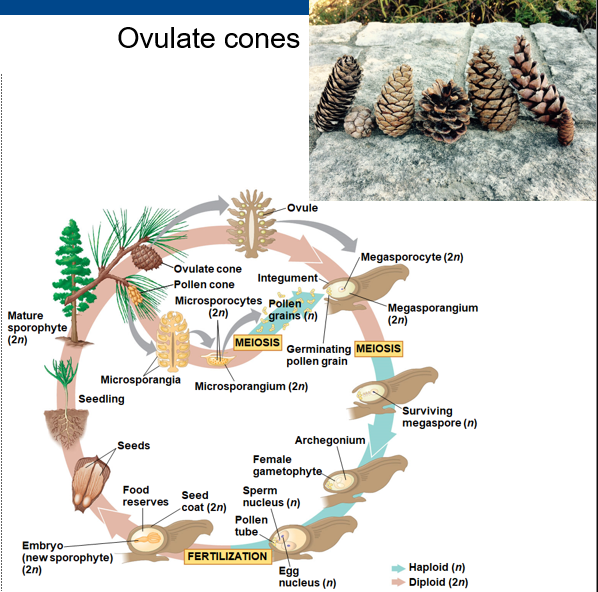
__ gametophytes are retained within the megasporangia
Female

Fossil evidence suggests that angiosperms originated about __ million years ago and diversified over a 20- to 30-million-year period
140

The earliest pollen fossils with angiosperm characteristics are ___ million years old
130

Early fossils of larger flowering plant structures are about __ million years old
125

All angiosperms are classified in a single phylum, __
Anthophyta
The __ is an angiosperm structure specialized for sexual reproduction
flower

A flower is a specialized shoot with up to four types of modified leaves called floral organs:
Sepals, which enclose the flower
Petals, which are often brightly colored to attract pollinators; wind-pollinated flowers generally lack brightly colored parts
Stamens, the male reproductive organs
Carpels, the female reproductive organs
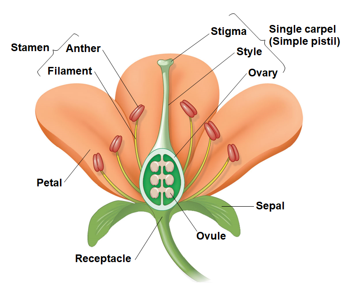
A stamen consists of a stalk called a __ , with a sac called an __
filament, anther

A carpel consists of an __ at the base of a _leading up to a sticky _, where pollen is received
ovary, style, stigma

The ovary contains the __ within the ovule(s)
female gametophyte(s)

The term __can be used to refer to a single carpel or two or more fused carpels
pistil
The flower of the sporophyte is composed of both male and female structures
Male gametophytes are contained within pollen grains produced by the microsporangia of anthers
The female gametophyte, or embryo sac, develops within an ovule contained within an ovary at the base of a stigma

A pollen grain that has landed on a stigma __, and the pollen tube of the male gametophyte grows down to the ovary
germinates

The ovule is entered through a pore called the
micropyle
Double fertilization occurs when the pollen tube discharges __
two sperm into the female gametophyte within an ovule
One sperm fertilizes the egg
The other combines with two nuclei in the central cell of the female gametophyte and initiates development of food-storing endosperm, a triploid structure that nourishes the developing embryo

Within a seed, the embryo consists of a root and one or two seed leaves called ___
cotyledons
Basal angiosperms
§include the flowering plants belonging to the oldest lineages
These include water lilies and star anise
Monocots and Eudicots
Most angiosperms are divided into two main groups: monocots (one cotyledon) and Eudicots (two cotyledons)

Monocots
About one-quarter of angiosperms, about 70,000 species, are monocots
The largest groups are the orchids, grasses, and palms
Eudicots
More than two-thirds of angiosperms, about 170,000 species, are eudicots
Eudicots include the large legume family and the economically important rose family
Angiosperm Life Cycle
