Chapter 2 - Structure and Function of the Nervous System
 Call Kai
 Learn
Learn Practice Test
 Spaced Repetition
 Match
Match Flashcards
 Knowt Play
1/84

There's no tags or description
Looks like no tags are added yet.
Name | Mastery | Learn | Test | Matching | Spaced | Call with Kai | Chat |
|---|
No analytics yet
Send a link to your students to track their progress
85 Terms
neurons are…
a single unit
vary in forms + functions
what are glial cells used for?
structural support
to insulate neurons
what are the four types of glial cells?
astrocytes
oligodendrocytes
schwann cells
microglial cells
what is the biggest glial cell?
astrocytes
what is the shape of an astrocyte?
astrocytes have a star-like shape
what is the purpose of astrocytes?
they maintain the functional and structural integrity of the blood brain barrier (BBB)
which glial cells make up myelin in the CNS?
oligodendrocytes
which glial cells make up myelin in the PNS?
shwann cells
what do microglial cells do?
clean damaged cells
what is the difference between the somatic nervous system and the autonomic nervous system?
somatic → moving our body parts voluntarily
autonomic → involuntary reactions (blinking, breathing, HR)
what is the purpose of myelin sheath?
it allows electrical signals to travel long distances (myelin = signal travels faster)
what is the purpose of the soma in a nerve cell?
to maintain the neuron’s metabolic activity
what is the purpose of dendrites in a nerve cell?
dendrites receive signals
what is the purpose of axons in a nerve cell?
to deliver signals
where are purkinje cells found?
cerebellum
which neurons send info and which neurons receive info?
presynaptic neurons → send info
postsynaptic neurons → receive info
what type of transmission occurs inside the neuron?
electrical transmission
what type of transmission occurs between neurons?
chemical transmission
what is the electrical potential?
electrical potential is the difference in voltage between the inside and the outside of the neuron
which ions are more prevalent outside the neuron and which are more prevalent inside?
outside: Na+, Cl-
inside: K+
ions travel through the membrane using…
channels or pumps
ion channels can be…
gated or non-gated
give an example of an ion pump
the sodium potassium pump
ion pumps are background mechanisms, this means that…
ion pumps work in the “background” constantly and at a steady rate to keep the cell alive
when a neuron is at rest, the cell membrane is selective to _______ but allows ______ to easily pass through
Na+, K+
dendrites have specialized protrusions called…
spines
what are spines?
little knobs attached by small necks to the surface of dendrites
purpose: receive input from other neurons
define dendrites
receive signals from other neurons at the synapse
structure: large, tree-like branches
define synapse
where neurons come together → presynaptic neuron sends neuron transmitters to postsynaptic neuron
neurons (like other cells) sit in a bath of salty extracellular fluid composed of…
mixtures of ions (K+, Ca+, Cl-, Na+)
the axon is a structure that extends from…
the soma (cell body)
describe the path of a signal from one neuron to another
dendrites and spines receive input from another neuron (NTs)
this produces small, graded potentials
these potentials are summed at the axon hillock
if threshold is reached, an action potential fires
the action potential travels down the axon towards the axon terminal
if the axon is myelinated, the signal travels faster
at the axon terminal, NTs are released into the synaptic cleft (depolarization causes Ca2+ channels to open)
NTs travel through the synaptic cleft and bind to receptors on the postsynaptic neuron
what is saltatory conduction?
when an electrical signal jumps between nodes of ranvier
what are the two forces that affect a neuron’s membrane potential?
1) ionic concentration gradient
2) electrical gradient
what helps create the ionic concentration gradient?
the sodium potassium pump
what helps create the electrical gradient
an ion pump and selective permeability (membrane is selective about what it will allow to pass through it)
the sodium potassium pump moves ions _____ their concentration gradient
against
voltage-gated ion channels react to…
dramatic changes in the electrical gradient
gated ion channels open or close in response to what?
changes in nearby transmembrane voltage or to chemical or physical stimuli
what does get the membrane to threshold?
excitatory inputs open Na+ channels
Na+ floods into the membrane
the neuron becomes depolarized
how does the Na+/K+ pump maintain resting potential?
by keeping a larger concentration of K+ inside the cell and Na+ outside (pump uses ATP as energy)
how do action potentials enable signals to travel for meters with no loss in signal strength?
action potentials continually regenerate the signal at each patch of membrane on the axon
the presence of what allows action potential to regenerate itself?
voltage-gated ion channels
distinguish between the ionic concentration gradient and the electrical gradient
ion gradient → focus is on the difference in ion amounts
electrical gradient → focus is on the charge difference (voltage)
while the ionic concentration gradient is driven by a difference in ________________ on each side of the membrane, the electrical gradient is driven by the difference in ________ across a membrane
amounts of ions, charge
in relation to the ionic concentration gradient, ions tend to move…
from areas of high concentration to areas of low concentration
the electrical gradient helps open up…
voltage-gated ion channels (cations pulled towards more negative side, anions pulled towards more positive side)
where is the densest concentration of ion channels found? what is this called?
the axon hillock, the spike-triggering zone

what occurs in the spike triggering zone?
action potential is initiated
REMEMBER: depolarization spikes!!!
what would occur if an axon has no myelin?
action potential would move freely around the neuron without the presence of myelin because ions would be moving freely so the signal would dissipate
what is myelin’s main job?
to guide the direction of the signal (preserve the signal)
“all or none” when describing action potential means…
it either happens or it doesn’t (there’s no in between)
a stronger stimulus does not make an action potential bigger, instead it…
increase the frequency (rate) that the action potential fires
what are the 5 phases of action potential?
threshold is hit (around -55 mV)
depolarization occurs and reaches its peak (peak is around 40 mV)
repolarization
hyperpolarization (refractory period)
resting state (-70 mV)
in myelinated axons what is found along the length of the axon but only at the nodes of Ranvier?
voltage-gated ion channels
what occurs at the synaptic cleft?
chemical transmission
what is the primary excitatory neurotransmitter?
glutamate
what is the primary inhibitory neurotransmitter?
GABA
what are residual neurotransmitters?
NTs that are left in the synaptic cleft after a signal has been delivered
what is one way to get rid of residual NTs?
reuptake
what is reuptake?
when a NT binds to the receptor on the presynaptic neuron
describe SSRIs
SSRIs stand for selective serotonin reuptake inhibitors
SSRIs bind to receptors on the presynaptic neuron
prevents serotonin from reuptake
more serotonin left in the synaptic cleft to improve mood
for temporal summation, inputs come from __________ while for spatial summation, inputs come from ____________
the same synapse, multiple synapse

which summation has inputs that are repeated and in quick succession and which has simultaneous inputs?
temporal summation → repeated, in quick succession
spatial summation → simultaneous
a gap junction creates…
physical channels between two cells

distinguish between sympathetic and parasympathetic
sympathetic → prepares the body for action (fight or flight)
parasympathetic → helps the body maintain its functions
identify dorsal, ventral, rostral and caudal in your mind
…
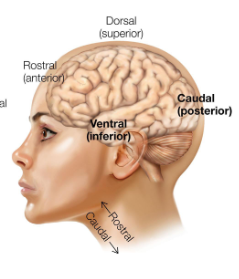
a region in the brain can be identified by multiple spatial names, for example…
the temporal lobe is ventral and dorsal

identify each line
red → midsagittal section
purple → lateral sagittal section

identify each line
green → axial, transverse, or horizontal
blue → coronal
what does the brain float in and what does this do?
the brain floats in cerebrospinal fluid
this reduces the pressure and weight of the brain and protects it from damage
what else is filled with CSF?
ventricles
the brain uses blood from the…
heart (20%)
the brain has no storage for…
glucose or oxygen
since the brain has no storage for glucose or oxygen, disruption of either of these causes…
unconsciousness or death
more neuronal activity =
more blood flow
what parts does the brainstem include?
medulla
pons
cerebellum
midbrain

identify the medulla, pons, cerebellum, and midbrain

what is the medulla responsible for?
vital functions like respiration and HR
sensory/motor relay station between body and brain
motor commands cross over to contralateral body
describe the pons
“the bridge”
main connection between the brain and the cerebellum
responsible for eye/face movements
what parts does the midbrain include?
inferior/superior colliculus + red nucleus
what is the midbrain responsible for?
sending pain signals down
the diencephalon includes what two parts?
hypothalamus and thalamus
diencephalan means…
between brain
the hypothalamus and thalamus make
interconnections between widespread brain areas