Chp 22 - Gluconeogenesis
 Call Kai
 Learn
 Practice Test
 Spaced Repetition
 Match
 Flashcards
 Knowt Play
1/71

Earn XP
Description and Tags
Exam 4
72 Terms

very important for big picture stuff
what does gluconeogenesis mean in simple terms?
making “new” glucose
gluconeogenesis is the _________ of glucose from _____________ precursors
synthesis, noncarbohydrate
what are the most common precursors in the human body that can be converted to glucose?
pyruvate, lactate, glycerol and amino acids
which two amino acids CANNOT be converted to glucose?
leucine and lysine
what is the major site of gluconeogenesis?
the liver
what site other than the liver can gluconeogenesis occur?
the kidney
when is gluconeogenesis important (in what situation)?
during fasting or starvation
what is glucose the primary fuel for?
the brain
what is glucose the ONLY fuel for?
red blood cells
when a human is fed, its dietary carbohydrates pass through the _______ and are converted into _______
gut, glucose
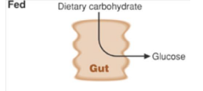
when a human is fasting or starved, what organ kicks in and begins gluconeogenesis?
the liver
what occurs first: glycogen degradation or gluconeogenesis?
glycogen degradation

why is gluconeogenesis important?
glucose is the major metabolic fuel in the body
we need glucose!!! → bad if we run out
glucose is converted to _________ in the cytoplasm of skeletal muscle cells
lactate (lactic acid fermentation)
what are the precursors for gluconeogenesis?
pyruvate, lactate, amino acids, glycerol
lactate is a product of what process…
lactic acid fermentation
lactate is excreted from _____ into the ______ ______
cells, blood stream
lactate can become reabsorbed by the _______ and used as a precursor to produce ________
liver, glucose
where are amino acids derived from?
proteins in the diet or muscle proteins during prolonged starvation
glycerol is a product of…
hydrolysis of triacylglycerols
can animals produce glucose from fatty acids?
NO!!
why can’t animals produce glucose from fatty acids?
the product of fatty acid degradation is acetyl CoA
oxaloacetate is only regenerated enough to keep the citric acid cycle going by combining with acetyl CoA to form citrate
essentially: the processes involved with fatty acid degradation will not produce glucose
plants can produce glucose from fatty acids
true
gluconeogenesis occurs in the _____ while glycolysis occurs in the ______
liver, muscle
refresher: glycolysis converts what to what?
one molecule of glucose to two molecules of pyruvate
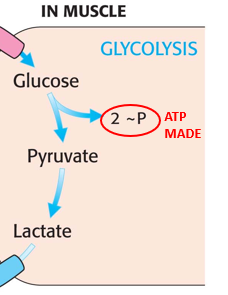
explain the processes listed here
breakdown:
GLYCOLYSIS: 1 molecule glucose → 2 molecule pyruvate, 2 ATP
LACTIC ACID FERMENTATION: 1 molecule pyruvate → 1 molecule lactate
all happening in muscle

explain the processes listed here
lactate → pyruvate (oxidation reaction catalyzed by the enzyme lactate dehydrogenase)
pyruvate → glucose GLUCONEOGENESIS
what two organs showcase inter-organ cooperation in a series of reactions?
the muscle and the liver
describe the Cori cycle
lactate produced by the muscle gets absorbed by the blood stream
the liver removes the lactate from the blood stream and converts it into glucose
this glucose can be released into the blood and converted into lactate in the muscle

how many ATP are produced by glycolysis in the muscle?
2 ATP
how many ATP are used by gluconeogenesis in the liver?
6
glycerol is derived from what process?
the hydrolysis of triacylglycerols
glycerol must be converted into what molecule to be processed by gluconeogenesis or glycolysis?
dihydroxyacetone phosphate

the conversion of glycerol to dihydroxyacetone phosphate occurs in how many steps?
two (meaning two enzymes)
what is the intermediate in converting glycerol to dihydroxyacetone phosphate?
glycerol phosphate
what process converts pyruvate into glucose?
gluconeogenesis
is gluconeogenesis the reverse of glycolysis?
NO!!
what is the first step of gluconeogenesis if your precursor is pyruvate?
pyruvate → oxaloacetate
what is the enzyme that catalyzes the first step in gluconeogenesis when pyruvate is the precursor:
pyruvate → oxaloacetate
pyruvate carboxylase
what is the second step in gluconeogenesis if the precursor is pyruvate?
oxaloacetate → phosphoenolpyruvate
oxaloacetate → phosphoenolpyruvate
what is the enzyme?
phosphoenolpyruvate (PEP) carboxykinase
many reactions are common for glycolysis and gluconeogenesis. however, there are three irreversible steps in glycolysis that must be bypassed in gluconeogenesis. list the enzymes for these steps
hexokinase, phosphofructokinase 1, pyruvate kinase

what are the enzymes unique to gluconeogenesis?
pyruvate carboxylase, phosphoenolpyruvate (PEP) carboxykinase, fructose 1,6 biphosphatase, glucose 6-phosphatase
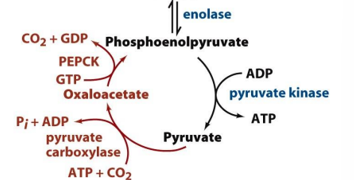
what enzymes in gluconeogenesis are needed to bypass the irreversible step catalyzed by pyruvate kinase in glycolysis?
pyruvate carboxylase and phosphoenolpyruvate carboxykinase
breakdown:
in glycolysis, pyruvate kinase catalyzes phosphoenolpyruvate → pyruvate
in gluconeogenesis, 2 enzymes listed above catalyze pyruvate → phosphoenolpyruvate
which enzyme in gluconeogenesis requires a biotin cofactor?
pyruvate carboxylase
(converts pyruvate to oxaloacetate)
where does the conversion of pyruvate to oxaloacetate occur? (gluconeogenesis)
the mitochondria
biotin serves as a carrier of activated ____
CO2
the first step in gluconeogenesis requires what energy source?
first step: pyruvate → oxaloacetate
answer: ATP
the second step in gluconeogenesis requires what energy source?
second step: oxaloacetate → phosphoenolpyruvate
answer: GTP
during the first step of gluconeogenesis for pyruvate, the same _______ is added and immediately removed from the structure in the second step
carbon
think about it, THIS MAKES SENSE bc oxaloacetate has one more CO2 group than pyruvate!!

where is oxaloacetate converted into phosphoenolpyruvate?
the cytoplasm
how does oxaloacetate leave the mitochondria and travel to the cytoplasm?
oxaloacetate gets converted into malate, leaves the mitochondria and gets converted BACK to oxaloacetate once in the cytoplasm

what energy source is used to convert malate to oxaloacetate in the cytoplasm?
NAD+ is used and converted to NADH + H+
once oxaloacetate is in the cytoplasm, what reaction can occur now?
oxaloacetate → phosphoenolpyruvate
enzyme: phosphoenolpyruvate carboxykinase
what is the phosphoryl donor in this reaction:
oxaloacetate → phosphoenolpyruvate
GTP
look at everything outlined here, find what parts are leaving and what parts are being gained (notice the gain of the phosphoryl group)

is this reaction reversible or irreversible in gluconeogenesis?
fructose 1,6-biphosphate → fructose 6-phosphate
irreversible
this reaction is coordinately/oppositely regulated with what enzyme?
fructose 1,6-biphosphate → fructose 6-phosphate
phosphofructokinase-1 (PFK)
fructose 1,6-biphosphate → fructose 6-phosphate
this reaction cleaves phosphate using what molecule?
water

does this step in gluconeogenesis generate ATP?
fructose 1,6-biphosphate → fructose 6-phosphate
NO
where does this reaction occur?
glucose 6-phosphate → glucose
the endoplasmic reticulum
does this reaction generate ATP?
glucose 6-phosphate → glucose
NO
what is the final step in gluconeogenesis?
include reactant, product and enzyme
glucose 6-phosphate → glucose
enzyme: glucose 6-phosphatase
where is glucose 6-phosphate transported before it is catalyzed by glucose 6-phosphatase?
the lumen (interior) of the endoplasmic reticulum
\
what must occur before glucose-6-phosphate can be transported out of the liver?
it must be dephosphorylated
glucose 6-phosphate is dephosphorylated because glucose 6-phosphatase is found (on what organelle?)…
sequestered in the ER lumen

in which organ would you find glucose 6-phosphatase?
the liver
at what times does the liver release glucose into the blood?
during muscular activity and between meals
phosphorylated glucose gets trapped inside the…
cell
what is the net reaction of gluconeogenesis? include all reactants and products (energy sources, molecules, etc)
2 pyruvate + 4 ATP + 2 GTP + 2 NADH + 2 H+ + 4 H2O
→
1 glucose + 4 ADP + 2 GDP + 6 Pi + 2 NAD+