chapter 1 - rate graphs
 Call Kai
 Learn
 Practice Test
 Spaced Repetition
 Match
 Flashcards
 Knowt Play
1/10

There's no tags or description
Looks like no tags are added yet.
11 Terms
what is a rate of reaction?
the change in concentration of a reactant or product over time
if you plot concentration against time, the rate is the gradient of the graph
how to calculate the gradient (and the rate) of the graph?
you find the change in concentration divided by the change in time
pick 2 points and read off the x and y values
calculate the differences in concentration values and the time values, and then divide one by the other

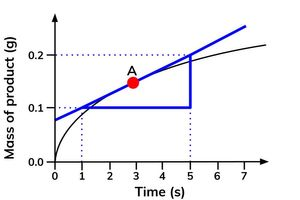
how to calculate the rate on curved graphs?
by drawing a tangent
what can be deduced from the shape of a concentration-time graph?
the order with respect to a reactant
zero order reaction?
produces a straight line with a negative gradient
the reaction rate does not change at all during the course of the reaction
the value of the gradient is equal to the rate constant
the straight line graph makes a zero order relationship easy to identify
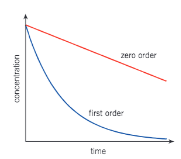
first order reaction?
produces a downward curve with a decreasing gradient over time
as the gradient decreases with time, the reaction gradually slows down
in a first-order concentration time graph, the time for the concentration of the reactant to halve is constant
this time is called the half-life, and the rate constant of a first order reaction can be determined using its value

second order reaction?
the graph for a second order is also a downward curve, steeper at the start, but tailing off more slowly
what is half-life?
time taken for half of the reactant to be used up
what type of half-lives do first order reactions have?
they have a constant half-life with the concentration halving every half-life
this pattern is called exponential decay
how can a first-order relationship be confirmed from a concentration-time graph?
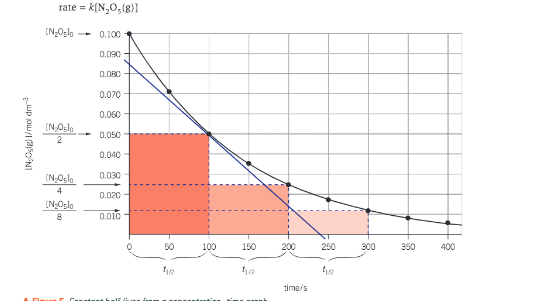
by measuring successive half-lives.
if they are the same, the reaction is first-order with respect to the reactant
example: first order relationship confirmed from a concentration time-graph?
the graph shows 3 successive half-lives with a constant value of 100s
the constant half-life means that this reaction is first order with respect to N2O5
[N2O5]0 u=is the initial concentration of N2O5 at time = 0s