7 - Principles of Complicated Exodontia
 Call Kai
 Learn
 Practice Test
 Spaced Repetition
 Match
 Flashcards
 Knowt Play
1/119

There's no tags or description
Looks like no tags are added yet.
120 Terms
Flap design
____ of flap should be broader than free margin. Adequate ____ supply prevents necrosis.
Base
blood

Flap Design
Must be of adequate size for:
1. Proper ______
2. Adequate access for _____
3. Provision of retraction without _____
visualization
surgery
tension
Flap Design
Length should extend at least ____ teeth anteriorly and ___ tooth posteriorly in a simple ENVELOPE flap
two
one
Flap Design
Flap should be a full-thickness mucoperiosteal flap that includes _____. _____, and _____
mucosa, submucosa, and periosteum
Flap Design
Flap incisions should be over sound ____. At least __ mm from edge of bony defect
bone
6
when making a flap Beware of _____ nerve and ____ nerve
lingual
mental
Nasopalatine vessels supply anterior _____ gingiva and emerge from _____ foramen
palatal
nasopalatine

Greater palatine vessels emerge from greater palatine foramen- supply_____aspect of palate
posterolateral

Vertical releasing incision
• At ______ end of envelope
• ______
• At line angle of tooth, DO NOT bisect the _____
anterior
Oblique
papilla
we will use a _____ incision in dentulous patients
Sulcular
we will use a _____ incision in edentulous patients
Crestal
alveolar crest
Envelope flap with 1 vertical releasing incision is a _____-cornered flap
three
Envelope flap with 2 vertical releasing incisions is a ____ cornered flap
four
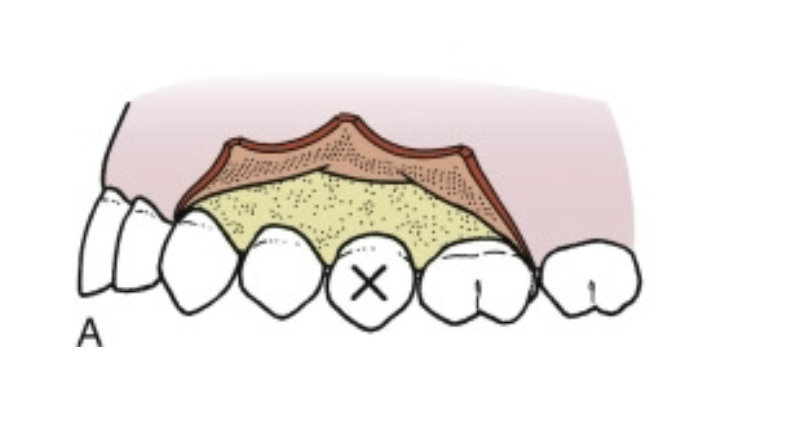
Type of flap?
Envelope (sulcular) flap
2 teeth anterior
1 tooth posterior
opens up like an envelope
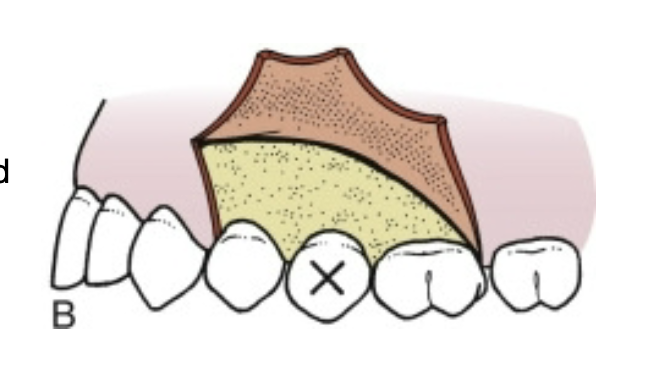
What type of flap
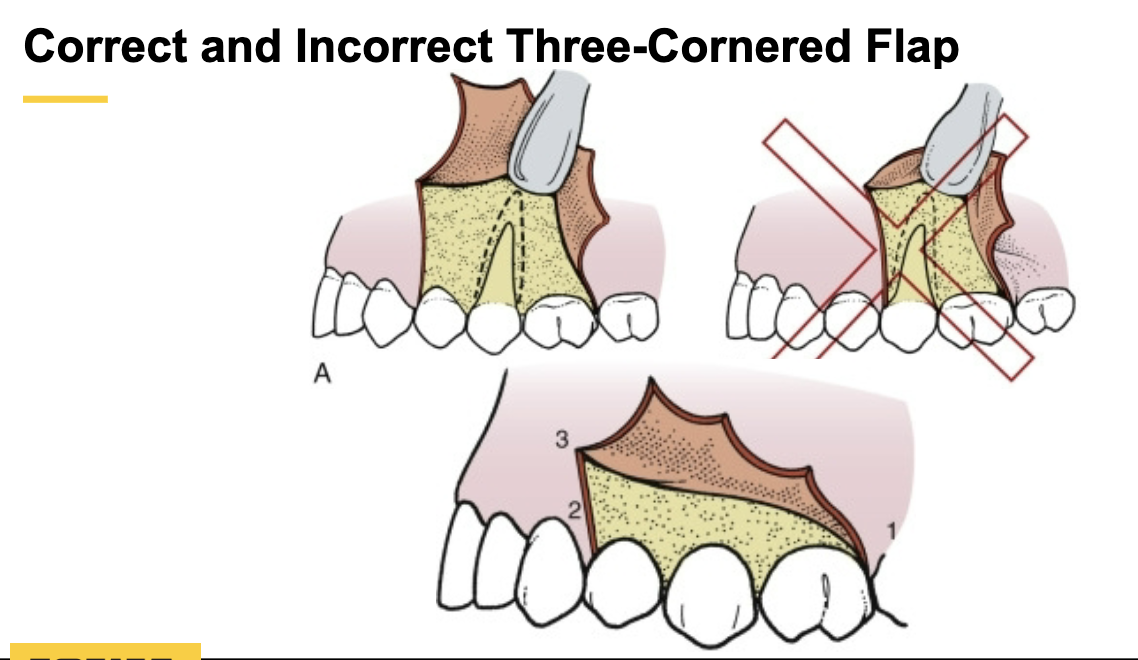
3 cornered flap
vertical releasing incision
In a 3 cornered flap we extend __ tooth anterior and _ posterior in this flap because we are exposing more SA of bone
1
1
correct and incorrect three-cornered flap (image)
.
3 parts of a full thickness mucoperiosteal flap
mucosa
submucosa
periosteum
Vertical-releasing incisions at the ends of the envelope incision convert the envelope incision into a______ flap (corners numbered)
four-cornered


Type of flap?
Semilunar flap
Semilunar incision, designed to avoid marginal attached gingiva when working on a ____ ____. The incision is most useful when only a _____ amount of access is necessary.
root apex
limited

semilunar flap is primarily used for ____ surgery
periapical
a semilunar flap Avoids trauma to ____ and ____ _____
papilla
gingival margin
in a semilunar flap Incision should not be placed over ___ defect
bony

Type of flap?
Y incision flap
Y incisions are used primarily on the _____
palate
In a Y incision Anterolateral extensions of midline incision are extended toward the _____ teeth
canine
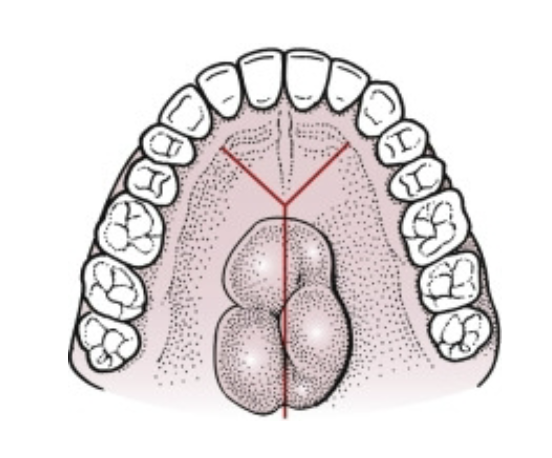
A Y incision is commonly used for maxillary ____ removal
tori
a surgical procedure where a piece of tissue is moved from one part of the body to another while keeping its original blood supply attached
Pedicle Flap (no image)
a flap is rotated from one area to another to fill in a soft tissue defect
pedicle flaps are often used to close ______ defects
oroantral
connection from mouth to maxillary sinus
Mucoperiosteal Flap Technique
1. Incise soft tissue with a #15 blade in a scalpel handle
2. Incision is carried down to bone and is
performed in a smooth continuous stroke
3. Scalpel is drawn toward the surgeon
4. For vertical releasing incision
• Soft tissue is reflected apically
• Definitive incision is made down to bone
• Direction is from apex to cervical margin
5. Reflection is begun with a #1 Woodson elevator (pointed edge)
6. Papilla are elevated first- the periosteal elevator is kept in close contact with bone underneath periosteum
7. After edge of flap is released, can use a sweeping motion with curved end of #1 Woodson or #9 Molt periosteal elevator
8. When performing a three-cornered flap elevate papilla of middle corner first. Push apically and backward from that point
9. Flap is retracted and held in position by Minnesota or Seldin retractor, periosteal elevator, etc.
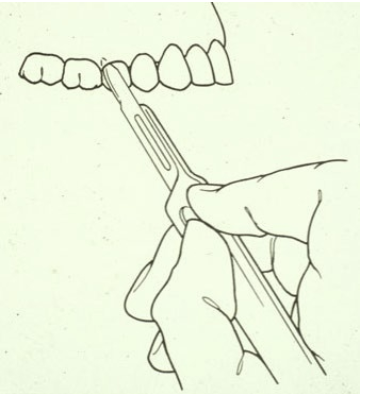
when making a vertical releasing incision, the direction is from the ____ to the ____ ____
apex
cervical margin
in a mucoperiosteal flap, ___ are elevated first
papilla
periosteal elevator is kept in close contact with bone uner periosteum

after elevating papilla you can use a ___ or ____ elevator in a sweeping motion
#1 woodson
#9 molt

When performing a three-cornered flap elevate papilla of ___ corner first. Push apically and backward from that point
middle
Flap is retracted and held in position by _____ or ____ retractor, periosteal elevator, etc.
Minnesota
Seldin
True or False
you can do a vertical release on papilla
false
DO NOT SPLIT PAPILLA
bone is thinnest there - can cause bone to resorb and gingiva can follow

Suturing Armamentarium
• Needle holder (gold handle)
• Suture needle
• Suture material
Most commonly used sutures
black silk
plain gut and chromic gut
black silk sutures are (resorbable/non-resorbable), (monofilament/multifilament), and is (well,poorly) tolerated
non-resorbable
multifilament
well
Plain gut or chromic gut is (resorbable/non-resorbable), (monofilament/multifilament), (well/poorly) tolerated
Resorbable, monofilament, well-tolerated
what are the typical sizes used for plain or chromic gut sutures
3.0 or 4.0
suturing ______ flaps and approximates ____ leading to primary wound healing
repositions
edges
suturing Augments _____ through tamponade effect
hemostasis
suturing Keeps soft tissue over ____ and prevents delayed healing
bone
suturing May help maintain___ ____ in socket
blood clot
Suturing Technique
1. Suture mobile tissue to attached tissue
2. In dentulous patients- papilla are reapproximated
3. Needle is inserted through mucosa at a right angle (helps prevent tearing)
4. Suture should be at least 3 mm from wound margin
5. DO NOT tie too tightly or too loosely
6. For a three-cornered flap- suture middle corner papilla first- this will align the edges of the flap
7. Remove sutures in 5-7 days if non-resorbable

sutures need to be at lease __mm from the wound margin
3
for a 3 corner flap, suture the ___ corner papilla forst- this will align the edges of the flap
middle
non-resorbable sutures need to be taken in about _____ to ____ days
5-7
4 types of sutures
1. Simple interrupted
2. Horizontal mattress
3. Figure-eight
4. Continuous
simple suture interrupted technqiue (image)
.

When is a Surgical (open) Extraction Indicated?
When excessive force is likely to be required during a closed extraction
Example: high risk of bone fracture, root fracture, crown fracture, or all of the above
Indications for Surgical (open) Extractions
1. To avoid use of excessive force that may result in bone fracture or root fracture
2. Dense buccal cortical bone
3. Short or no crown
4. Severe divergent roots/hypercementosis
5. Close proximity to maxillary sinus
6. Extensive caries
7. Extensive restorations
8. Ankylosed teeth
9. Endodontic treated teeth
10.Retrieve root tips
Heavy or dense cortical bone (image)
.

Short clinical crowns with evidence of bruxism (image)
.

Hypercementosis (image)

Widely divergent or dilacerated roots (image)
fracture at curve likely

Roots closely associated with maxillary sinus (image)
.

Teeth with extensive caries or large restorations (image)
.

Ankylosed Tooth (image)
tooth fused to bone

Endodontic Treated Tooth (image)
more brittle

Retained Roots (image)
.

Technique for open extractions of single rooted teeth
1. Provide adequate visualization and access by reflecting a ______ flap.
mucoperiosteal
Technique for open extractions of single rooted teeth
Determine if removal of ____ is necessary.
bone
Option 1: under direct visualization, _____ forceps and attempt extraction
reseat
Option 2: grasp a small area of ____ bone with the buccal beak of the forceps. Squeeze handle of forceps, ____ through bone and engage tooth. Attempt extraction
buccal
crush
Option 3: use a straight elevator (or periotome) and try to wedge the
blade into the ____ space. Attempt to luxate tooth.
PDL
Option 4: remove _____ bone with a bur or chisel. Width of bone to be removed approximates width of ___. Vertical distance may be about ½ to 2/3 the length of the root.
buccal
root
Option 5: may use a ____ _____ to help elevate or lever the root from the socket
purchase point
After the extraction is completed:
3. Check bony edges for _____. Smooth bone if necessary.
4. _____ surgical field.
5. _____ flap and suture.
sharpness
Irrigate
Reposition
Technique for open extractions of single rooted teeth
A small envelope flap can be reflected to expose the _____ root. Under direct visualization, the forceps can be seated more _____ into the periodontal ligament space, which eliminates the need for ___ removal.
fractured
apically
bone
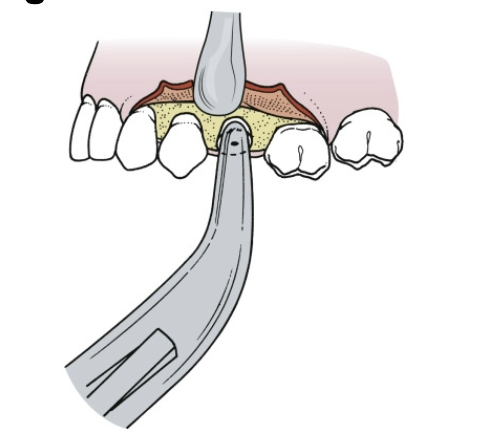
Option 2
If the root is fractured at the level of bone, the ____ beak of the forceps can be used to remove a small portion of bone at the same time that the ____ is grasped
buccal
root

Option 3
The small straight elevator can be used like a shoehorn to ____ the broken root. When the straight elevator is used in this position, the hand must be securely supported on adjacent teeth to prevent inadvertent slippage of the instrument from the tooth and subsequent injury to adjacent tissue
luxate

Option 4
Bone is removed with a bone-cutting bur after reflection of the standard ____ flap. Bone may be removed approximately __ to _ the length of the tooth root
envelope
½ to 2/3

Option 4 cont.
After bone has been removed and the tooth root luxated with the ____ _____, the forceps can be used to remove the root.
straight elevator

Option 5
If the tooth root is firmly in bone, ____ bone can be removed, and a ____ ___ can be made for the insertion of the elevator.
buccal
purchase point

Option 5 cont
A). A ___ ____, such as the crane pick, is inserted into the purchase point, and the tooth is elevated from its socket.
B). The flap is _____ and sutured over intact bone.
pick elevator
repositioned

Option 6
Section root vertically with a ___ ____ bur
701 fissure
very thin bur
Surgical Removal of Multirooted Teeth
• Section tooth into ____ single rooted teeth
several
divide and conquer
Technique for Surgical Removal of Multirooted Teeth
Procedure is similar to surgical removal of single rooted teeth
1. Provide adequate visualization and access. Reflect flap.
2. Evaluate if removal of bone and sectioning of roots is necessary.
3. If tooth sectioning is required, use a 702 or 703 fissure bur.
4. After tooth is sectioned, use a straight elevator to luxate and mobilize the sectioned roots.
a. If crown is sectioned, may use upper or lower universal forceps to remove individual sections.
b. If crown is missing, may use straight or triangular elevators to remove roots. Sometimes a purchase point may be required.
5. Remove sectioned roots.
6. Check bony edges, smooth if necessary.
7. Irrigate.
8. Reposition flap and suture.
Mandibular molars are typically sectioned in half between the ____ and ____ roots.
mesial
distal

Maxillary molars are typically sectioned into ____ using a Y-shaped sectioning. The ____, _____, and _____ roots are sectioned from each other
thirds
palatal
mesiobuccal
distobuccal
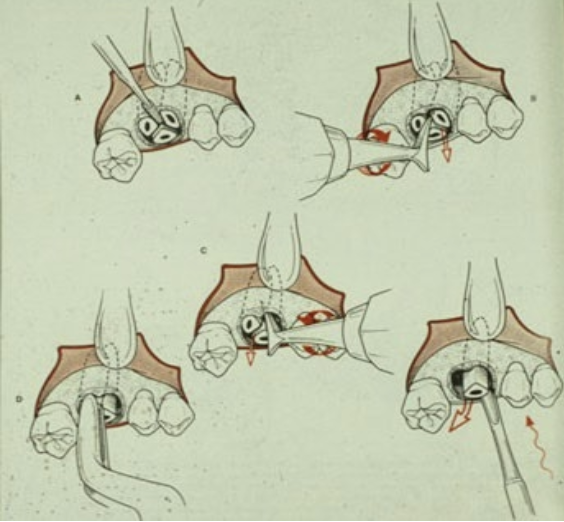
Removal of Small Root Fragments and Root Tips
1. Provide adequate visualization. Good light and good suction.
2. May first attempt removal via closed technique.
3. Attempt to remove root tip with a root tip pick. Avoid excessive apical or lateral pressure
4. Under limited circumstances, may attempt removal with an endodontic file or
bur technique.
5. If a closed technique is unsuccessful, proceed with an open technique.
closed technique to remove root tip (image)
.

Closed Technique for Removal of Root Tip (image)
.

Removal of Small Root Fragments and Root Tips (cont.)
Option 1:
Reflect a full-thickness mucoperiosteal flap. Remove bone with a ____ or ____. Elevate root tip with a straight elevator or root tip pick.
bur
chisel
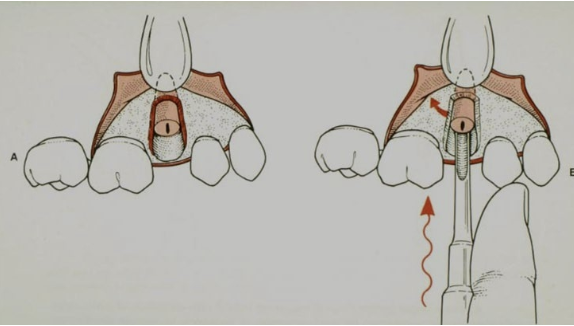
Removal of Small Root Fragments and Root Tips (cont.)
Option 2:
May attempt “___ ____ ” technique (indicated when there is a compelling need to preserve buccal bone
open window
Conditions that must exist to leave a tooth root in the alveolar process:
1. Root fragment is less than __ mm in length
5
Conditions that must exist to leave a tooth root in the alveolar process:
2. Root fragment must be deeply embedded in ____. At least ___ - ____mm of
bone coronal to root tip is preferred
bone
3-4
Conditions that must exist to leave a tooth root in the alveolar process:
3. Involved tooth must not be _____ and no _____ is present around root apex
infected
radiolucency
Surgical risks that may outweigh benefits:
1. Endangerment of ____ structures i.e., inferior alveolar nerve, mental nerve, lingual nerve
vital
Surgical risks that may outweigh benefits:
2. If root may be displaced into tissue ____ or ____ ____
spaces
maxillary sinus.
Surgical risks that may outweigh benefits:
3. Need for excessive removal of _____.
bone
Protocol to Follow if Root is Left in Place
1. Inform patient
2. Document with radiograph
3. Document in chart the decision to leave root tip in place and that patient was informed
4. Recall patient for follow-up evaluation during the ensuing year
5. Instruct patient to notify you if problems occur
Multiple Extractions
1. Extract maxillary teeth first:
a. Local anesthetic has more rapid onset
b. Prevents debris from falling into mandibular extraction sockets
c. Less torquing sensation
2. Extract posterior teeth first, then anterior teeth. Leave 1st molars and canine teeth for end of sequence
3. Compress lingual and buccal plates
4. Reposition soft tissue and feel for sharp edges or undercuts
5. Smooth bone if necessary
6. Irrigate with saline
7. Gingivoplasty if necessary
8. Suture
9. Gauze pack
when extracting multiple teeth, extract ___ teeth forst
maxillary
why extract mazillary teeth first
a. Local anesthetic has more rapid onset
b. Prevents debris from falling into mandibular extraction sockets
c. Less torquing sensation
should you extract anterior or posterior teeth forst when extracting multiple teeth
posterio
Leave ____ molars and _____ teeth for end of sequence
1st
canine