Causal Diagrams
 Call Kai
 Learn
 Practice Test
 Spaced Repetition
 Match
 Flashcards
 Knowt Play
1/7

There's no tags or description
Looks like no tags are added yet.
8 Terms
causal diagrams
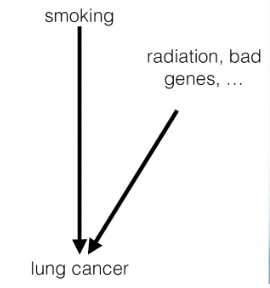
the basic cause-effect relation (smoking → lung cancer)
mechanism or mediator
explains how the main cause influences the main effect
(smoking → change of DNA in lung cells → lung cancer)
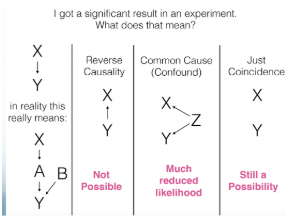
measures confounding variables (common causes)
Spurious correlation: Can make it appear like there is a correlation even when there really not’t (false positive)
Can make a relationship appear stronger than it actually is
Can make a relationship appear in the opposite direction
common causes
When we are worried that there might be a common cause, we must statistically control for it
You should only control for variables that are plausibly direct causes of the DV

unmeasured confounding variables
An alternative cause that you don’t know about, did not measure, or cannot measure
Also known as noise variables
How do we figure out the causal structure
We do studies about each cause-effect relationship to build it up link by link
Evidence that is necessary for each causal link:
A correlation or statistical relationship
Temporal precedence (causal direction)
Eliminate (or reduce) confounds
observational studies
Can provide evidence of a statistical relationship (correlation)
Can provide evidence of temporal precedence, which provides evidence for the causal direction
However, in all observational studies, there can still be confounds
How do experiments provide evidence for causality?
Provide evidence of a statistical relationship
Temporal precedence provides evidence for the causal direction
Removes confounds or a least dramatically reduced the likelihood of confounds through randomization